Alibaba: Did the Chinese counterpart of "Google" see its dream shattered amid the chip crisis?
After being restricted from access to high-end chips and suffering a sharp stock price correction, Alibaba released its financial results for the second quarter of fiscal year 2027 on the evening of the 19th. Judging solely from the financial report of this quarter, the performance is quite good with basically no major flaws.
The growth rate of AI Cloud continues to accelerate and its profit margin improves significantly; the growth of the e-commerce sector stabilizes and profitability recovers after the loss of food delivery business narrows; even the newly spun-off AI lab and application sector also sees accelerated revenue growth and narrowed losses.
However, the problem lies in that what the market cares about is not the current performance, but whether Alibaba Cloud and AI application business can maintain the expected strong growth if there is a shortage of computing power in the future. What the market is trading is the valuation downgrade under the weakening of long-term expectations, not the quality of current performance.
1. Overall Performance: Revenue Meets Expectations, Profit Exceeds Expectations by Nearly 10%
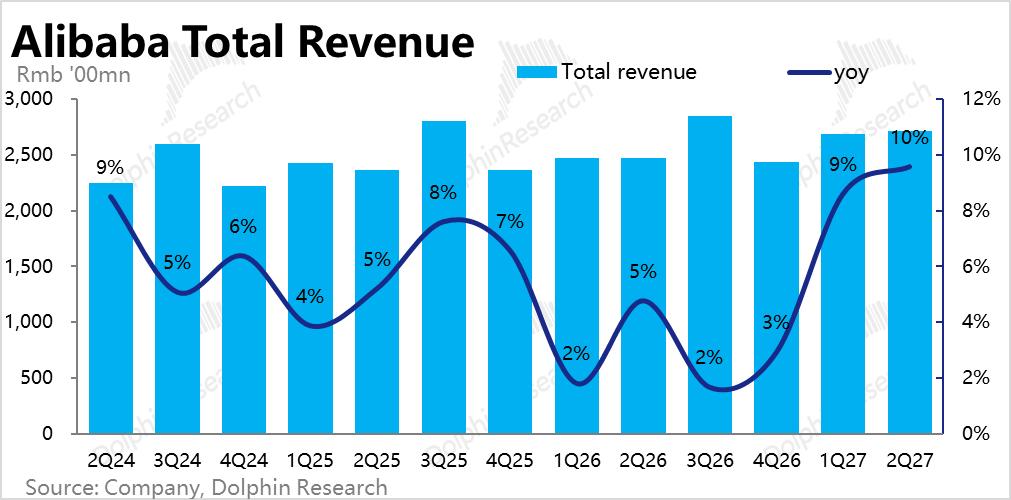
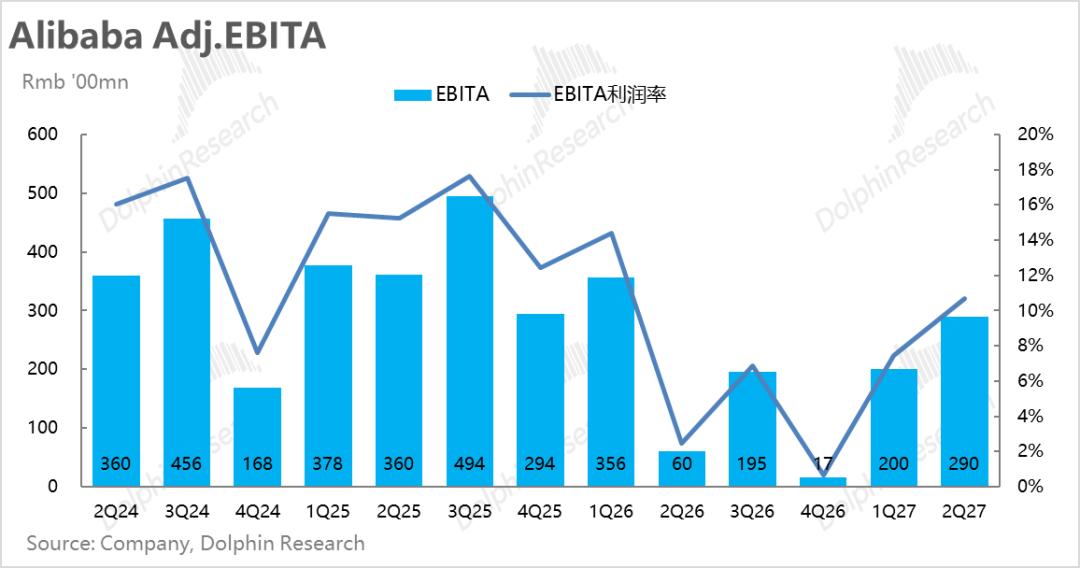
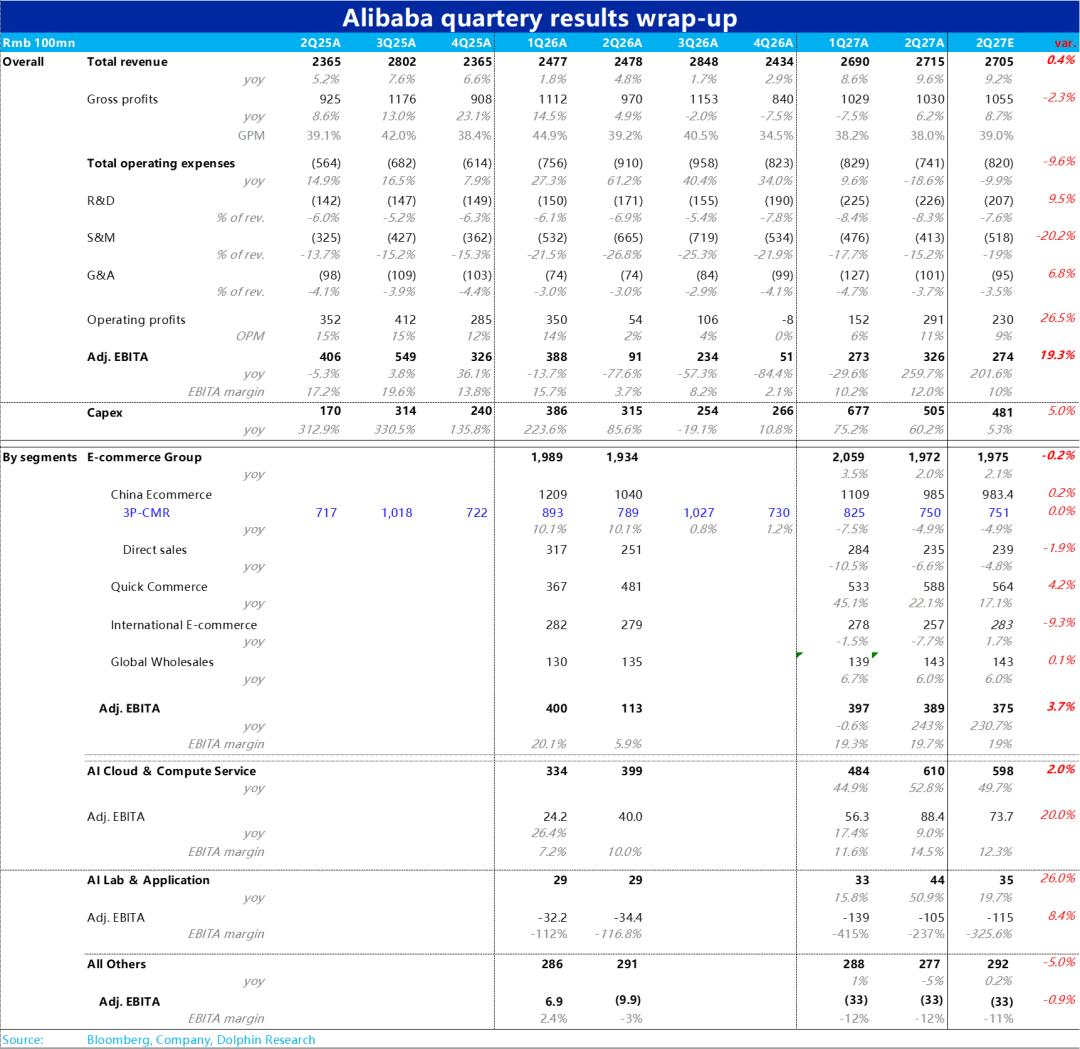
Alibaba's total revenue in this quarter reached 271.5 billion yuan, up 9.6% year on year, which is basically in line with the expectations of major financial institutions. The adjusted EBITA was 32.6 billion yuan, which has increased significantly both year on year and quarter on quarter, nearly 10% higher than the expectations of major institutions. It can be said that the growth is steadily improving, while the profit has recovered significantly.
From the perspective of expectation difference, the source of the outperformance mainly comes from the cloud sector. Alibaba's EBITA is about 1.5 billion yuan more than the expectation of major institutions, and the profits of other major sectors are roughly consistent with the expectations of major institutions.
2. AI Cloud: Growth Rate Continues to Accelerate, Profit Margin Improves Significantly
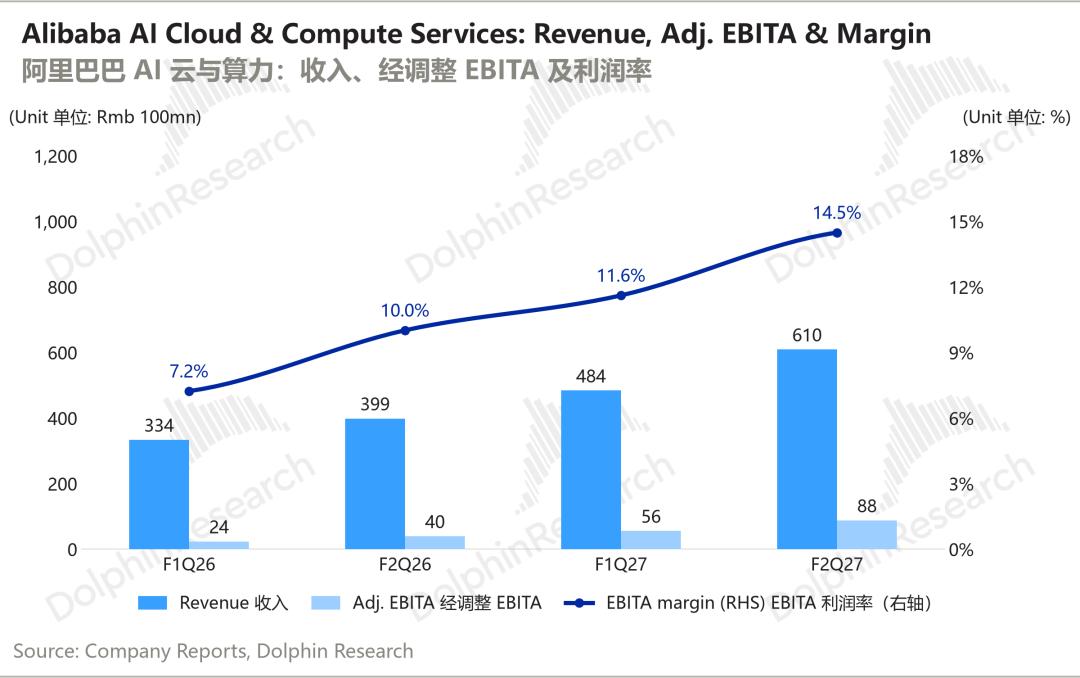
The revenue of AI Cloud and computing power in this quarter reached 61 billion yuan, up 53% year on year, continuing to accelerate significantly compared with the previous quarter (45%), which is at the upper end of the growth rate range expected by major institutions. Meanwhile, the EBITA profit margin reached 14.5%, rising by nearly 3 percentage points quarter on quarter, significantly higher than the expected 12%~12.5% of major institutions.
If there is no threat of being restricted from access to chips, the cloud sector is actually in its strongest performance cycle for many years, with revenue continuing to grow at an accelerated pace while the profit margin is rapidly approaching the 20% target.
From a segmented perspective, the external commercial revenue growth is even stronger, up 64% year on year. Among them, the revenue of AI-related products has reached 17.9 billion yuan, accounting for nearly 30% of the total cloud revenue, and continues to maintain triple-digit year-on-year growth.
Moreover, Alibaba has given the revenue breakdown of computing devices (including T-Head) for the first time, which reached 10 billion yuan in this quarter.
On the earnings call, the management attributed the rise in cloud profit margin to three points: the increase in the proportion of high-margin products in recurring revenue; the pricing increase brought by the global shortage of computing power; and the scale effect.
3. Domestic E-commerce: CMR Decline Stabilizes, Profit Recovers as Food Delivery Losses Narrow
In the general e-commerce sector, the core indicator CMR is nominally down about 5% year on year. Although it is still negative growth, the decline has at least narrowed (-7.5% in the previous quarter), which is consistent with the expectations of major institutions; after excluding the revenue deduction caused by the new merchant cooperation program, the actual comparable growth rate is about +1%, which is consistent with the previous quarter.
Although the absolute growth of the far-field e-commerce business is still quite weak, it has at least stabilized at the current stage and no longer deteriorated. Looking ahead, the management said that the consumption environment in the December quarter is still under pressure. The core operating indicators since the beginning of the quarter are consistent with the trend of national online physical retail, and the performance of necessities is better than that of optional goods.
From a segmented perspective, the revenue of the instant retail business increased by about 22% year on year, higher than market expectations, which indirectly verifies that the performance of the food delivery business is improving.
As for self-operated retail revenue, it shrank year on year but the decline narrowed (from -10% to -7%).
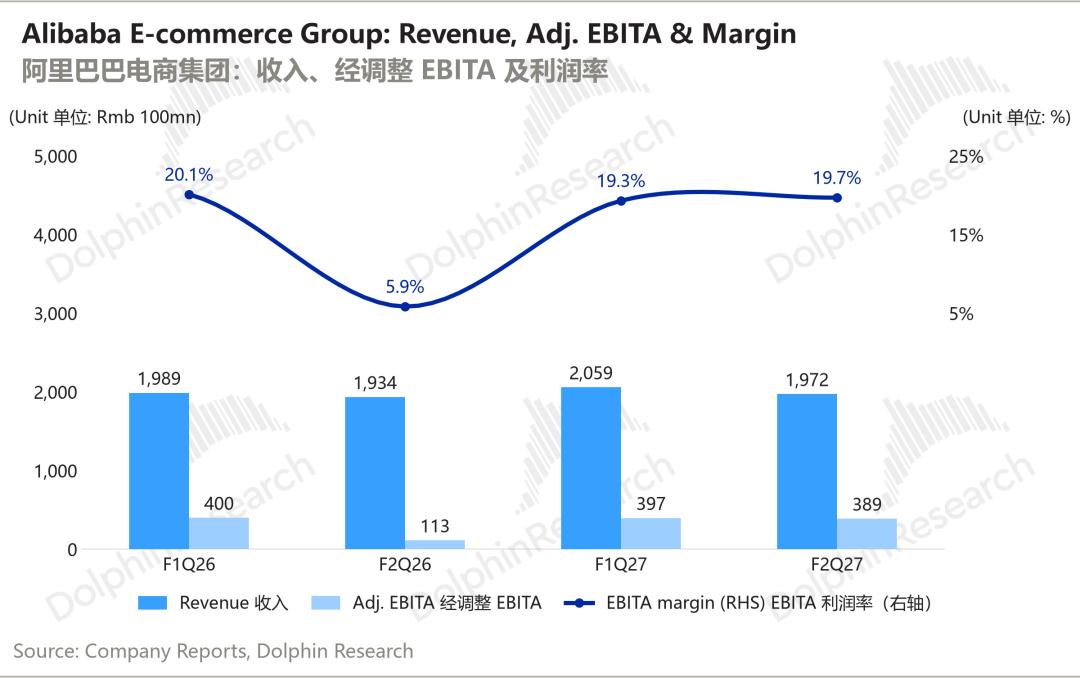
In terms of profit, Alibaba's e-commerce group's adjusted EBITA (excluding equity incentives) was 38.9 billion yuan, 3.4 times the profit of the same period last year, which is basically consistent with the expectations of major institutions. The company said it is mainly contributed by the improvement of unit economics of food delivery and the steady growth of far-field e-commerce.
According to the company's statement, the profit of far-field e-commerce in this quarter is roughly flat year on year, while the overseas business slightly reduces losses, which implies that the loss of the instant retail business in this quarter is about 9.5 billion yuan, which is roughly consistent with market expectations. Although the absolute loss has not narrowed much compared with the previous quarter (10~11 billion yuan), this quarter is the peak of order volume in summer vacation, so the unit economic profit per order has improved quite a lot.
The management added on the earnings call: the GTV of non-catering categories in online instant retail in the September quarter increased by more than 40% year on year, and the expansion of self-operated front warehouses was relatively fast; the unit economic profit of food delivery improved as expected, with stable market share and continuously increasing customer unit price.
4. AI Lab and Applications: Revenue Accelerates, Losses Narrow
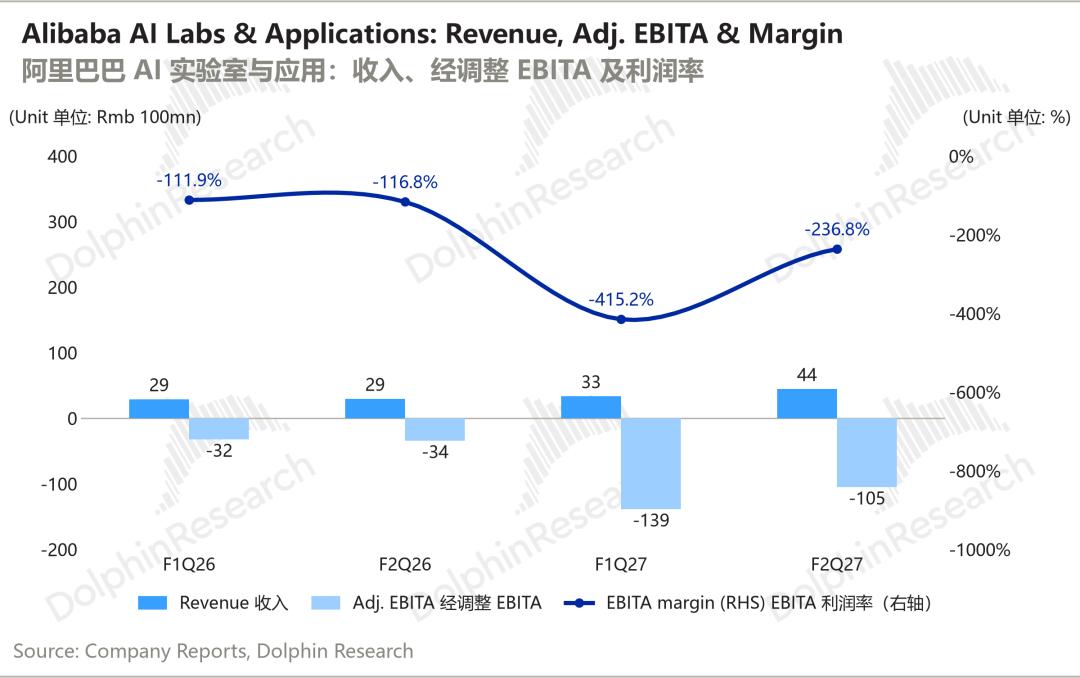
The new AI lab sector, which is mainly composed of foundation model R&D and Qwen's 2B/2C applications, generated revenue of 4.4 billion yuan in this quarter, up 51% year on year, significantly accelerating from about 16% in the previous quarter, which is significantly better than the expectations of major institutions; at the same time, the loss was 10.5 billion yuan, which also narrowed from 13.9 billion yuan in the previous quarter. While revenue growth accelerates, losses narrow, which is also a quite good performance trend.
The company said revenue growth mainly comes from rising demand for agent products from enterprises; the quarter-on-quarter narrowing of losses comes from the simultaneous improvement of model training efficiency and Qwen App marketing delivery efficiency.
According to third-party data: the monthly active users of Qwen App in September was about 158 million, which decreased slightly compared with June; however, the share of desktop visits of Qwen Work in September rose from 15% in June to 22%. The decline of C-end users and the rise of B-end users show that the current AI monetization mainly relies on B-end business.
5. Capex Remains High, Free Cash Flow Is Still Negative but Outflow Narrows
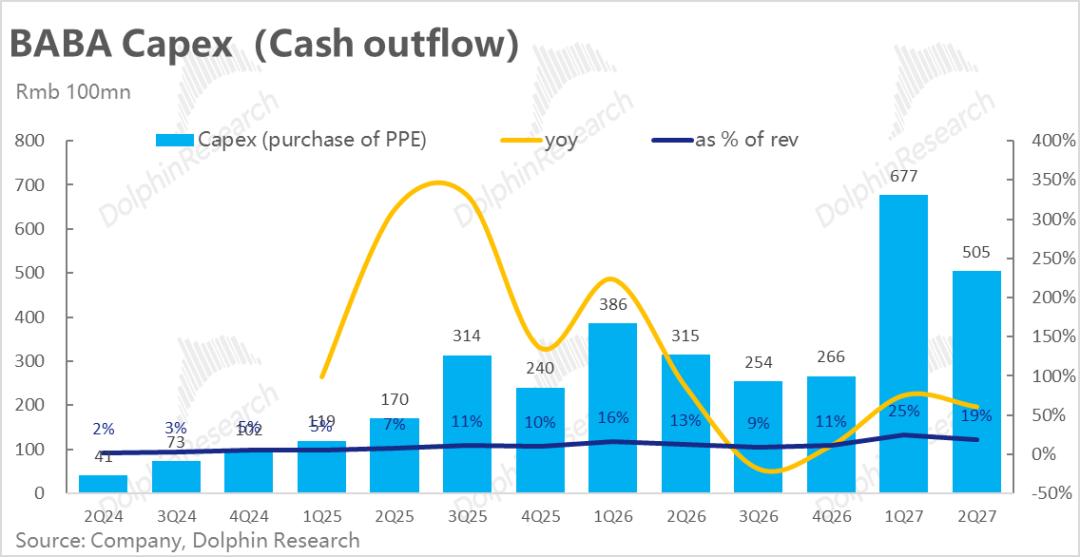
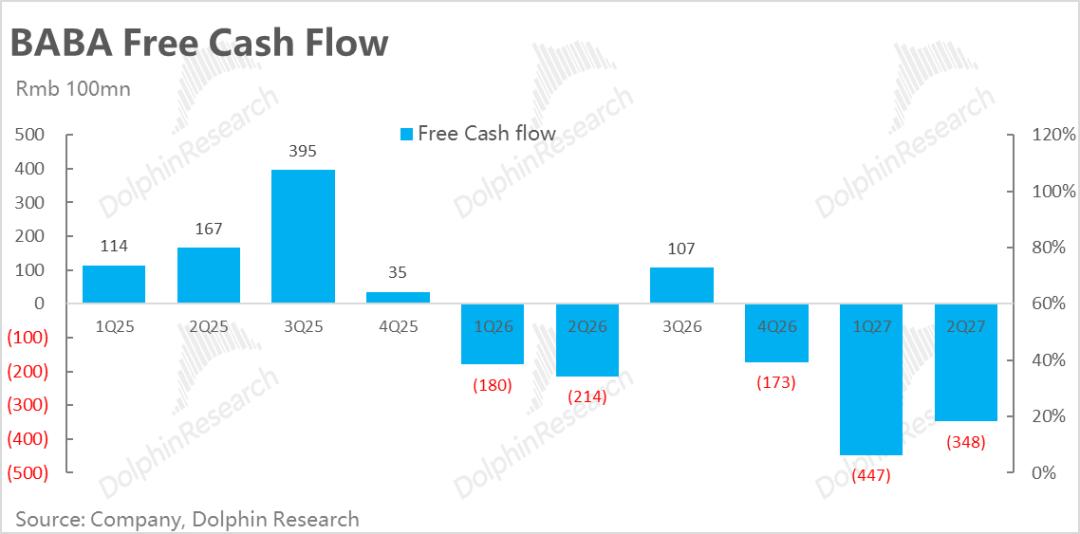
The Capex in this quarter was 50.5 billion yuan, which is still at a high level, but it has decreased from 67.7 billion yuan in the previous quarter, and is also lower than the expectations of most major institutions. Operating cash flow was 15.7 billion yuan, and free cash flow was about -34.5 billion yuan. Although it is still negative, it has also narrowed compared with the previous quarter.
On the whole, although the company's cash flow is still under considerable pressure under the still high Capex, the situation has eased marginally. In the current market environment where people dislike companies "spending money randomly", the decline of Capex is not a bad thing.
The management reminded last quarter not to extrapolate linearly, and this quarter's earnings call also confirmed that the quarter-on-quarter decline in Capex mainly reflects the fluctuation of the procurement cycle. Looking ahead, the management said that 2027–2028 will be the most aggressive investment stage (self-developed chip ramp-up), and it is expected that the overall cash flow will turn positive in the second half of 2028.
6. Other Businesses: International E-commerce Is Affected by EU Customs Fines
In terms of other businesses, the revenue of international e-commerce in this quarter was 25.7 billion yuan, down 8% year on year, which was mainly dragged down by the additional tax imposed by EU customs. Fortunately, the loss continued to narrow.
The global wholesale revenue was 14.3 billion yuan, up 6% year on year, which is roughly consistent with the growth rate of the previous quarter and market expectations, with stable performance.
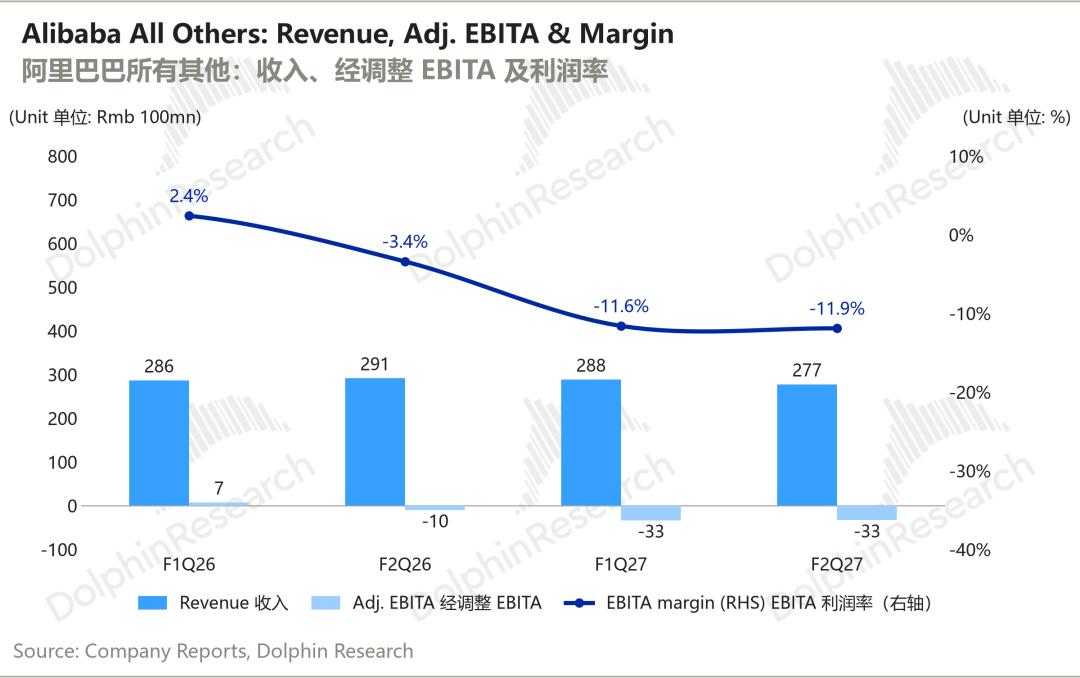
As for the other business sectors including Cainiao, AutoNavi and other businesses, their revenue was 27.7 billion yuan, down 5% year on year, which was mainly dragged down by the decline in Cainiao's revenue; while the loss was about 3.3 billion yuan, which was also roughly flat with the previous quarter. At least the loss has not expanded, no gains and no losses.
7. Gross Profit and Expenses: Gross Margin Slightly Declines, Marketing Expenses Drop Sharply
In terms of costs and expenses, the gross margin in this quarter was 38.0%, down about 1.2 percentage points year on year, which is mainly affected by the rising proportion of cloud and technology business revenue and the revenue deduction of the new merchant cooperation program.
Sales expenses were 41.3 billion yuan, shrinking significantly both year on year and quarter on quarter. The expense ratio decreased by nearly 3 percentage points compared with the previous quarter, corresponding to the narrowing of investment in food delivery and AI applications, as well as the change in caliber that some subsidies were recorded as revenue deduction instead of sales expenses.
R&D investment reached 22.6 billion yuan, a year-on-year increase of about 32%, which is not unexpected as the company continues to increase investment in AI and other technologies.
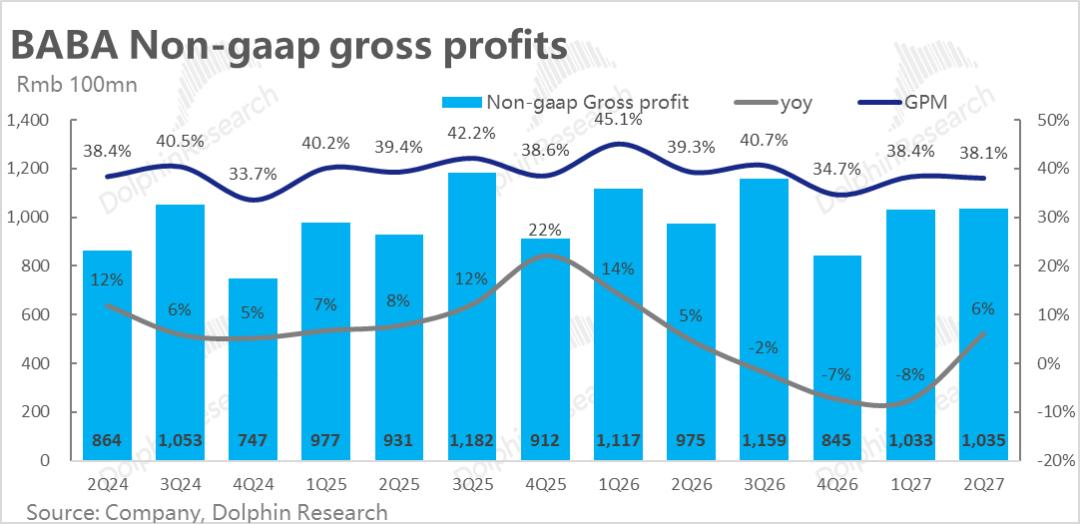
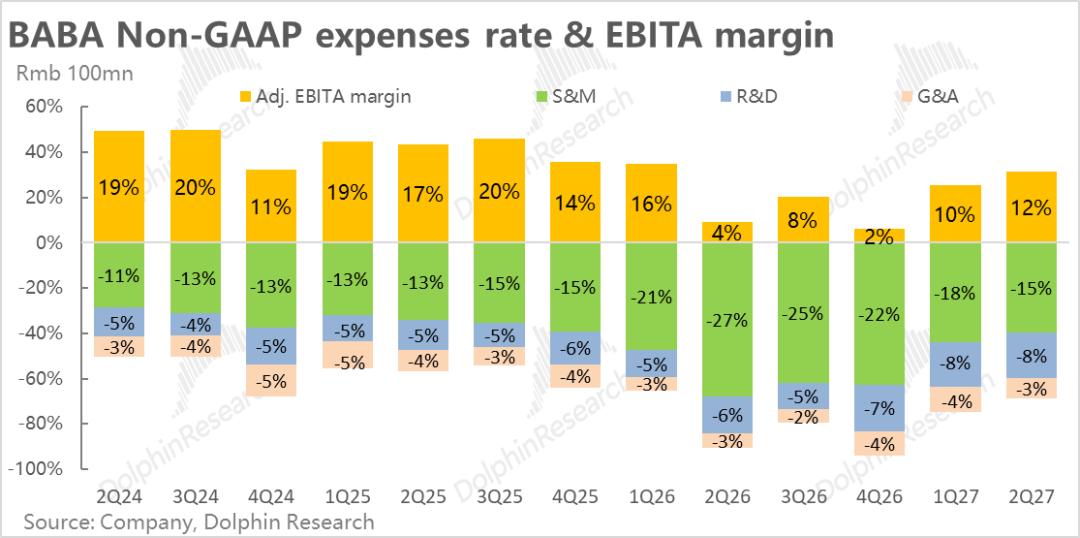
8. Overview of Important Financial Report Information
Dolphin Research View:
1. There Are No Obvious Shortcomings in This Quarter's Performance, but the Outlook Ahead Is Full of Uncertainties
Looking at this quarter alone, Alibaba's performance is quite good with basically no major defects.
On the AI side, the growth and profit of the cloud business continue to improve, and the newly spun-off AI lab and applications also show a trend of rising revenue and narrowing losses;
On the e-commerce side, CMR growth has stabilized, and the profit of the e-commerce sector is recovering as food delivery losses narrow and the profit of traditional far-field e-commerce stabilizes.
However, this quarter's performance is not the market's top concern. What is more important is the outlook for the future, and there are considerable challenges on the two main lines of e-commerce, cloud and AI:
(1) Cloud and AI: Restricted Access to Chips, Both Growth Rate and Valuation Face Downgrade
As the prospect of the general e-commerce business is not very good, the biggest driving force for Alibaba's performance and valuation currently falls on the cloud and AI business. Recently, the two major bills, Remote Access and