Are orders being propped up by financing? Following NVIDIA, AMD has also been shorted, with its share price plunging by nearly 8%.
After Muddy Waters shorted NVIDIA, AMD, another leading company in the chip industry, has also been targeted by short sellers.
On local time November 19, hedge fund Hunterbrook Capital released a short report, directly directing market concerns over NVIDIA's financing model to AMD, which has been highly sought after by capital recently.
After the news was released, AMD's share price once extended its decline to 11%, hitting the lowest level since November 9. By the close of US stocks, AMD closed at $489.19, down 7.72%, and continued to fall 2.34% in after-hours trading.
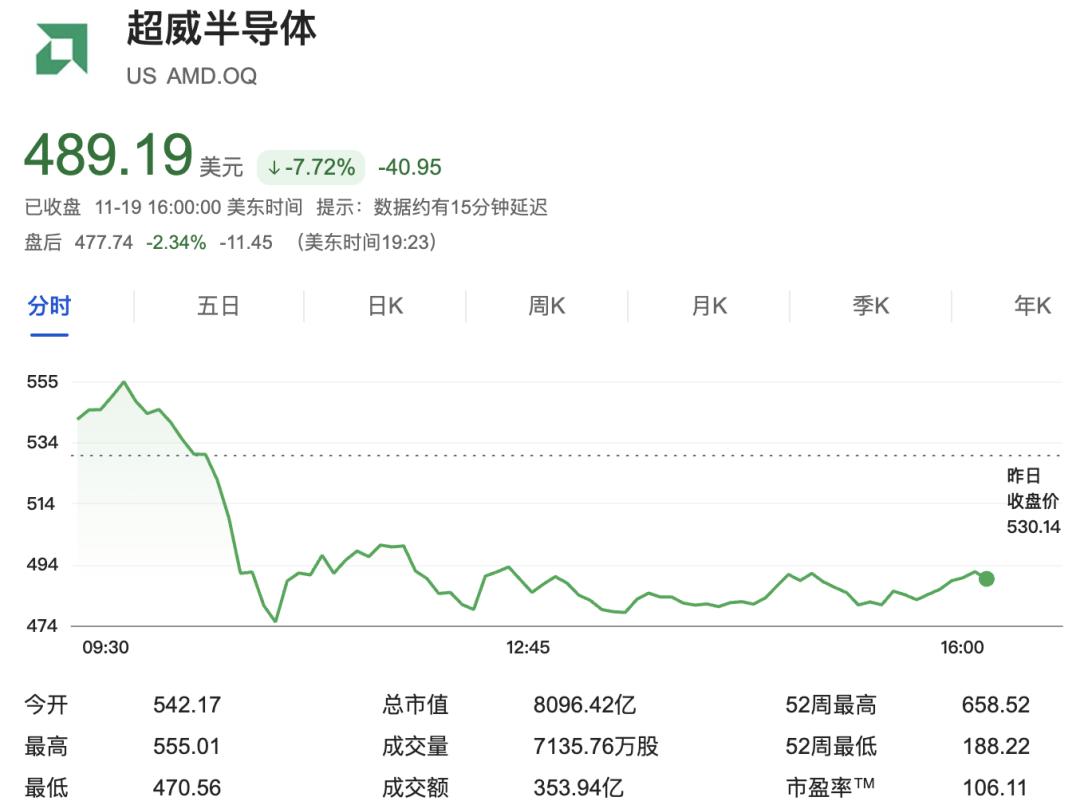
Dragged down by this, US chip stocks opened higher and moved lower that day: NVIDIA fell more than 3%, marking the 6th consecutive day of decline, while Micron Technology and Broadcom fell more than 2%. Most other weighted tech stocks also declined, with Amazon down nearly 4%, Meta and SpaceX down more than 3%, and Google down nearly 3%. AMD was one of the weakest performers among the Nasdaq 100 constituent stocks of the day.
Public information shows that Hunterbrook Capital is a New York-based hedge fund that drives transactions based on investigative reporting. Before targeting AMD, Hunterbrook has shorted a number of tech-related targets, including network equipment manufacturer Ubiquiti, robotics enterprise Richtech Robotics, fuel cell enterprise Bloom Energy, and Hercules Capital which focuses on technology credit. Its short position on Ubiquiti eventually suffered a short squeeze and ended in failure.
In the aforementioned report, Hunterbrook directly pointed out that AMD's order growth does not all come from real end demand, but is propped up by a circular transaction structure built on equity commitments, guarantees, leases and equity investments.
In simple terms, AMD provides large commitments to cloud vendors and server partners. After customers obtain credit and equity support, they use the funds to purchase AMD's Instinct series AI chips, which artificially inflates the order volume.
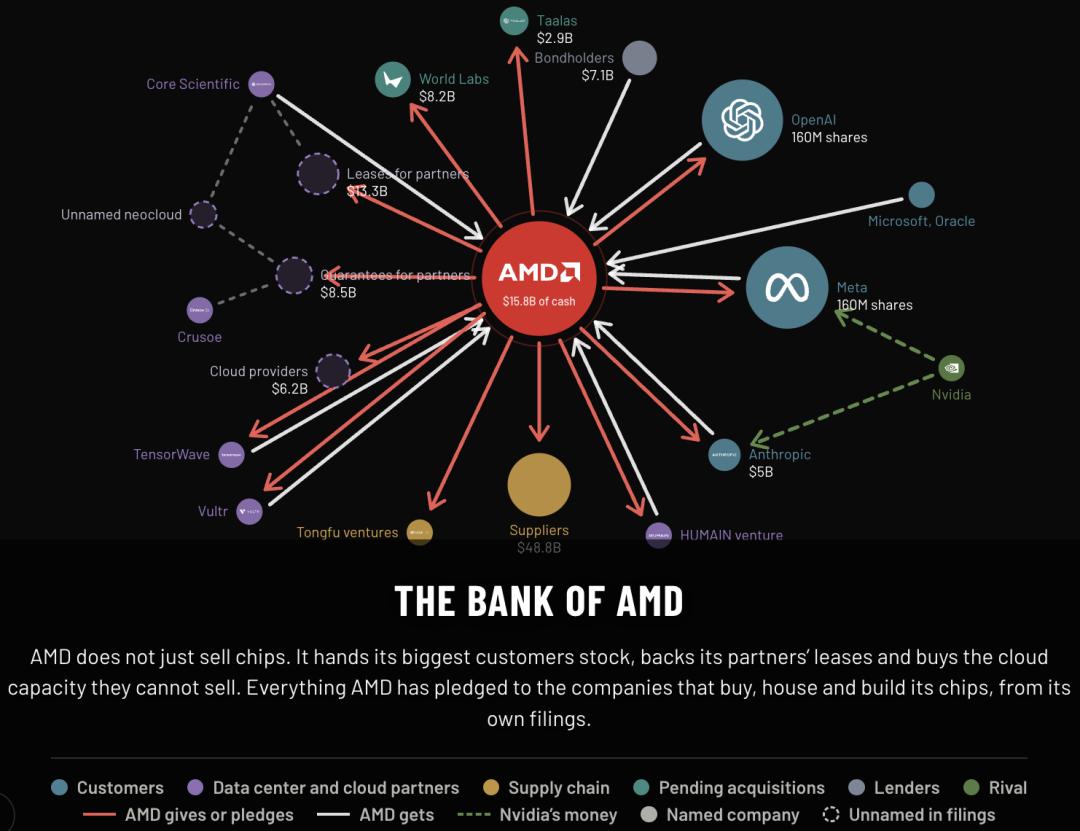
Hunterbrook compares AMD to a "bank" Image source: Hunterbrook
The report also disclosed that Hunterbrook has established a short position in AMD, while going long on a basket of comparable chip targets.
The report calculated a set of highly impactful exposure data: AMD has offered customers equity commitments of up to 320 million shares, corresponding to an estimated valuation of about 161.1 billion US dollars; coupled with cloud leases and guarantee commitments of about 28 billion US dollars, and equity investment commitments of 5.1 billion US dollars, the total size of all conditional commitments is huge. In contrast, AMD's cash on hand and short-term investments are only 15.8 billion US dollars. These commitments do not need to be fully paid immediately, and are contingent liabilities that will be fulfilled only after a customer defaults.
Hunterbrook believes that once the AI capital expenditure cycle brakes and customers' cash flow deteriorates, AMD will suffer the double blow of shrinking orders and impairment of guarantees, and the foundation of its valuation will quickly loosen.
The report also mentioned that Google's TPU and AWS's self-developed Trainium chips continue to ramp up, and the increase in supply will trigger a chip price war, further amplifying the vulnerability of AMD's customer binding model.
In addition, Hunterbrook compared and calculated the commitment exposure of AMD and NVIDIA, taking the scale of each commitment divided by the rolling revenue of the past four quarters as the measurement standard. The data shows that in the three types of arrangements for driving downstream procurement, namely lease commitments transferred to partners, equity investment commitments, and cloud computing power underwriting commitments, AMD's relative proportion is significantly higher than that of NVIDIA; only in the item of partner obligation guarantees, NVIDIA's proportion is higher, while the proportion of supplier procurement commitments of the two in revenue is roughly equivalent.
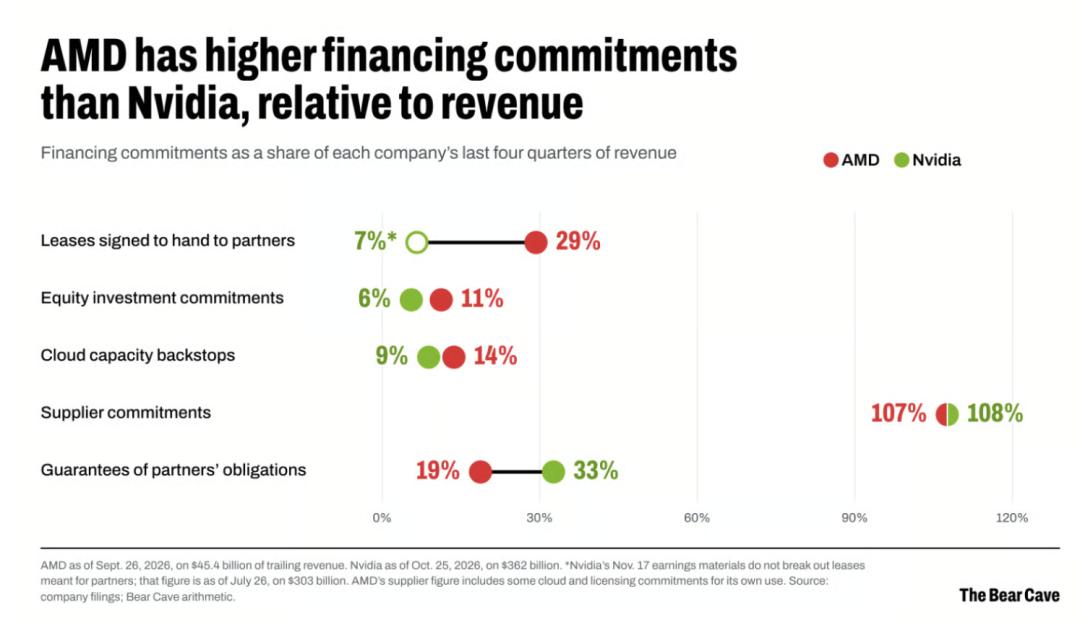
Comparison chart of financing commitments between AMD and NVIDIA Image source: Hunterbrook
In other words, AMD's revenue volume is far smaller than that of NVIDIA, but it undertakes higher downstream binding commitments relative to its revenue, which means it has less tolerance for the cooling of AI capital expenditure, and related risks are more likely to be amplified.
In response to Hunterbrook's doubts, AMD responded that the report distorted the company's business arrangements and customer cooperation model, all of its cooperation frameworks have risk control, there is no circular transaction problem described in the report, and the company's business is stable.
As early as the stage when this round of AI computing power market heated up, investor Michael Burry, known as the prototype of "The Big Short", repeatedly warned of the hidden dangers of similar financing models. He compared the current cycle where AI manufacturers provide financing to customers and customers use the money to purchase equipment to Cisco's supplier financing story during the dot-com bubble in 2000. In Burry's view, much of the AI capital expenditure recognized by the market as rigid is essentially a closed loop that does not continuously create new end demand.
Just on November 4, AMD released its financial report for the third quarter of 2026 with record-high revenue. The total revenue for the period was 13.4 billion US dollars, up 45% year-on-year and 16% quarter-on-quarter; GAAP net profit was 2.4 billion US dollars, and GAAP gross margin was 54%. Among them, the revenue of the data center business, which is the most valued by the market, was 8.5 billion US dollars, with a year-on-year increase of as high as 97%, and the main growth driver came from EPYC server CPUs and Instinct AI GPUs.
Lisa Su, Chairman and CEO of AMD, said on the earnings call: "We enter the fourth quarter and 2027 with strong momentum. We do see very strong demand, across the data center business, CPU business, and data center AI business... We expect data center to account for more than 80% of the company's total revenue in 2027, and drive revenue and profit growth."
In October this year, Lisa Su also gave an optimistic judgment to the market. At the Open Compute Project (OCP) Global Summit, she said that with the growth of agent AI workloads, the company expects the potential market size of CPUs to exceed 200 billion US dollars by 2030, with a compound annual growth rate of about 50% in the next 4 to 5 years. She also predicted that the data center AI accelerator market will approach 1.5 trillion US dollars by 2030, and called 2026 the "Year of Inference", saying that inference workloads will account for about 60% of the AI market in the future.
Lisa Su also said that AMD has begun to deliver Helios systems in September, and the first batch of systems has been deployed to customers including OpenAI, Meta, Microsoft, Oracle and Anthropic, and production capacity is expected to continue to increase from the fourth quarter to the first half of next year.
Essentially, this game around AMD is the market re-pricing the growth quality of AI computing power. In the past two years, capital has been accustomed to simply equating the revenue growth rate of chip manufacturers with real computing power demand, but now the underlying logic of the AI computing power bull market is facing a more stringent review.
This article is from the WeChat Official Account "Jiemian News", author: Song Jianan, published with authorization from 36Kr.