Anthropic Goes Public: 10 Noteworthy Facts
A company went public, raising 81.3 billion U.S. dollars, with its market cap once exceeding 2 trillion U.S. dollars on the first trading day.
Undoubtedly, Anthropic has set a new IPO record in the U.S. capital market.
But what makes this IPO noteworthy is far more than just a group of newly minted millionaires or how many financing records a single company has broken.
It is more like a centralized showcase: the technological value, private wealth, capital commitments and business risks accumulated by the AI industry over years are all laid out on the table on the very same day.
What is changing behind this, and what remains unchanged?
1. AI Companies Start Competing for Capital
In this public offering, Anthropic issued 980 million shares at an issue price of 83 U.S. dollars, raising 81.34 billion U.S. dollars. In addition, the company arranged a simultaneous private placement of 260 billion U.S. dollars.
The two items add up to more than 1.07 trillion U.S. dollars.
What does this mean?
This is a large-scale capital mobilization centered on AI infrastructure.
More notably, Anthropic is not a revenue-less startup. Its full-year revenue in 2025 has reached 4.585 billion U.S. dollars, and in the first nine months of 2026, the figure even hit 33.242 billion U.S. dollars.
Why does a company with rapidly growing revenue need to raise funds on such a large scale?
The answer lies in the fact that competition for frontier models requires locking in computing power, chip and data center resources for the coming years in advance. For Anthropic, financing is not just about expanding business, but also about buying the ticket to the next phase of competition.
IPOs of AI companies are shifting from financing for business expansion to reserving capital for a long-term technology race.
2. One IPO Creates a Group of Newly Wealthy Individuals
When Anthropic went public, the direct beneficiaries are not only the founders, but also early employees and investors.
The Wall Street Journal estimates based on prospectus documents that the value of restricted shares held by employees is about 88.7 billion U.S. dollars, and the value of options after deducting exercise costs is about 1.4 trillion U.S. dollars. The total exceeds 230 billion U.S. dollars, involving about 5,300 employees.
According to this estimation, the average equity value corresponding to each employee exceeds 44 million U.S. dollars. Of course, this is only a book average, the actual distribution is highly uneven, and it does not mean that everyone can cash out immediately.
But it still reveals a striking fact: the wealth created by AI is no longer just a game for a small number of founders and venture capitalists.
A more interesting detail is that in Los Angeles, some people are already willing to accept Anthropic shares as payment for a nearly 30 million U.S. dollar luxury mansion.
This means that the private equity of AI companies is becoming a wealth certificate that can be exchanged for real estate in the real world.
3. The Market Not Only Needs to Buy New Shares, But Also Absorb Old Shares
This is probably the most easily overlooked design of Anthropic's IPO this time.
Traditional IPOs usually set lock-up periods for insiders to prevent founders and early shareholders from selling a large number of shares immediately after listing.
Anthropic has adopted a different arrangement.
According to the prospectus, up to about 316 million shares may be eligible for sale starting from the first trading day after listing. Another maximum of about 3.3 billion shares may become eligible for sale in phases before the end of the 180-day lock-up period for ordinary shareholders. Founders and some major shareholders are subject to longer restriction arrangements.
This means that the supply the market faces is far more than the 980 million shares issued in the IPO.
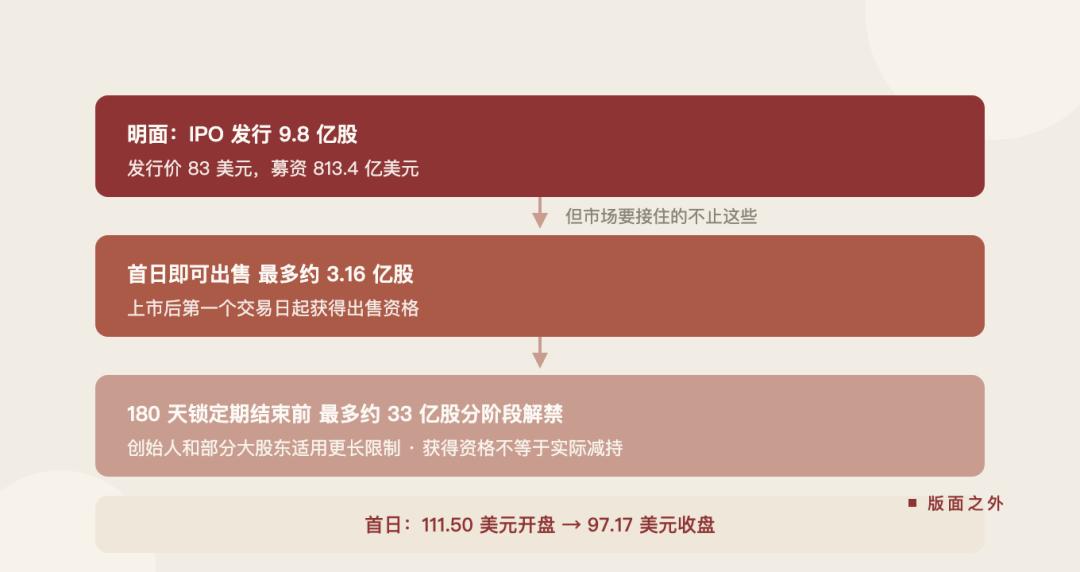
Of course, being eligible for sale does not equal actual reduction of holdings, nor does it mean that all these shares will enter the market on the first day.
But it raises a problem that the AI private market rarely needed to face in the past: when a huge amount of private equity accumulated by a company over several years suddenly enters the public market, how much liquidity is needed to absorb it?
Anthropic's share price fell back from the first transaction price of 111.50 U.S. dollars to close at 97.17 U.S. dollars on the first trading day.
This trend alone cannot prove that supply pressure has crushed the market, but it is enough to remind investors that how high a company's valuation is and whether the market can digest its shares are two different questions.
This is also the part that I think the market tends to underestimate. What investors see is a buying spree, but what really needs to be observed is the stock supply in the coming months and even years.
4. All the Money in AI Eventually Flows to Computing Power
The funds Anthropic raised will not stay in bank accounts for a long time.
There is a more staggering figure in the prospectus: as of the end of September 2026 and thereafter, the company's signed procurement, leasing and other computing power and infrastructure commitments add up to about 9.009 trillion U.S. dollars.
Of this total, about 4.475 trillion U.S. dollars are expected to be incurred by the end of 2030, and about 698 billion U.S. dollars are expected to be paid in the next 12 months.
Of course, 9.009 trillion U.S. dollars is not a bill that needs to be cashed immediately. Some of the contracts have termination rights or preconditions, and the specific payment also depends on the delivery and usage of computing power.
But this figure is enough to show that Anthropic is making advance arrangements for computing power supply for more than a decade in the future.
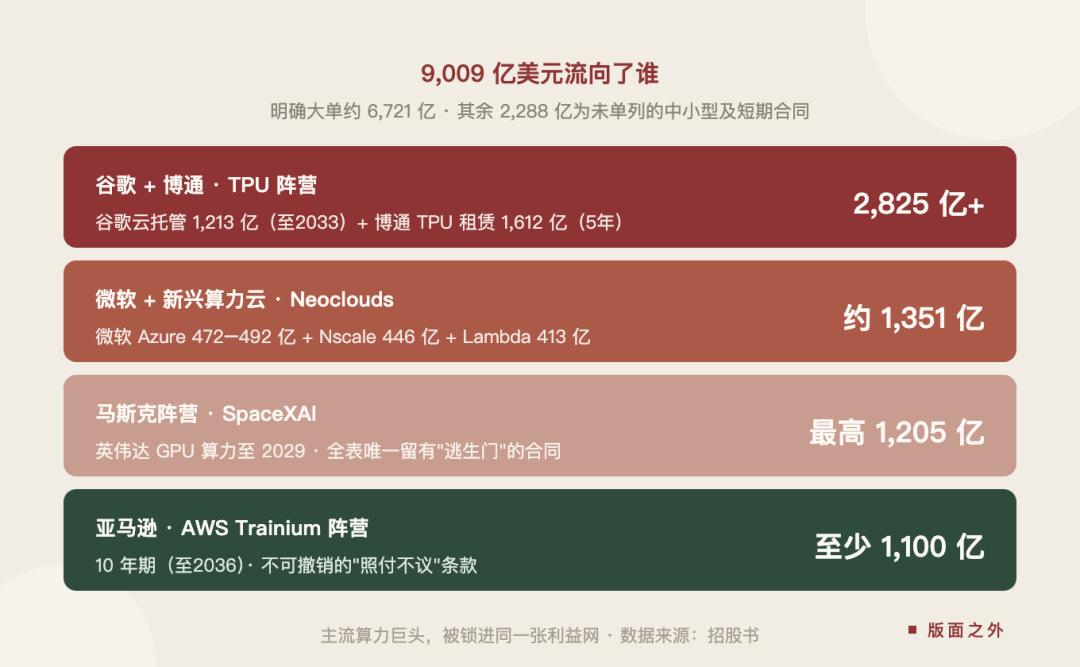
Google and Amazon are important participants in this.
Google is both a shareholder of Anthropic and a cloud service provider, while Amazon also provides both capital and computing power infrastructure.
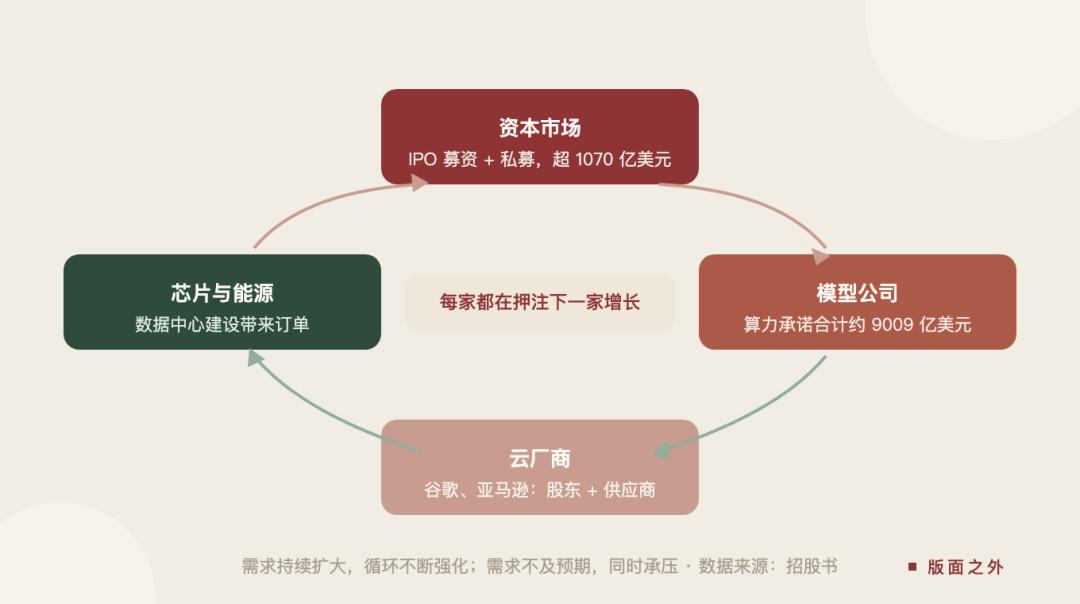
This forms an interesting industrial chain: the capital market raises funds for model companies, model companies use the money to buy computing power, cloud vendors obtain revenue and continue to build data centers, and chip manufacturers and energy suppliers benefit from it.
The AI industry is forming a cycle driven jointly by capital, models, computing power and infrastructure.
This cycle is supported by real business demand, but there is also a point that needs vigilance: every company in the industrial chain is betting to varying degrees that the next company will continue to grow.
If model demand continues to expand, the cycle will keep strengthening. If demand growth falls short of expectations, computing power contracts, infrastructure investment and capital returns may come under pressure at the same time.
This is the real risk after the AI industry is capitalized.
5. Having Revenue Does Not Mean Having Returns
Anthropic's financial data is very interesting.
In the first nine months of 2026, the company's revenue reached 33.242 billion U.S. dollars, up more than 12 times year on year; in the same period, its operating loss was 1.26 billion U.S. dollars.
But its net loss reached 104.039 billion U.S. dollars.
Seeing this figure, it is easy to think that the more Anthropic earns, the more it loses.
This is not the case.
About 94.3 billion U.S. dollars of this loss comes from the fair value change of financial instruments such as convertible notes, derivative liabilities and SAFE. Such items are affected by factors including the rise in the company's valuation, and do not equal to the amount of cash the company actually burned in its operations.
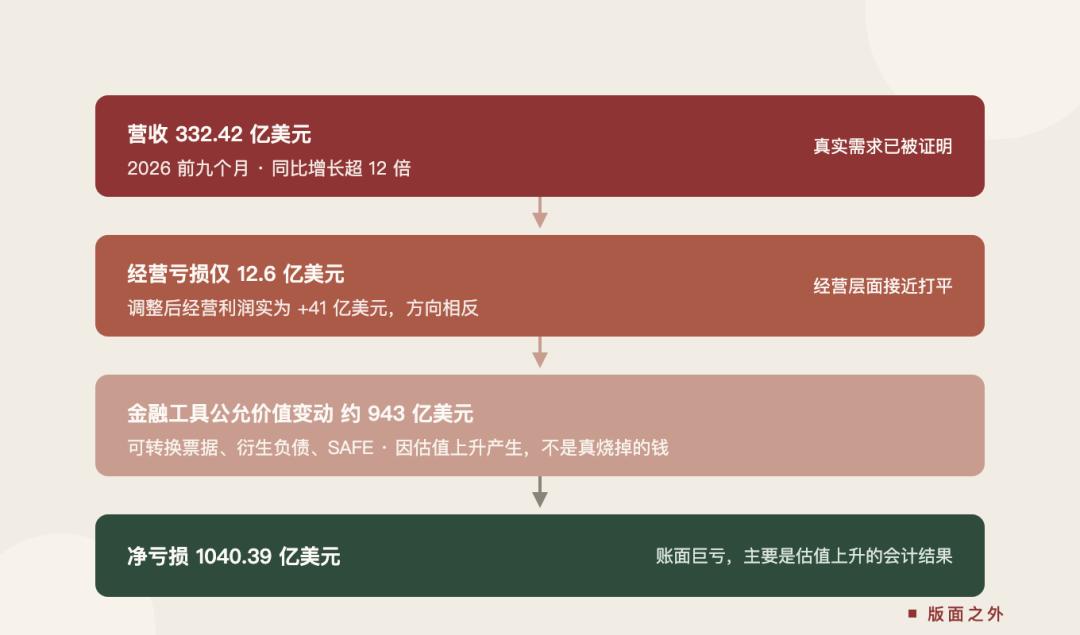
There is another noteworthy detail: Anthropic disclosed that its adjusted operating profit in the first nine months of 2026 was 4.1 billion U.S. dollars, which is in the opposite direction to the operating loss calculated according to accounting standards. This shows that under different calibers, the company's profitability performance varies greatly.
Here comes the question: with such rapid revenue growth, can the company form stable profits and cash flow in the future?
After all, the computing power and infrastructure expenses of 18.808 billion U.S. dollars in the first nine months already accounted for about 57% of the revenue in the same period.
The stronger the model capability, the more customers use it, and revenue will surely grow, but the demand for computing power will also expand synchronously.
This divides the AI bubble issue into two layers: Does AI have real demand? Anthropic has given a fairly strong proof.
However, can AI obtain returns matching the capital input? This question has not been fully answered yet.
Real industrial demand can support the growth of a company, but cannot automatically prove that its current valuation is reasonable.
This is also the most important stress test that Anthropic's listing brings to the entire AI industry.
6. Safety Ideals Collide With Capital Tests
At Anthropic's listing site, there are two scenes worth looking at together.
Upstairs, Dario Amodei and his sister Daniela rang the Nasdaq opening bell.
Downstairs, protesters held banners that read "Freeze AI".
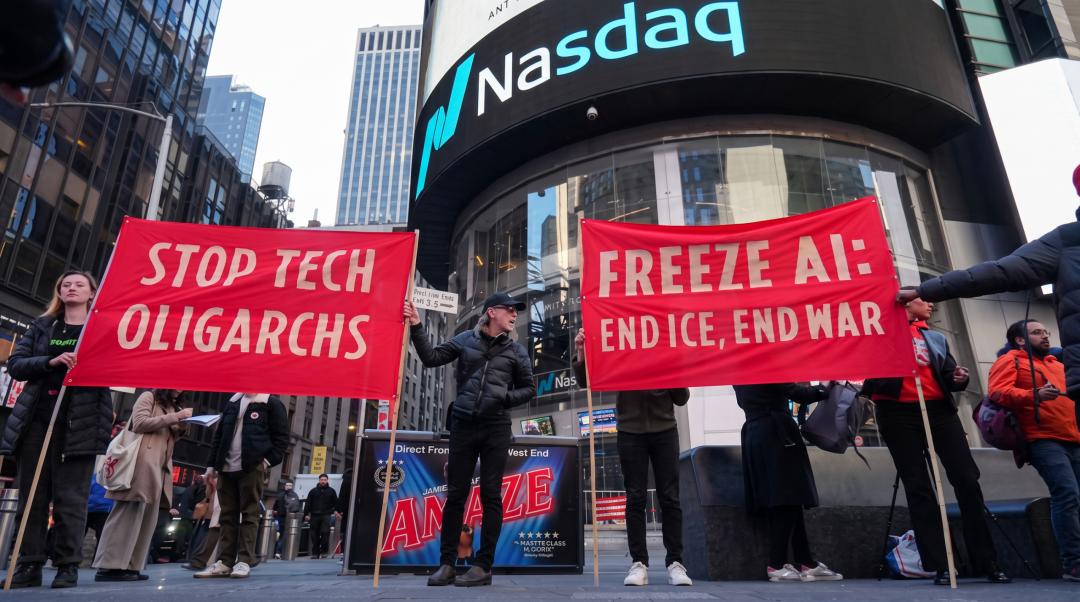
This company has always regarded AI safety as its core mission. It even adopted the organizational form of Public Benefit Corporation (PBC), requiring the board of directors to strike a balance between the economic interests of shareholders, the interests of affected groups and long-term public interests.
Anthropic also set up a long-term benefit trust, giving it the power to elect and remove the majority of members of the board of directors.
This is a rather special corporate governance arrangement. But after listing, it also has to face another set of rules of the capital market: growth, competition, profit and shareholder return.
Claude needs to keep getting stronger to cope with competitors such as OpenAI and Google. The company needs to keep expanding revenue to support the increasingly huge investment in computing power.
Thus a contradiction arises: Anthropic hopes to keep prudent about the development of AI, but the business competition it is in requires it not to slow down easily.
This does not mean that after listing, the safety mission will necessarily give way to growth. The PBC and the long-term benefit trust are exactly the institutional arrangements the company tried to protect its mission.
But whether the system can resist the pressure of market competition and capital return ultimately needs to be tested by time.
On the day of the bell-ringing, the two voices from upstairs and downstairs exactly constitute a real situation in the AI era: capital wants technology to run faster, while society begins to question who on earth should decide how fast it runs.
7. Claude Starts to Create Claude
There is another figure in Anthropic's prospectus: in September 2026, over 90% of the code contributions in the company's code base were completed by Claude.
Moreover, Claude does not just help engineers write code. It has entered the company's research process, participating in experiments, training data preparation and model safety testing.
Anthropic also disclosed that from January to September 2026, the value of the company's internal use of Claude increased by more than 250 times calculated at the public price; in April 2026, this monthly value exceeded the company's monthly personnel expenses excluding equity incentives for the first time.
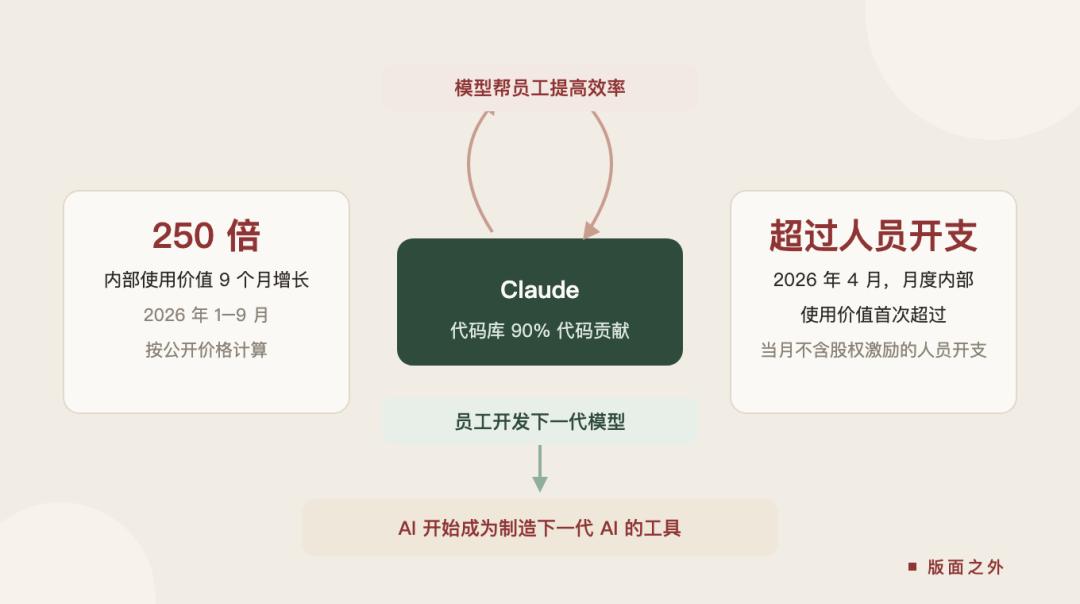
This means that Claude is not only a product sold externally, but also becoming a production tool for Anthropic itself.
The model helps employees improve efficiency, employees use higher efficiency to develop the next generation of models, and the new model further improves R&D efficiency.
This may form a continuously strengthening feedback loop.
It is different from the efficiency improvement of ordinary software companies. If AI can continuously participate in AI R&D, the competitive advantage of model companies may shift from leading in a certain generation of models to the capability of continuously iterating models.
Of course, 90% of code contribution does not mean that 90% of R&D work has been completed automatically. Anthropic also clearly stated that fully independently designing and building several consecutive generations of frontier models still requires meaningful human supervision and understanding for now.
But one thing has changed: AI is no longer just a product made by tech companies to sell to customers, it has begun to become a tool for tech companies to make the next generation of products.
This may be one of the most noteworthy productivity changes in the AI industry.
8. FTX Missed Anthropic's Most Crazy Surge
In Anthropic's wealth story, there is another rather dramatic character: the bankrupt cryptocurrency exchange FTX.
In 2021, Sam Bankman-Fried (SBF), the founder of FTX, invested 500 million U.S. dollars in Anthropic through his affiliated Alameda Research. At that time, the company was just established, and its valuation was only about 4 billion U.S. dollars.
Later FTX went bankrupt, and the liquidation team needed to repay funds to customers and creditors.
In 2024, the liquidation team sold all these Anthropic shares and recovered about 1.336 billion U.S. dollars.
This transaction seemed quite successful at that time: 500 million U.S. dollars turned into 1.336 billion U.S. dollars, with an investment return of more than 1.6 times.
But calculated based on Anthropic's IPO issue valuation of about 1.5 trillion U.S. dollars this time, the value of this batch of shares at that time was close to 370 billion U.S. dollars.
The same investment has a difference of nearly 360 billion U.S. dollars before and after.
Of course