North America's box office has once again exceeded 10 billion U.S. dollars, while the domestic market has regressed to the level of 2015: A Song of Ice and Fire of the film market
The global film market is witnessing a "Game of Thrones" of contrasting extremes.
On one hand, the North American market is making a full recovery. According to data from Box Office Mojo, as of November 18, the total annual box office in North America has reached 8.67 billion U.S. dollars, exceeding the full-year figure of 2025. Given that there is still more than a month before the end of the year, with two blockbusters *Avengers 5* and *Dune: Part Three* as strong backings, the industry generally predicts that this year's North American box office will once again exceed 10 billion U.S. dollars, approaching the 2019 level.

On the other hand, the domestic market has hit its lowest point in nearly 11 years. As of press time, the current total box office stands at 32.043 billion yuan, with the daily box office on workdays remaining just above 10 million yuan. The release scale of *Dune: Part Three* on December 31 is relatively small, leaving *Avengers 5* as the only remaining blockbuster that could prop up the market. The total annual box office is highly likely to land in the range of around 35 billion yuan. Excluding the pandemic years, this figure is lower than the 43.773 billion yuan recorded in 2015, and may drop by more than 30% compared to last year's 51.8 billion yuan.
More investment of attention, time and capital is required. What are the differentiated advantages of offline entertainment compared with online entertainment? If the global film market is facing changes in the economic cycle and structural industrial adjustment, and is impacted by short videos, streaming media and AI-generated content, how has North America managed to attract more Generation Z audiences, and what kind of inspiration can it bring to the domestic market?
Contrasting Q3 Financial Results
The key breakout point of the North American film market mainly lies in the summer box office season. A number of heavyweight blockbusters have continuously ignited the public's enthusiasm for movie-watching. The annual box office champion *Spider-Man 4* grossed 959 million U.S. dollars in North America, setting a new record for the franchise and a new high in North American film history, with a cumulative global box office of 2.52 billion U.S. dollars, ranking third in film history. *Odyssey* grossed 626 million U.S. dollars in North America and 1.7 billion U.S. dollars worldwide. The film refreshed Christopher Nolan's personal career record, and even broke the record of *Avatar* with over 200 million U.S. dollars in North American IMAX box office and 555 million U.S. dollars in global IMAX box office.
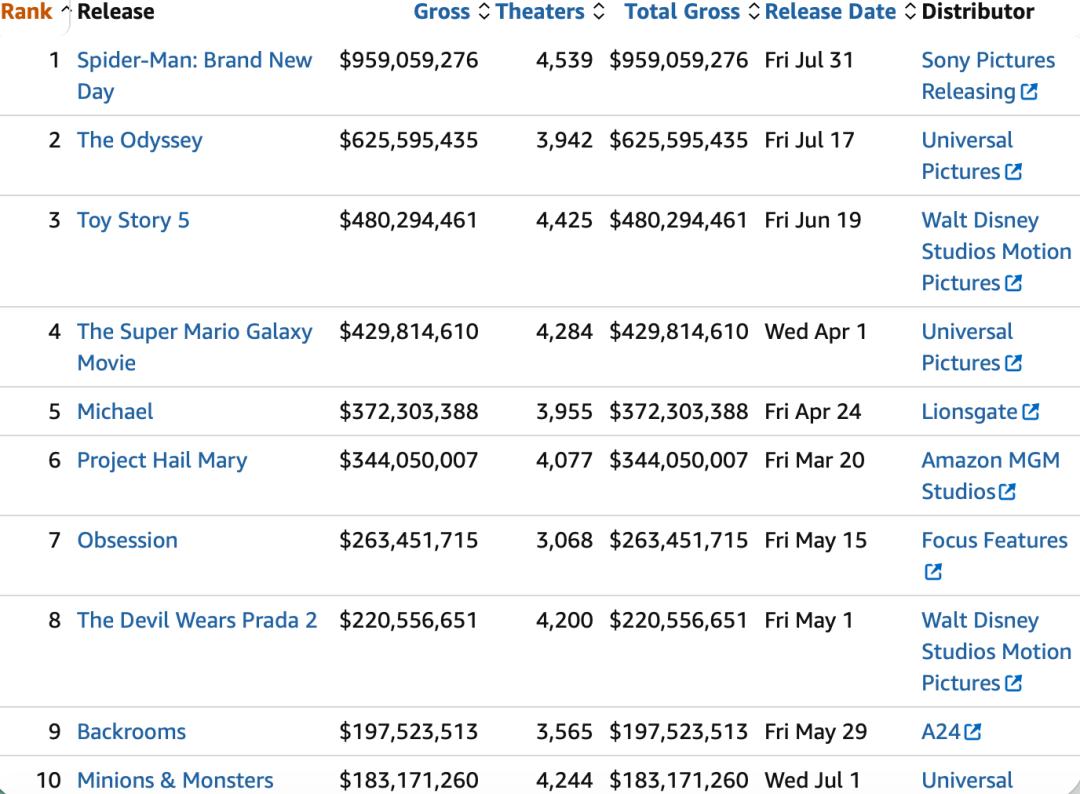
The subsequent *Toy Story 5* achieved results of 480 million U.S. dollars in North America and 1.156 billion U.S. dollars worldwide. *The Super Mario Bros. 2*, which was screened from April all the way through the summer season, and the biographical film *Michael Jackson: The Road to Stardom*, are both 1-billion-U.S.-dollar global hits. Driven by multiple big hits including IP sequels and original works by famous directors, North America has for the first time in history achieved the result that the monthly box office exceeded 1 billion U.S. dollars for four consecutive months in the summer season. *Obsession* and *The Backrooms* both achieved huge box office success with low production costs. However, the above-mentioned North American box office hits, especially the latter few titles, have relatively low popularity in the domestic market.
The contrasting performance between the domestic and overseas markets is directly reflected in the Q3 financial reports. Visual effects blockbusters have driven the share prices of many North American theater chains to hit new highs. AMC Entertainment Holdings announced that its revenue in the third quarter of 2026 reached 1.711 billion U.S. dollars, a year-on-year increase of 31.6%, with a net profit of 109.3 million U.S. dollars. Its adjusted EBITDA hit a record high of 347.5 million U.S. dollars, a year-on-year increase of 183.7%. During the period, Cinemark's revenue increased by 23% year-on-year to 1.06 billion U.S. dollars, and its adjusted EBITDA increased by 51% to 268 million U.S. dollars. Comcast's film distribution revenue reached 2.217 billion U.S. dollars, up 83.3%. Sony's film division revenue in Q3 hit 513.7 billion yen, up 48%.
In the first three quarters, due to a 40% year-on-year drop in box office in the first half of the year and a slight recovery during the summer season, most domestic film companies recorded negative revenue growth compared with the same period last year. Benefiting from hits such as *Eight Immortals!* and *Welcome to the Dragon Restaurant* in Q3, Ruyi Pictures showed a recovery trend in the third quarter of 2026, with quarterly revenue of 3.3 billion yuan, a year-on-year increase of 6.77%, while its revenue in the first three quarters decreased by 14.20% year-on-year. China Film's single-quarter revenue in Q3 2026 was 1.079 billion yuan, down 10.97% year-on-year, its single-quarter attributable net profit was 72 million yuan, down 59.10% year-on-year, and the figure for the first three quarters decreased by 11.50% year-on-year. Shanghai Film made a profit of 18.51 million yuan in the first three quarters, but suffered a loss of 9.07 million yuan in its main business after non-recurring profit and loss deduction, down 31% year-on-year.
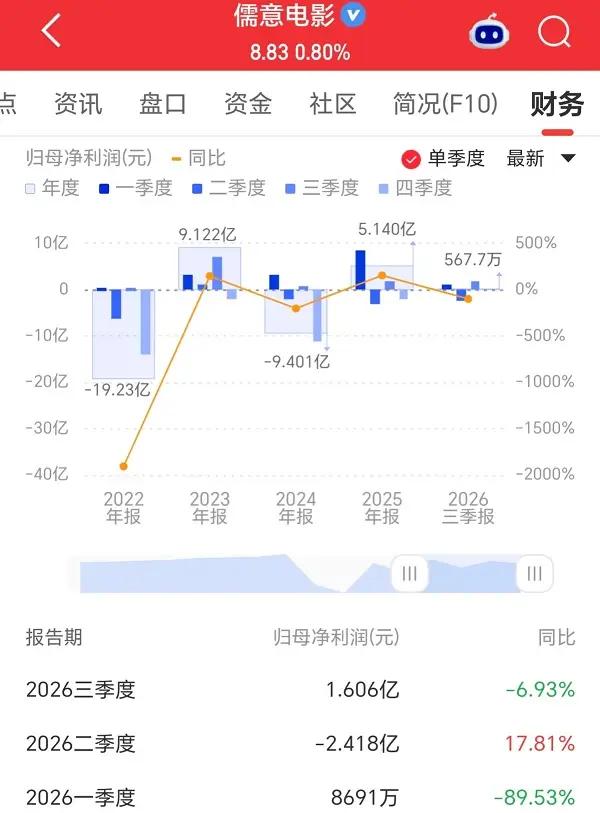
Bona Film Group, Huayi Brothers and Beijing Culture have continued to make losses for three consecutive quarters this year. Enlight Pictures managed to keep its net profit positive, but the drop after losing the *Ne Zha* effect is staggering: in the first three quarters, Enlight Pictures' attributable net profit fell to 50.12 million yuan, and its non-recurring profit and loss deducted net profit was only 10.72 million yuan, down 99.53% year-on-year. For theater chain stocks, Hengdian Pictures, Happiness Blue Ocean and Jinyi Pictures all posted overall losses in the first three quarters.
Judging from the contrasting performance in financial reports, content remains the primary driving force that attracts audiences to cinemas, and large projects are strongly tied to performance fluctuations. The bumper harvest of North American theater chains is inseparable from the strong pulling power of blockbusters such as *Spider-Man 4* and *Odyssey* on premium screening halls. The slowdown of domestic box office this year is also due to the lack of super hits. If the phenomenal *Ne Zha 2* is excluded from last year's performance, the market would not have performed much better than this year.
Apart from content, North American theater chains have also made a lot of efforts in experience upgrades such as infrastructure construction and concession products. A report released by Cinema United not long ago shows that over the past two years, cinemas across North America have invested a total of 2.7 billion U.S. dollars in renovation, upgrading and innovation. In the past year alone, cinemas spent 1.2 billion U.S. dollars on premium entertainment experiences, among which the 8 largest North American theater chains invested 840 million U.S. dollars. These moves include adding bars, game halls, AR devices, heated recliners, 70mm IMAX film screens and more. Cinemark has equipped nearly 75% of its North American screening halls with luxury recliners, and operates more than 650 screening halls with motion seats.
These investments have brought effective feedback this year when genre blockbusters are concentrated and the film supply list is strong. Take Cinemark as an example, the revenue of premium screening halls such as XD, IMAX and ScreenX increased by 50% year-on-year. These premium screening halls, accounting for just over 6% of the total number of halls, contributed 18% of its global box office. The revenue from motion seats increased by 62% year-on-year, hitting a new quarterly high. The global concession revenue and per-capita concession revenue in the United States both hit new Q3 historical highs. The derivative revenue in the first nine months of 2026 has exceeded the total amount of the whole year of 2025. More upscale, more immersive and more unique experiences that are suitable for social sharing are becoming the reasons for young people to go to cinemas.
In a similar vein, Ruyi's active initiative to build "Super Entertainment Space 2.0", introduce trendy toys and anime derivatives, and carry out cross-border cooperation with KPL, all aim at offline transformation and breaking into the young consumer group. These measures will form a multiplier effect when content supply is strengthened, but their effect is limited when the appeal of content has not recovered.
Is Generation Z Returning to North American Cinemas?
This year, an obvious phenomenon that affects the development potential of the industry is that the appeal of films to young audiences in the domestic market and in the North American market has gone in two completely different directions.
The *2025 China Film Market Insight* released by Tuopu Data in November 2025 shows that the appeal of current film content to young audiences is declining. In 2025, film audiences under the age of 24 accounted for only 15%, while in 2019 this proportion was 38%. The data also shows that since 2022, audiences aged 30 to 39 have become the main movie-watching group, accounting for 40% in 2025. In other words, the main audience group of the Chinese mainland film market is middle-aged people, so the content creation tendency may also become more "middle-aged oriented".
Young audiences are diverted by other entertainment methods such as streaming media, short videos and short dramas, and the aging of film audiences is usually a common perception, which seems to be confirmed by domestic data. However, when we look at North America, we get the opposite conclusion.
According to reports from *The New York Times*, industry analysts point out that currently teenagers and young people in their 20s account for about 40% of the total number of cinema audiences in North America. The article cites industry surveys from the National Association of Theatre Owners (Cinema United, formerly NATO) and ticketing platform Fandango, showing that Generation Z not only leads in annual average movie-watching frequency (about 6 to 7 times a year), but also is more willing to pay for premium formats such as IMAX, Dolby and 70mm film screenings.
The reason given by many interviewed young audiences is "anti-fragmented experience". In the daily life highly fragmented by algorithms and short videos, cinemas provide a rare immersive space where people can "put down their phones with a clear conscience for two hours". In addition, the popularity of TikTok film clips, podcast discussions and the film review platform Letterboxd has turned offline movie-watching into a cultural check-in behavior with the attribute of "social currency".
The "social tendency" of Chinese and American audiences also shows different trends: a survey of 7,000 audiences by Fandango shows that in terms of cinema attendance rate, Generation Z has the highest proportion, reaching 87%. Compared with Millennials who regard cinemas as an escape from reality to get rid of daily affairs, Generation Z treats cinemas as an offline social space — what they watch is not that important, the key is to go watch it together.
Affected by changes in population structure and entertainment habits, domestic audiences are increasingly moving towards "solo movie-watching" and "de-socialization". According to Maoyan Data, the proportion of solo movie-watching during this year's National Day holiday reached 25.7%, the highest in nearly six years, and the year-on-year drop in the proportion of group movie-watching hit a recent low. The average number of films watched per person is only 1.08, and the proportion of audiences who watch 2 or more films is also declining.
If we want to enhance the youth attribute and social attribute, efforts need to be made in aspects such as content innovation and social topic appeal. The change of audiences means that the downstream cinema experience end, from the sense of ritual to the uniqueness of experience, is bound to make changes. Previously, Warner Bros. released the first batch of pre-sale tickets for 70mm IMAX screenings of *Dune: Part Three* 8 months in advance, triggering a ticket-grabbing frenzy. The double tickets for the premiere night were sold at a sky-high price of 4,500 U.S. dollars on second-hand platforms, comparable to top-tier concerts.
At the same time, content creators at the upstream end are also bound to evolve in the direction of innovative internet-friendly style and youth orientation. *Obsession* and *The Backrooms*, two big hits directed by Generation Z directors who also have YouTube video blogger backgrounds, the former grossed 500 million U.S. dollars worldwide with a cost of only 750,000 U.S. dollars, and the latter grossed 387 million U.S. dollars worldwide with a cost of tens of millions of U.S. dollars. This indirectly proves how the new generation's network-oriented audio-visual language, rhythm and thinking can directly hit the public's emotional and pain points, successfully resonate with their peers, and also proves that the old structure is impacted, the "old-fashioned mindset" needs to make way for fresh creativity, and horror thrillers are just-in-demand products in the economic downturn and the optimal solution for making big gains with small investments. These two films have even triggered a trend in Hollywood of betting on YouTube bloggers.

To attract domestic Generation Z, apart from the meme-filled comedy *Here Comes the Ox*, the poetic emotional dialect film *Love Letter to Grandma*, anime IP with distinct two-dimensional style, and the in-depth extraction of exciting points in the *Ne Zha* series can also be effective options.
This year is coming to an end. What kind of stories will the domestic and North American film markets write in the new year? We will wait and see.
This article comes from the WeChat official account "Entertainment Unicorn" (ID: yuledujiaoshou), Author: Mia, published by 36Kr with authorization.