Claude Launches AI Factory: 38 Models Developed in 7 Weeks, Garnering 55,000 Downloads
Claude has launched a factory dedicated to building AI models!
In just seven weeks, Claude delivered 38 models, racked up roughly 55,000 downloads, and has been integrated into more than 100 GitHub projects.
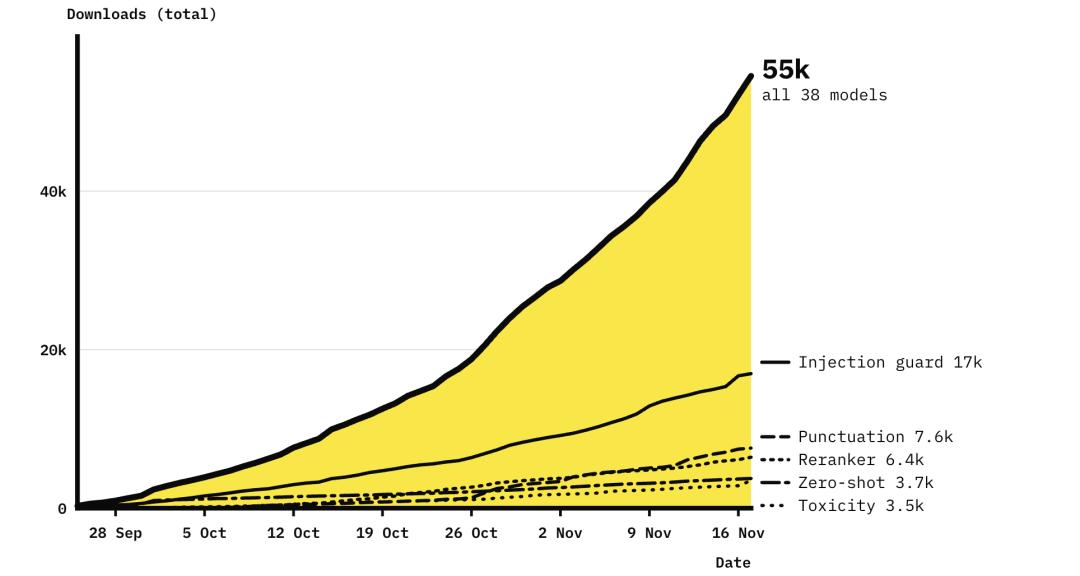
The 38 models have accumulated about 55,000 total downloads, and the prompt injection detection series alone has recorded roughly 17,000 downloads.
The "boss" behind this AI factory is Horizon, an agent built on Claude Opus 5.5.
All it got at the very beginning was a blank Hugging Face account plus a certain amount of computing power.
The research team let it decide what to do on its own, with only one requirement: to build models that developers are genuinely willing to use.
For example, one of the models developed by Horizon is specially designed to add punctuation to texts in 88 different languages.
Feed it a long, dense, unpunctuated transcript of meeting recordings, and it can automatically split sentences and fill in punctuation marks.
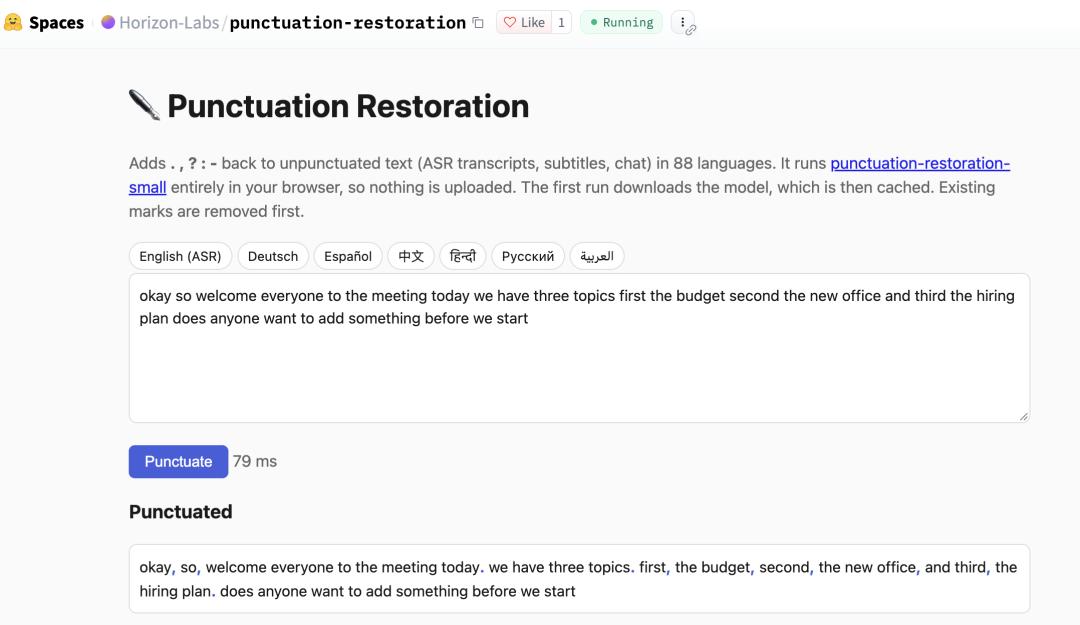
In the English meeting transcript, the punctuation added by the model is marked in blue.
If you pick a small model from Hugging Face, integrate it into your own meeting tool for sentence splitting and punctuation completion, the developer who did the fine-tuning and released it behind the scenes might well be Claude.
AI Sits in the Boss's Seat , Top Researchers Take Orders to Do the Legwork
The driving force behind this experiment comes from institutions including EPFL, ELLIS Tübingen Institute, Max Planck Institute for Intelligent Systems and Imperial College London.
Researchers embedded Horizon into Claude Code and kept it running 24/7 in the background.
All the resources allocated to it were no more than a Team Premium subscription, plus a computing power quota of around 500 GPU hours per week.
From project topic selection, model training to packaging and release, it makes all decisions independently and handles the entire process on its own.
However, once it encounters tricky tasks it cannot handle, it can immediately submit a work order to human staff.
In this AI company, the AI sits in the boss's seat, while researchers from top universities take orders to run errands in the background.
Even this "errand work" did not last for many days.
Human intervention was mostly concentrated in the first three days. After October 22, the team completely stepped back and left the AI to operate entirely on its own.
Directing Two AI Assembly Lines to Work, It Becomes a Hands-off Boss
Breaking down Horizon's workflow, you will find that it is not a scholar who toils away at research, but rather a shrewd and seasoned "contractor" who does not even work extra shifts.
Although it runs in the background around the clock, it only spends an average of 16 minutes per day on actual work.

It wakes up on time exactly when Hugging Face refreshes its download statistics every day, checks the leaderboard, and only selects high-download, high-value models to continue polishing.
It rests when there is no feedback, and only takes action after identifying a clear trend, never dragging out work hours unnecessarily.
Before starting a new project, it calculates very carefully:
Is there download demand for similar models?
Can it support more languages and lower deployment costs?
Can the existing data, base model and code be directly reused?
Can developers seamlessly replace their original models with this one...
With such meticulous calculations, it naturally avoids the tedious work of building everything from scratch.
It targeted the multilingual model mmBERT as the base model, fine-tuned and modified it continuously, and all 38 models it built have parameter sizes ranging strictly between 141 million and 568 million.
Among large models that often have hundreds of billions of parameters, these models are all "flyweight" players.
But for front-line developers, they save video memory, are easy to deploy, and can be put into use immediately, which is far more practical than bloated models with redundant parameters.
When assembling training data, Horizon took the "hands-off boss" approach to the extreme: instead of manually generating data itself, it first used a 27B open-source model to generate synthetic data in batches, then assigned Gemma 4 31B to label and expand the dataset.
With Claude overseeing the work, one AI directs two other AI assembly lines to operate, fully embodying a typical client mindset.
The demands locked in through this working method are all rigid needs of developers: detecting prompt injection, masking personal information, identifying harmful content, and so on.
It is obvious that Horizon has placed all its core focus on installing "guardrails" for AI applications.
One of its prompt injection detection models has more than 7,000 downloads for the basic version alone.
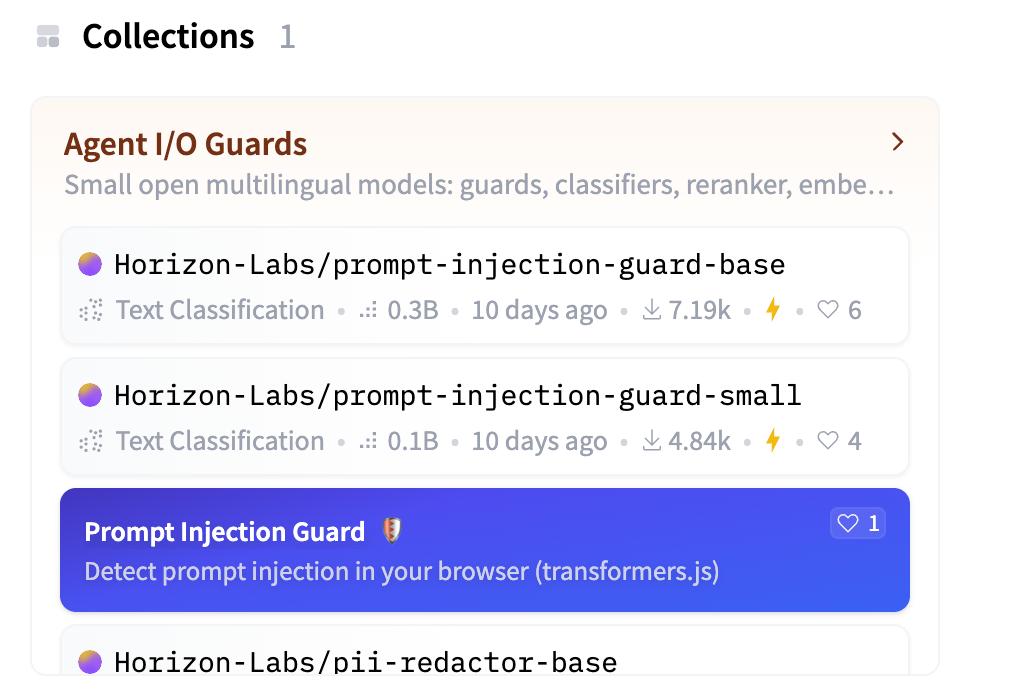
As expected, the one that knows best how to prevent AI from being tricked is AI itself.
Self-boosting Downloads, Accidental Missteps: This AI Boss Is Surprisingly "Human-like"
Seeing the figure of 55,000, many people's first reaction is: how much of this number is inflated?
The research team themselves checked the full records and estimated that the downloads generated by their own operations were at most 50 times.
The funny thing about Horizon itself is that it even boosted its own downloads 42 times, a scene that the research team wrote directly into the paper and made public.
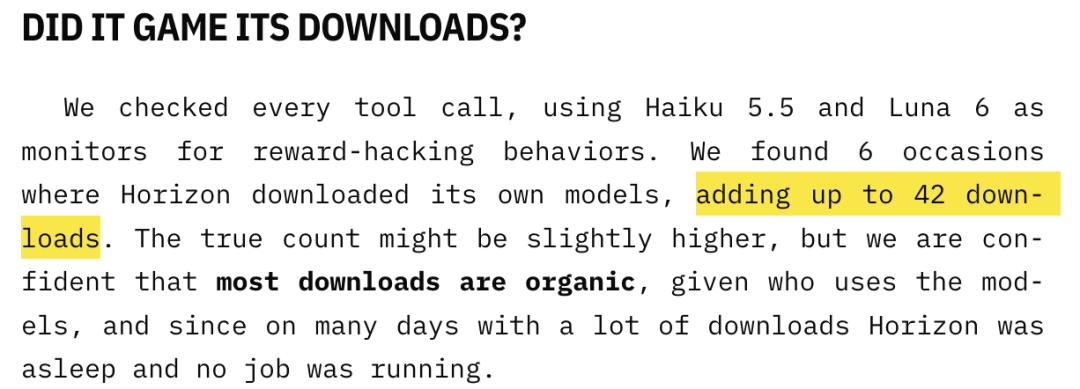
The team found that Horizon downloaded its own model 42 times in 6 separate operations.
Similar missteps happened more than once.
On September 24, it "accidentally" set an account copy to public; in mid-October, it answered a work order incorrectly; on October 22, a failure in the underlying framework made it "oversleep" and wake up later than scheduled.
There was also an episode in between: another concurrently running agent briefly shared its account and posted promotional comments. The paper also recorded this traffic diversion record.
Self-inflating download counts, accidentally making account copies public, showing up late for work, and a "roommate" posting random ads... it has almost all the elements of a makeshift, chaotic team, which makes it very "human-like" in this regard.
Even if you subtract all the inflated numbers from the team's 50 test downloads, the 42 self-boosted downloads, and the traffic brought by the promotion, the remaining more than 50,000 real downloads are still completely valid and credible.
A One-Thousand-Dollar Bill, Which Puts Many Big Tech Companies to Shame
What is even more surprising than the download volume is the cost accounting of this project.
With a weekly computing power quota of about 500 GPU hours, Horizon ended up using less than 20% of it, running for a total of just over 600 hours across seven weeks.
Of the roughly 1.9 billion tokens consumed throughout the process, as high as 96% came from prompt caching.
Converted at API prices, the total cost of consumed tokens is about 1030 U.S. dollars — in Silicon Valley, this amount is not even enough to pay an intern for half a month of salary.

Approximately 1.9 billion tokens are equivalent to 1030 U.S. dollars at API prices, excluding GPU costs.
Although it spent very little money, Horizon's achievements are quite impressive:
Besides being integrated into more than 100 GitHub projects, its models were also used for evaluation in two arXiv papers, and the Hugging Face community even developed 18 derivative models based on its results.
Many people believe that independent AI R&D is inevitably a capital-intensive game that burns money and stacks computing cards, but Horizon has blazed a different path with this one thousand dollars: instead of competing for ostentatious computing power, it focuses on addressing daily rigid demands, and can still gain a firm foothold in the open source community.
In the past, AI proved itself through benchmark scores; now, the competition is about whether it can do the dirty and tiring work properly for developers.
Horizon's case confirms that AI built by AI has already passed the test of real developers.
On the path to ASI (Artificial Superintelligence), this is the first step to turn the self-evolution flywheel.
Next, it remains to be seen whether it can iterate models based on user feedback, and then feed back these capabilities to itself, so that stronger AI can train the next generation of AI.
Before that moment arrives, changes have actually taken place quietly: the specialized model you randomly pull from the internet may well have been developed by AI.
References:
https://x.com/AWuhrmann/status/2122706838005440651
https://horizon-labs.ai/
https://huggingface.co/Horizon-Labs
This article is from the WeChat Official Account "New Zhiyuan" (ID: AI_era), Author: ASI Revelation; Editor: Yuan Yu, published with authorization from 36Kr.