As an OEM manufacturer for Adidas and Li-Ning with an annual revenue of 5.8 billion yuan, why does Longxing Tianxia make a profit of merely 5 yuan per pair of shoes?
On November 9, 2026, the review result of the 57th deliberation meeting in 2026 held by the Listing and Examination Committee of the Shanghai Stock Exchange shows that the initial public offering of Guangdong Longxing Tianxia Technology Co., Ltd. meets the issuance conditions, listing conditions and information disclosure requirements, and its IPO on the main board of the Shanghai Stock Exchange has been officially approved.
According to the prospectus, Longxing Tianxia is mainly engaged in the development, design, production and sales of sports shoes. It is a professional sports shoe manufacturer with scale advantages, brand influence and market competitiveness, and has established cooperative relations with well-known sports brands such as adidas, Under Armour, Li-Ning, ANTA and HOKA. According to the data of Frost & Sullivan, in 2025, Longxing Tianxia ranked 7th in the global sports shoe manufacturing industry with a global market share of 1.78%, and its domestic revenue ranked second.
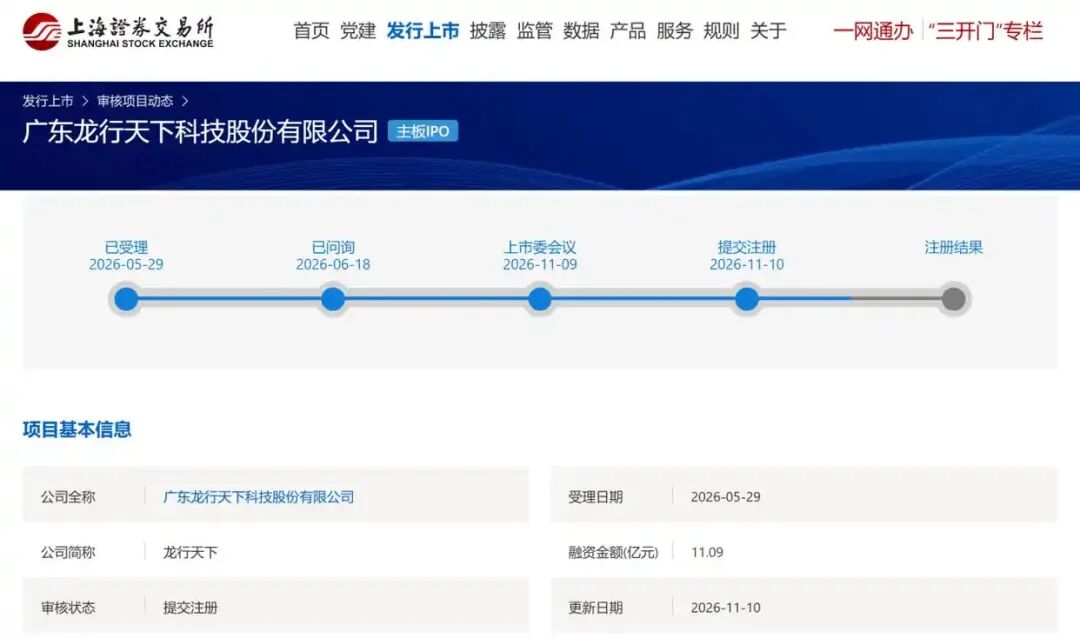
Since the full implementation of the registration-based IPO system, there have been very few IPO projects in the footwear manufacturing industry accepted by the main board of the Shanghai Stock Exchange. The approval of Longxing Tianxia's IPO therefore carries signal significance that goes far beyond the individual company itself.
01
From Molds to Complete Shoes: How Did Longxing Tianxia Break Into the OEM Market?
The starting point of China's sports shoe OEM industry highly coincides with the eastward migration of global manufacturing in East Asia. In the 1970s and 1980s, brands such as Nike and adidas outsourced their manufacturing links, and OEM giants such as Taiwan's Pou Chen (parent company of Yue Yuen) took the lead in undertaking these orders. Driven by the labor and land dividends brought by the reform and opening-up policy, footwear manufacturing capacity was transferred on a large scale to Jinjiang, Fujian and Dongguan, Guangdong.
The first batch of shoe factories in Jinjiang mastered production technology, quality control system and management experience in the process of doing OEM for Nike and adidas, and gradually formed a complete industrial chain, which was called "Nike Apprentice" by industry researchers. The core logic at this stage was cost arbitrage: brand owners held the power of design, channels and pricing, while OEMs made a living on processing fees, and their profit boundaries were set by the brand owners.
However, the profit ceiling of OEM business is extremely low. Under the pressure of thin profit, the sports shoe industry began to differentiate in the middle and late 1990s.
In 1999, ANTA signed Kong Linghui with 800,000 RMB and invested 3 million RMB in CCTV advertisements, making its sales revenue jump from the level of tens of millions of RMB to 300 million RMB. The brand building model of "star + advertisement" launched a thrilling leap for a large number of OEM shoe enterprises to develop independent brands, while Dongguan and Putian took completely different paths based on the Taiwan-funded OEM system and high imitation production.
Longxing Tianxia entered the finished shoe manufacturing industry exactly during this differentiation period. In 1998, Long Shuchu, Long Jinchu and Chen Tongju co-founded Zhansheng Mold Factory, cutting into the upstream of the industrial chain from shoe molds. Molds are the high point of shoemaking process density. This choice gave Longxing Tianxia the initial conditions for vertical integration in the future, but also limited it to the supporting links of the industrial chain for a long time, rather than the main battlefield of finished shoe OEM that directly faces brand customers.
This experience did not bring considerable revenue scale, but left Longxing Tianxia two things that were crucial later: the mastery of the underlying logic of shoemaking technology, and the early trust accumulation as a "supporter" in the brand customer development system. The service targets of the mold factory are the development centers of major brands themselves. Longxing Tianxia had been embedded in the product development chain of brands before it even produced a single pair of finished shoes.
Since 2011, Longxing Tianxia has set up factories in Guangdong, Hunan, Hubei, Jiangxi and Vietnam successively, extending its business from molds to outsoles, uppers, and finally finished shoes. The industrial background of this transformation is that local Chinese sports brands (Li-Ning, ANTA, etc.) began to restructure their supply chains after experiencing the inventory crisis in the early 2010s, seeking local manufacturers with rapid response capabilities and integrated supporting capabilities. With the self-supply of molds and outsoles as the fulcrum, Longxing Tianxia cut into Li-Ning's supply chain, and gradually expanded its customers to international brands such as adidas, Under Armour and Decathlon.
In 2012, Long Shuchu overruled different opinions and signed an agreement with his hometown Taoyuan, Hunan, to locate the production base of Hunan Longxing Tianxia Sporting Goods Co., Ltd. in Taoyuan. The total investment of this project is 350 million RMB, covering an area of more than 160 mu. Construction started in 2012 and it was successfully put into operation in 2014.
This means that Longxing Tianxia has effectively separated its headquarters and production bases: Guangdong, as the location of the headquarters and mold capacity, undertakes development and management functions; while inland areas such as Taoyuan provide land cost advantages and large-scale labor supply that the Pearl River Delta no longer has.
By 2015, "Longxing Tianxia" completed the construction of a corporate structure, and a manufacturing group starting from a mold workshop and cutting into finished shoe OEM with vertical integration took initial shape.
02
A "Large but Thin Profit" OEM Sample
The prospectus shows that from 2023 to the first three quarters of 2026, Longxing Tianxia achieved operating revenue of 4.211 billion RMB, 5.588 billion RMB, 5.834 billion RMB and 4.52 billion RMB respectively, and realized attributable net profit of 212 million RMB, 281 million RMB, 258 million RMB and 198 million RMB respectively.
It is worth noting that from 2023 to 2025, the net sales profit margin of Longxing Tianxia estimated by attributable net profit was only 5.03%, 5.03% and 4.42% respectively, showing a downward trend even below 6%. Estimated based on the sales volume of 51.75 million pairs in 2025, the net profit per pair is about 5 RMB. The Listing Committee of the Shanghai Stock Exchange also required the company to explain the stability of its operating performance in terms of the gap in revenue and market share with leading enterprises.
According to the prospectus, Longxing Tianxia is a professional sports shoe manufacturer with local Chinese background. It does not engage in brand operation business. As the manufacturing link in the middle reaches of the industrial chain, it purchases shoe materials from upstream raw material suppliers, organizes production according to the order demands and product specifications of downstream brand customers, and finally delivers the finished shoes to the brands to enter the terminal circulation and sales channels.
During the reporting period, the revenue of sports shoes as the pillar product was 3.665 billion RMB, 5.063 billion RMB and 5.300 billion RMB respectively, and its proportion in the main business increased from 89.28% to 91.05%, with the revenue source highly concentrated in a single category.
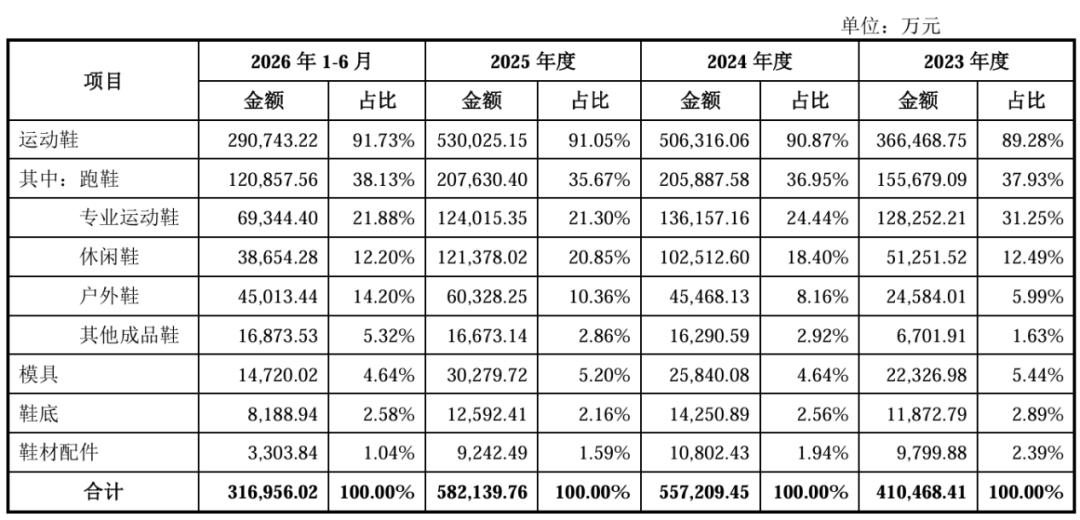
The concentration on the customer side is also remarkable: from 2023 to 2025, the revenue from the top five customers accounted for 86.74%, 88.86% and 86.25% of the operating revenue respectively, remaining above 80% for three consecutive years. From January to June 2026, the proportion of the top five customers was 24.42% for Li-Ning, 20.87% for Decathlon, 20.48% for adidas, 13.64% for Under Armour and 8.94% for ANTA respectively.
However, major customers are also changing: Under Armour's orders shrank from 1.323 billion RMB in 2024 to 970 million RMB in 2025, and the gap was filled by the incremental orders from adidas, Decathlon and ANTA. Prospectus data shows that in 2025, the revenue contribution of adidas, Decathlon and ANTA to Longxing Tianxia was 1.279 billion RMB, 860 million RMB and 603 million RMB respectively, increasing by 196.65%, 117.17% and 166.81% respectively compared with 2023.
In terms of profit margin, from 2023 to 2025, the comprehensive gross profit margin of Longxing Tianxia was 19.10%, 17.61% and 18.48% respectively, and rebounded to 19.33% in the first half of 2026. The net profit margin in the same period was 5.03%, 5.03% and 4.52% respectively. The prospectus attributes the difference between its gross profit margin and that of comparable companies in the same industry to the differences in production base layout, production scale and product structure.
The prospectus reveals that by the end of June 2026, Longxing Tianxia has opened 26 factories in China, Vietnam and Indonesia, with about 26,300 employees, including 15 domestic factories. Based on the shipment volume, domestic production capacity accounts for 67.41%, and domestic revenue accounts for 59.41%.
This layout is reasonable in serving the rapid iteration and small-batch fast-response orders of domestic brands. About 95% of the products sold by adidas in China have achieved local production, and the domestic production capacity of Longxing Tianxia exactly meets this demand. However, domestic labor and land costs are significantly higher than those in Southeast Asia, and the high proportion of domestic production capacity also suppresses the gross profit margin space of Longxing Tianxia to a certain extent.
03
The Real Gap With Industry Leaders
In 2025, the comprehensive gross profit margin of Longxing Tianxia was 18.48%, lower than 21.89% of Huili Group and 22.76% of Yue Yuen Group. But compared with industry leaders, what Longxing Tianxia lacks is not only the comprehensive gross profit margin, but also a large gap in net profit margin and expense structure.
For example, Huili Group had a net profit margin of 12.84% in 2025, with a period expense rate of only 4.51%, and the net profit per pair was about 14.1 RMB, nearly three times that of Longxing Tianxia (about 5 RMB per pair). The core of Huili's model is not selling at a high price, but compressing the expenses in the manufacturing link to the extreme, achieving the highest net profit margin with the lowest value per pair.
In 2025, the gross profit margin of Yue Yuen Group's manufacturing business was 18.2% and the net profit margin was 6.4%. Its gross profit margin is close to that of Longxing Tianxia, but with more mature global capacity scheduling and expense control, its net profit margin is still one level higher than that of Longxing Tianxia.
From a horizontal comparison, the gross profit margin of 18%-19% of Longxing Tianxia is not the lowest in the industry, but the conversion efficiency from gross profit margin to net profit margin is low. On the one hand, this is because Longxing Tianxia actively gave up the low-cost arbitrage space in Southeast Asia in terms of cost structure, and on the other hand, it lacks the extreme compression capability on the expense side like Huili.
The prospectus reveals that from 2024 to 2025, the accounts receivable turnover rate of Longxing Tianxia was 4.54 times and 3.98 times respectively, while the average value of comparable companies in the same industry was 7.26 times and 6.52 times respectively, and the payment collection efficiency was about 40% slower than that of the same industry. The inventory turnover rate decreased from 6.03 times in 2024 to 4.94 times in 2025, down 18.08%; the book value of inventory increased from 623 million RMB at the end of 2023 to 1.021 billion RMB at the end of 2025. In the same period, the accounts receivable turnover rate of Huili Group was above 5.9 times, and that of Zhiqiang International was above 6.4 times.
This gap also indicates from the side: Longxing Tianxia has weaker bargaining power when facing downstream brand customers, and has to obtain orders with longer account periods and higher inventory occupation. For an enterprise with already thin net profit margin, the operating capital is stretched by both the customer side and the inventory side, which means that the capital investment required for scale expansion is larger, and the return generated by unit capital is lower.
It is worth noting that most sports shoe OEM enterprises are deeply bound to downstream customers, but their customer structures are not exactly the same.
At present, the proportion of the top five customers of Huili Group has dropped from 79.13% in 2024 to 72.55% in 2025, and the customer diversification strategy is continuously advancing. The top four customers of Yue Yuen's manufacturing business account for more than 78% of the footwear revenue, and the concentration is also not low, but Yue Yuen's customer portfolio covers the most dispersed order pool of global leading brands such as Nike and adidas, and the impact of single brand fluctuation on its overall capacity load is relatively controllable.
In the customer list of Longxing Tianxia, Li-Ning and adidas together account for more than 44%. In recent years, Li-Ning is falling into growth difficulties, with its revenue growth rate of only 3.2% in 2025 and its net profit declining slightly for two consecutive years. The contraction of Under Armour has actually occurred, which may affect the revenue stability of Longxing Tianxia to a certain extent.
The approval of Longxing Tianxia's IPO has also brought the real situation of the sports shoe OEM industry to the capital market. The global 7th scale, 5.8 billion RMB of revenue and 51.75 million pairs of shipment volume are the results of Longxing Tianxia's 30 years of industrial accumulation; but the net profit of 5 RMB per pair, lower turnover efficiency than the industry, highly concentrated customer structure and domestic-biased capacity layout show that this enterprise is still in the transformation from "scale dividend" to "efficiency dividend". Whether it can catch up with the industry giants in terms of efficiency may be the question that Longxing Tianxia must answer in the future.
This article is from the WeChat Official Account "Blue Shark Consumption", written by Zhang Erhe, edited by Lu Xucheng, and published by 36Kr with authorization.