QuestMobile 2026 Double 11 Insight Report: The era of tremendous changes has dawned. Epic-level fierce competition is underway between comprehensive e-commerce platforms and content e-commerce platforms, the supply of content marketing is in surplus, and the content reach efficiency is highly differentiated across different industries.
Today, I'd like to share the 2026 "Double 11" Insight Report with you. Many users feedback that this year's "Double 11" is very plain and calm. However, Mr.QM wants to say that this year's "Double 11" is "thunder surging under the silent surface". Behind consumers' calm perception, the "epic battle" between comprehensive e-commerce and content e-commerce has reached a stage of "bloody close combat", and this huge change has just begun, just as Mr.QM predicted in 2019 that the huge change in the online video industry had already started. What is affected by this is not only e-commerce and content, but also a large number of store owners, KOLs and brand owners!
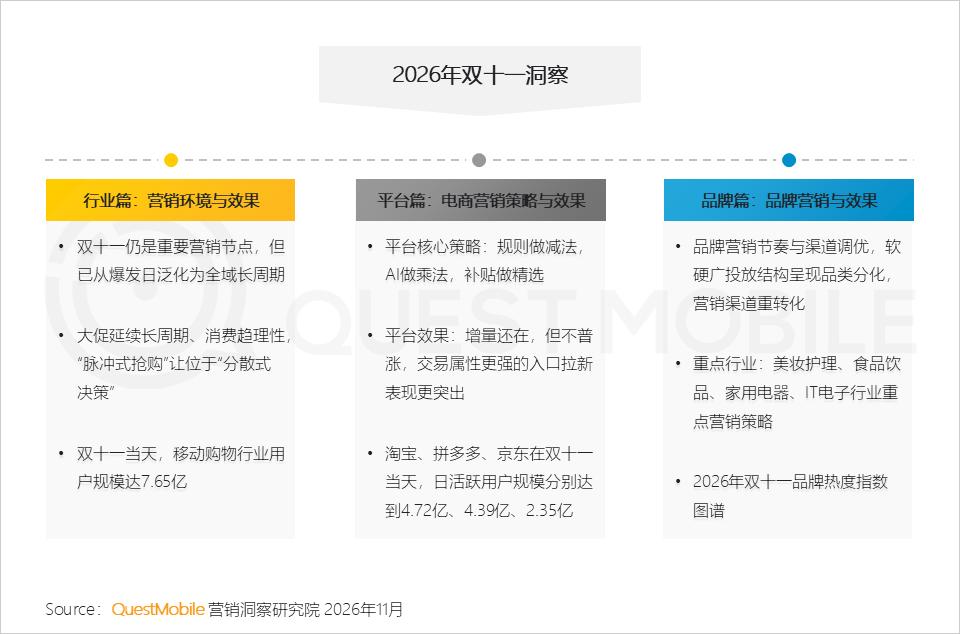
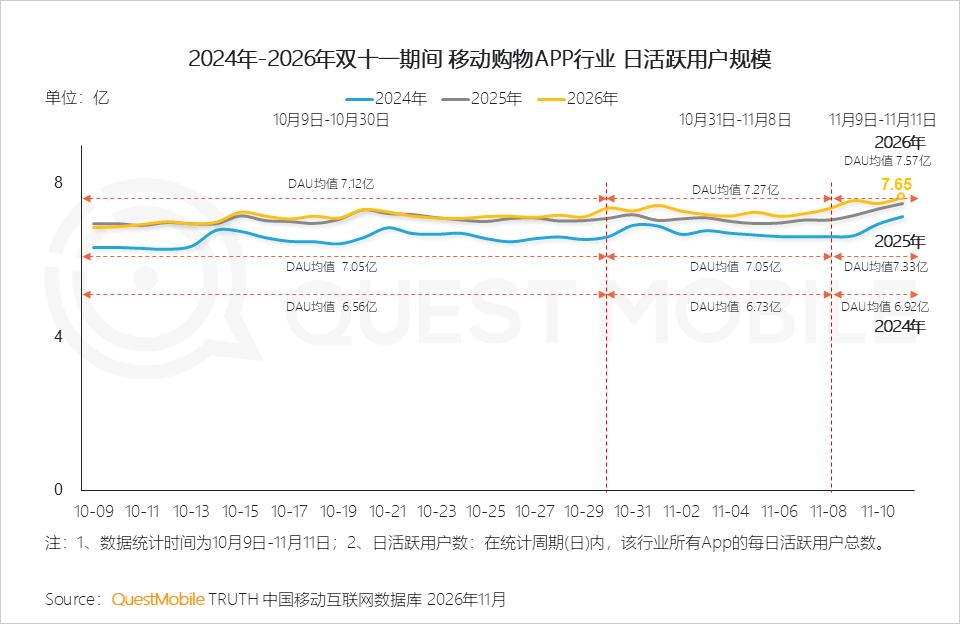
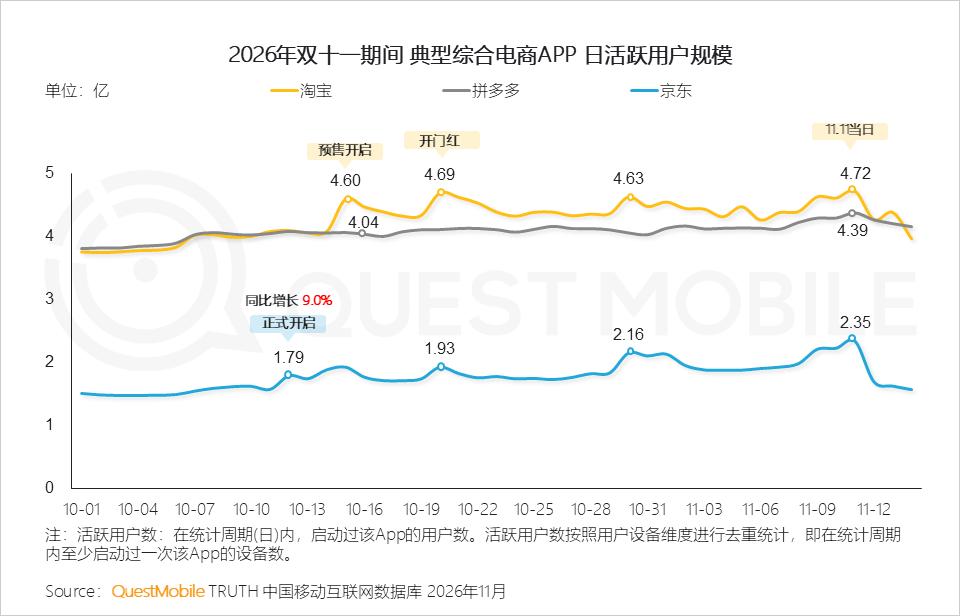
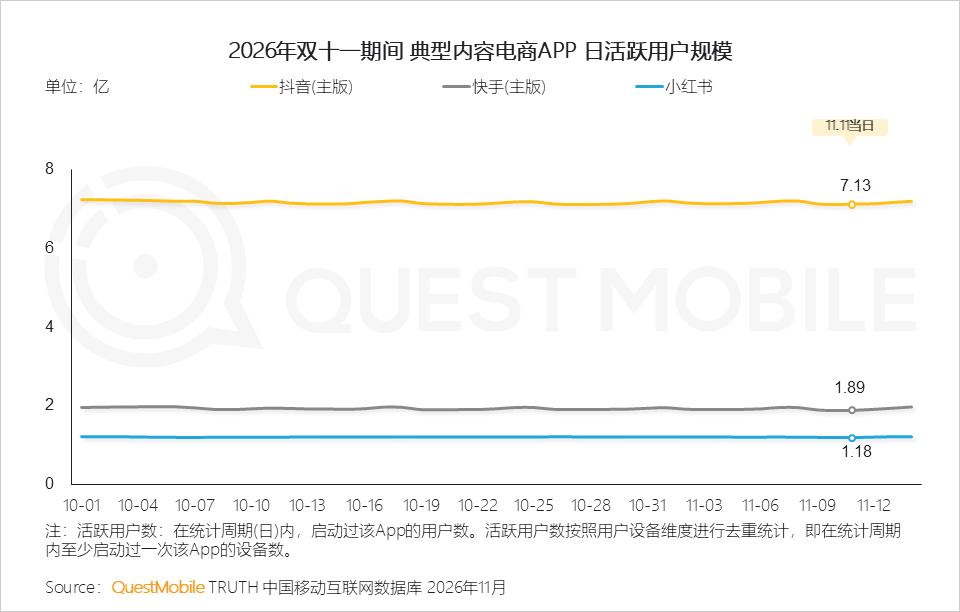
According to QuestMobile data, on November 11, the daily active user scale of the mobile shopping industry reached 765 million, slightly higher than 749 million in 2025 and 716 million in 2024. Among them, in terms of comprehensive e-commerce, the daily active user scale of Taobao, Pinduoduo and JD.com was 472 million, 439 million and 235 million respectively; in terms of content e-commerce, the daily active user scale of Douyin, Kuaishou and Xiaohongshu was 713 million, 189 million and 118 million respectively.
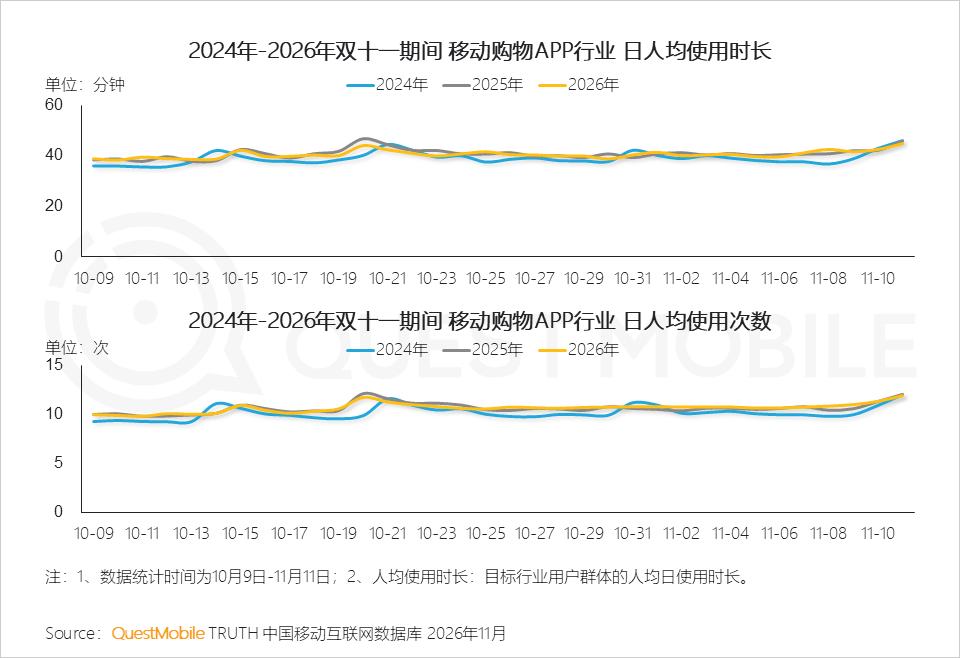
In fact, during the entire "Double 11" period (October 12 to November 11), the average daily active user scale of the mobile shopping APP industry was 723 million. Although it was slightly higher than 709 million in 2025 and 667 million in 2024, the per capita usage duration and per capita usage frequency showed a slight decline, indicating that the stock competition trend of the industry has been very obvious.
This brings us back to the problem mentioned by Mr.QM at the beginning: the "close encounter" between content e-commerce and comprehensive e-commerce has reached a white-hot stage. For comprehensive e-commerce platforms, in order to expand the silver-haired group and stimulate rapid purchase conversion, they do not hesitate to adopt the "involution-style" strategy, turning the big promotion into a long-period seesaw battle, advancing the soft advertisement content seeding, setting conversion nodes as assistance, and introducing AI shopping guides to stimulate consumers and AI operation tools to improve efficiency for merchants!
For content e-commerce platforms, they continue to leverage the momentum of the national-level "Double 11" promotion festival to break through the circle and stimulate user conversion. For example, compared with last year, during the 2026 "Double 11" period, the proportion of male users on Xiaohongshu increased by 14.9%, and the proportion of post-80s and post-90s users increased by 5%, forming a complement to the existing crowd of the platform.
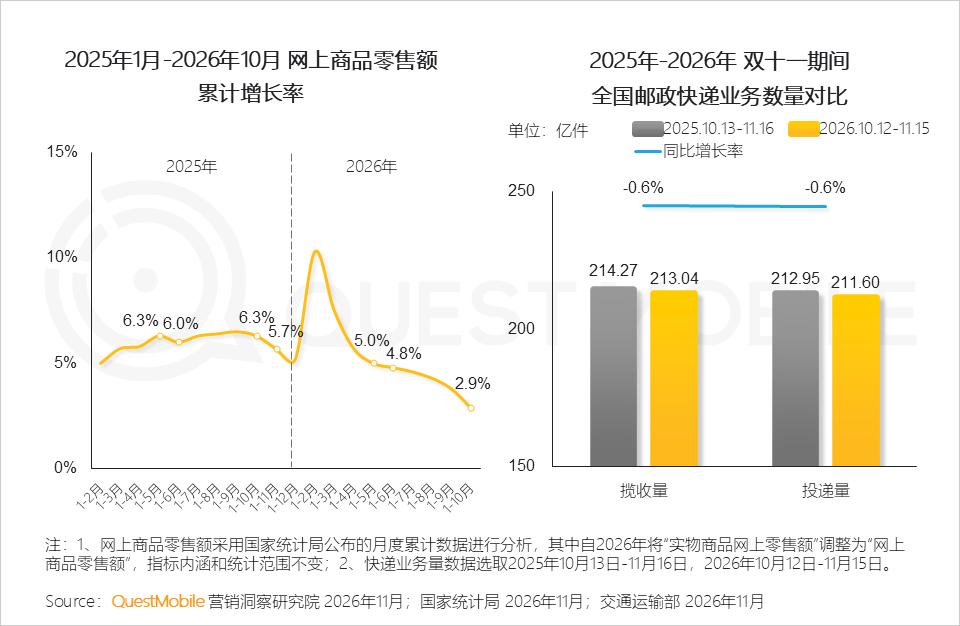
With no incremental market left, the volume of express parcel collection and delivery also decreased slightly by 0.6% year-on-year. However, the impact on the industrial chain is far more than that. Behind this, a more important issue has emerged: the supply of content marketing is already in surplus!
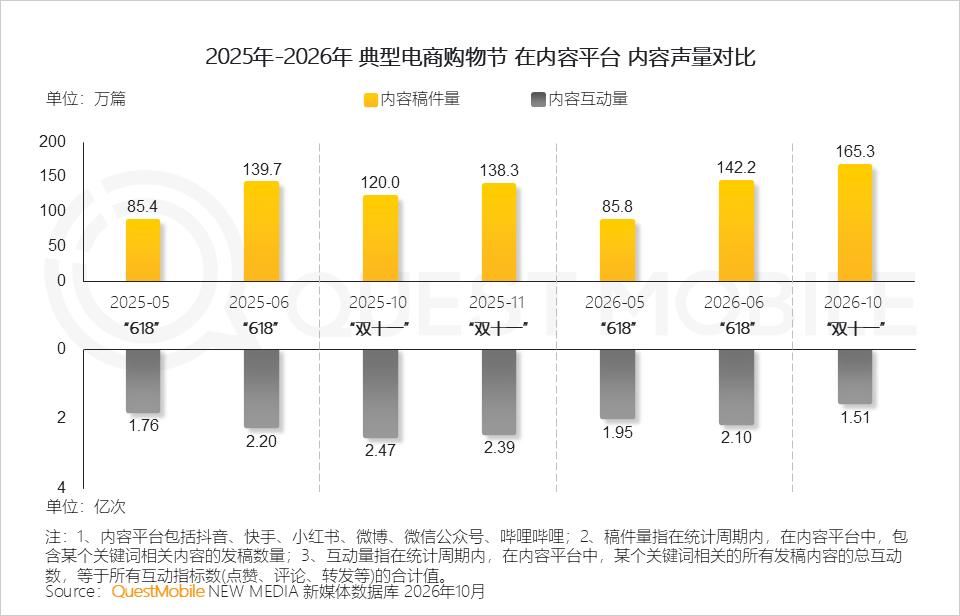
In October 2026, the number of content articles on core content platforms reached 1.653 million, with 151 million interactions; while in the same period of 2025, these two figures were 1.2 million and 247 million respectively. The sharp decline in interaction volume and the rapid rise in content volume form a "striking contrast"! In fact, this situation has already emerged faintly during the 618 shopping festival in 2026: in June 2025, the number of content articles and interaction volume were 1.397 million and 220 million respectively, and by June 2026, these two figures had become 1.422 million and 210 million.
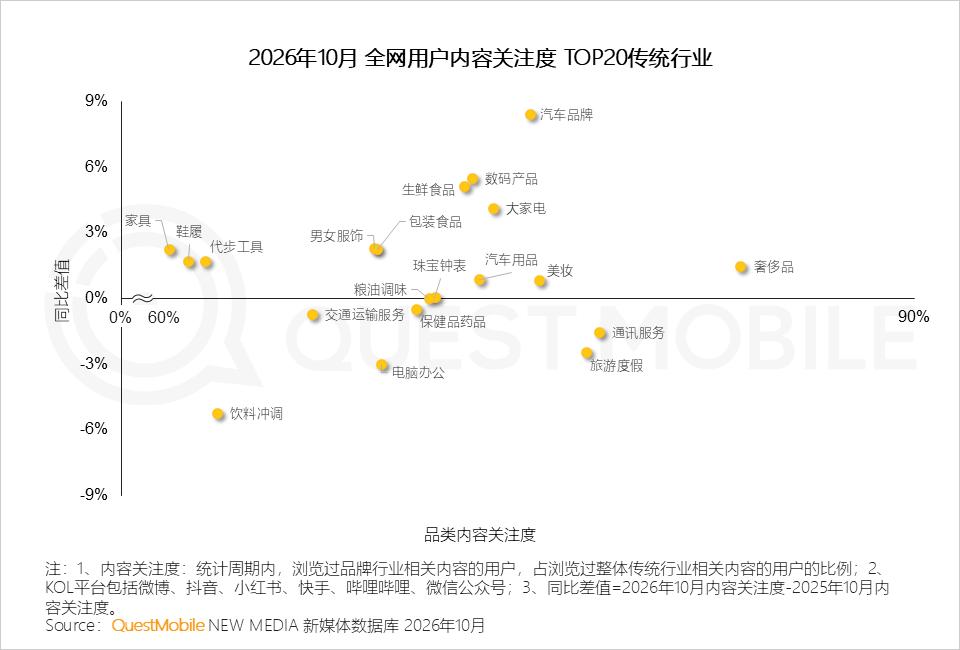
At the same time, the "epic competition" between comprehensive e-commerce platforms and content e-commerce platforms, just like a "galaxy-level collision", not only leads to the surplus of content marketing supply, but also leads to stratification of content reach efficiency in different industries: on the one hand, the content attention of head industries remains at a high level, for example, automotive brands, digital products, fresh food, large home appliances, etc. still maintain growth; on the other hand, the number of industries with declining attention is increasing, and industries such as beverage and instant drinks, computer office supplies, tourism and vacation have declined to varying degrees.
For brand owners, this is not only a matter of paying attention to hard advertisements and soft seeding articles, nor just a matter of paying attention to competition in the same industry, but also a matter of paying attention to the "content reach efficiency", which makes the choice of "marketing strategy" more complicated. For example, the beauty care industry increasingly relies on the placement of hard advertisements to strengthen the certainty of exposure, and drive in-e-commerce conversion + short video goods selling; while the food and beverage industry values short video off-platform seeding and conversion, and the home appliance industry strengthens the exposure investment on comprehensive e-commerce platforms...
Want to know the specific situation? Just check the report.
2026 Double 11 Insight
1
[Industry Chapter]
E-commerce competition has shifted from traffic dividend to retained user operation,
and big promotions have shifted from acquiring new customers to improving stock efficiency
1. Double 11 is still an important marketing node, but it has evolved from a single outbreak day to a full-domain long-cycle activity
1.1 The growth rate of online retail sales of physical goods has slowed down, the volume of express parcel collection and delivery has decreased slightly year-on-year, and the pulse effect of logistics during the big promotion period has declined
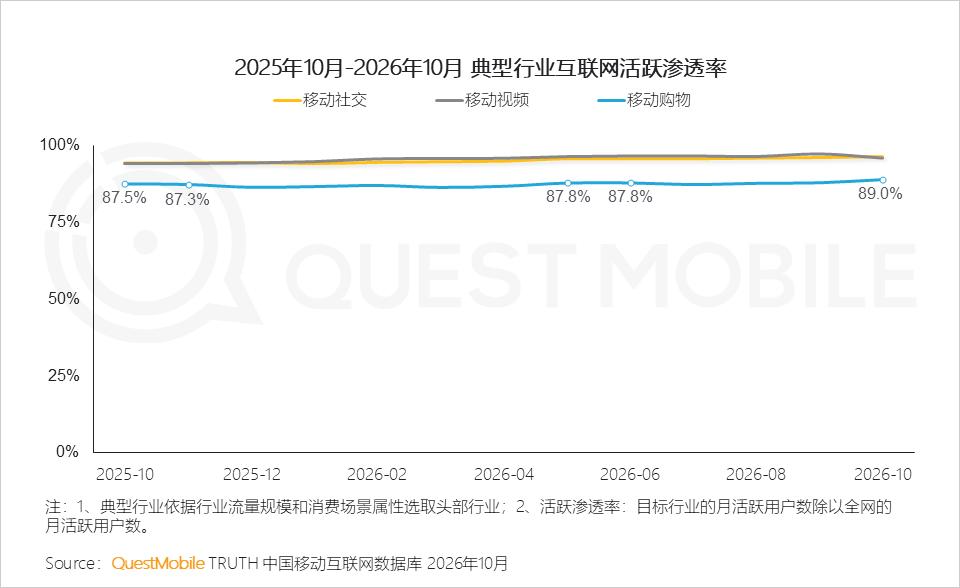
1.2 The penetration rate of the mobile shopping industry is close to 90% of the entire network, with a small gap from the social and video industries, and the industry has entered a stock game stage
QuestMobile data shows that the penetration rate of the mobile shopping industry in October 2026 was 89.0%, up 1.5% year-on-year compared with October 2025.
1.3 Observed from user voice volume, the number of Double 11 content articles hits a new high, but content interaction volume declines. Marketing of brands and platforms is still expanding, but users' willingness to interact has cooled down
1.4 Users' attention to the consumer industry is also changing. The content attention of head industries remains at a high level, and the efficiency of content reach begins to stratify
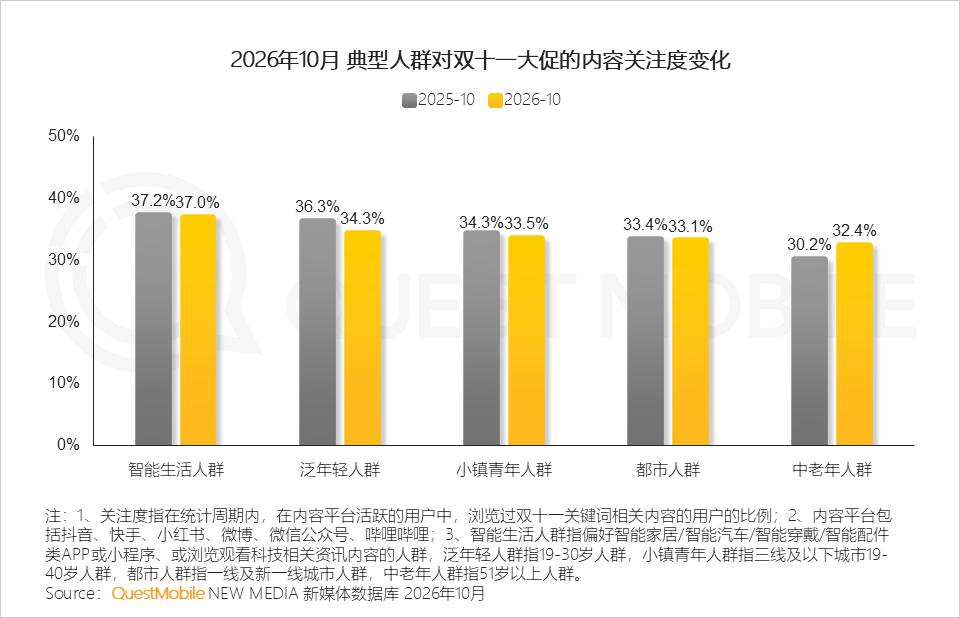
1.5 The attention to Double 11 promotions has shown a "silver-haired" migration trend. The middle-aged and elderly group's attention to promotions is on the rise, while young people are relatively restrained, and incremental attention flows to the silver-haired group
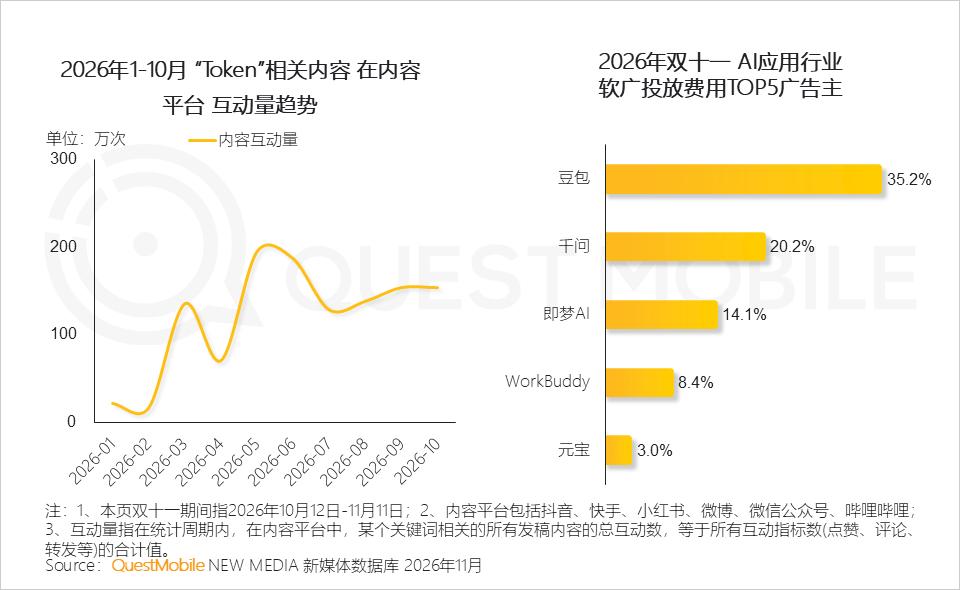
1.6 The interaction volume of Token-related topics remains at a high level throughout the year. Tokens are put on the shelves, making AI a stockpiled commodity for the first time
One of the landmark events of 2026 Double 11 is that AI has changed from a back-end tool serving transactions to a front-end commodity that can be traded. Tmall and JD platforms have launched Token recharge centers, cooperating with AI manufacturers. At the same time, Token and AI membership packages also appear in the live streaming rooms of top influencers and brands.
2. Promotions continue to extend for a long cycle, consumption tends to be rational, and "pulse-style rush buying" gives way to "decentralized decision-making"
2.1 Platforms "rush to start and involute", the big promotion continues the long-cycle seesaw battle, exchanging time for GMV. WeChat Mini Shop, as a new participant for the first time, has become a new variable
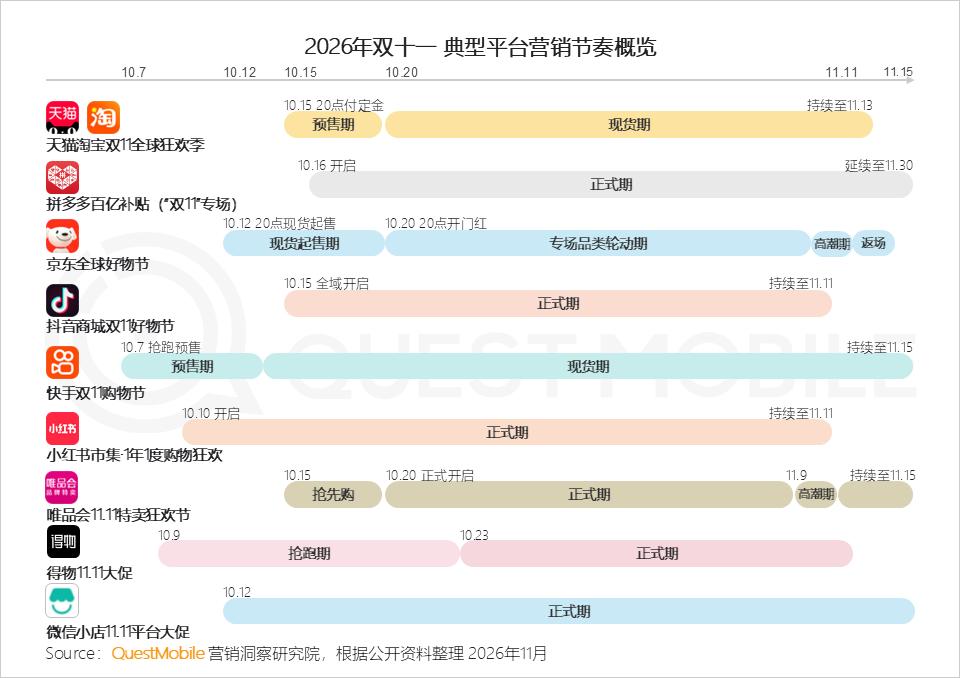
2.2 During the Double 11 period, DAU gradually rises, but the growth rate narrows, with outbreaks at multiple nodes
QuestMobile data shows that on November 11, 2026, the scale of active users in the mobile shopping industry reached 765 million, which was the highest peak during the Double 11 period.
2.3 On November 11, the per capita usage duration decreased, and the usage frequency also decreased slightly. The occupation of users' usage duration and frequency by the big promotion continues to narrow. Users "browse faster and buy more accurately", and decision-making efficiency is improved
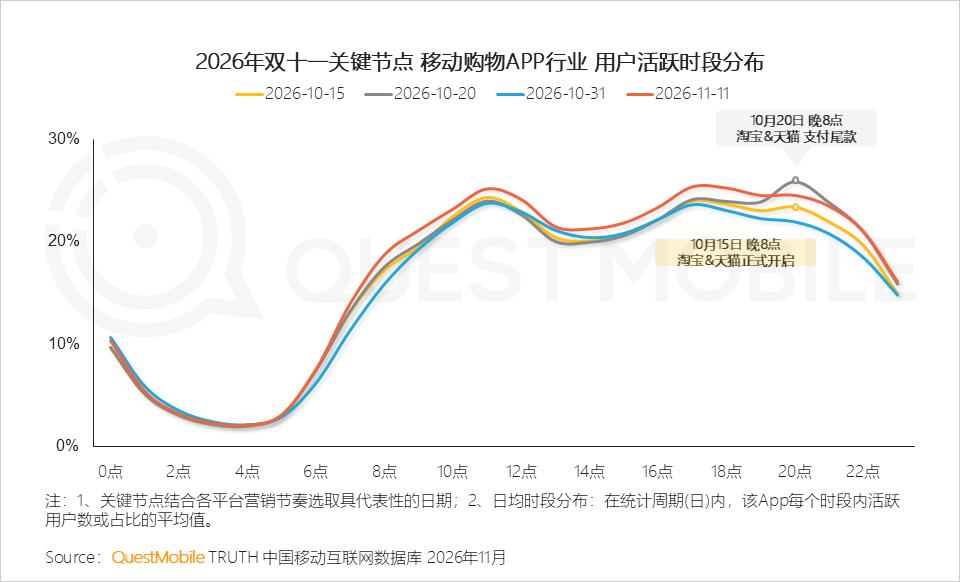
2.4 The activity level jumps at the evening peak on November 11, but the distribution throughout the day tends to be gentle. Promotional consumption has been embedded in daily time periods, and platform marketing strategies can still slightly boost user active performance
QuestMobile data shows that at 20:00 on October 20, when the first batch of final payments were made, the proportion of active users on mobile shopping APPs was 25.9%, at 17:00 on November 11, the proportion of active users was 25.4%, and at 20:00 it was 24.6%.
2.5 November 11 is still the key peak node for e-commerce platforms
QuestMobile data shows that on November 11, 2026, the user scale of Taobao APP reached 472 million; the user scale of Pinduoduo APP reached 439 million; the user scale of JD APP reached 235 million.
2.6 The Matthew effect on content e-commerce platforms intensifies
QuestMobile data shows that on November 11, 2026, the user scale of Douyin APP reached 713 million; the user scale of Kuaishou APP reached 189 million; the user scale of Xiaohongshu APP reached 118 million.
QuestMobile data shows that on November 11, 2026, the user scale of Douyin Mall APP reached 59.797 million; the user scale of Vipshop APP reached 19.195 million; the user scale of Dewu APP reached 10.042 million.
