Anthropic's listing on the US stock market sees institutional investors scrambling to grab its shares with 6 times oversubscription, while retail investors are preparing to cash out, revealing a staggering hidden risk worth as high as 900.9 billion US dollars.
When humanity first gets the chance to create intelligence powerful enough to reshape the entire society, we are no longer just facing a new industry, but a brand new era.
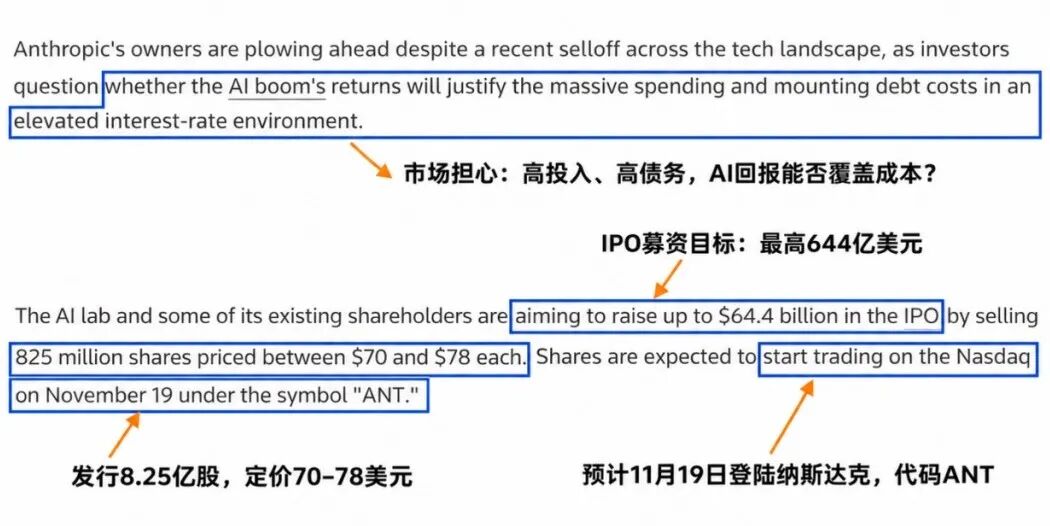
This coming Thursday, November 19, Anthropic, the company behind Claude, is expected to list on the Nasdaq under the ticker symbol ANT.
Calculated at the upper limit of the offering range, its fully diluted valuation is approximately 1.4 trillion US dollars, with planned fundraising of around 644 billion US dollars. According to Bloomberg reports, institutional subscription intentions have reached roughly 6 times the offering size.
Yet a stark contrast emerges.
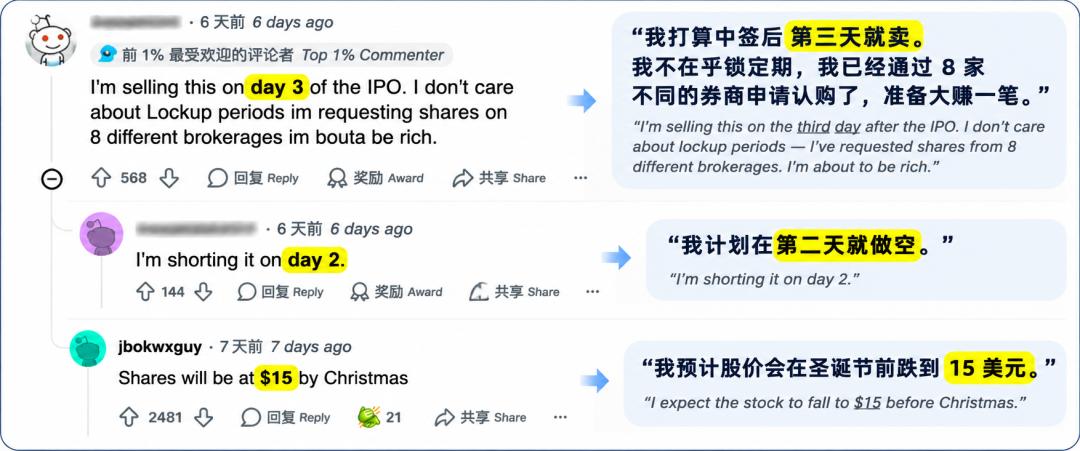
Institutional investors are scrambling for shares, while retail investors on Reddit are discussing how to exit: some plan to sell on the third day after winning the allotment, and others are calling for a drop to $15 before Christmas.
On the other side, OpenAI originally planned to raise funds at a valuation of 1.4 trillion US dollars, but the recent tranche of financing it completed landed at a valuation of around 1.25 trillion US dollars.
One is lowering its valuation, the other is going public at a higher valuation, institutions are snatching up allocations at 6 times oversubscription, but retail investors are thinking about exiting. Is Anthropic more valuable, or has the market overdrawn its growth for the next few years in advance?
To understand this 1.4 trillion US dollar valuation, there is an unavoidable background: the route dispute between open-source and closed-source models.
Nvidia hopes that open-source models will be fully rolled out, as the more people use them, the more chips it can sell; Anthropic relies on the technological generation gap of closed-source models, where enterprises are willing to pay more for Claude, on the premise that other models cannot do the same job.
Right before its listing, Nvidia also plans to invest approximately 100 billion US dollars in Anthropic through a concurrent private placement.
Some people even suspect that behind Jensen Huang's recent controversy, Dario Amodei, CEO of Anthropic, is using regulatory policies to "target him" — one wants to tighten chip export restrictions, the other makes a living by selling chips, and the motivation is obvious. Of course this is just speculation, but the conflict between the two sides has indeed existed for a long time.
You can also share your thoughts in the comment section: Which do you prefer, Jensen Huang's open-source ecosystem, or Anthropic's closed-source moat?
The route dispute is the underlying backdrop, but what really determines whether this 1.4 trillion valuation is justified are the following five specific questions.
In today's article, I will break down the key points with data:
- Why does Claude outperform ChatGPT and Gemini in the enterprise market?
- Revenue has surged by more than 12 times, why did Q3 profit suddenly turn to loss instead?
- The $9.009 trillion computing power commitment — is it a moat or a time bomb?
- Why are computing power sellers, channel fee collectors and stock buyers all sitting at the same poker table?
- Is $1.4 trillion really expensive? Facing the maximum 20% retail allotment and the 15-day anti-short-term trading rule, what should retail investors do?
This issue contains a large amount of information, you can bookmark it for easy reference when we explain the specific data later. We are not just looking at the listing of an AI company, but using Anthropic as a window to observe the competitive landscape of the entire AI industry, and who the ultimate winner of this trillion-dollar capital race will be.
Does Claude get more budget in the enterprise market?
Let's start with the first question.
A valuation of 1.4 trillion US dollars cannot be supported only by market sentiment, and it must ultimately be reflected in the actual payment capacity of enterprise customers.
Regarding Anthropic's competitiveness, let's first give a conclusion that is different from most people's daily intuition: What makes Anthropic truly outstanding is not that Claude is smarter than ChatGPT in all tests, but that it is taking away the AI budget that enterprises are most willing to spend.
We can directly look at the market share data.
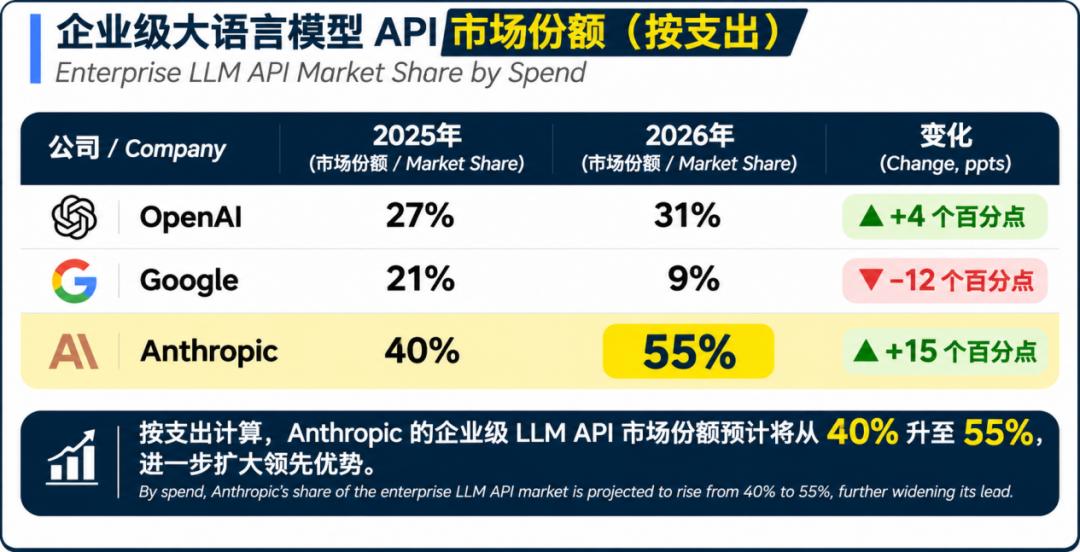
According to the September 2026 report from Menlo Ventures, in the enterprise large model API spending market, for every $100 that enterprises spend on large model services, roughly $40 flowed to Anthropic last year, and this figure has risen to $55 this year.
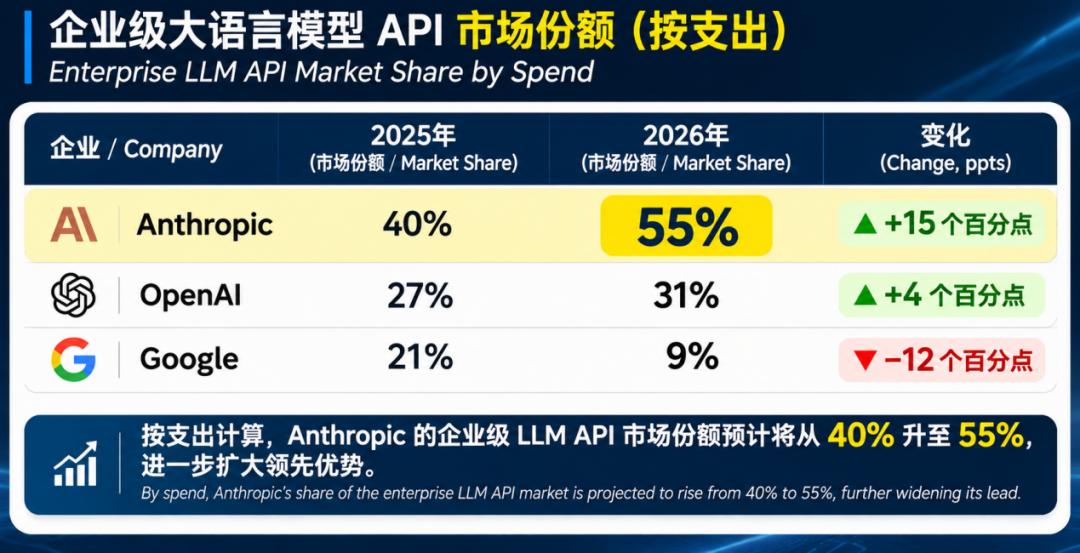
In the same report, OpenAI's share rose from 27% to 31%, while Google's share dropped from 21% to 9%. Notice this structural change: OpenAI's share is actually growing too, and it is Google that has clearly lost enterprise market share.
This means that ChatGPT is still very popular among individual consumers, but when it comes to the formal procurement, contract signing and payment process in enterprise departments, Claude gets the most capital.
Why are enterprise finance and technical leaders willing to approve budgets for Anthropic?
You can understand it by looking at the implementation process of the Claude Code product.
Take the most common scenario in software engineering: an engineer needs to fix a vulnerability in an old system. Many people think that the most time-consuming part for engineers is writing new code, but in reality, they often only modify two lines of code in the end, and spend half a day beforehand just locating the problem.
He has to first understand the code logic written by others several years ago, figure out exactly which link went wrong, and run tests after modification to confirm that this change will not break other functions.
What Claude Code solves is exactly the most labor-intensive work during that half day. It can automatically browse the entire code base, find out which module the problem may be in, try to come up with a revised solution, and then submit the test results to the engineer. The engineer still needs to do the final check, but he already has a set of ready-made troubleshooting results, and does not need to start from scratch.
For enterprise managers, this is a very clear economic calculation. Companies do not need to listen to grand technical concepts, they only need to let a 10-person team use the product for a trial month, calculate all the time spent on engineer code review and rework, and compare how many working hours are saved on average for the same type of task from receiving the request to modifying and launching.
If writing code is half an hour faster, but checking code takes an extra hour, this deal is not cost-effective; but if ten people can steadily save effective working hours every day, the labor cost saved in a month will far exceed the software subscription fee, and the company will have sufficient reasons to let more R&D teams use it. The commercial scale of Claude Code is gradually expanding through this quantifiable efficiency calculation.
At present, Claude's penetration on the enterprise side is accelerating significantly.
According to the latest November 2026 survey from ETR, the proportion of enterprises that use Claude extensively has risen from 38% in June this year to 62%, an increase of 24 percentage points in just five months. If we also include enterprises that are currently in trial and evaluation, the overall coverage rate has risen from 82% to 90%.
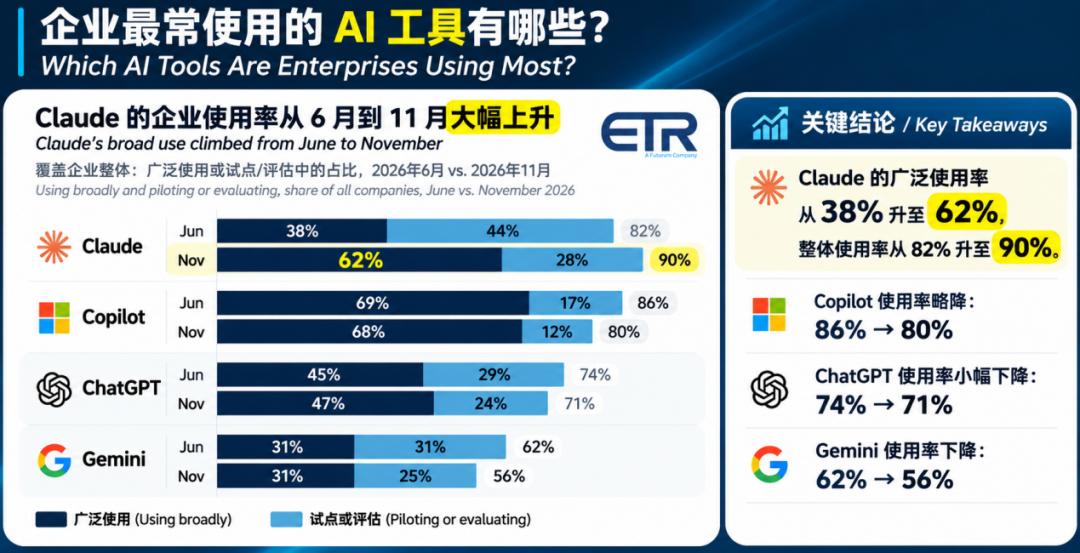
Once deployed into the production environment, the product stickiness is completely different. Enterprises will connect all internal code permissions, security specifications, manual approval processes and automated testing standards to it.
At this stage, even if Google or OpenAI launches a new tool with similar functions, enterprise procurement leaders who want to replace it must re-verify that the new tool can run stably in their own code base according to the original rules. Claude Code has run through this set of enterprise workflows first, thus establishing a real replacement barrier.
This also explains why in many large companies, office software and basic cloud services continue to be used from Google, while engineering teams will separately purchase Claude Code — because R&D leaders only care about which tool can help the team deliver software faster.
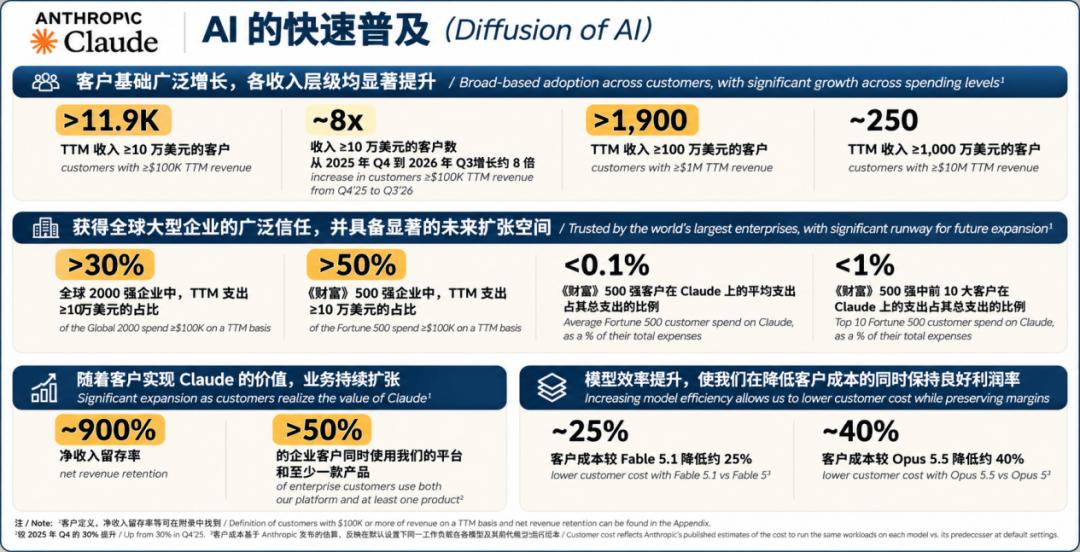
Customer data in the prospectus further confirms this stickiness. As of the end of September 2026, the number of enterprise customers with annual spending exceeding $100,000 has exceeded 11,900, compared with only more than 950 a year ago.

An even more critical indicator is net income retention rate, which has reached 900%, which means that the spending amount of the same group of old customers this year has reached 9 times that of last year.
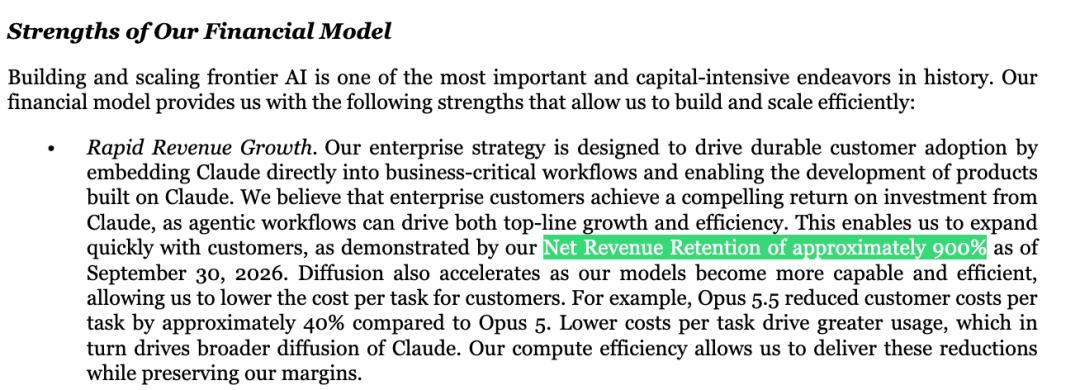
At the same time, although more than half of the Fortune 500 companies are already paying customers of Anthropic, the average spending of these large enterprises on Claude currently accounts for less than 0.1% of their total IT budget.
If this proportion gradually increases from 0.1% to 1% in the future, it theoretically means a tenfold space for expenditure expansion.
Up to this point, the logic of commercial growth seems very smooth: the product addresses enterprise pain points, the number of customers increases rapidly, and old customers are also doubling their purchases. But investment cannot only focus on revenue growth, we also need to look at the cost structure.
When the engineering team of an enterprise expands from 10 people using Claude Code to 1000 people calling it frequently every day, every code reading, file modification and test run consumes real computing power in the background. After customers are willing to pay more, for every additional dollar Anthropic receives, how much profit can it finally retain?
This directly leads to the second question we are going to break down today: Why did revenue grow so fast in the third quarter, but the company's operating profit suddenly turned to loss?
Why did operating profit turn to loss in the third quarter?
First of all, here is the judgment from our US Stock Investment Network: The $567 million operating loss under GAAP in the third quarter is not the most alarming signal. What really deserves vigilance is that revenue is still growing rapidly, but the computing power cost required to obtain every dollar of revenue suddenly increased in the third quarter.
Compare the second quarter and the third quarter together. In the second quarter of 2026, calculated in accordance with US GAAP, Anthropic recorded an operating profit of $974 million, with an operating profit margin of 8.4%. The market once thought that large model companies had finally crossed the profitability threshold.
But in the third quarter, it directly turned to an operating loss of $567 million under the same caliber, with a profit margin of -3.3%. In just one quarter, the profit margin fluctuated by nearly 12 percentage points.
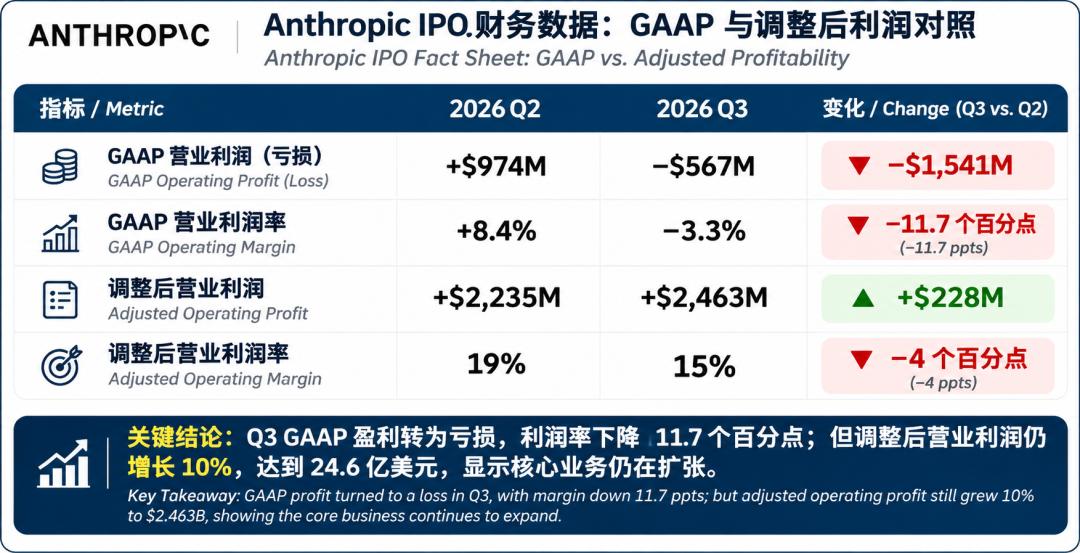
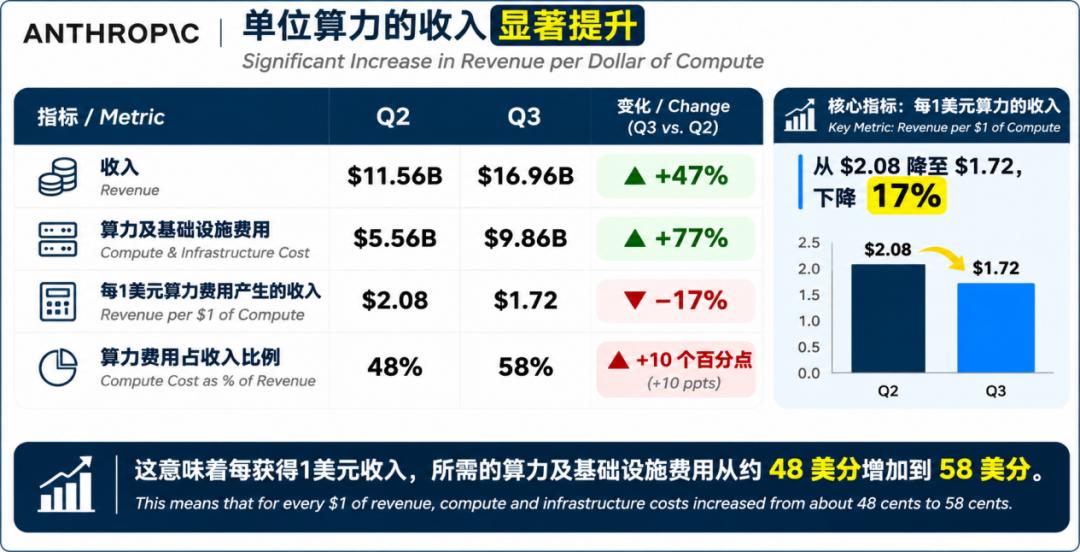
Why is the contrast so big? The prospectus gives two specific reasons.
First, the call demand from enterprise customers in the third quarter exceeded expectations, and the computing power locked under the original multi-year contracts was not sufficient, so the company could only temporarily purchase about $50 billion of short-term computing power, at a price significantly higher than that of long-term contracts.
Second, the company accrued about $2 billion in non-cash charitable donation expenses related to employee equity in the third quarter.
Therefore, if you only look at the GAAP loss, it is easy to mistakenly think that profitability has suddenly deteriorated.
After excluding these $2 billion non-cash expenses, the adjusted operating profit in the third quarter actually reached $2.463 billion, which is higher than the $2.235 billion in the second quarter. But what we really need to pay attention to is that the adjusted operating profit margin dropped from 19% in the second quarter to 15% in the third quarter. The company is still making money, but the profit-making efficiency is starting to face pressure.
