14% revenue improvement, OpenAI develops chips with AI, completing 1 year of manual workload in 5 months, Astra takes the lead
Zhidx News, November 19 — Just now, OpenAI announced that its model has boosted the PPA (core chip design metrics) of AMD's flagship GPU IP by up to 14% in less than five months, which is equivalent to the R&D workload of human engineers for about a full year previously.
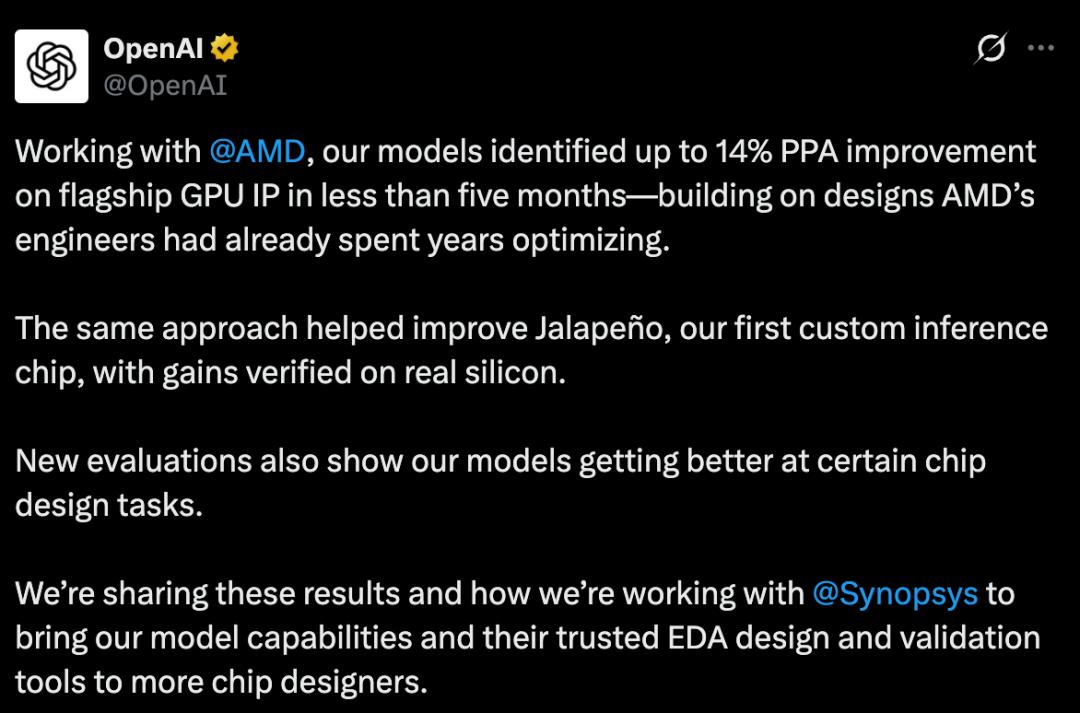
OpenAI's research proves that in RISC-V evaluation tasks, the model can explore brand-new processor architectures; on the basis of mature mass-produced designs such as Jalapeño, AMD's next-generation flagship GPU and CPU, it can achieve incremental optimization.
Jalapeño, OpenAI's first self-developed inference chip, adopts the modification scheme proposed by the model, which reduces the standard cell area of the vector unit by about 13% and that of the matrix unit by about 10%. OpenAI says these optimization effects have been verified during the tape-out and debugging phase of the Jalapeño chip.
To measure its model's capability in end-to-end chip design tasks, OpenAI evaluated multiple generations of models sequentially against two open-source processor designs. The results show that all five models, namely GPT-6.2 Astra, GPT-6 Astra, GPT-6.1 Sol, GPT-5.6 Sol and GPT-5.5, scored higher when designing processor cores from scratch based on written requirements than when optimizing existing designs.
Meanwhile, to ensure capability iteration is built on a credible evaluation system, OpenAI is cooperating with Synopsys to integrate cutting-edge AI capabilities into the EDA toolchain that engineers currently use for chip design and verification.
01.
Chip design participation dates back to the GPT‑4o era
OpenAI discloses AI-assisted chip design optimization path
In early 2025, GPT‑4o was already used to assist in the design of OpenAI's self-developed inference chip Jalapeño. This early version of the model has achieved a number of remarkable PPA optimizations.
The vector unit is responsible for scheduling and executing parallel computing tasks, and the optimization benefits of this module come from floating-point adders, multipliers, conversion circuits, reduction logic and special function units. The model explored multiple logic implementation schemes, and studied how to split computing tasks into different pipeline stages, finding optimization space for hardware reuse and reducing intermediate storage overhead.
The matrix unit is an arithmetic component, and its optimization benefits come from multiple improvements including floating-point adders, multipliers and low-precision dot product circuits. One of the multipliers was redesigned, reducing the synthesized cell area by about 15% while cutting the latency from two clock cycles to one; another revised adder also achieved about 15% cell area optimization while keeping the two-cycle latency unchanged. Further optimization of the dot product logic and pipeline structure brought more benefits to this module.
OpenAI collaborated with AMD on PPA optimization work, achieving a maximum 14% performance improvement for the flagship GPU IP on top of the original deeply optimized baseline version.
OpenAI says the model taps into more optimization space by rewriting the code that describes the chip's circuits. This is equivalent to completing the R&D workload that originally took about a full year in less than 5 months. AMD has applied some of the optimized changes to designs that were recently sent for tape-out, and some other optimization schemes have been incorporated into the mass production design files for subsequent iterative versions.
Researchers observed that the model can reach the level of a senior micro-architect and perform reasoning analysis on RTL code. The model can rewrite the circuits responsible for arithmetic operations, control operations and data movement. It uses Synopsys tools to verify that every rewrite does not change the original function of the module, and evaluates the trade-off among power consumption, performance and area.
AMD's verification shows that with the design generated by OpenAI's model, multiple core modules of its next-generation flagship CPU have achieved several percentage points of PPA improvement.
02.
GPT‑6.2 Astra
Leads RISC-V core throughput optimization tests
The results obtained by OpenAI on Jalapeño and AMD chips prove that the model can optimize mass-production-level designs.
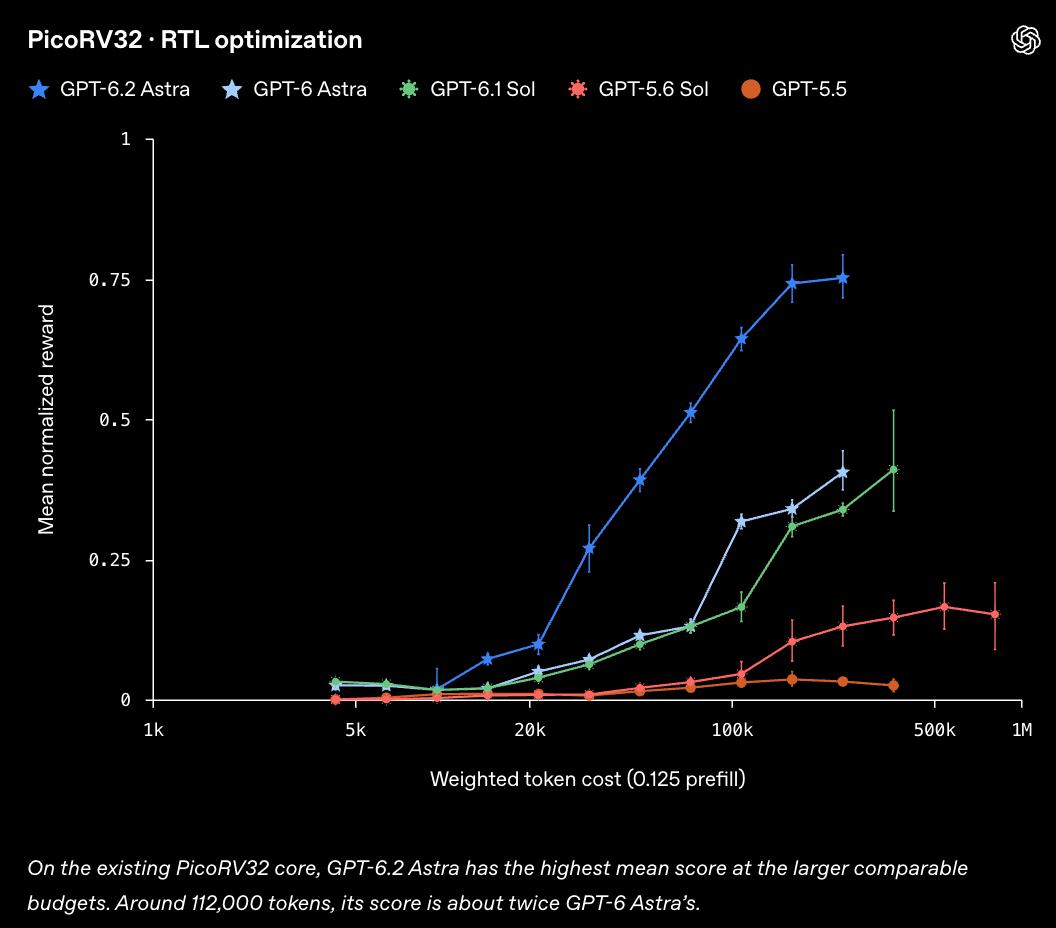
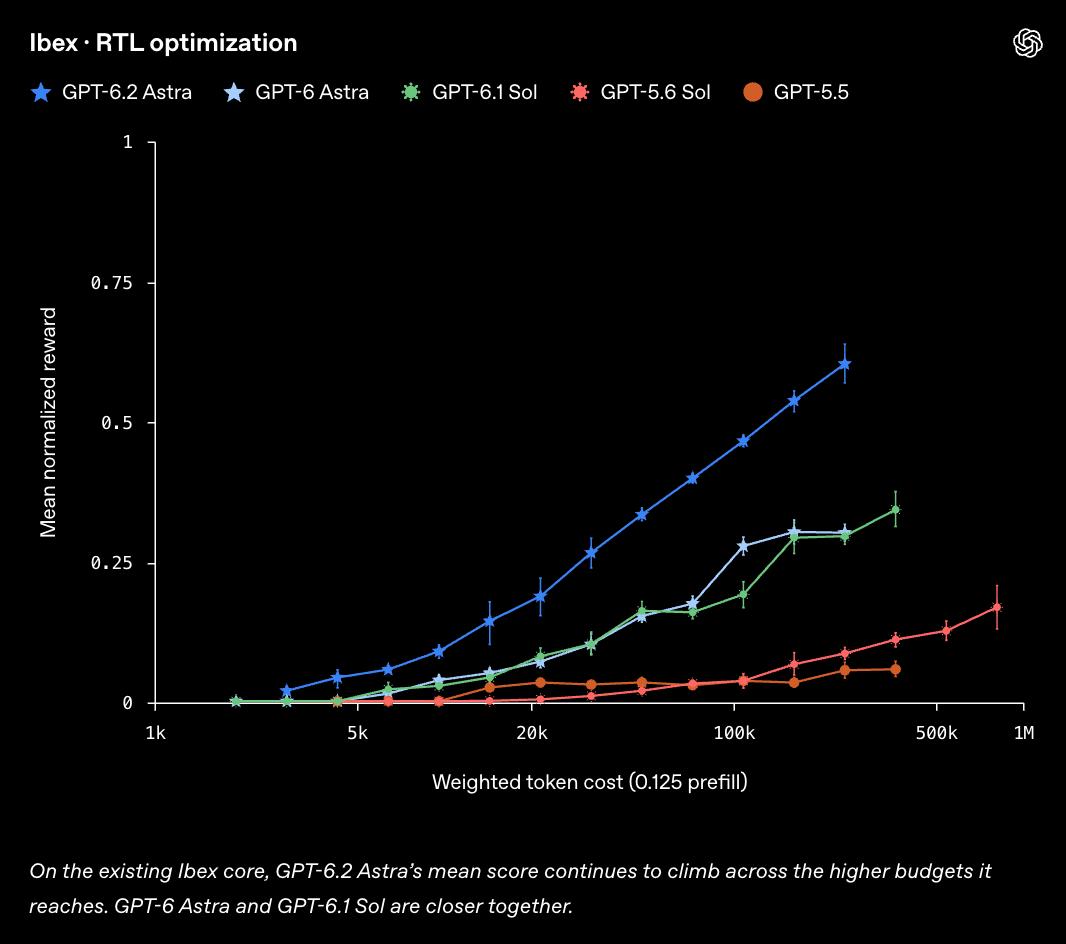
To measure the iteration progress of each generation of models in chip design capabilities, OpenAI used two open-source 32-bit RISC-V cores for testing: PicoRV32 is a streamlined core for reprogrammable chips such as FPGAs, and OpenTitan uses Ibex as an embedded processor in its secure chips. Both are complete processor cores for embedded and microcontroller-class workloads.
Researchers provided each generation of models with the original hardware description code of each processor core, and asked it to improve the throughput. That is to say, a certain modification may reduce the number of clock cycles required for an instruction, but increase the duration of a single clock cycle; the throughput metric can measure the combined effect of these two changes at the same time.
It verifies the output of each version of the design through simulation. If the design fails the verification, or occupies more than 16 times the area of the original core, it is scored 0. For designs that pass the verification, it uses test workloads that the model has never seen to measure the instructions per clock cycle (IPC). The geometric mean of these workload results is taken, and then multiplied by the maximum clock frequency estimated by Yosys to get the estimated value of instructions per second.
For each processor core, they set the optimal throughput observed under the same constraints as the baseline of 1.0.
Under the same resource overhead of about 112,000 tokens per single call, GPT‑6.2 Astra has the highest average score on both processor cores, and GPT‑6.1 Sol scores higher than GPT‑5.6 Sol on both cores.
In the second task, researchers provided the model with written requirements and templates in the open-source code, which define how the processor core connects with other parts of the system. The model independently selects the data flow path inside the core and how to split the work into multi-stage pipelines.
For both processor cores, the correctness verification, storage and cache configuration, and throughput targets are consistent with the previous RTL optimization task.
With an overhead of about 112,000 tokens per single call, all five models scored higher when designing processor cores from scratch based on written requirements than when optimizing existing designs, and this conclusion holds for both PicoRV32 and Ibex cores.
The improvement of GPT‑6.2 Astra on Ibex is greater than that on PicoRV32. A total of 9881 valid scoring runs were completed in the entire evaluation, covering two tasks, two processor cores and all token resource configurations.
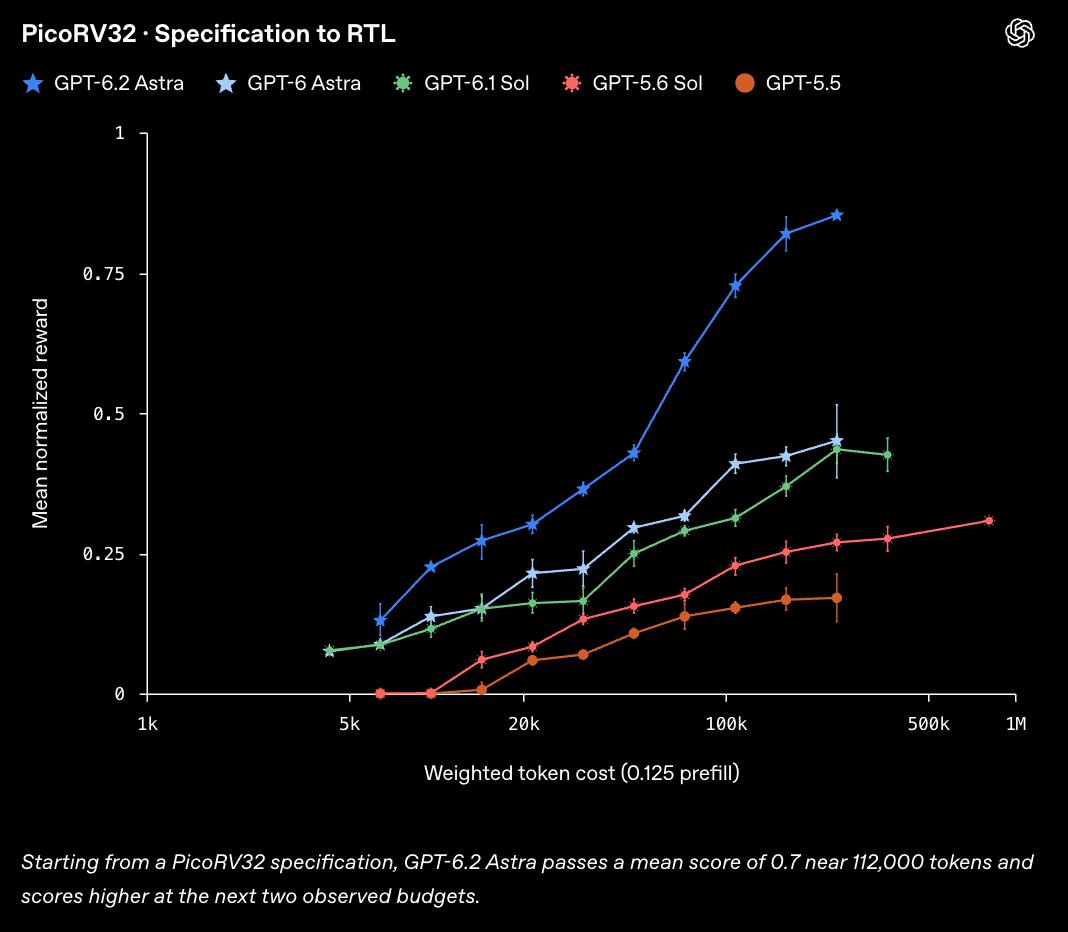
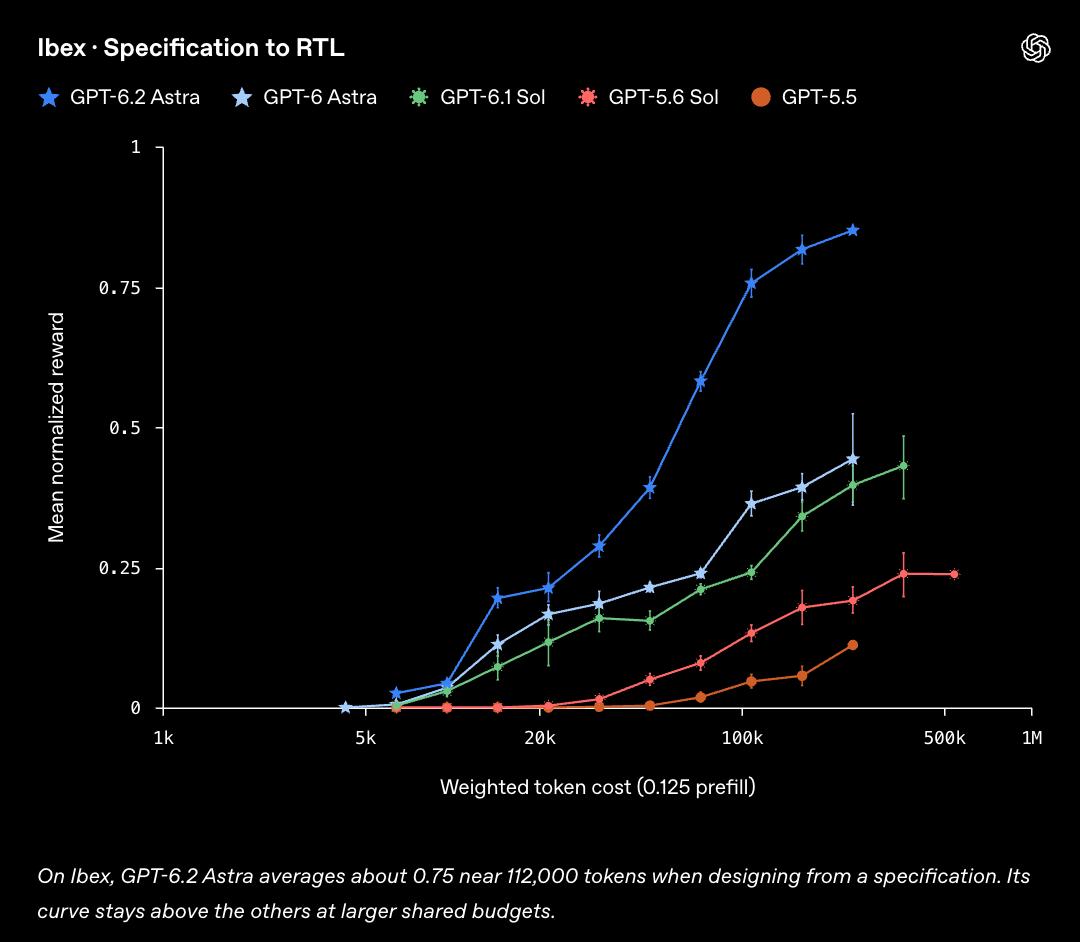
Designing from scratch based on written requirements allows the model to choose to omit some native functions in the original core, such as performance counters and extended instructions. Such features contribute limited to throughput improvement under the test workload this time, which can partially explain why the score of this task is higher.
OpenAI says that if these functions are forced to be retained, stricter circuit area constraints are set, and timing checks are performed after physical synthesis, this set of tests will be closer to the real mass production chip design scenario.
03.
Conclusion: AI opens up a new battlefield for chip design
From OpenAI's research results, it can be seen that in the field of chip design, AI already has the ability to tap incremental benefits on mature mass-produced designs and independently explore the microarchitecture space based on specifications.
This may give rise to a new battlefield for future chip competition. Chip manufacturers should not only focus on the chip process, packaging and architecture itself, but also pay attention to how to use AI to improve efficiency, so as to complete PPA convergence faster and shorten the R&D cycle.
Source: OpenAI
This article is from the WeChat official account "Zhidx", Author: Cheng Qian, Editor: Li Shuiqing, published with authorization from 36Kr.