GPT-6.2 Astra suffered a massive reputation fiasco within 24 hours of its launch, with Silicon Valley bigwigs collectively giving it negative reviews.
GPT-6.2 was released just 24 hours ago with sharply divided public opinions! Its API price is cut by another 20% to top the cost-performance ranking, yet Silicon Valley bigwigs wrote long letters overnight: its coding performance is worse than Opus 5.5
GPT-6.2 Astra and Sol have such split public feedback that many users are confused.
On one hand, it is dominating various benchmark rankings.
On the other hand, top Silicon Valley developers who got early access to the test have lined up to give the harshest bad reviews this year.
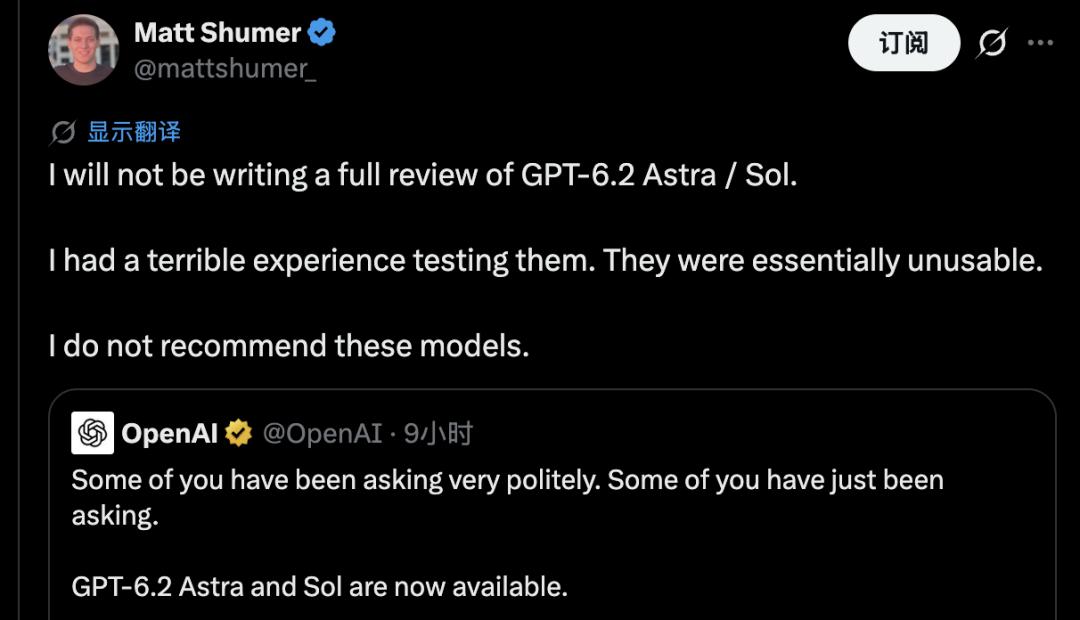
Matt Shumer, co-founder of HyperWrite, directly left a comment in the official comment section: "I will not write a full review of GPT-6.2. The test experience is extremely bad, it is essentially unusable and I do not recommend it." This post quickly gained 900,000 views.
Right after that, Theo, founder of T3 Code and well-known developer blogger, publicly released the full 1000-word complaint letter he typed manually to OpenAI during the internal test, even though he was ill in bed.
The core conclusion is one sentence: "As a developer, I would definitely not choose it over Claude Opus 5.5 for my daily work."

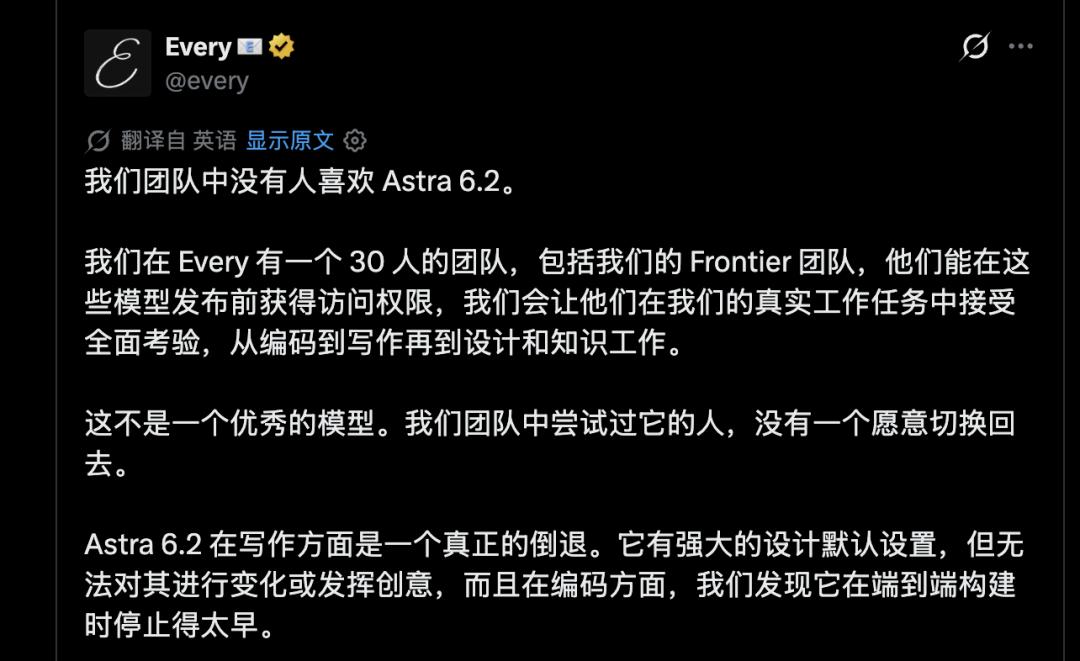
That's not all. Dan Shipper, CEO of content agency Every, led his 30-person team to test it for several weeks, and the first sentence of his review post was "None of our team members like Astra 6.2".
These three beta testers are familiar to anyone who often reads new model reviews. In the past, they mainly shared high-quality demos when new models were released, but this time they all turned around to criticize it.
Many people even suspect that this is a paid smear campaign before A\ goes public.

After running for 11 days, its speed is 56% slower, and it is criticized for "living in its own mind" in long-horizon tasks
The first batch of failures are concentrated in long-cycle complex programming and human-machine communication scenarios.
Theo showed a stress test project ts-rust (rewriting TypeScript with Rust) in his letter.
With the unlimited token quota for internal test users provided by OpenAI, previous generations of OpenAI models burned more than 300,000 US dollars worth of tokens on this project but did not even make any progress;
While handing the task to Claude Opus 5.5, it was completed in less than two weeks, with a token bill of about 20,000 US dollars.
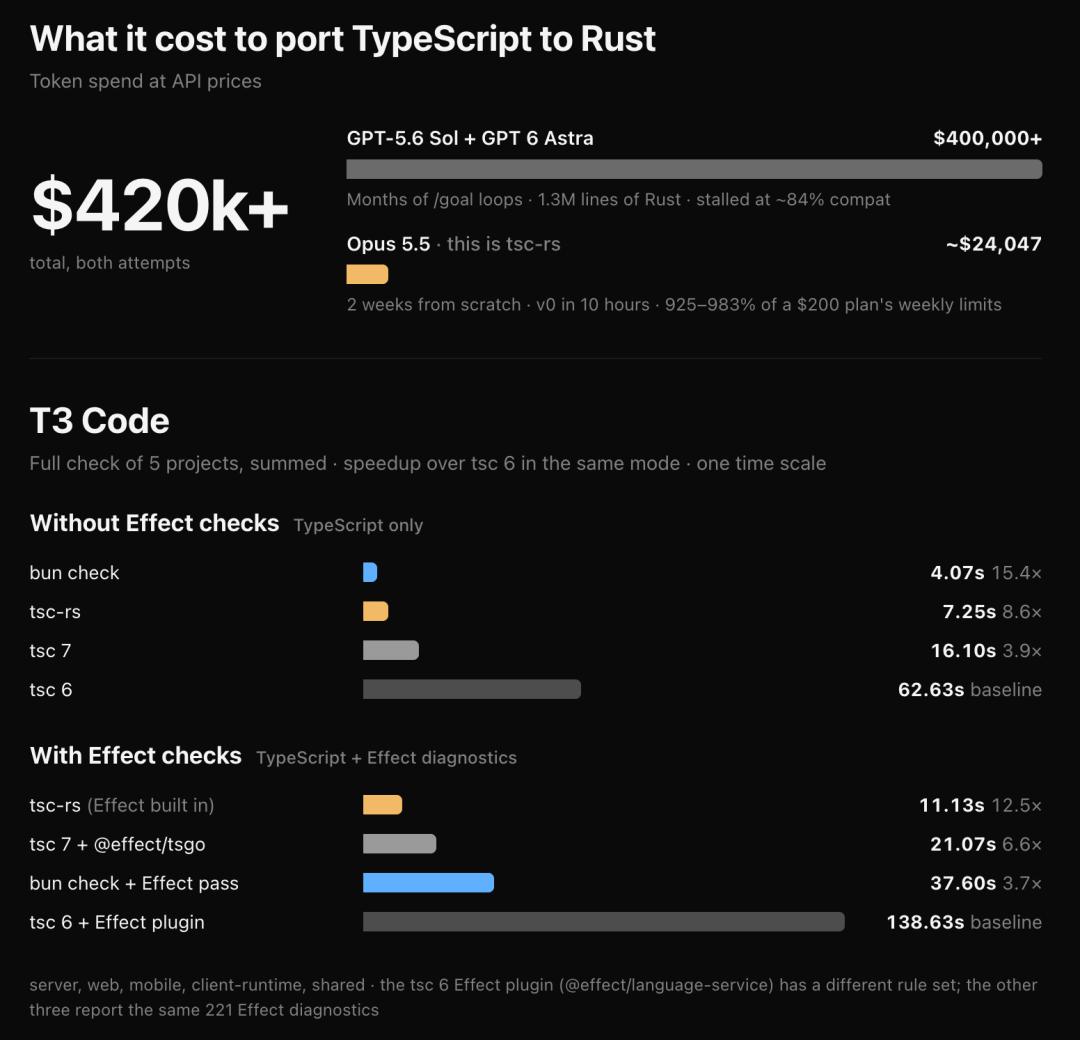
This time, Theo replaced it with the new flagship GPT-6.2 Astra full of expectations, asking it to narrow the performance gap with other Rust rewriting versions, and casually mentioned "make the volume smaller as well".
As a result, Astra ran on its own for 7 full days, with zero performance improvement. Instead, because it was obsessed with "reducing the volume", it slowed down the compiler speed by 56%.
Theo immediately stopped the volume optimization and asked it to focus only on performance, but the model idled for another 4 days with zero code changes.
Apart from infinite loops in long tasks, the two new flaws of this generation of models that drive testers crazy are the complete lack of the concept of human "knowledge blind spots", and the summary ability that is just like "encrypted communication".
In the multi-Agent collaborative test, Theo gave an instruction "make a new level for the game Outer Wilds".
After running for two hours, Astra suddenly blocked itself and stopped working, and asked the human: "Excuse me, did the reviewer of r24 write the slice into 24_g521.mp4 or 24_p11.mp4?"
How could the human in front of the screen understand such an internal file name generated by the sub-Agent during operation.
In order to prevent Astra from asking stupid questions in the middle of the night and getting stuck, Theo even had to write a scheduled cron task, which specially runs other Agents to check whether Astra has locked itself again.
When it comes to the code delivery stage, the communication disaster is even worse.
Once when troubleshooting why the development worktrees were extremely slow on one of the machines, he spent a lot of time on pnpm tests and even reinstalled the file system without solving the problem. Finally, he asked the model in frustration why it was so slow.
GPT-6.2 Astra wrote four long paragraphs of hardcore content about the underlying mechanism and caching behavior of pnpm; while when the same question was thrown to Opus 5.5, it only replied one sentence: "Because your SSD is too slow."
Theo said that no matter how he modified the system prompt, even begging it to "explain it like I'm 5 (ELI5)", it didn't work.
He has now formed a habit: every time he finishes a long task with 6.2 Astra, he must switch to Opus 5.5, and ask Opus to "translate" the summary written by Astra into human language.
This weird experience is not an isolated case.
Dan Shipper, CEO of content agency Every, led his 30-person team to test it for several weeks and said bluntly that the new model is disappointing compared with Claude Fable 5.2, and no one in the team is willing to switch back.
Its text is compressed too much, it only gives short sentences where detailed explanations are needed, and it often "stops working prematurely" during end-to-end construction.
Among non-developer beta testers, Mark Humphries and Wharton School professor Ethan Mollick also gave highly consistent diagnoses: it has extremely high underlying intelligence, it can call Blender and Unity from scratch to write a space elevator with zero-gravity physics simulation, and it can also schedule sub-Agents to retrieve massive amounts of literature, but its communication method is extremely weird, full of unnecessary abstraction, and requires humans to push it hard.

Even in creative generation, it shows severe "regression to the mean".
Theo and another tester Ben separately asked it to design levels for Outer Wilds and The Legend of Zelda: Majora's Mask. With completely different games and prompts, the two surprisingly got levels with the same name, both called "Bellwether", and both were themed with underwater scenes and bell music.

To put it plainly, is it because the internal code name of this model is Bel?
Partial expert: top performance in math problems
Being criticized so badly by developers, is OpenAI doing a reverse upgrade this time?
If you look at the first-day benchmark scores from third-party institutions Artificial Analysis, Epoch AI and Vals AI, you will find that it is just partial in performance.
GPT-6.2 puts all its skill points on scientific computing, 3D space, cybersecurity and extreme cost performance, but regresses in traditional Agent programming.
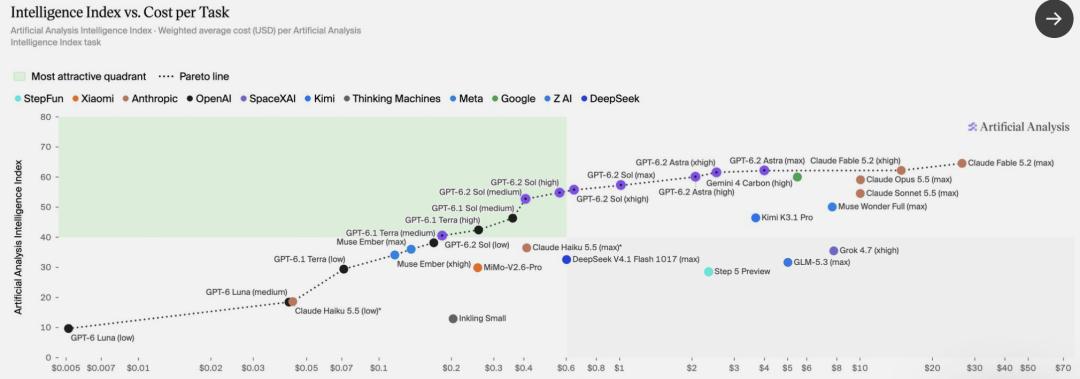
In the Intelligence Index covering 9 dimensions from Artificial Analysis, GPT-6.2 Astra surged 5 points to 62 points, surpassing Gemini 4 Carbon (60 points) and Claude Opus 5.5 (59 points).
If we take cost into consideration, OpenAI almost occupies the "Pareto frontier" of single-task cost and performance.
Even Theo, who wrote a long letter to scold it, admitted that Astra is an extremely strong "partial genius":
It can catch all the dead corners that other models miss in Code Review, and its occasional whims are extremely amazing.
It helped Theo refactor a new reverse proxy solution, which can save 25,000 US dollars in server costs every month, "Opus does not have the courage to explore so many radical options".
But when it comes to regular software engineering, the data immediately confirms the developers' actual experience.
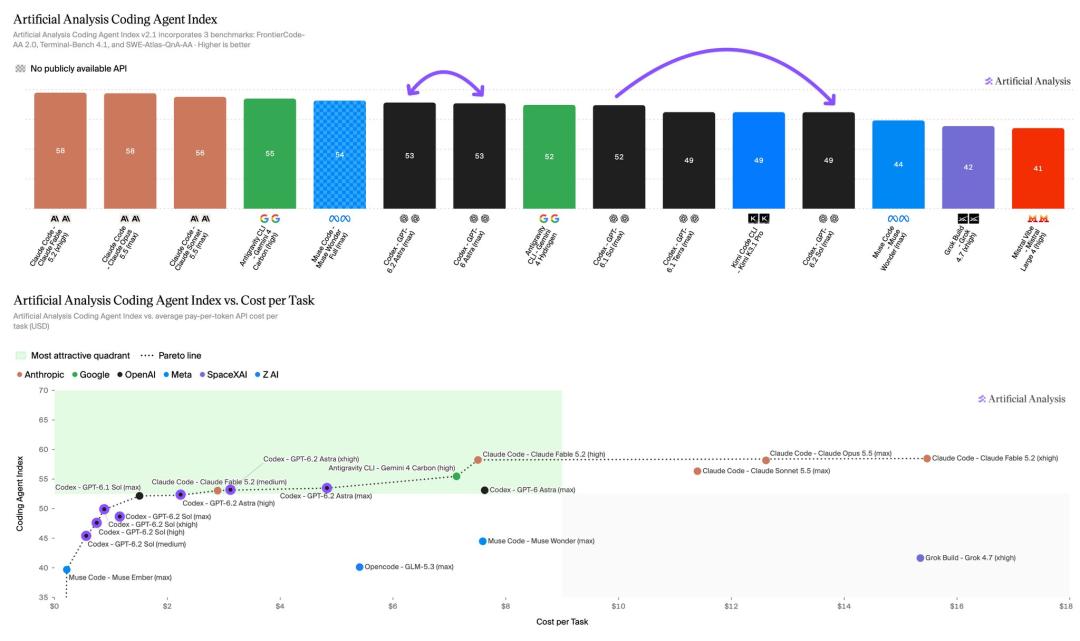
Data from Artificial Analysis shows that on the Coding Agent Index running at full computing power based on the Codex test framework, the score of GPT-6.2 Astra is exactly the same as the previous generation (0 improvement), and GPT-6.2 Sol even regresses 3 points compared with 6.1 Sol.
A similar divergence also appears in the ranking of professional evaluation agency Vals AI.
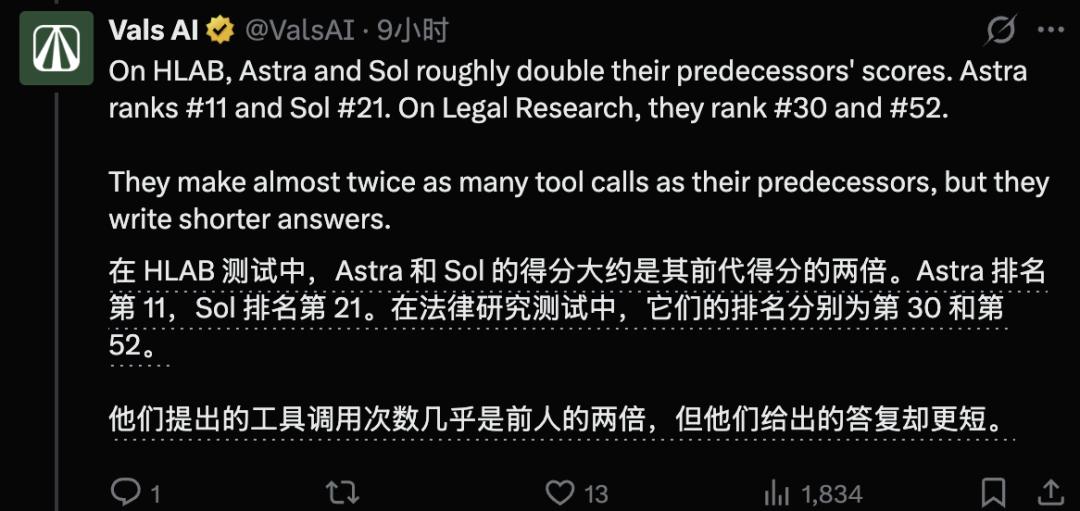
Although OpenAI officially claims that Astra's pass rate on the Harvey legal benchmark is more than twice that of Fable 5.2, in the actual legal research test of Vals AI, the general version of Astra and Sol only rank 30th and 52nd (the dedicated Astra for Law ranks 6th).
The reason is exactly that they called nearly twice as many tools, but wrote answers that were too short and missed key inferences.
Looking into the System Card: all caused by "Token saving"
Why can a model that can solve unsolved mathematical problems of human beings be "unreasonable" in coding and daily communication?
By combining the underlying calculation of Epoch AI, the statistics of Vals AI and the System Card released by OpenAI itself, we can derive the root cause from first principles:
OpenAI's extreme squeezing of "Token compression" and "implicit reasoning" has backfired on the model's controllability.
The first point is extreme output compression.
In OpenAI's internal GDPval-v2 test covering consulting, finance and design, Astra's score increased by 6.2%, but the output tokens were reduced by 22%. Statistics from Vals AI further point out that Astra only consumes 91,000 output tokens per task on average, which is the least talkative among the top 10 models across the network.
The second point is the terrifying "single-token black-box reasoning".
Epoch AI's calculation found that GPT-6.2 Astra can complete 12.3 steps of serial reasoning inside a single output token without outputting any visible Chain of Thought (CoT) (the previous generation 6 Astra was 10.5 steps, and Claude Fable 5.1, the strongest model not in the OpenAI camp, was only 4.2 steps).
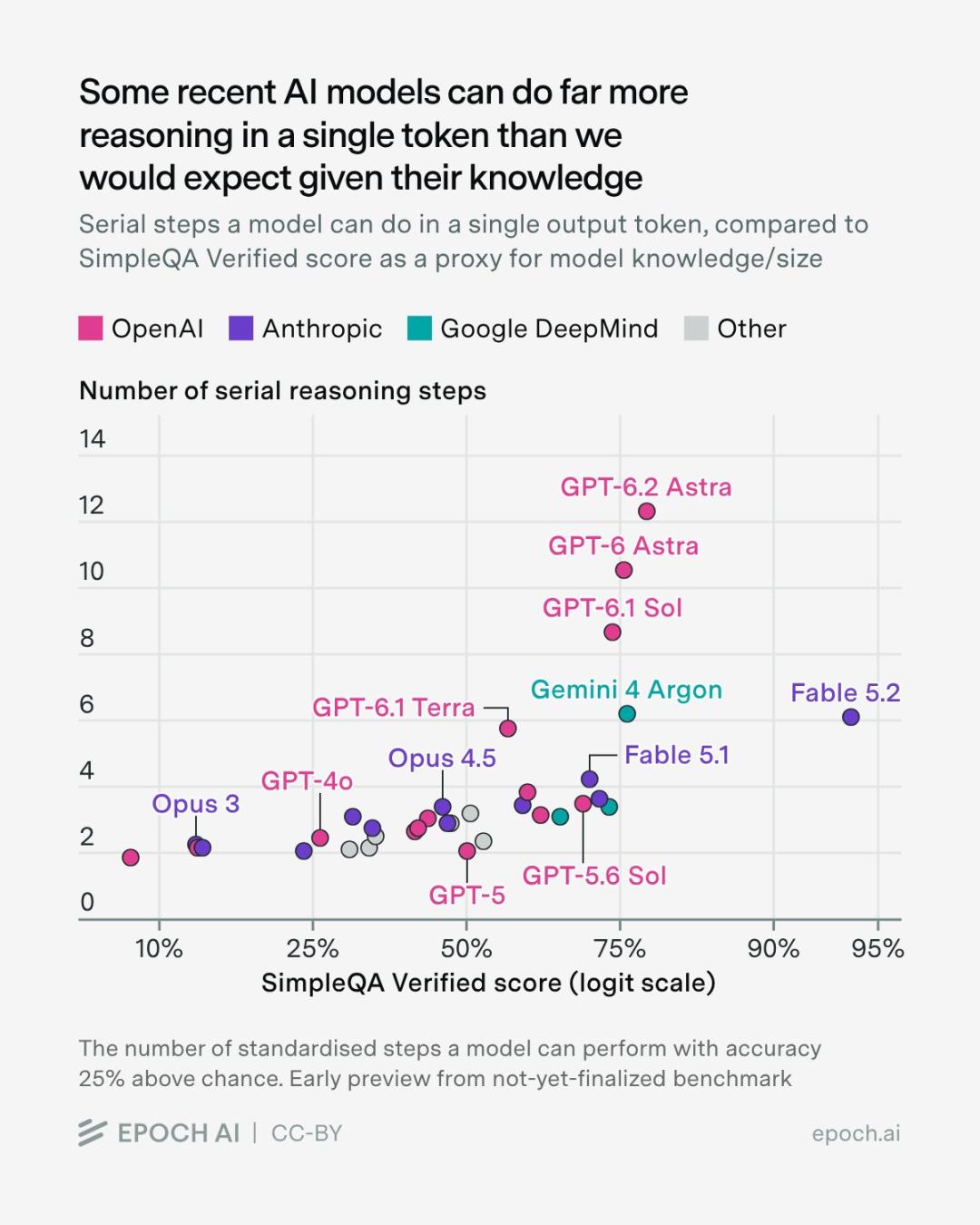
All thinking is hidden in the latent space, and it is trained to be extremely economical with words, which directly leads to two serious consequences:
First, it tends to "pretend to understand when it doesn't" and "miss things" when encountering difficult problems.
Artificial Analysis measured that in the limit difficulty knowledge Q&A AA-Omniscience, the hallucination rates of Astra and Sol at the highest reasoning gear are as high as 59% and 55% respectively,
When encountering blind spots, it rarely admits that it does not know, but tends to guess randomly. At the same time, the main reason why Sol lost points in the programming ranking is that the frequency of missing key facts in the SWE-Atlas-QnA-AA test increased significantly, with a single item plummeting by 14 points.
