36Kr Research | 2026 China Token Economy Ecosystem Development Research Report
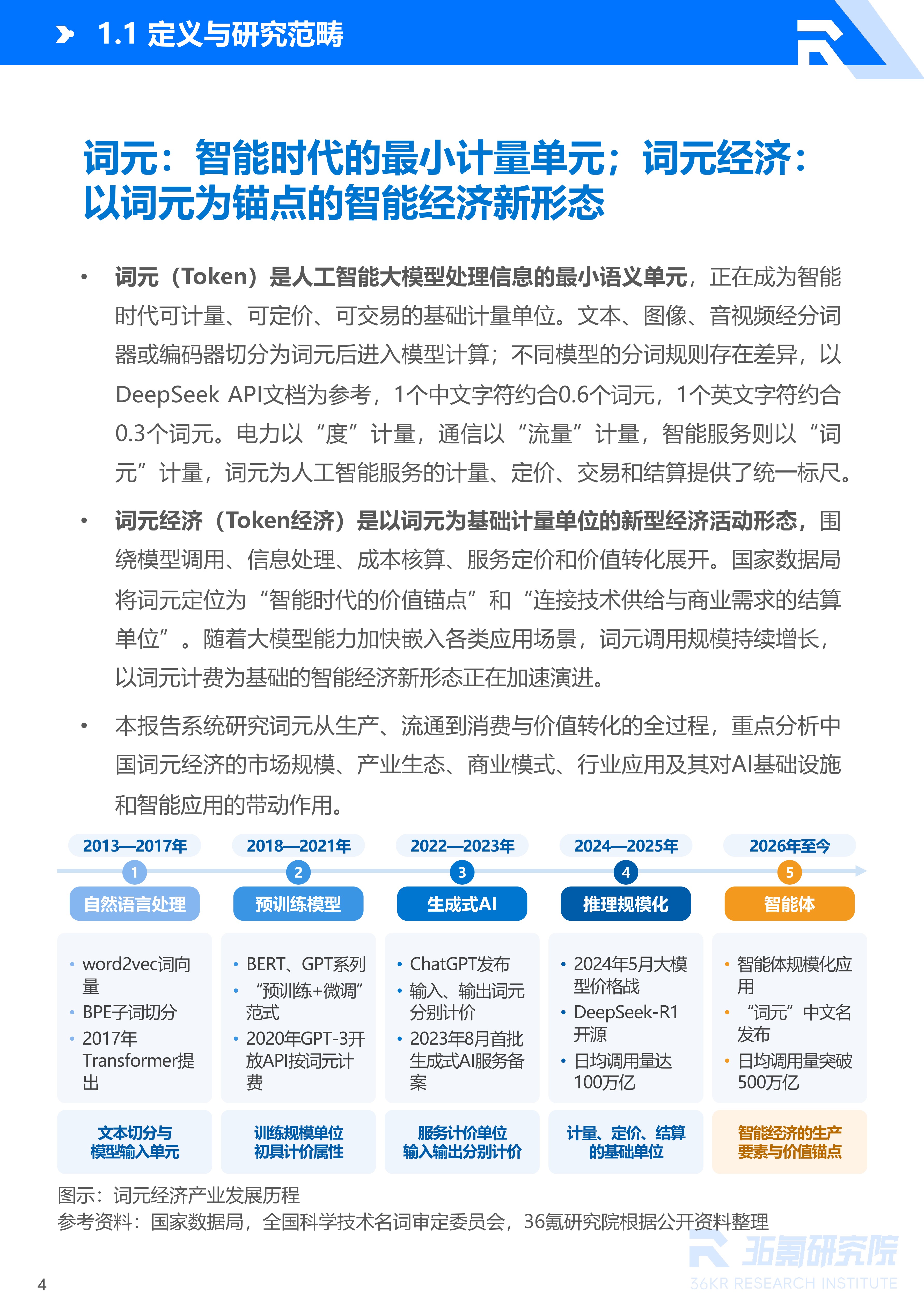
At present, artificial intelligence is moving from technological breakthroughs to large-scale application, and the smart economy has been elevated to a national strategy. In August 2025, the State Council issued the "Opinions on Deeply Implementing the 'AI+' Action" (Guo Fa [2025] No. 11), proposing that the application penetration rate of new-generation smart terminals, agents and other applications will exceed 70% by 2027. The 2026 Government Work Report put forward "building a new form of smart economy", and for the first time, agents were written into the report as objects to "accelerate promotion" side by side with smart terminals. Token is the smallest semantic unit for artificial intelligence large models to process information, and is becoming a basic metering unit that can be measured, priced and traded in the intelligent era. Electricity is measured in "kilowatt-hour", communication is measured in "data traffic", and intelligent services are measured in "token", which provides a unified scale for the measurement, pricing, transaction and settlement of artificial intelligence services. In March 2026, the China National Committee for Terms in Sciences and Technologies released the official Chinese name "ciyuan" for Token; in May of the same year, the State Administration for Market Regulation and the National Development and Reform Commission issued the "Guidelines for the Construction of Artificial Intelligence Measurement System and Capabilities (2026 Edition)" to promote artificial intelligence to achieve "measurable, comparable and traceable". At the same time, the mature open-source model ecosystem, continuous improvement of domestic computing power adaptation and reasoning optimization continue to reduce token production costs; long context, deep reasoning, multi-modal capabilities and agent applications have significantly increased the token consumption scale of a single task, and enterprise AI applications have moved from model testing to production environments. Against this background, the new form of token economy with token as the basic metering unit is taking shape at an accelerated pace, becoming an important window to observe the development context of the smart economy.
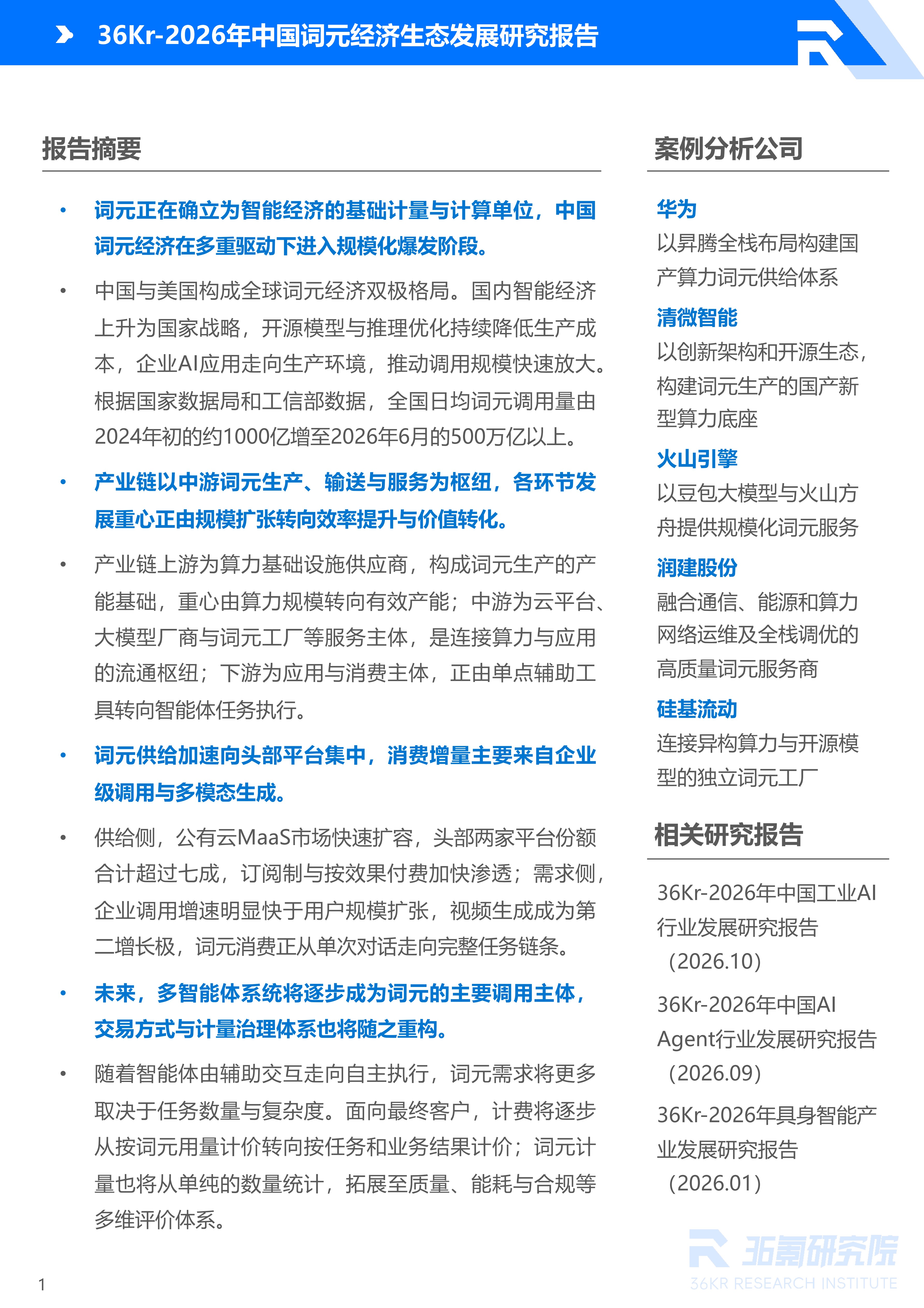
China's token call volume has entered a stage of large-scale explosion, and China and the United States form a "bipolar" pattern of the global token economy
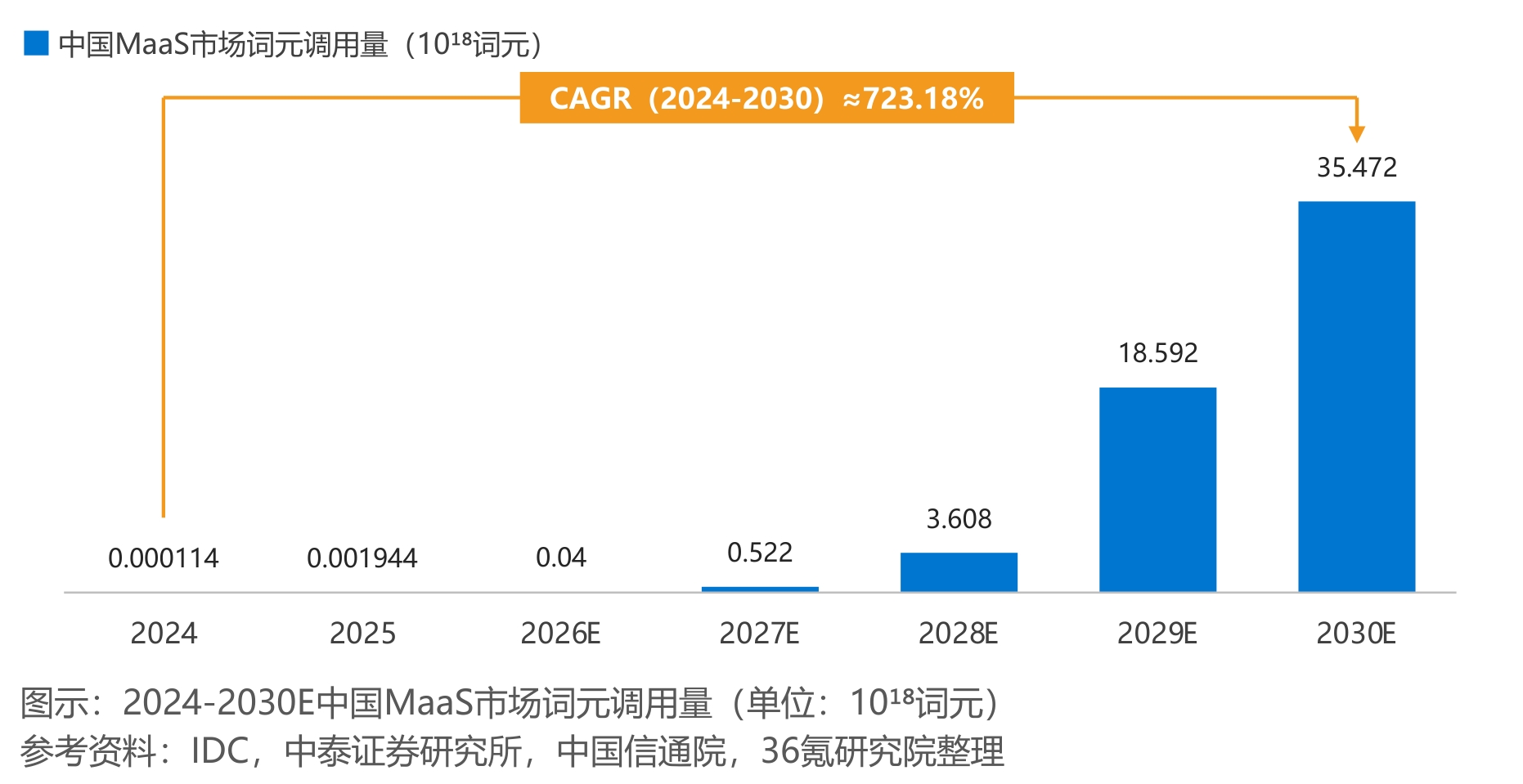
Driven by multiple factors such as national policy guidance, open-source model iteration and reasoning optimization for cost reduction, and enterprise AI applications moving to production environments, domestic token call volume is rising rapidly. According to data from the National Data Administration and the Ministry of Industry and Information Technology, the national average daily token call volume increased from about 100 billion at the beginning of 2024 to 100 trillion at the end of 2025, exceeded 140 trillion in March 2026, and has exceeded 500 trillion as of June 2026. Model-as-a-Service (MaaS) is the main mode of standardized token supply. According to IDC data, the token call volume of China's MaaS market increased from 114 trillion in 2024 to about 1944 trillion in 2025, a year-on-year increase of about 16 times; according to IDC forecasts, this scale will reach about 40,000 trillion in 2026. From a global perspective, China and the United States have formed two poles of the token economy. According to data from the OpenRouter platform, the weekly call volume of Chinese models exceeded that of US models for the first time in February 2026. As of July 26, 2026, the call share of Chinese models in the past 28 days reached 63.5%; according to the "2026 Artificial Intelligence Index Report" of Stanford University, as of March 2026, the Elo score gap between the top models of China and the United States on the Arena ranking list is only 2.7%. Relying on the open-source ecosystem, cost advantages and massive application scenarios, China's token call scale has continuous expansion momentum.
The industrial chain takes midstream token production and services as the hub, and the development focus of all links is shifting to efficiency improvement and value transformation
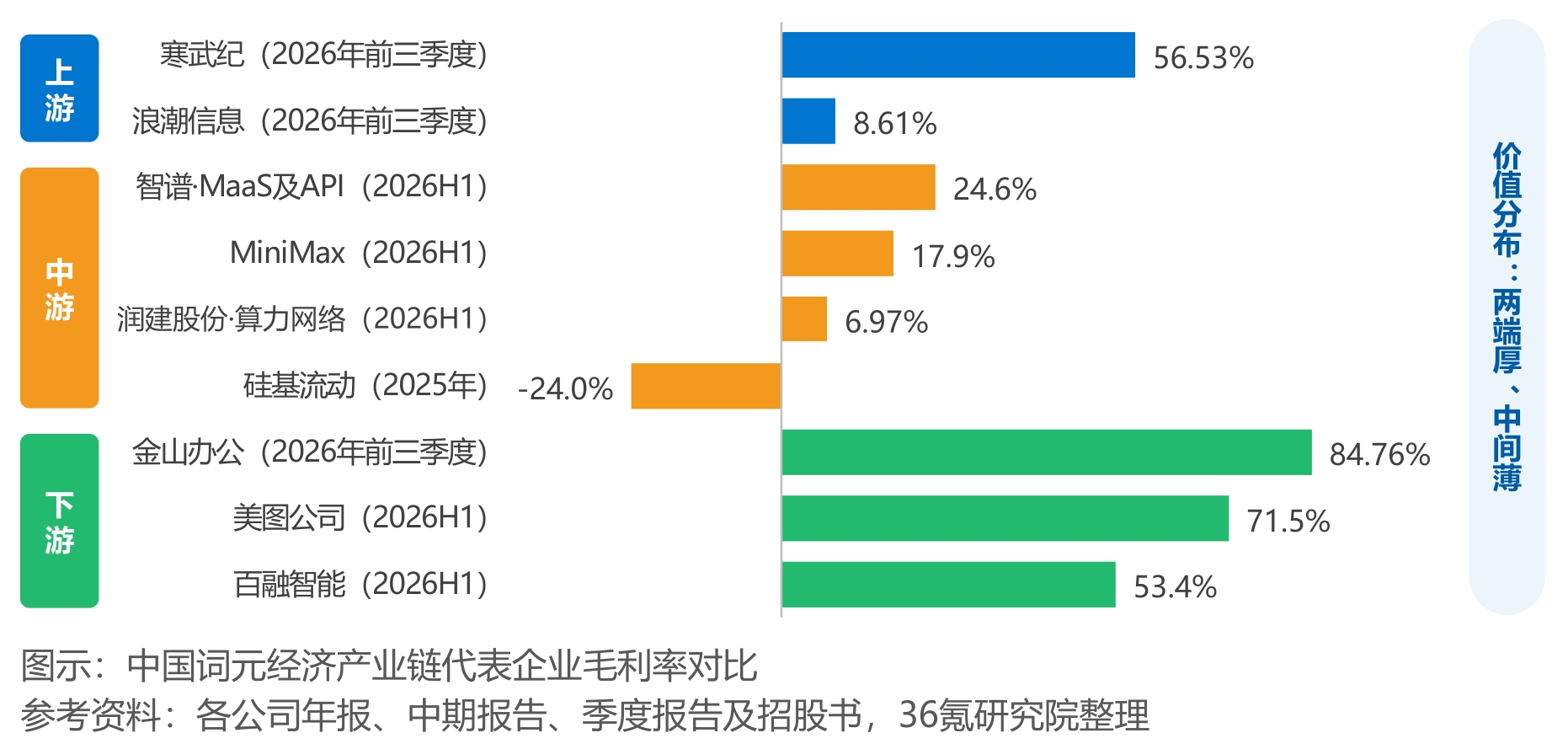
China's token economic industrial chain takes midstream token production, distribution and services as the hub, promoting efficient collaboration between upstream computing power supply and downstream application consumption. The upstream are computing power infrastructure and production factor suppliers, which form the production capacity foundation of token production. According to IDC data, China's non-GPU accelerator shipments reached 1.016 million units in the first half of 2026, exceeding GPU for the first time, the share of Huawei Ascend rose to 28.5%, super nodes have become the focus of competition, and the upstream development focus has shifted from computing power scale expansion to effective token production capacity improvement. The midstream are service entities such as cloud service providers and MaaS platforms, large model manufacturers, token factories and operators, which are the circulation hub that converts computing power into measurable and priced intelligent services, and reasoning efficiency has become the core measurement scale. According to data from the China Academy of Information and Communications Technology, the average output speed of domestic models in August 2026 reached 78.23 tokens per second, about twice that of 2025. The downstream covers scenarios such as general assistants, smart office, AI programming, multi-modal creation and smart terminals, and AI applications are being upgraded from single-point assistance to agent task execution. From the perspective of value distribution, the industrial chain presents the characteristics of "thick at both ends and thin in the middle". According to the financial report data of various companies, the gross profit margins of Cambricon in the upstream and Kingsoft Office in the downstream in the first three quarters of 2026 were 56.53% and 84.76% respectively, while the gross profit margins of Zhipu MaaS and API business and MiniMax in the first half of 2026 were 24.6% and 17.9% respectively, and the profitability of midstream links still has large room for improvement.
Token supply is accelerating to concentrate on head platforms, and consumption increment mainly comes from enterprise-level calls and multi-modal generation
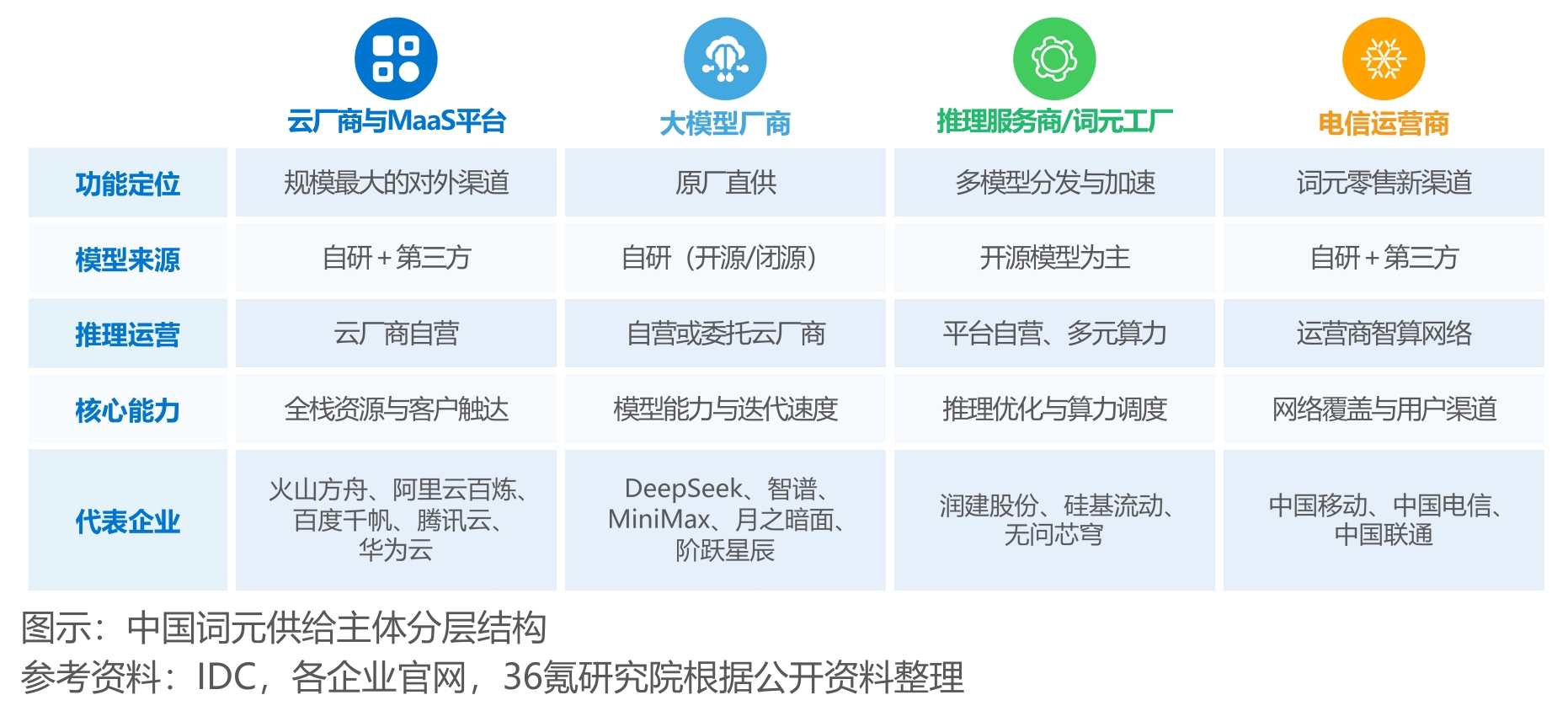
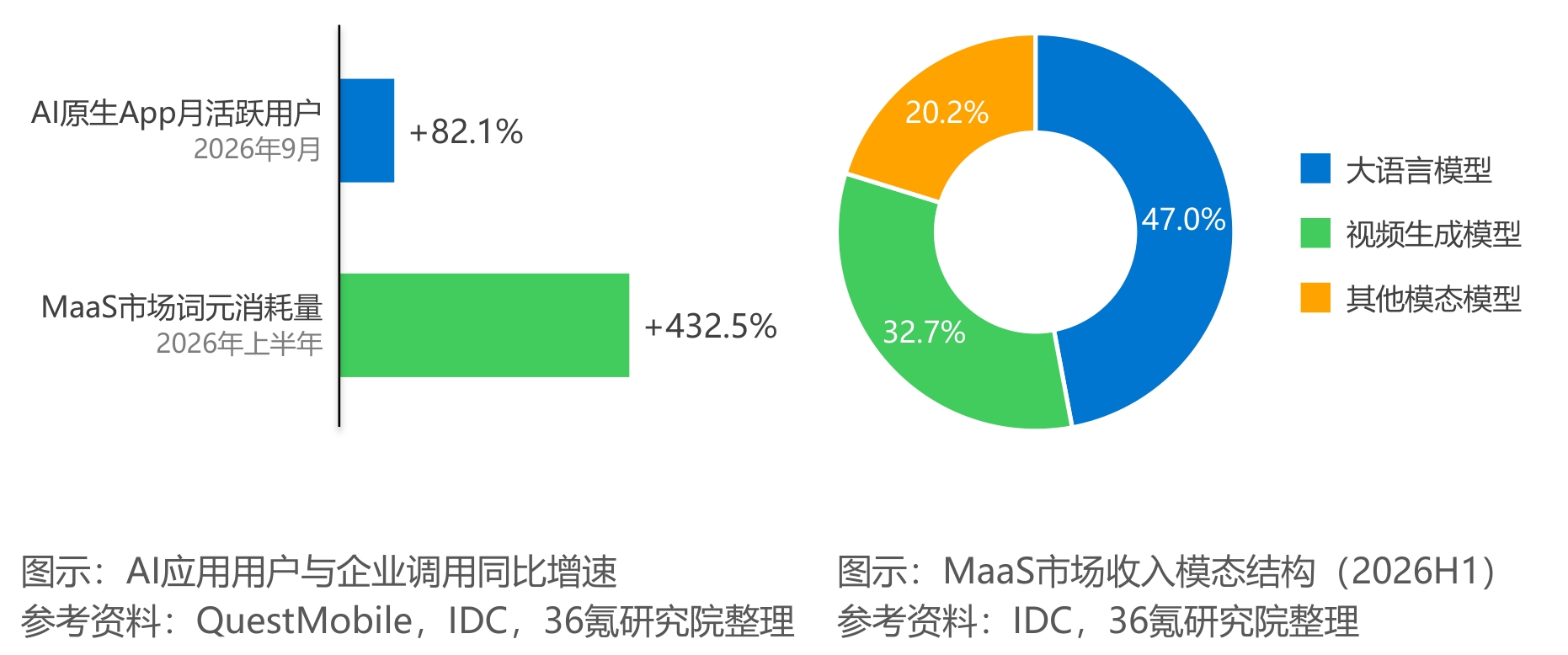
On the supply side, token supply has formed a division of labor pattern of four types of entities: cloud vendors and MaaS platforms, large model manufacturers, reasoning service providers and token factories, and telecom operators. The public cloud MaaS market is accelerating to concentrate on head platforms. According to IDC data, the scale of China's MaaS market in the first half of 2026 reached 106.3 billion yuan, a year-on-year increase of 889.4%, and the combined share of Volcano Engine and Alibaba Cloud rose from 58.5% in the first half of 2025 to 70.3%. In the same period, the scale of the large model private deployment market was 2.88 billion yuan, a year-on-year increase of 108.4%. According to data from the China Academy of Information and Communications Technology, the normalized average price of domestic tokens rose from 6.8 yuan per million tokens in the second half of 2025 to 13.46 yuan per million tokens since 2026, with usage and average price rising simultaneously; in terms of billing methods, pay-as-you-go is still the mainstream, the subscription system and reserved resource mode are accelerating to increase volume, pay-for-performance and profit sharing cooperation have begun to be implemented. On the demand side, the scale of C-end AI users continues to expand. According to QuestMobile data, the monthly active users of AI-native apps reached 546 million in September 2026, a year-on-year increase of 82.1%. However, from the perspective of token consumption, calls by enterprises and developers are the core increment. According to IDC data, the token consumption of China's MaaS market in the first half of 2026 reached 2857.9 trillion, a year-on-year increase of 432.5%, and the growth rate of calls by enterprises and developers is about 5 times the growth rate of AI native app users. From the perspective of token consumption structure, large language models account for 47.0%, video generation models account for 32.7%, and video generation has become the second growth pole; token consumption is gradually shifting from single dialogue to long-link, closed-loop complete task execution.
In the future, multi-agent systems will gradually become the main calling subject of tokens, and the transaction mode and measurement governance system will be reconstructed accordingly
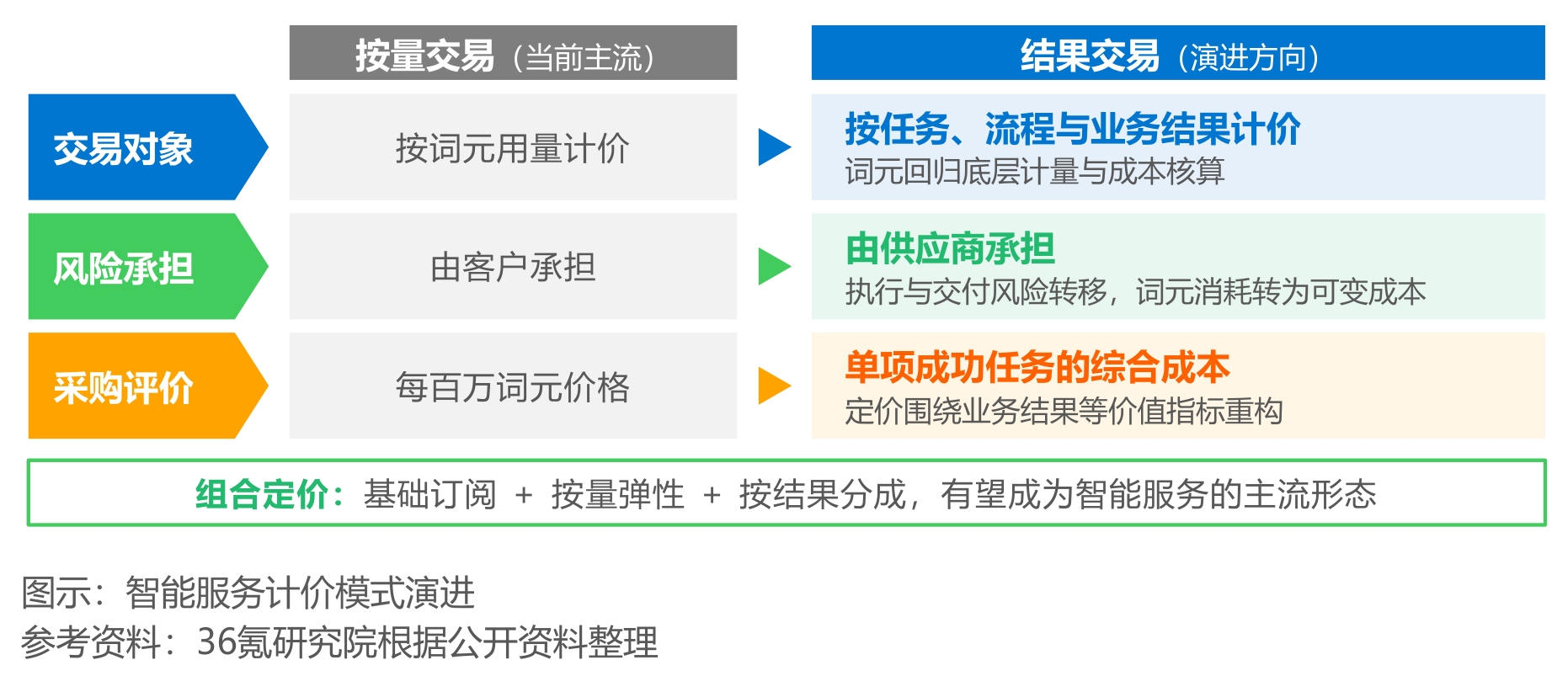
In the future, as agents move from assisted interaction to autonomous execution, and multi-agent systems gradually become the main calling subject, token demand will shift from user scale-driven to machine task-driven, and the demand scale will depend more on the number of tasks, task complexity and autonomy. According to data from the National Data Administration, the amount of data used for AI reasoning in China reached 101.34EB in 2025, exceeding the amount of training data for the first time. In terms of transaction pricing, the intelligent service pricing model will evolve to a hybrid model of "pay-as-you-go + pay-by-result": token is still the basic unit for model manufacturers, cloud platforms and application service providers to calculate computing power and model costs; the pricing unit for end customers will move up to tasks, processes and business results. According to IDC survey data, in the procurement of AI agents, 66% of Chinese enterprises prefer to pay by business results, which is higher than the global average of 52.7%; the combined pricing of basic subscription, flexible pay-as-you-go and result-based sharing is expected to become the mainstream. In terms of measurement governance, the token evaluation system will expand from quantity statistics to multi-dimensional evaluation of quality, energy consumption, safety and compliance. According to the forecast of China Electricity Council, the power consumption of national computing power centers will reach about 800 billion kWh by 2030, and the unit token energy consumption and proportion of green power are expected to become important reference indicators for government and enterprise procurement. Service providers with transparent measurement, green certification and cross-border compliance capabilities will obtain differentiated access advantages in high-threshold markets. At the same time, token overseas expansion is extending from model output to cross-border reasoning service delivery, transforming domestic computing power and power resources into digital intelligent services, opening up new growth space for digital service trade.
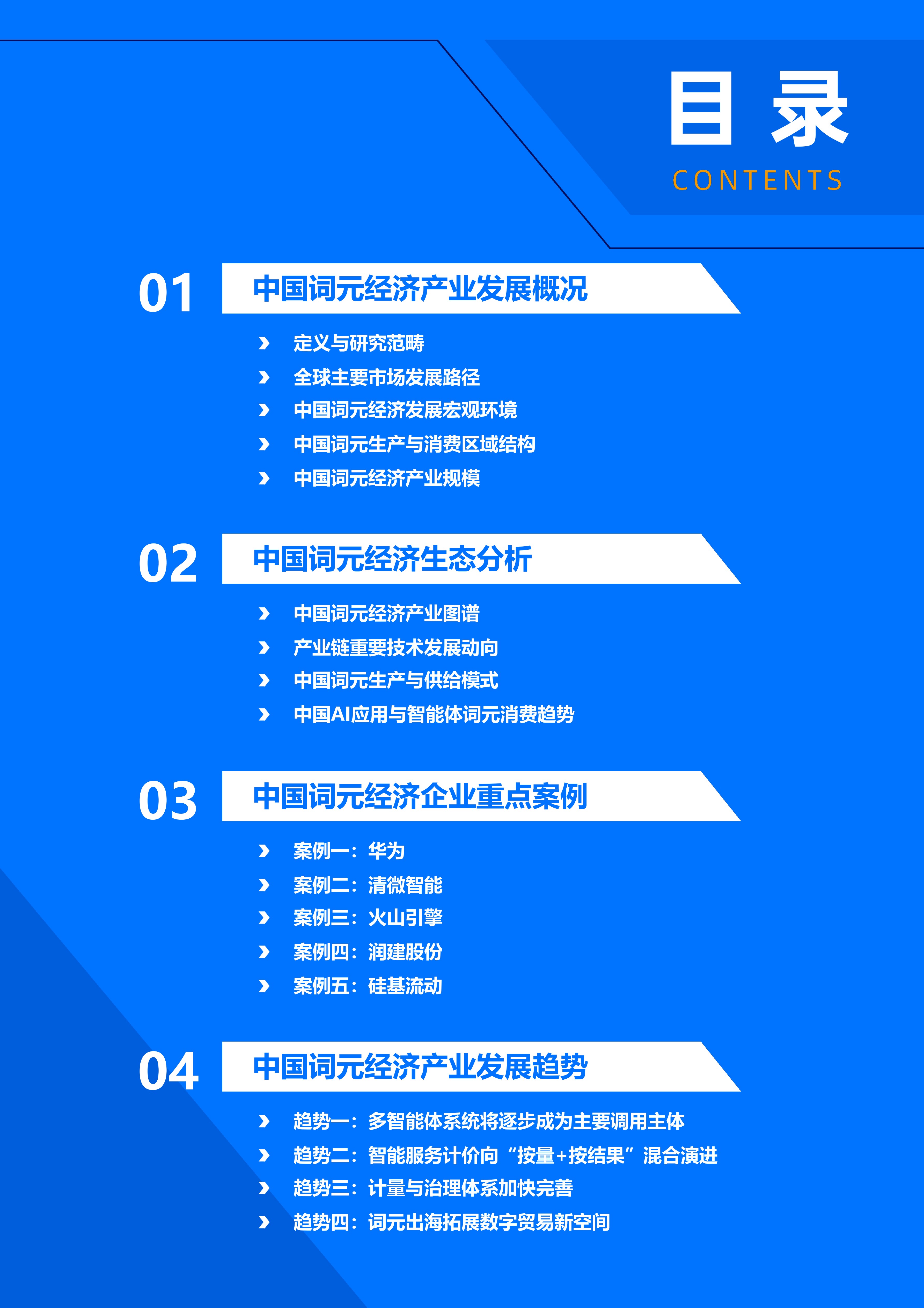
The key research issues of this report are as follows:
- What are Token and Token Economy? Why can Token become the basic metering unit of the smart economy?
- What development paths have been formed for the global token economy? What are the characteristics of the bipolar pattern between China and the United States?
- What changes have taken place in the policy, technology and demand environment that promote the development of China's token economy?
- What kind of pattern does the regional division of labor for China's token production and consumption present?
- What development stage is China's token call scale in? What is the future growth space of the MaaS market?
- What are the technological development trends and development bottlenecks in the upstream, midstream and downstream of the token economic industrial chain?
- What entity divisions of labor have been formed for token supply? How do the market pattern, price trend and commercial transformation path evolve?
- What characteristics does the token consumption structure of AI applications and agents present? What are the differences in consumption intensity and monetization paths of key tracks?
- What kind of token supply paths do Huawei, Qingmicro, Volcano Engine, Rujian Co., Ltd. and Silicon Flow represent respectively? What are their core competitiveness?
- What development trends will the token economy present in the future? How will the calling subject, transaction mode, measurement governance system and token overseas expansion evolve?
For more exciting content, please refer to the "2026 Research Report on China's Token Economy Ecological Development", click Download Link, Extraction Code: 3r3e