Patches have become "vulnerability manuals", and Google has revealed that hackers are using AI to generate attack codes based on the patches.
The manufacturer has just released a security patch, and an update prompt pops up on your screen.
You are busy with ongoing tasks, so you casually click "Remind me later".
At this very moment, hackers are also waiting for this patch.
They let AI keep a close eye on exactly the lines of code the manufacturer modified. Once a flaw is detected, the AI can even automatically write exploit code and test it on the old software version.
There is a window period between the public release of the patch and the moment you finish installing the update.
Your software still retains the original vulnerability, while attackers may already have a "vulnerability specification" that is accurate down to specific lines of code.
Just this week, Google Threat Intelligence Group (GTIG) released a report.
Google found a staging server of hackers that was directly exposed to the public internet, and extracted an AI attack framework named exploit_agent from it.
Its mission sends chills down one's spine:
It continuously compares the code before and after the software fix, deduces the location of the vulnerability from the differences, then automatically generates and executes exploit code.
Google stated in the report that this is the first time they have discovered that attackers use a large model framework to connect the entire process from "vulnerability mining" to "vulnerability exploitation" without any human intervention in the middle.
Their conclusion is: Large models are compressing the patching window period for enterprises.
Of course, this does not mean that all unupdated systems will be compromised the moment the patch is released, and Google has not disclosed which targets this framework has actually breached.
But a dangerous signal has already lit up: the moment the patch is released, the security alarm is not lifted at all, instead, the starting gun for both the offensive and defensive sides goes off.
Where the manufacturer makes fixes , AI hackers will keep watch
When a manufacturer releases a security patch, it is just like a lock manufacturer issuing a recall notice, and even thoughtfully attaching a structural comparison diagram of the old and new lock cylinders.
Householders are busy with work and have not had time to change the locks, while thieves have already used AI to thoroughly study the drawings, and go door to door to test every unrenewed lock on the whole street.
In a real scenario, suppose you maintain a small website, and a certain plug-in in the background has just pushed out a security update.
According to normal habits, you plan to finish the work at hand first, make a backup later, test compatibility, and then perform the upgrade.
But during the few days you schedule the task, as long as the fix code is public, both hackers and you can get this material.
Hackers use AI to place the old and new versions of code side by side, and all modified parts become signposts.
For example, if a new permission check suddenly appears in the new version, it explicitly reminds the outside world that the old version had loose controls at this point.
After finding the modification, there is still a distance before launching a real attack. But with the patch as a clue, attackers no longer need to fish for a needle in the haystack of the entire code base.
The cybersecurity community calls this type of vulnerability n-day: the vulnerability is public, the patch has been released, but a large number of users have not installed it yet.
Google's report analyzes that compared to the effort of digging for never-seen-before zero-day vulnerabilities, using AI to scan for n-days may be "more cost-effective".
Because all reference materials are ready-made. You can compare what was changed before and after the software update, and the manufacturer's update description may also state what issues are fixed this time.
If stubbornly pursuing zero-day vulnerabilities is a closed-book exam, using AI to disassemble patches is simply copying homework with the answer sheet in hand.
There is a noteworthy change in the data tracked by Google. In 2025, an average of 10.5 vulnerabilities were exploited in actual attacks every month. In the first 8 months of 2026, this number rose to nearly 18.
What are the extra vulnerabilities? Among them, zero-day vulnerabilities increased from an average of 8 per month to 11, reaching 22 in August alone. Roughly calculated based on the monthly average given in the report, known vulnerabilities (n-day) increased from about 3 per month to about 7 per month.
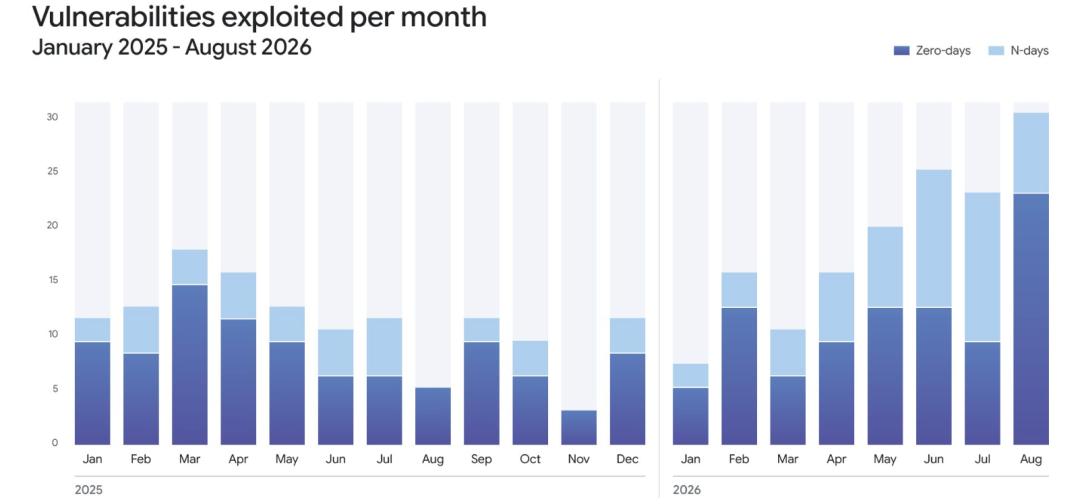
Number of vulnerabilities actually exploited monthly from January 2025 to August 2026. Dark blue represents zero-day vulnerabilities, light blue represents known vulnerabilities (n-day).
For people who have not installed the patch, the light blue part is particularly worth noting.
From the moment the manufacturer publicly releases the fix code to the moment you complete the update, the vulnerability in the old version still exists, while attackers can already see where the manufacturer made modifications.
Right after reading the patch, launch the attack immediately
There is a long-running joke in the cybersecurity community: "Patch Tuesday, Vulnerability Wednesday".
Microsoft is used to releasing patches collectively on the second Tuesday of every month. As soon as the patches are made public, while administrators are still testing and scheduling, attackers may already be studying exactly what has been fixed this time.
In the past, every step from reading the patch to writing exploit code required human handover. The most alarming part of exploit_agent is that hackers are trying to hand over this relay baton entirely to machines.
When humans use AI for assisted analysis, they send the code over, wait for it to spit out an explanation, and then humans make the decision for the next step.
But in the automated pipeline, the output of the previous step's model directly becomes the input of the next step's program. The analysis result is directly used to generate code, and immediately enters the execution phase after generation.
To string together this process, exploit_agent is connected to multiple cutting-edge models and local models at the same time.
It focuses on popular Web applications, and continuously compares code around the release of every patch announcement. Once a suspected vulnerability is found, it starts writing exploit code and then "fires automatically".
Google showed its "reading history" at that time in the report:
A section of access control logic in version 2.19.25 of the WordPress plug-in Spectra.
Google did not state that it dug out a vulnerability here, but caught it red-handed "in the middle of solving the problem".
Digging deeper along this server, Google also found a full set of hacker toolkits, with all scripts for intranet reconnaissance, brute force cracking, and installing webshell backdoors ready for use.
The most amusing one is a cleanup script specially designed to delete backdoors left by other hackers.
Although Google has not yet caught the actual combat results of exploit_agent, the power of large models to help hackers seize time has already been verified in another real-world attack.
At the end of August this year, two vulnerabilities in the print management software PaperCut were exploited by hackers as zero-day vulnerabilities.
Within one day after the vulnerabilities were made public, security researchers and the company Huntress used large models to produce usable exploit code.
By the 4th day, GreyNoise detected an attack that affected hundreds of organizations.
Hackers were very likely assisted by AI from start to finish, writing exploit code, testing whether the code works, and listing targets to attack.
How fast was the intrusion? From breaking into the first machine to obtaining the permission to manage the entire domain, it only took a few minutes. This means that the machines hackers can control are far more than just the initial one.
Although this attack has nothing to do with exploit_agent, it is essentially the same thing: hackers have compressed attack preparation into an hourly-level pipeline, while the update approval process of most enterprises may still be waiting for the regular meeting next week.
How many targets can fully automated AI attacks actually hit?
Opening the configuration file of exploit_agent, there are two very down-to-earth comments hidden inside:
LLM API key, for automated exploitation (exploit_agent pilot);
Fill in your own key here, do not fill it in the chat. Both lines are required.
Even the so-called "unattended" attack system still requires humans to manually fill in two lines of keys before startup. The coder even has to give repeated reminders just like guiding a novice, to prevent users from making low-level mistakes.
"No human intervention required" only refers to the execution phase after the program starts running. Humans are still needed to set up the stage and insert the key in the early stage.
The "lethality" of exploit code also needs to be viewed calmly.
At this stage, a lot of exploit code written by AI may still be "paper tigers".
On October 21, the official patches for two PHP vulnerabilities were just released, and hundreds of verification codes claiming to be usable popped up online in the following days, but all of them turned out to be useless after testing.
According to Google's analysis, this batch of "watered-down code" is most likely generated by large models.
In addition, this type of framework has an obvious shortcoming, which Google describes as "trading stealth for speed": it runs with a lot of noise and leaves many traces, making it very easy to be exposed.
Since they are rough, noisy, and low in accuracy, can we rest easy then?
On the contrary.
Google is convinced that cybercriminal gangs that do not care about stealth will continue to use such tools. For hackers who profit from volume, even if nine out of ten shots miss, one hit is enough to cover their costs.
What the defending side really needs to pay close attention to is how much human intervention these tools require, and which vulnerabilities they can repeatedly exploit in real environments.
When the update prompt arrives, the fix has just started
Now, on the table for both the offensive and defensive sides, what is being competed for are two completely different speeds:
On one side, machines run nonstop, reading code, writing exploits, running scripts, working around the clock;
On the other side, there is the human work order flow, scheduling, testing, approval, waiting for the next maintenance window.
For individual developers and website maintainers, there is only one realistic question: after the security update is released, how long will it take for you to actually fix your system?
It is impossible to complete the update in one step, and the only solution is to distinguish priorities.
The cybersecurity agency Mandiant suggests in its AI-assisted vulnerability management guide that priorities should be sorted according to the system's degree of external exposure, data sensitivity, and actual attack situation.
Fortunately, AI can also help the defending side seize time.
Let it sort out announcements, compare dependencies, draft fix plans, and cooperate with testing to check modifications, which can save a lot of tedious manual monitoring work.
Stepping out of the details of offense and defense, this incident also serves as a reminder for the current heated debate on Artificial Super Intelligence (ASI).
People are always worried whether the "god-level brain" that will be born one day in the future will get out of control, but exploit_agent shows us a much closer risk:
AI does not need to evolve superhuman intelligence at all. As long as it can continuously call tools and directly turn analysis into action, the risk level has already changed.
After all, when the manufacturer fixes the code, it does not mean your software automatically becomes immune. Patches lying in the update list cannot block any line of exploit code.
The window period between the public release of the patch and the effective implementation of the fix is exactly the time that hackers want to seize.
They do not need AI to dig new vulnerabilities, they only need to go through the whole exploitation process for the old vulnerability before you click "Confirm Update".
Perhaps the moment you click "Remind me later", the hacker's AI is already reading this patch.
This article is from the WeChat official account "AI_era" (ID: AI_era), written by ASI Revelation; edited by Yuan Yu, and published with authorization from 36Kr.