CSPC Pharmaceutical Group has just released its third-quarter report, and there are still significant divergences in the market towards it.
At midday on November 18, CSPC Pharmaceutical Group (01093.HK) released its performance report for the first three quarters. During the reporting period, the group recorded a revenue of RMB 25.26 billion, representing a year-on-year increase of 27.0%; profit attributable to owners of the company reached RMB 7.076 billion, up 101.5% year on year.
The following is a detailed analysis of this financial report.
01. Doubled profit mainly comes from a one-time upfront payment
Of the RMB 7.076 billion profit recorded in the first three quarters, licensing fee revenue accounted for RMB 6.268 billion, taking up nearly 90% of the total.
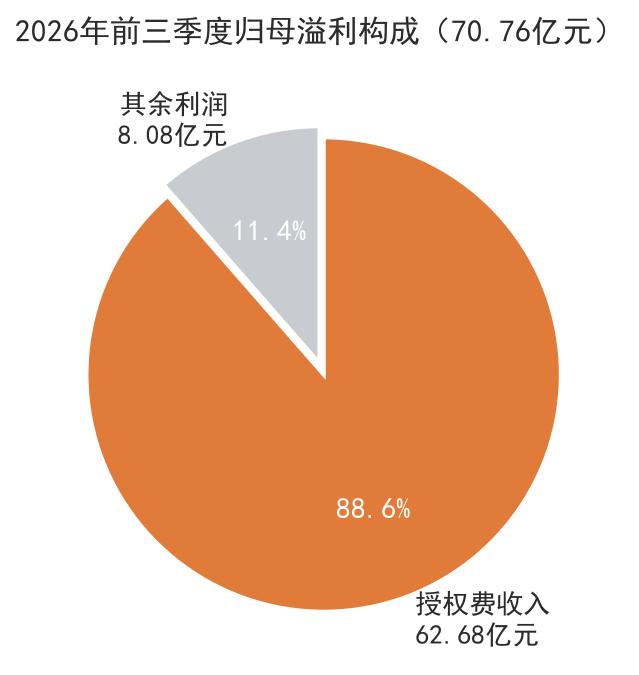
Figure: Composition of profit attributable to shareholders for the first three quarters of 2026. Source: Company performance announcement, compiled by YiYao
The main part of this licensing fee comes from a transaction between CSPC and AstraZeneca. In January 2026, CSPC licensed the overseas rights of eight long-acting polypeptide projects to AstraZeneca, with a total potential value of up to 18.5 billion US dollars, setting a new record for out-licensing transactions by Chinese pharmaceutical enterprises. In accordance with the agreement, CSPC received a 1.2 billion US dollar upfront payment in May 2026, of which 840 million US dollars (about RMB 5.74 billion) was recognized as licensing fee revenue during the reporting period.
It should be noted that the licensing fee revenue is actually recorded and recognized in the accounts. However, its nature is different from drug sales — it is received in a lump sum and recognized in installments, rather than generated from continuous end-market sales. Understanding this point is the premise of reading this financial report.
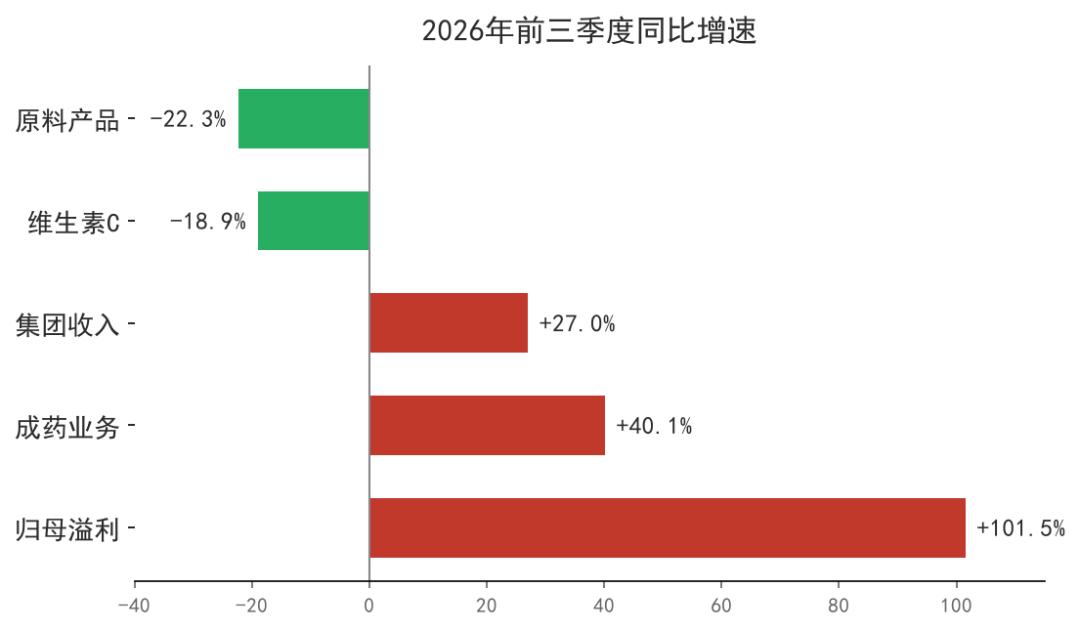
Figure: Year-on-year growth rate of each business segment. Source: Company performance announcement, compiled by YiYao
02. Core business is divided into three segments with different development trends
After excluding the licensing fee, CSPC's core business can be split into three segments.
Finished drug sales: Steady growth. The finished drug business recorded a revenue of RMB 21.648 billion in the first three quarters, up 40.1% year on year, which includes the RMB 6.268 billion licensing fee. After excluding the licensing fee, the drug sales revenue is about RMB 15.38 billion. Calculations from China Industrial Securities International show that CSPC's finished drug revenue (excluding licensing revenue) in the first half of the year was RMB 10.17 billion, representing a year-on-year growth of 10.8%. The drug sales growth rate after excluding the licensing fee in the first three quarters remains roughly at this level. This segment is mainly supported by Enbipu, of which the company disclosed that it "continues to deeply cultivate the grassroots and out-of-hospital markets, and its sales revenue has achieved a significant year-on-year increase".
Active pharmaceutical ingredients (APIs): At the cyclical bottom. The API business recorded a revenue of RMB 2.336 billion in the first three quarters, down 22.3% year on year; among which, vitamin C revenue was RMB 1.451 billion, down 18.9% year on year. The company attributed this to the decline in product selling prices, coupled with increased supply and intensified competition brought by the release of industry production capacity.
Functional foods and others: Small proportion, slightly under pressure year on year. The revenue of the functional foods and other business in the first three quarters was RMB 1.276 billion, down 11.1% year on year. This segment accounts for about 5% of the group's total revenue, with a significantly smaller scale than finished drugs and APIs, so its marginal impact on the overall revenue is limited, but it is a non-negligible part of the three core business segments. Its decline, superimposed with the cyclical pressure of the API segment, shows that after excluding the licensing fee, CSPC's traditional business is not expanding across the board, but presents a differentiated pattern of "steady finished drug business, weak API business, and slightly under-pressure functional foods and other business".
In addition, the licensing fee needs to be mentioned separately: it is one-off, but can occur sustainably. The licensing fee is the main source of current profit, but at the same time it represents a systematic business capability of CSPC, which will be explained separately in the next section.
Putting the three segments together, the picture of CSPC's Q3 report is: the one-off licensing fee contributes the majority of the profit, drug sales are advancing steadily at a growth rate of around 10%, while APIs and functional foods drag down the overall performance at the bottom.
03. CSPC's BD is not a one-off transaction
The cooperation between CSPC and AstraZeneca is continuous.
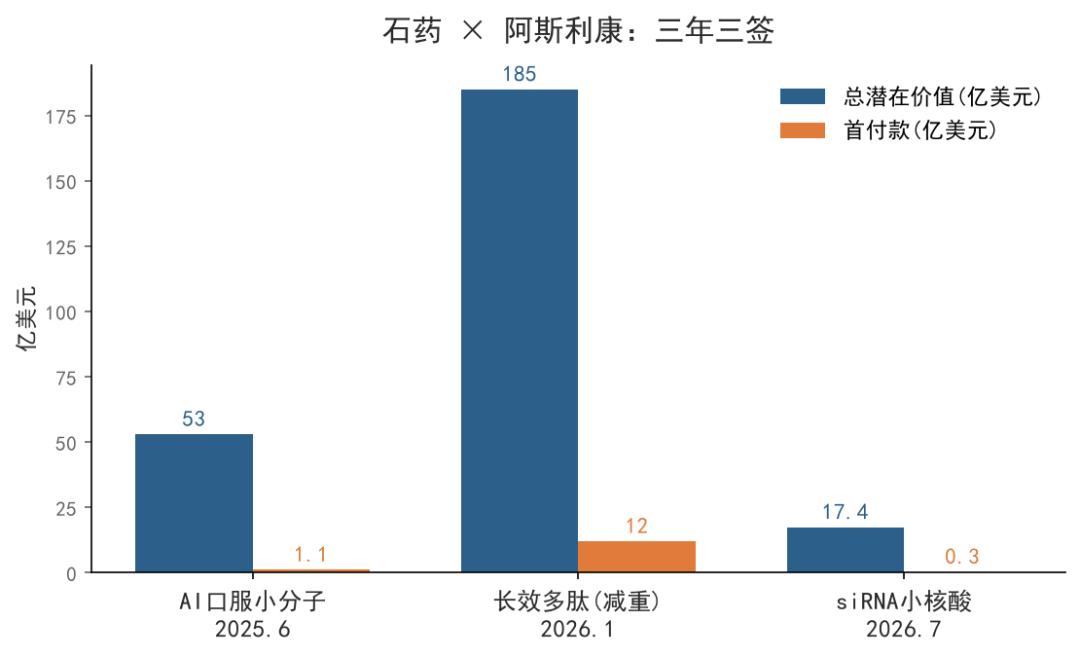
Figure: Three out-licensing transactions between CSPC and AstraZeneca. Source: Company announcements, China Merchants Bank International research report, compiled by YiYao
According to statistics from China Industrial Securities International, CSPC has completed six out-licensing transactions since 2025, with a total upfront payment of about 1.49 billion US dollars. Sorting from China Merchants Bank International also shows that since the end of 2024, CSPC has signed six out-licensing agreements covering multiple directions including Lp(a) inhibitors, MAT2A inhibitors, ROR1 ADCs, oral GLP-1, irinotecan liposome, and AI-driven small molecule discovery platforms.
This point is worth noting: CSPC's out-licensing is not occasional, but systematic. AstraZeneca has changed from a single buyer to a continuous partner, and the amount of each single transaction has gradually increased. This means that CSPC's R&D platform can continuously generate assets that can be priced by the outside market, which is the basis for the market to give it innovative drug valuation.
But it should also be made clear that the 18.5 billion US dollars is the total potential amount, not the actual received amount. What is actually cashed in are the upfront payment and phased milestones, and the rest of the amount needs to be realized one by one as R&D and sales milestones are met.
04. The subsequent core anchor is SYS6010
The licensing fee will eventually be fully recognized. After 2027, CSPC's profit will need to be supported by its later-stage pipeline, among which SYS6010 is the core asset.
SYS6010 is an EGFR ADC. According to the research report of China Industrial Securities International, its Phase III clinical trial (SYNSTAR-01) for EGFR-mutant non-small cell lung cancer previously treated with TKI has reached the primary PFS endpoint; in the third-line and above population previously treated with TKI and platinum-containing chemotherapy, it achieved a median PFS of 7.6 months and a median OS of 19.4 months.
Around SYS6010, CSPC has also laid out a number of late-stage assets: B7-H3 ADC (SYS6043, Phase III trial for platinum-resistant ovarian cancer has been initiated), PD-1/IL-15 bispecific antibody (SYS6090, has obtained FDA Fast Track designation), and SYS6055, the first in-vivo CAR-T approved for clinical trials in China.
CSPC and Hengrui have similar situations — part of their current profit comes from licensing revenue. The difference is that CSPC's drug sales are still growing, and its ADC pipeline has already met the endpoints in Phase III trials. The real test is whether products such as SYS6010 can fill the profit gap after the licensing fee is no longer available.
05. Several points to note
First, the profit is likely to show a "U-shaped" trend. The earnings forecast of China Industrial Securities International illustrates this point.
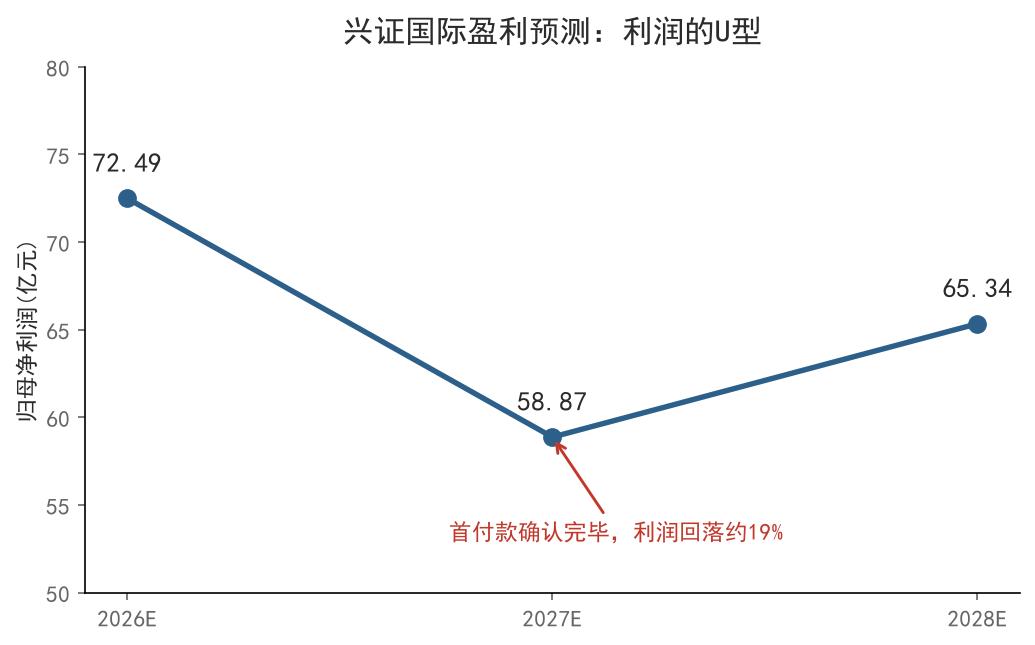
Figure: Earnings forecast of China Industrial Securities International (November 2026). Source: China Industrial Securities International research report
According to this forecast, CSPC's net profit attributable to shareholders in 2027 will drop by about 19% compared with 2026. The reason is that AstraZeneca's upfront payment is recognized intensively in 2026, and this part will decrease in 2027. This does not mean that the operation is deteriorating, but that this year's base is raised by the one-off licensing fee.
Second, 18.5 billion US dollars is the upper limit, not a commitment. Whether the milestones can be fulfilled and to what extent depends on the clinical advancement of assets such as SYH2082, which is still in the early stage at present.
Third, there is no clear signal on when the API business will get out of the bottom. The prices of vitamin C and antibiotics depend on the rhythm of industry capacity clearance, and there is limited space for CSPC to make efforts on its own in this regard.
Fourth, the market still has large divergences over CSPC. The range of institutional target prices is obviously wide. The essence of the divergence lies in the different weights assigned to the two issues: "whether BD capability can be sustained" and "whether ADCs can take over the profit contribution".
04. Conclusion
What is notable about CSPC's Q3 report is not the "doubling of profit" itself, but that the source of the doubling can be clearly broken down: RMB 6.268 billion in licensing fees, around 10% growth in drug sales, and the still shrinking API business.
Among the three segments, the first one is one-off, the second one is of high quality, and the third one is a drag. Only by looking at them separately can we make an appropriate judgment on this financial report.
Three indicators can be followed in the future: the complete Phase III PFS data of SYS6010 and the NDA submission time point; the received amount and time point of the next R&D milestone under the AstraZeneca transaction; and whether the prices of APIs such as vitamin C can stabilize. The trend of these indicators can better reflect CSPC's performance in the next year than the "doubling of profit".
This article is from the WeChat official account "YiYao", written by LI Jingyi, authorized for release by 36Kr.