Jason Wei, the father of Chain-of-Thought, has left Meta and joined the $20 billion AI unicorn.
Another heavyweight researcher has left Meta's Superintelligence Lab.
This time, it is the "Father of Chain-of-Thought" Jason Wei.
On November 18, Brendan Foody, co-founder and CEO of AI startup Mercor, announced on the X platform that Jason Wei has officially joined Mercor as Chief Scientist.
Jason Wei later confirmed the news. He said that after spending more than a wonderful year at Meta TBD Lab, he is very happy to join Mercor. He also specially mentioned that as more and more companies start training AI models, data will shape the next frontier of AI development.

It is worth noting that Jason Wei's new employer is not Google DeepMind, OpenAI or another cutting-edge large model lab, but Mercor, a startup that started with AI talent recruitment and expert data services.
Just a week ago, Mercor just announced the completion of a $750 million Series D financing, with a valuation reaching 200 billion US dollars.
From Google Brain to OpenAI, then to Meta's Superintelligence Lab, now Jason Wei has chosen Mercor again. Why did this important researcher in the field of large model reasoning choose an AI data company as his next stop?
From Google Brain to OpenAI and Meta, the research path of the Father of Chain-of-Thought
In the field of large model research, Jason Wei is a name that cannot be avoided.
Jason Wei has worked at Google Brain, OpenAI and Meta successively, with research focuses covering large language model reasoning, agents and model evaluation.
What made him widely known is the paper published in 2022 titled "Chain-of-Thought Prompting Elicits Reasoning in Large Language Models".
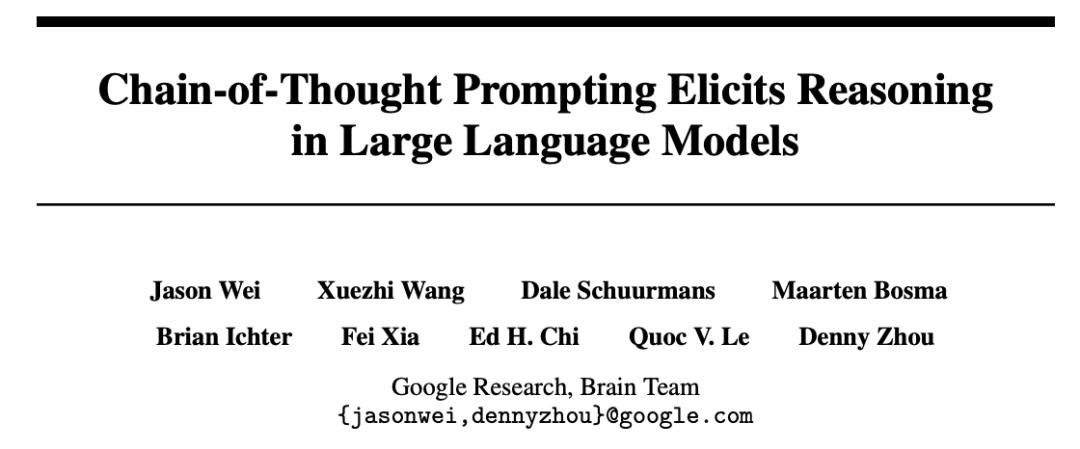
As the first author of this paper, Jason Wei, together with researchers from Google Brain, proposed the Chain-of-Thought Prompting (CoT) method.
At that time, large language models were already able to complete many natural language tasks, but they often performed poorly when facing mathematical problems that required multi-step reasoning.
The research team found that instead of letting the model give the answer directly, it is better to add examples containing intermediate reasoning steps in the prompt to guide the model to complete the calculation step by step.
For example, for a mathematical word problem, an ordinary prompt may only require the model to output the final number, while the Chain-of-Thought Prompting will show how to analyze the conditions, list the calculation steps, and then get the answer.

This method does not need to modify the model parameters, and only by changing the prompt examples provided to the model, can it significantly improve the multi-step reasoning performance of sufficiently large large language models.
Since then, CoT has become one of the most influential methods in large model reasoning research, and researches on self-consistency of Chain-of-Thought, reasoning path search and other related topics have emerged one after another.
In 2023, Jason Wei joined OpenAI, participated in projects such as OpenAI o1 and Deep Research, and also participated in the development of a number of model evaluation benchmarks.
The SimpleQA released in 2024 is mainly used to measure the accuracy of large language models in answering factual questions. It contains 4326 questions with clear answers, which are used to examine whether the model can answer accurately and whether it knows that it cannot answer a certain question.
The BrowseComp released in 2025 mainly evaluates the complex web search capability of AI agents. Compared with ordinary factual Q&A, the questions in BrowseComp often require multiple rounds of search, information screening and cross-validation to find the answers.
HealthBench is oriented to the medical scenario, and evaluates the model's performance in real medical conversations from multiple dimensions such as accuracy, communication quality, and instruction compliance through detailed scoring criteria formulated by doctors.

From CoT to SimpleQA, BrowseComp and HealthBench, Jason Wei's research experience spans the improvement of large model reasoning capabilities and how to evaluate these capabilities.
In July 2025, he moved from OpenAI to Meta's newly established Superintelligence Lab, becoming one of the well-known AI researchers recruited by Meta from competitors at that time.
Now, after working at Meta for more than a year, he has chosen a new direction again.
Just raised 750 million US dollars, what is the origin of Mercor?
Compared with the several AI giants where Jason Wei used to work, the name of Mercor may not be so widely known. But in the AI training data and model evaluation market, this company has grown into a unicorn with a valuation of 200 billion US dollars.

Mercor was founded in 2023, co-founded by Brendan Foody, Adarsh Hiremath and Surya Midha.
The company initially cut into the market with AI-driven talent recruitment business, helping enterprises find and match suitable talents. With the rapid development of generative AI, Mercor has gradually shifted its business focus to providing professional talents, training data and evaluation services for cutting-edge model companies.
For example, if an AI lab wants to improve the model's financial analysis capabilities, general Internet texts alone may not be enough. It also needs professionals who understand financial workflows to help design real tasks, evaluate model outputs, and provide high-quality training samples.
Mercor provides data and feedback for AI model training and evaluation by organizing professionals in different fields. At present, its expert network has covered more than 5 million people and has become an important service provider for cutting-edge model labs.
On November 10, Mercor announced the completion of a $750 million Series D financing with a valuation of 200 billion US dollars. The participating institutions include Benchmark, General Catalyst, as well as NVIDIA, Salesforce and others.
However, Mercor's goal is no longer limited to providing expert data to AI labs.
In this financing announcement, the company clearly stated that the new funds will be used to further invest in model evaluation, post-training infrastructure, and build an environment for AI agents to learn complex workflows.
At the same time, Mercor is also expanding its capabilities originally oriented to cutting-edge labs to enterprise customers.
Different enterprises have their own business systems, internal rules and quality standards. Even if a general model achieves good results on public benchmarks, it may not be able to directly complete the work of a specific enterprise.
Therefore, enterprises need to establish an evaluation system for their own tasks, and then use expert feedback and special data to improve model performance.
For Mercor, this means that the business is extending from organizing experts to participate in model training to further helping customers evaluate, improve and adapt AI models.
The joining of Jason Wei happened exactly at the stage when the company increased its investment in research.
The Father of Chain-of-Thought and the author of LoRA meet at Mercor
In fact, before Jason Wei joined, Mercor had already started to build its own AI research team.
On October 8, Mercor published an article titled "Why Mercor Is Building a Research Team", formally introducing the company's research plan.
Its core idea is: first discover real work tasks that the model cannot complete through evaluation, then use domain experts to understand the cause of failure, build training data, improve model capabilities through post-training, and finally re-evaluate the improvement effect.
To this end, Mercor is researching real work task evaluation, training data quality, model post-training, and how human expertise can promote the improvement of AI capabilities and other issues.
In terms of real work evaluation, Mercor has launched the APEX series of benchmarks, covering professional fields such as management consulting, investment banking, corporate law, accounting and software engineering. Different from traditional knowledge Q&A, these evaluations focus on testing whether AI can complete tasks with actual work requirements.
In terms of model training, Mercor has also released specific experimental results. In the post-training research, Mercor conducted experiments using the Qwen3.5-397B model, increasing its Pass@1 score on the APEX-Agents benchmark from 16% to 27%.
More interestingly, Mercor has gathered a group of researchers with representative research achievements in the field of large models.
Among them is Edward J. Hu.
Edward J. Hu is the first author of the famous paper "LoRA: Low-Rank Adaptation of Large Language Models", and he also worked at OpenAI before.
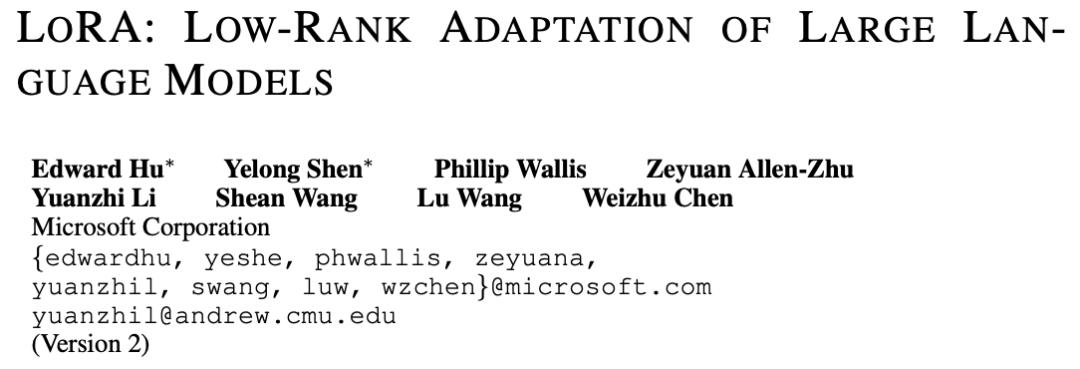
LoRA performs parameter-efficient fine-tuning on large models through low-rank matrices, which greatly reduces the number of parameters that need to be trained when adapting the model, and has become one of the widely adopted technologies in the field of large model fine-tuning.
In addition to Edward J. Hu, Mercor's research team also includes Minyang Tian, the first author of SciCode and CritPt, Victor Barres, the first author of tau²-bench, and other researchers from Anthropic, Ai2 and other institutions.
Now, with the joining of Jason Wei, this company that started with AI talent and data services has welcomed another researcher with important influence in the field of reasoning and model evaluation.
It is worth mentioning that Brendan Foody, founder of Mercor, revealed in the official announcement that Jason Wei has not only been a customer of Mercor in the past few years, but also one of the company's important communication partners.
Brendan Foody said in the official announcement that Jason Wei will help Mercor build a research team, focusing on promoting research in data and evaluation.
This direction has a lot of intersections with Jason Wei's previous work at OpenAI. He participated in the development of evaluation benchmarks such as SimpleQA, BrowseComp and HealthBench, while Mercor is expanding model evaluation to real work scenarios such as finance, law, and software engineering, and trying to use the evaluation results to improve the model.
Jason Wei also talked about the importance of data in his personal official announcement. He believes that as more and more companies start training AI models, data will shape the next frontier of AI development.
For a company that is extending from expert data services to AI evaluation and post-training research, this may be the reason why the two sides came together this time.
From Chain-of-Thought to model evaluation, and now to real work tasks and data research, Jason Wei's next stop is worthy of continued attention.
Reference links:
https://x.com/BrendanFoody/status/2122825607763689873
https://x.com/_jasonwei/status/2122826605362127094?a=m63C7Y9P_nHCJU683Og&s=20
This article is from the WeChat official account "Almost Human" (ID: almosthuman2014), edited by Neo, and released with authorization from 36Kr.