Agile Group swaps US$5.183 billion in offshore debts for 64.6% equity, with three remaining hurdles to clear for the restructuring.
When the six-week window expires, Agile's offshore debt restructuring is still at the stage of negotiating texts, and no legally binding agreement has been signed yet. According to the company's announcement on November 16, Agile Group intends to enter into an offshore debt restructuring support agreement with offshore creditors, with the total principal of the debts involved amounting to about 5.183 billion US dollars. The signing of the agreement is only the first hurdle, and there are three more hurdles ahead: court approval, voting and operation.
From its first offshore debt default in May 2024 to the release of the term sheet covering almost all offshore financial liabilities and the restructuring support agreement text in October 2026, this time-honored private real estate enterprise spent about two and a half years negotiating "unpayable debts" into "exchangeable shares".
The Cost of Debt-to-Equity Swap
The core of Agile's offshore debt restructuring is not maturity extension, but equity transfer.
According to the plan disclosed by the company, Agile will issue a total of about 9.199 billion new ordinary shares, accounting for about 64.6% of the company's share capital immediately after the completion of the restructuring, in exchange for the release and settlement of the debts within the scope. Creditors can choose shares of the new company, or choose new exchangeable bonds — the latter are issued by a newly established special purpose vehicle, with a term of 364 days, mandatory exchange into new company shares at maturity, and a maximum issuance amount of 35.65 billion Hong Kong dollars.
Converted to specific instruments, the distribution is roughly as follows: holders of exchangeable bonds shall account for about 722 million shares proportionally, accounting for about 5.1% of the post-restructuring share capital; holders of perpetual securities and Private Debt A shall account for about 1.488 billion shares, about 10.4%; scheme creditors of the Hong Kong listed company shall account for about 2.017 billion shares, about 14.2%; scheme creditors of the Hong Kong guarantors shall account for about 4.973 billion shares, about 34.9%. That is to say, the closer the creditors are to the guarantee level, the higher the equity proportion they can get.
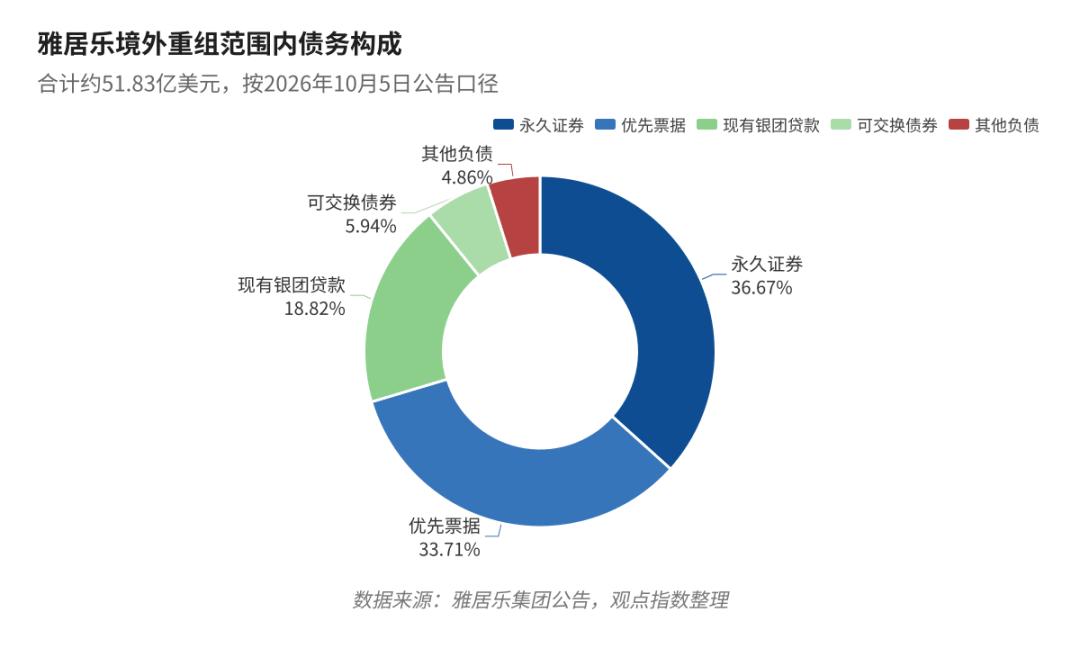
The composition of the 5.183 billion US dollars determines that the difficulty of this negotiation does not lie in the total amount, but in the categories. Among them, the outstanding principal of perpetual securities is 1.9 billion US dollars, which is the largest single part; senior notes amount to 1.747 billion US dollars, existing syndicated loans 975 million US dollars, exchangeable bonds 308 million US dollars, and other liabilities 252 million US dollars. The four types of instruments are under different legal jurisdictions, and the demands of their holders are not consistent.
For the original shareholders, the controlling stake is in jeopardy. The Chen Zhuolin family previously held a total of 56.67% of the shares through entities such as Top Coast Investment Limited, among which Top Coast alone held 47.42%. Calculated based on the issuance scale of 9.199 billion new shares and the existing share capital, the family's shareholding will drop to about 20% after the restructuring is completed. As a result, creditors have changed from "debtors" to "major shareholders", and the company's control structure has been rewritten accordingly.
To get creditors to sign as soon as possible, the plan sets up a cash consent fee: for agreements entered into within 28 days after the launch of the support agreement, 0.2% of the outstanding principal of the relevant debt will be paid; for those entered into after 28 days and within 42 days, the proportion is 0.1%. The proportion is not high, but it is enough to quantify the cost of "wait-and-see".
Several Hurdles Remaining Ahead
The support agreement is the starting point of the restructuring, not the end.
According to the terms of the agreement, the Hong Kong guarantors must submit an originating summons to the Hong Kong court within 6 months after the date of the agreement to apply for convening relevant creditors' meetings; this period can be extended for another 3 months by written notice from the company, provided that relevant members of the coordination committee do not raise written objections within 5 business days after the notice. Even if everything goes smoothly, the time from signing to court approval will be counted in years.
The procedures themselves are "inter-conditional". The plan is proposed to be implemented through the restructuring scheme under Part 26A of the UK Companies Act 2006, as well as the listed company Hong Kong scheme and the guarantors' Hong Kong scheme proposed under Sections 670, 673 and 674 of the Hong Kong Companies Ordinance. If any link fails to be passed, the whole plan cannot take effect.
Coverage is the second variable. At the time of the announcement in October, the coordination committee held a total of about 61.5% of the total outstanding principal of the existing syndicated loans, which provided a base of votes for the plan. Whether the holders of senior notes, perpetual securities and exchangeable bonds will follow to sign, and what the signing proportion will be, depends on the actual progress within the consent fee window period, and shall finally be subject to the company's announcement.
The parallel pressure at the legal level cannot be ignored. In December 2025, Agile was once served a winding-up petition filed by a partner, and the first hearing was scheduled for February 25, 2026. The restructuring support agreement can reduce the uncertainty brought by the petition, but will not automatically eliminate all judicial procedures.
That is to say, the support agreement solves the problem of "most people standing together first", not "everyone has agreed". The voting threshold of the creditors' meeting, the court's approval discretion, and the calculation of the recovery rate by holders of different instruments will all reappear in subsequent links.
The Operational Challenge
The reduction on the debt side cannot replace the growth on the operation side. In the first half of 2026, the total pre-sales amount of Agile, together with its joint ventures, associates and projects sold under the "Agile" brand, reached 3.8 billion yuan, down 26.5% year on year; the corresponding pre-sales gross floor area was 408,000 square meters, down 26.1% year on year; the average pre-sales price was 9,323 yuan per square meter, down 0.4% year on year. The company stated straightforwardly in its interim report that sales have further shrunk, and liquidity has also been greatly affected.
The revenue structure is also changing. The turnover in the first half of the year was 10.861 billion yuan, of which property management accounted for 6.044 billion yuan, 55.6% of the total; property development accounted for 3.805 billion yuan, 35.0% of the total; other businesses accounted for 1.012 billion yuan, 9.4% of the total. The fact that development business gives way to service business is a natural result after the scale shrinks.
On the profitability side, the gross loss for the period was 2.048 billion yuan, with a gross loss rate of 18.9%; the loss for the period was 6.146 billion yuan; the loss attributable to shareholders of the company was 8.83 billion yuan, including a profit of 2.764 billion yuan attributable to holders of perpetual capital securities. As of the end of June, the total cash and bank balances amounted to 4.514 billion yuan, and total borrowings decreased by 1.824 billion yuan compared with the end of 2025.
Fortunately, the asset base is still solid. It has a land reserve with an estimated total gross floor area of 25.03 million square meters in 68 cities and regions, with an average floor price of 2,445 yuan per square meter; among which the Pearl River Delta accounts for about 7.49 million square meters, 30% of the total, and the Yangtze River Delta accounts for about 1.13 million square meters, 4% of the total. In the first half of the year, about 1,600 households and about 147,200 square meters of properties were delivered in 12 cities.
On one hand, 5.183 billion US dollars of offshore debt is converted into equity; on the other hand, there is pre-sales of 3.8 billion yuan and cash of 4.514 billion yuan in half a year. What the restructuring reduces is the leverage on the balance sheet, and it will not bring a penny of payment collection to the projects. What really determines whether this company can get out of the woods is still whether sales can stop falling, whether property delivery can continue, and whether the new shareholder structure and operation team after the restructuring can remain stable.
On the surface, this is a transaction that uses 64.6% of the equity to clear off offshore debts; in essence, it is a re-pricing of Agile's residual value by creditors.
The establishment of the action does not mean the establishment of the result. After the agreement is signed, whether the creditors' meeting and court procedures can proceed as scheduled, whether sales can stabilize in the second half of 2026, and whether the operation strategy will be adjusted again after the change of control, all remain to be observed.
This article is from the WeChat Official Account "Viewpoint", author: Viewpoint New Media, published with authorization from 36Kr.