2026 Q3 Hotel Industry Earnings Report: Those Who Cut Prices Failed to Attract More Guests, While Those Who Raised Prices Held Their Ground?
On the evening of November 16, I went through Huazhu's quarterly report, and the first section I looked at was the same-store performance. The overall ADR (Average Daily Rate) in China rose by 1.8%, while the average price of stores that had been open for more than 18 months fell by 1.3%. The same batch of rooms had two sets of figures, and the gap was quite significant.
01
Let's start with this section.
According to the Q3 2023 performance announcement of Huazhu Group released on November 16, the average daily room rate in China reached 309 yuan, up 1.8% from 304 yuan in the same period last year. However, the occupancy rate failed to keep pace: 82.6% was 1.4 percentage points lower than the same period last year, and the overall RevPAR of 256 yuan almost remained flat.
Two pages down in the table, the same quarter adopts another set of calculation rules. According to the same quarterly report, the same-store RevPAR of hotels that have been in operation for more than 18 months was 248 yuan, down 4.4% from 259 yuan last year, the same-store ADR dropped by 1.3%, and the same-store occupancy rate fell by 2.7 percentage points.
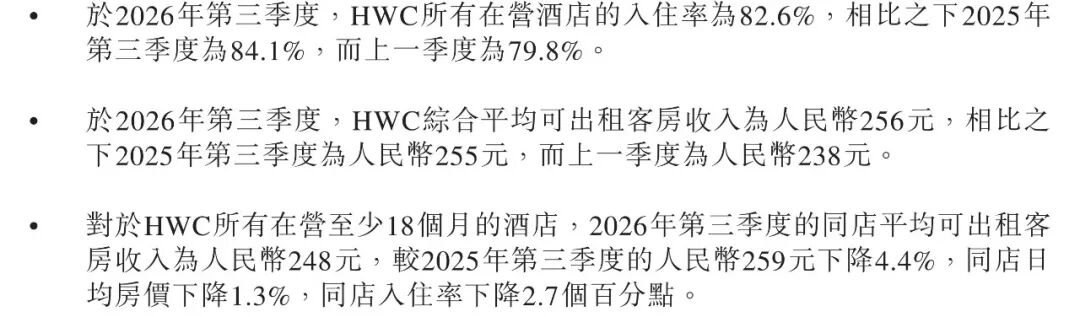
Source: Huazhu Group <2026 Q3 Financial Performance Announcement>
The figure reported by the group shows a growth, while the figure from the store side shows a decline, and the two sets of data refer to the exact same batch of rooms. In the announcement, Ji Hui attributed this to the extreme weather during the summer vacation, repeatedly stating that the overall RevPAR performance was stable, driven by product upgrading and revenue management.
He did not mention the same-store section at all.
BTG Hotels made this point clearer. According to its Q3 quarterly report released on October 30, the RevPAR of all hotels excluding light-management hotels in the third quarter was 186 yuan, down 2.4% year-on-year. However, if we only look at mature stores that have been open for more than 18 months, the figure changes immediately: the 3409 stores excluding light-management ones dropped to 183 yuan, down 7.8%, and the total 6016 stores including light-management ones fell to 159 yuan, with a decline of 8.3%.
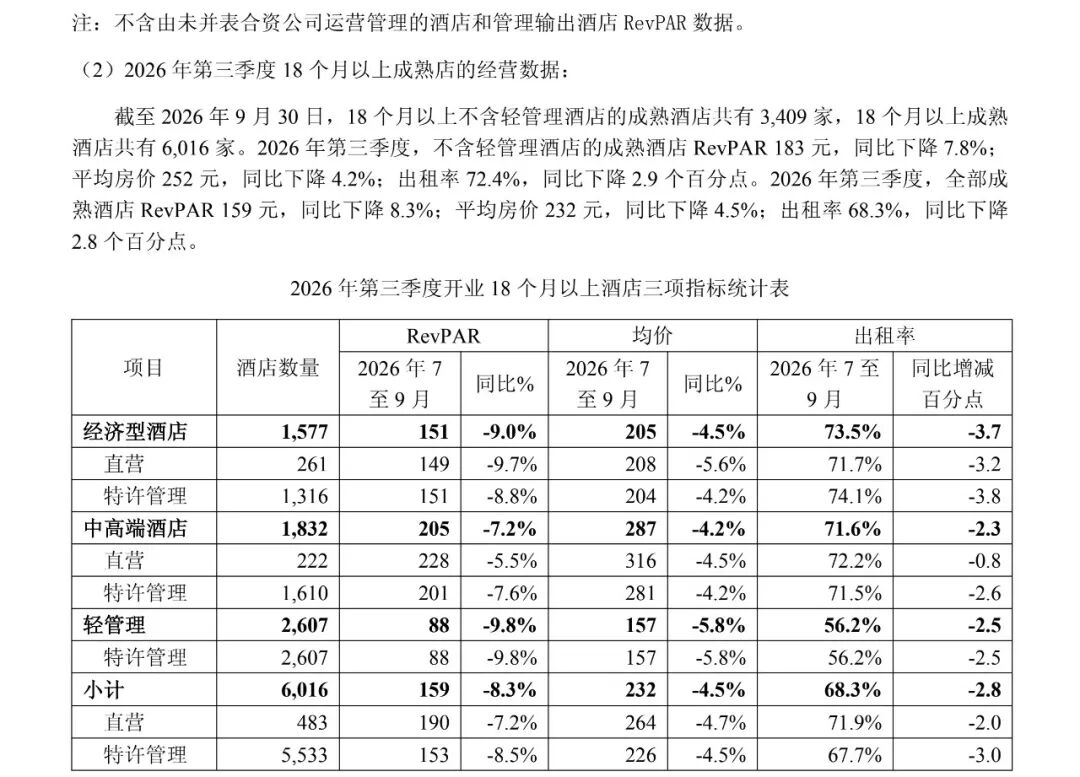
Source: BTG Hotels <2026 Q3 Report>
The decline is more than three times faster than that of the whole system.
There is another table in the same announcement that breaks down the 6016 mature stores by tier. The RevPAR of the 1577 economy hotels was 151 yuan, 9.0% lower than last year; the 1832 mid-to-high-end hotels performed slightly better, with RevPAR of 205 yuan, down only 7.2%; the 2607 light-management hotels at the bottom had the worst performance, with RevPAR of 88 yuan down 9.8%, and the occupancy rate was only 56.2%.
For those 2607 light-management hotels, the average ADR was 157 yuan, meaning a room was sold for less than 160 yuan per day.
I went through the appendices of the four groups one by one, and the same-store section is not publicly displayed by every group. Huazhu and BTG Hotels both list it separately, but in different positions: one is hidden in the operation summary on page 3 of the quarterly report, and the other is placed after the three-indicator table on page 8 of the Q3 report.
Jin Jiang Hotels has a more detailed accounting breakdown. According to its Q3 quarterly report released on October 30, the RevPAR of domestic limited-service hotels in the third quarter was 167.13 yuan, down 2.23%, while the directly-operated hotels in the same segment recorded RevPAR of 164.89 yuan, up 9.06%.
One figure drops by 2.23%, the other rises by 9.06%, for the same company in the same quarter.
Atour repeated the same pattern as Huazhu. According to its financial report released on November 10, the overall RevPAR in the third quarter was 373 yuan, up 0.5% from 371.3 yuan in the same period last year, the average ADR was 452.9 yuan, up 1.3%, and the occupancy rate of 79.7% only dropped by 0.5 percentage points.
According to the respective Q3 reports of the four groups, only two of them can still report positive overall RevPAR growth: Atour with 0.5% and Huazhu with 0.4%, both of which are extremely close to zero. For the same-store section, Huazhu's figure dropped by 4.4%, and Atour's dropped by 4.2%.
There is another table in the second half of the same financial report, which only counts 1538 stores that have been in operation for more than 18 months. The same-store RevPAR was 356.6 yuan, down 4.2% from 372.2 yuan last year, the same-store average ADR was 433.7 yuan, down 2.1%, and the same-store occupancy rate was 79.5%, down 1.6 percentage points.
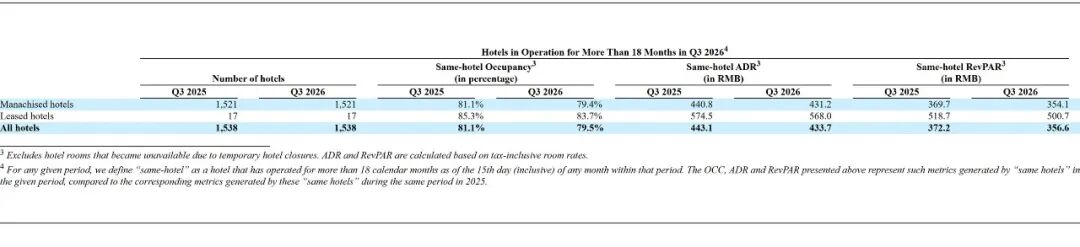
Source: Atour Group <2026 Q3 Unaudited Financial Performance> Same-store Operation Indicator Table
The nearly 20-yuan gap between the overall figure and the same-store figure can only come from the new stores added to the network in this quarter. These new stores must be sold at a price higher than 452.9 yuan to lift the overall average.
New stores push up the average price, while old stores cut prices. The two forces work together to make the figure reported by the group show a growth.
One caliber needs to be clarified. Atour calculates RevPAR based on total revenues, as the footnote of its financial report states in the original words "total revenues", so you cannot get the correct figure by multiplying its ADR by the occupancy rate. Therefore, in the following content, we only use the year-on-year change of its own two quarters, and do not compare the absolute value with other groups.
The profit side presents a completely different picture. According to the respective Q3 reports of the four groups, Huazhu's attributable net profit was 1.801 billion yuan, up 22.6%, Jin Jiang's was 510 million yuan, up 35.88%, BTG Hotels' was 381 million yuan, up 6.54%, and Atour's was 448 million yuan, down 5.5%.
Revenue is going down while profit is going up, which is the case for three of the four groups. Atour is the exception: its net revenue rose by 30% to 3.429 billion yuan, but its profit decreased by 5 percentage points, as the money was spent elsewhere.
For foreign-funded hotel groups, three different paths led to three different results.
According to Marriott International's financial report released on November 2, global RevPAR rose by 6.5%, but in Greater China, it only reached 75.72 US dollars, down 0.3%. The occupancy rate of 68% was 1.5 percentage points lower than the same period last year, while the average ADR of 111.31 US dollars instead rose by 1.9%.
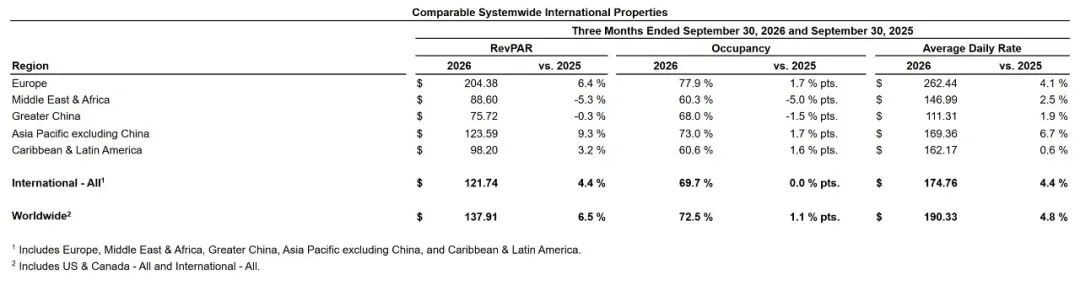
Source: Marriott International 2026 Q3 Financial Report (SEC Form 8-K Exhibit 99.1)
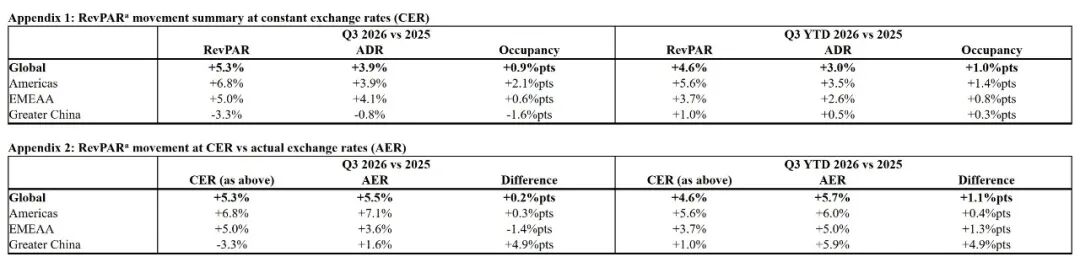
According to InterContinental Hotels Group's Q3 trading update released on October 22, global RevPAR rose by 5.3%, but in Greater China, it fell by 3.3%, with average ADR down 0.8% and occupancy rate down 1.6 percentage points, making it the only region with negative growth across the globe.
Source: InterContinental Hotels Group
According to Hyatt's financial report released on October 29, global RevPAR rose by 7.2%, while in Greater China, it reached 94.89 US dollars, up 2.1%. The occupancy rate of 74.9% only dropped by 0.7 percentage points, and the average ADR of 126.61 US dollars rose by 3.0%.
The three groups operate in the same market but took three different actions. IHG cut prices by 0.8%, but the occupancy rate still dropped by 1.6 percentage points, and RevPAR fell by 3.3%. Marriott raised prices by 1.9%, the occupancy rate dropped by 1.5 percentage points, and RevPAR barely maintained stability. Only Hyatt raised prices by 3.0%, the occupancy rate only dropped by 0.7 percentage points, and RevPAR instead increased by 2.1%.
In this market, price cuts failed to attract more guests, while groups that raised prices managed to hold their ground.
Hilton's quarterly report does not have a separate section for China, only the overall Asia-Pacific region, where RevPAR in the third quarter was 71.78 US dollars, down 0.5%. The three companies have different disclosure calibers, but when viewed together, the overall trend is consistent.
When looking at the three consecutive quarters, the curves are also different. According to the respective disclosed first three quarters calibers of the two groups, Marriott's Greater China RevPAR in the first three quarters was 84.71 US dollars, down 0.8%, and the single-quarter decline was only 0.3%, meaning the downward trend is narrowing. On the contrary, IHG still recorded a 1.0% growth in the first three quarters, but the single-quarter figure turned to a 3.3% decline. For the same market, one group is climbing up, while the other has just started to slide down.
02
Then where did the profit of this quarter come from?
Let's look at the supply side first.
BTG Hotels cited STR data in its Q3 report. During the 2026 summer vacation from July 1 to August 29, domestic hotel supply increased by 2.4% year-on-year, while demand only increased by 0.3%. Room revenue decreased by 0.4%, and the RevPAR index was 97, close to a 3% year-on-year decline. There is a sentence in the announcement: the growth rate of new hotels and new rooms is still faster than the growth rate of demand.
Supply is growing faster, which is the general premise. And the supply is still increasing.
According to Marriott's financial report, it added a net of 20,100 rooms in the third quarter, with 634,000 rooms in the global construction pipeline, which is described as a record high. IHG's Greater China region added a net of 18,600 rooms during the year, and its system scale increased by 10.3% year-on-year. Huazhu opened 664 new stores and closed 175 stores in the third quarter, with a net increase of 489 stores, and its full-year target of opening 2200 to 2300 stores remains unchanged. BTG Hotels has 8169 stores, up 8.91% year-on-year.
Demand only increased by 0.3%, while the number of rooms is still growing at a double-digit rate.
To make the accounts balance, the most convenient way is to let others pay for the store opening.
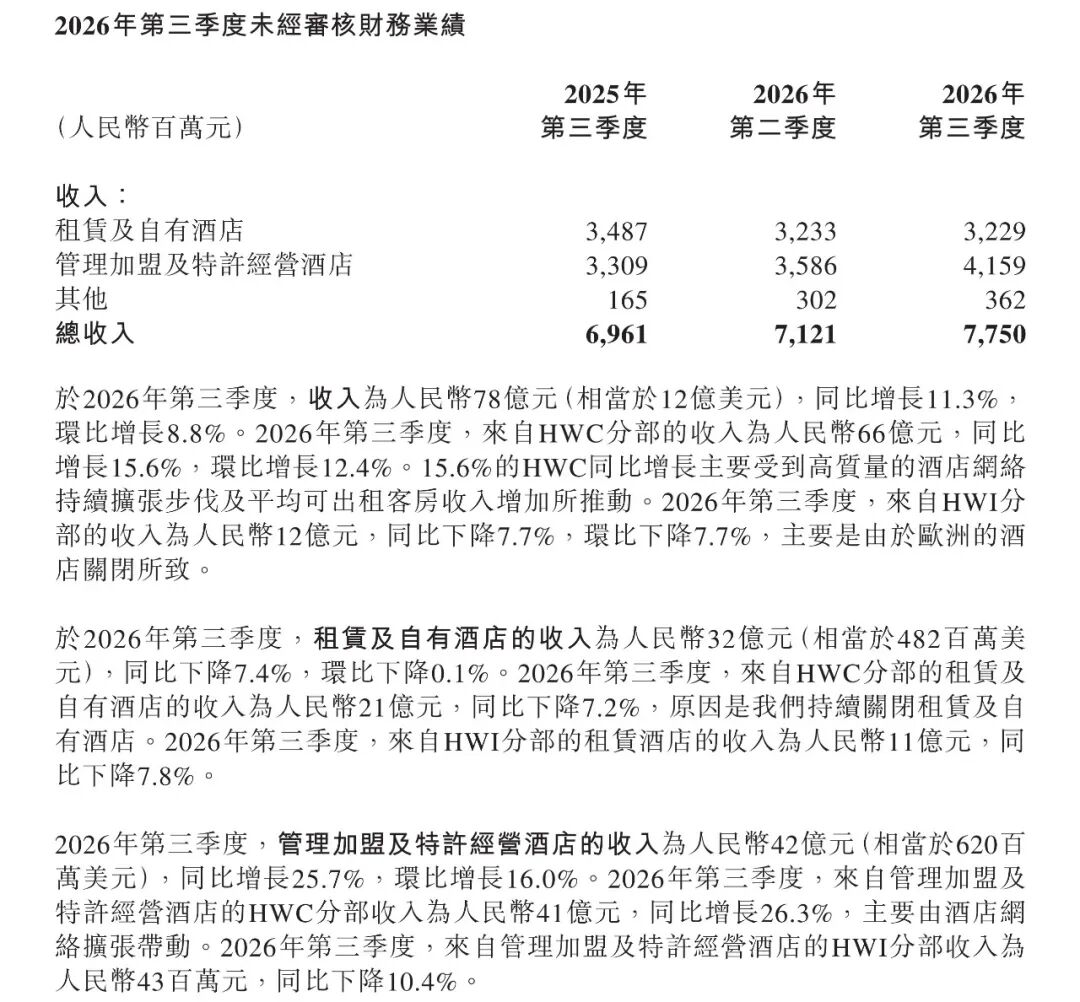
Huazhu's revenue structure in the third quarter illustrates this point. According to the quarterly report, management, franchise and licensing revenue reached 4.159 billion yuan, up 25.7%, accounting for 53.7% of the total revenue, while the leased and owned hotel revenue was 3.229 billion yuan, down 7.4% instead.
According to the same announcement, the franchise revenue increased by 850 million yuan year-on-year, while the group's total revenue only increased by 789 million yuan.
Source: Huazhu Group <2026 Q3 Financial Performance Announcement>
To put it bluntly, except for franchise revenue, the sum of all other businesses is shrinking.
The situation on BTG Hotels' side is more straightforward. According to its quarterly report, the average number of available rooms of directly-operated hotels in the first three quarters decreased by 9.6% year-on-year, and the hotel operation business revenue decreased by 11.07%, while the hotel management business revenue increased by 11.59% in the same period.
One group is closing directly-operated stores, the other is also closing directly-operated stores, and both are collecting franchise fees.
Atour took a different path, neither relying on opening stores nor closing stores, but on selling retail products.
According to the same financial report, retail revenue reached 1.362 billion yuan, up 61.0%, accounting for 39.7% of the net revenue, nearly 40%. In the same period, franchise hotel revenue was 1.878 billion yuan, up 20.4%, and leased hotel revenue was 134 million yuan, down 18.6%.
For a hotel group, 40% of its revenue does not come from rooms.
The accounts of this business are also in the report. The retail cost was 653 million yuan, accounting for 47.9% of retail revenue, slightly higher than 47.3% last year, with gross margin just over 50%. To achieve