Nvidia's quarterly revenue has exceeded 100 billion U.S. dollars, but the world of yesterday is gone forever.
Author | Qiu Xiaofen
Editor | Yuan Silai
Amid the storm triggered by Jensen Huang's departure, NVIDIA has released what is arguably its most high-profile financial report in recent years.
In the early hours of November 18, Beijing time, NVIDIA released its financial results for the third quarter of fiscal year 2027. This is the first performance report of NVIDIA since former CFO Colette Kress took over as interim CEO.
Financial data shows that NVIDIA's revenue in the third quarter reached 115.8 billion US dollars, a year-on-year increase of 103%; net profit reached 65.3 billion US dollars, a year-on-year increase of 105%, both hitting all-time highs. Among them, the revenue of the data center business reached 107.6 billion US dollars, a year-on-year increase of 110%, accounting for 93% of the total revenue.
According to statistics based on the location of customers' headquarters, NVIDIA's quarterly revenue from Chinese mainland and Hong Kong is 11.05 billion US dollars, a year-on-year increase of about 272%. This does not mean that China's AI chip business has recovered. NVIDIA still does not include the revenue from data center computing business in China in its financial guidance for the next quarter.
In just five days since the turmoil, NVIDIA's market value has evaporated by about 800 billion US dollars, equivalent to a drop of 3.5 times the market value of Alibaba. The impressive financial report has injected a strong shot in the arm into the market. After the release of the financial report, NVIDIA's stock price rebounded in after-hours trading, rising by about 4% at one point.
However, even with a financial report that doubled both revenue and profit, the doubts of the capital market have not completely dissipated. The market later gave up part of the gains, and then rebounded to a rise of about 3.4%, showing that market sentiment remains volatile.
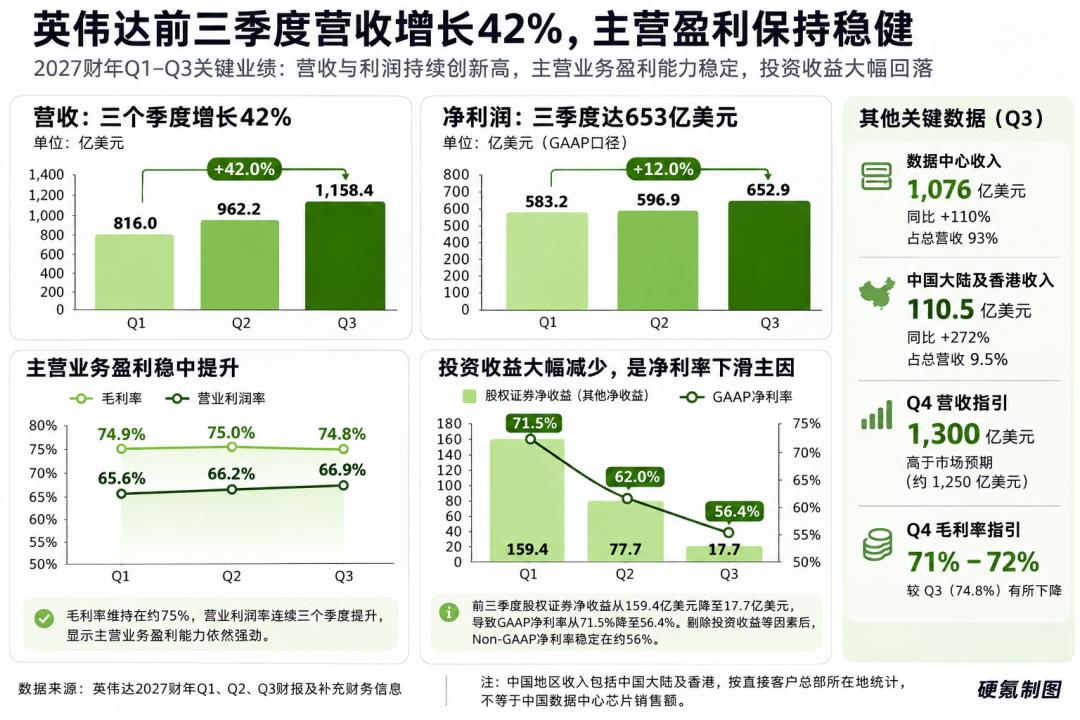
Financial data of NVIDIA in the first three quarters of this year, drawn by Hard Krypton
At least from the financial data, Jensen Huang's departure has not immediately shaken NVIDIA's growth fundamentals. However, the concerns of the capital market have gone far beyond the focus on the company's own performance. The fate of Jensen Huang personally and NVIDIA as a company has been strongly tied to the future AI development process of China and the United States.
Over the past few years, relying on the technological advantages of high-end GPUs, NVIDIA has gradually built a huge industrial network spanning chip manufacturing, cloud computing, and AI model companies. And Jensen Huang himself is the weaver standing at the very center. He is not only a technical leader, but also a key bridge in a sense. His sudden departure and the constantly changing geopolitical environment are bringing new uncertainties to this network.
In China, some cloud vendors and AI enterprises have begun to step up the reserve of overseas computing power resources, and some enterprises have accelerated the adaptation of domestic GPUs. The uncertainty of high-end computing power supply is redistributing the interests of the domestic computing power market.
Facing the growing geopolitical risks, NVIDIA has also begun to adjust its internal governance structure. On the eve of the release of the financial report, NVIDIA's board of directors announced the establishment of a new permanent body "National Security and Export Control Oversight Committee", which will coordinate national security policies, export control compliance and global trade risk management at the board level.
This also sends a clear signal that the past relationship model that relied heavily on Jensen Huang's personal mediation between Washington and global customers is being dismantled into a more institutionalized board-level oversight structure.
In the U.S. capital market, a group of cloud service providers, optical communication and chip manufacturing enterprises that NVIDIA has deeply tied to in the past few years have also suffered successive sharp drops in stock prices. The market has begun to re-examine the industrial relationships built by NVIDIA in the past.
On the one hand, the performance remains strong, on the other hand, industrial uncertainties are increasing. After losing Jensen Huang, NVIDIA is facing a more complex test than the financial report. And the global AI industry has also stepped into drastic turmoil accordingly.
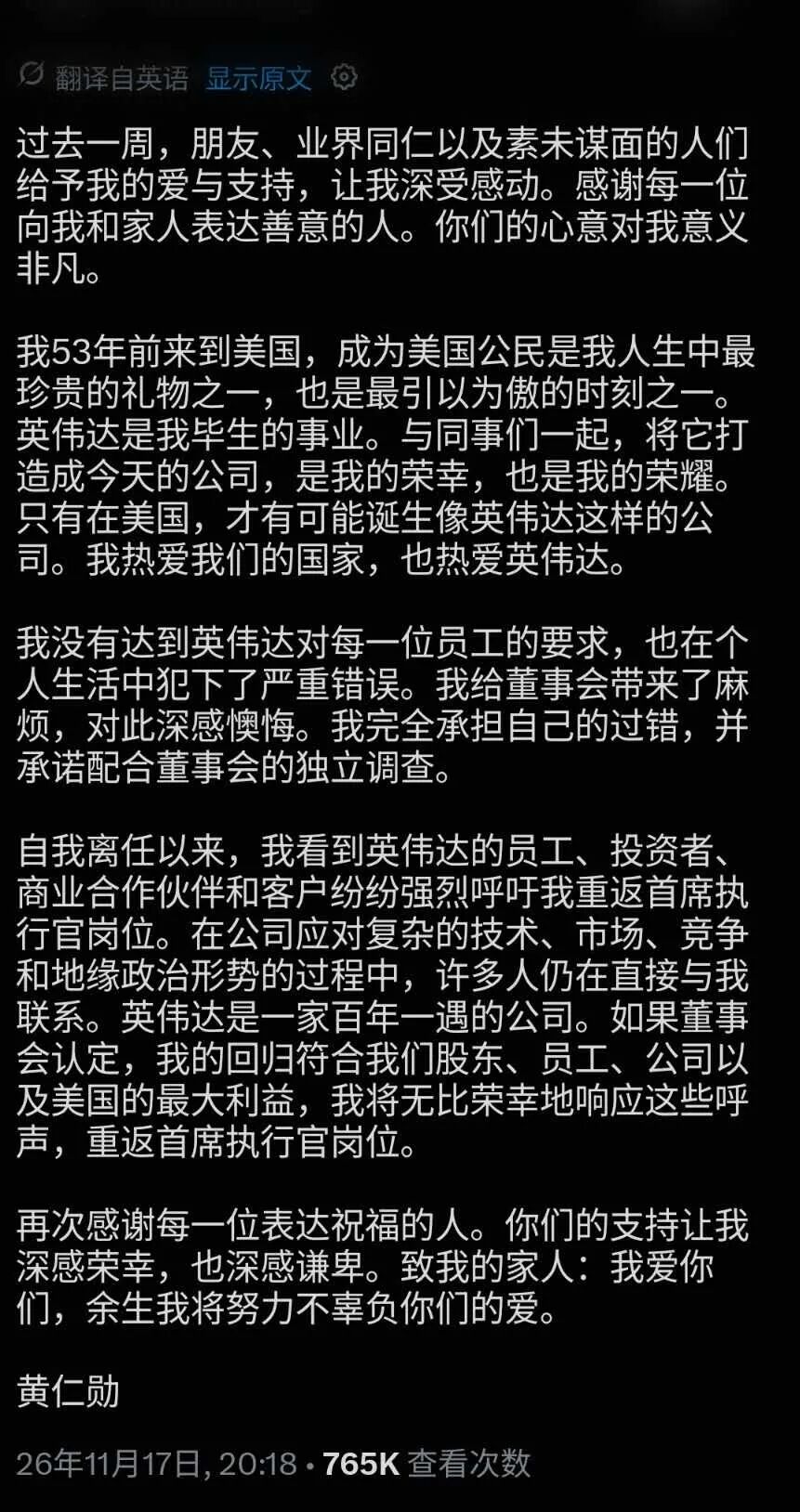
Jensen Huang's latest speech on the 17th
China's Computing Power in the Turmoil
Recently, Hard Krypton has communicated with many people in the domestic computing power industry and found that in the face of NVIDIA's uncertain future, the industry has formed a relatively consistent expectation: In the future, it may be more difficult for Chinese enterprises to obtain NVIDIA's high-end computing power. "If NVIDIA is taken over by other management teams later, the difficulty of getting GPUs will most likely increase, and the overseas investigation of the supply chain will also continue." A person from a cloud vendor told Hard Krypton.
According to media reports on November 12, some Chinese cloud vendors and AI enterprises have begun to lock in overseas NVIDIA GPU resources in advance, some small and medium-sized model companies are also contacting Southeast Asian computing power lessors — trying to lock in future computing power resources as much as possible before the supply policy is further tightened.
But the situation took a sharp turn for the worse faster than they expected.
Just four days later, overseas computing power channels also faced new regulatory pressure.
On November 16, the U.S. Department of Commerce issued new regulations to further strengthen the supervision of data centers in third countries and remote access to advanced AI chips. This means that U.S. restrictions on computing power for China are extending from the export of physical chips to overseas computing power services — even if GPU resources are locked in advance, they may not be able to be used continuously in the future.
NVIDIA
However, the tightening of computing power supply is not bad news for all manufacturers. For cloud vendors that have reserved a large number of GPU resources in the past, the change in supply and demand may instead bring new business opportunities.
"The shortage of computing power is a good thing for us personally. Business will definitely be easier to do next year. Recently, all customers on hand are seizing the time to inquire about prices and snap up computing power." A salesperson from a cloud vendor told Hard Krypton.
When the supply of new high-end GPUs is limited, while the demand for model training and reasoning is still growing, manufacturers that already hold stock computing power will have greater bargaining power. On the contrary, enterprises that lack computing power reserves and still rely on new purchases or overseas leases may face higher costs and supply risks.
On the one hand, the scarcity of stock computing power is further amplified, on the other hand, the uncertainty of new computing power and overseas leasing channels continues to increase — the NVIDIA turmoil is intensifying the differentiation of China's computing power market.
In fact, a large number of domestic manufacturers have long noticed the change of industry trend and adjusted their business directions in advance.
"We are currently working on the second alternative, increasing the intensity of domestic adaptation to cope with potential market changes next year." Another person from a cloud vendor said.
The aforementioned person from the cloud vendor observed that before the turmoil, the players trying domestic computing power were basically central enterprises and state-owned enterprises, while start-ups were worried about the time cost — after getting financing, start-ups need to launch products quickly, and they cannot continue financing without products, so it is difficult for them to have sufficient patience to do domestic adaptation. Therefore, domestic computing power was more regarded as a supplementary option in the past. But now, with the increase of overseas supply uncertainty, domestic chips have begun to take on a more important role in ensuring supply.
An obvious change is that since this year, the adaptation scope of domestic computing power is expanding, gradually extending from a single model to multiple mainstream models and chip platforms.
In the past, domestic chips often needed to be optimized separately for different models. Now, in February this year, Zhipu GLM-5 has been adapted to many domestic chips such as Huawei Ascend, Cambricon, and Moore Threads; in the same period, Taichu Yuanji has been compatible with more than 30 mainstream large models; in September, Huawei Ascend entered the official support system of PyTorch, which means that domestic computing power is trying to extend from single model adaptation to the underlying software ecosystem.
Jensen Huang
The policy side has also quietly sent out signals.
An industry insider told Hard Krypton that in the past two months, some local computing power subsidy projects have put forward stricter requirements on the proportion of domestic GPUs used — among them, some projects even require that the proportion of domestic acceleration cards must reach more than 80%.
An industry insider judged to Hard Krypton that in the process of industrial development, it is inevitable to encounter phased black swan events, but these impacts may not change the long-term trend. "On the contrary, some phased adjustments may make the certainty of industrial development stronger. There will be short-term pain, but in the medium and long term it may be a good thing, which can make the development of this industry more solid."
NVIDIA in the Post-Jensen Huang Era
Outside NVIDIA's headquarters in Santa Clara, USA, across the ocean, the white flowers placed by people after Jensen Huang left have not withered yet.
It is not so much that they are sad for Jensen Huang, but that they are mourning the passing of a better world.
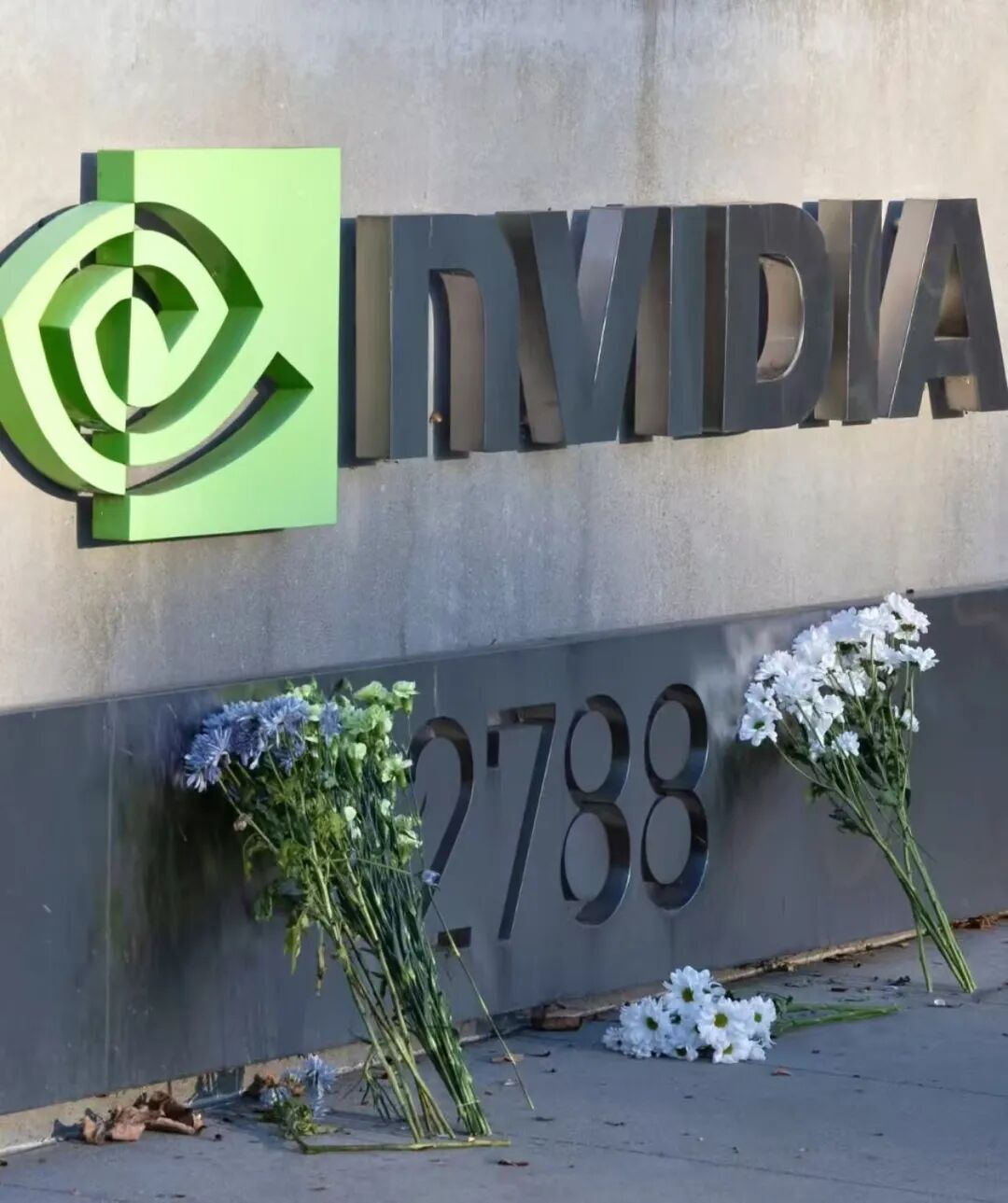
Some people placed flowers at the entrance of NVIDIA to "pay tribute"
The "return to rescue" operation around Jensen Huang has already started.
According to foreign media reports, Jensen Huang's supporters are setting up a "war room" participated by Silicon Valley tech executives, trying to win the support of the White House and promote his return. An online petition asking for his reinstatement has now attracted more than 180,000 signatures.
For this chip giant founded by Jensen Huang and led by him for more than 30 years, the unexpected departure of the founder is obviously not an ordinary management change. There are more complex and huge contradictions and interests behind it. Even if Jensen Huang finally returns, his work style will inevitably change.
Before today's earnings call, Jensen Huang publicly stated that "if the board invites him, he is willing to come back to lead NVIDIA". In response, NVIDIA Chairman Harvey Jones said firmly at the opening of the call that "the board has no intention of restoring Jensen Huang's position as CEO and will not accept analysts' questions on this issue".
Before everything is settled, the impact of the turmoil has expanded and spread to the entire upstream and downstream of the AI industry chain.
Over the past year, NVIDIA has completed a series of equity investments, procurement commitments and technical cooperation.
From taking stakes in Intel, Synopsys, and Marvell, to investing billions of dollars in optical communication enterprises such as Lumentum and Coherent, and then reaching capital and technical cooperation with Corning and Nokia, NVIDIA's investment map has covered chip design, manufacturing, optical communication and network infrastructure. In the downstream, NVIDIA has injected capital into cloud service providers such as CoreWeave and Nebius to support the construction of computing power infrastructure.
That is to say, NVIDIA is no longer just a GPU supplier, but also plays multiple roles such as industrial investor, important purchaser and customer capital provider. By locking in upstream production capacity and supporting downstream computing power demand, NVIDIA is trying to include more enterprises into its computing power ecosystem and build a huge semiconductor empire.
However, the deep binding that was regarded as a competitive barrier in the past has now become a source of crisis.
According to statistics of public market data by Hard Krypton, from November 11 to 16, the stock prices of CoreWeave and Nebius, the AI cloud service providers invested by NVIDIA, fell by about 17.9% and 30.7% respectively cumulatively; optical communication enterprises Lumentum and Coherent fell by about 15.7% and 12.3% respectively, Corning fell by about 11.9%; in addition, Intel and Marvell fell by about 11.2% and 13.9% respectively; Nokia and Synopsys also fell by about 8.9% and 4.5% respectively.
Before NVIDIA's earnings call, the nine companies had a total market value evaporation of about 1118 billion US dollars, roughly equivalent to one Pinduoduo or two Meituan.
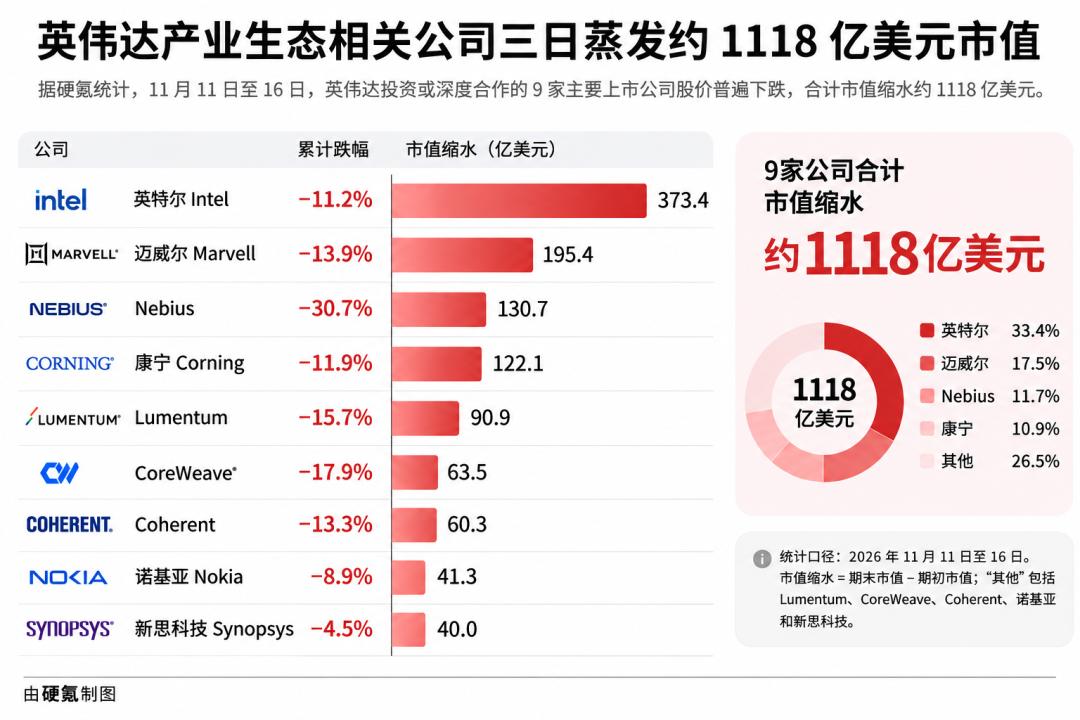
Decline of NVIDIA's industrial chain companies before the release of financial report, drawn by Hard Krypton
However, as NVIDIA released its better-than-expected financial report, market sentiment began to reverse. In after-hours trading after the release of the financial report, CoreWeave and Nebius rebounded by about 5% and 6% respectively, and the stock prices of semiconductor companies such as Intel also rose.
This round of market fluctuations that first fell and then rose reveals another side of NVIDIA's industrial layout: The industrial ecosystem that NVIDIA built through capital and technical cooperation in the past has become a network where risks and benefits are mutually transmitted.
For NVIDIA, the current test may not be how many more GPUs it can sell, but after losing Jensen Huang, whether the company can continue to maintain the rhythm of past technological iteration, capital investment and industrial cooperation under the leadership of new professional managers.
Jensen Huang's departure may be the biggest change NVIDIA has experienced in recent years. And it will affect the trend of the AI industry in the eastern and western hemispheres for many years to come. When we look back then, we may find that we are standing at the turning point of the era at this moment.
