iQiyi has made profits but lost growth, a quarterly report rewritten by short dramas?
On November 16, iQiyi released its financial report for the third quarter of 2026, presenting a contradictory performance sheet: total revenue and membership income declined year-on-year, while Non-GAAP operating profit turned positive from loss.
The platform attributed the weak membership income to "the relatively light content lineup in the same period". Some voices in the market interpreted the return to profitability as a phased victory of the long-video industry's cost reduction and efficiency improvement strategy. However, data of Hongguo Short Dramas forms a sharp contrast at the same time window: its independent App has 168 million daily active users, which has exceeded the sum of daily active users of four major long-video platforms including Tencent Video, iQiyi, Youku and Mango TV. The average daily viewing time per user is about 125 minutes, and it is rapidly swallowing users' attention and advertising budget relying on the free-to-watch with ads model.
A core question arises accordingly: Is this hard-won profitability of iQiyi a signal that the paid business model of long videos has truly achieved sustainable operation, or a short-term hemostasis achieved by actively compressing investment in head content under the continuous squeeze of short dramas?
When the free ad-supported short dramas have run out of a completely different monetization paradigm, the membership subscription logic that long videos rely on for survival is encountering an unprecedented structural challenge.
Profitability brought by contraction?
In the third quarter, iQiyi released a financial report featuring "a 10% revenue drop and profit just crossing the break-even line".
First look at the revenue side. In the third quarter, iQiyi's total revenue reached 6.01 billion yuan, down 10% year-on-year; membership service revenue was 3.97 billion yuan, down 6% year-on-year; online advertising revenue was 1.28 billion yuan, up 3% year-on-year, mainly driven by performance-based advertising; content distribution revenue was 400 million yuan, down 38% year-on-year; other revenue was 360 million yuan, down 39% year-on-year. The Non-GAAP operating profit for the period was 25 million yuan, turning around from an operating loss of 21.9 million yuan in the same period of last year.
After the financial report was released, the capital market gave a feedback in the opposite direction: iQiyi's US stocks plummeted by about 17.90%, closing at $0.68. According to Nasdaq rules, once the closing price is below $1 for 30 consecutive trading days, the company will receive a compliance notice and have a 180-day remediation period. If it cannot stay above $1 again, it will face the risk of delisting.
Then look at the cost side, which is the key to understanding the quality of profits. The operating cost in the third quarter was 4.9 billion yuan, down 10% year-on-year, of which content cost was 3.52 billion yuan, down 13% year-on-year. The decline rate was significantly faster than that of revenue, which was the main driving force for the gross margin recovery; sales and management expenses were 790.5 million yuan, down 15% year-on-year; R&D expenses were 362.5 million yuan, down 1% slightly year-on-year.
In other words, the profit statement returning to positive is not mainly brought by revenue expansion, but the result of faster contraction of content investment and operating expenses.
The membership sector also shows a differentiation of "stable volume, rising price but still declining revenue". In the third quarter, the average daily number of subscribed members was about 107.5 million, up about 6% year-on-year, and the average monthly revenue per member reached 15.54 yuan, exceeding 15 yuan for the first time.
The number of members has not collapsed, and price increase has become the main support for revenue; however, against the background of relatively light content lineup, membership revenue still declined by 6% year-on-year, which means that the unit price increase is not enough to fully offset the renewal and viewing pressure brought by weakened content attractiveness. The official attributed the decline in membership revenue to "the relatively light content lineup in the same period", and the weight of the content lineup itself is exactly the result of trade-offs in content investment.
There is a negative cycle that needs to be warned of: cutting the supply of blockbuster content will weaken the platform's attractiveness to new and old members; after the willingness to renew membership declines and revenue slows down, the platform may further compress the content budget.
In the short term, cost reduction has secured the profit safety cushion; in the long term, if the content thickness continues to thin, users' reason to pay for membership will also be weakened. Whether this cycle has started needs to be verified by the member retention and content lineup data in the next few quarters.
Looking outward, the pressure does not only come from long-video peers.
According to QuestMobile's monitoring, Hongguo Short Dramas App has 168 million daily active users and an average daily viewing time of about 125 minutes per user (Note: the statistical caliber of daily active users includes opening behaviors such as check-in and watching coin incentive activities, which is not exactly the same as the statistical caliber of long-video platforms), indicating that what it competes for is no longer just fragmented time such as commuting and queuing, but the whole evening time that originally belongs to chasing TV dramas and variety shows.
The disposable viewing time of users is a relatively fixed pool. For every extra minute short dramas take up, the whole block of time that long videos can get will decrease by one minute — this is a zero-sum game of attention distribution, rather than two non-interfering markets.
Collision of underlying logic of two business models
The deep-seated background of iQiyi's pressure is the collision of the underlying logic of two sets of content business models.
Long videos follow the C-end paid route: users pay membership fees first, the platform bears high production and procurement costs in advance, bets on head blockbusters, and relies on story depth and long-term character relationships to retain users; its ceiling is the upper limit of users' willingness to pay, membership penetration rate and price increase space.
The short drama route represented by Hongguo is paid by the B-end advertisers: content is free for users, the platform monetizes through ads, most of the costs are postponed and transferred to producers and traffic investment teams, and relies on high-density reversal hooks to complete instant retention. The monetization link is "traffic — advertisement — traffic investment horse race".
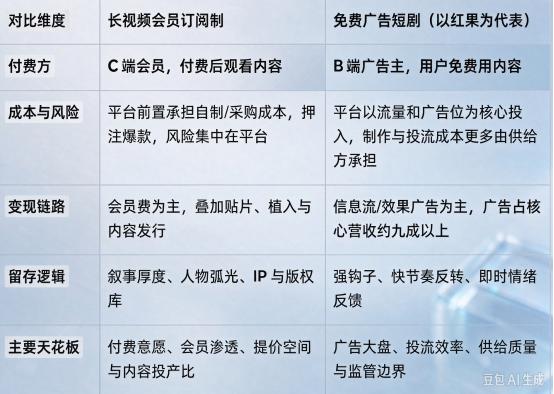
What the two models compete for is the same group of users' attention and the same pool of advertising budget.
Brands' advertising investment is shifting from long-video pre-roll ads and drama placement to short drama feed ads with shorter conversion links and measurable delivery effects; this also explains why iQiyi's advertising revenue only achieved a slight increase driven by performance-based ads, while long drama advertising relying on brand placement is relatively under pressure.
Objectively speaking, short dramas have not completely replaced long dramas in content form, but they have developed an alternative solution that does not require users to pay and has a lighter expansion cost structure — which is the most substantial challenge to the foundation of long-video subscription. Users may not cancel their memberships because of this, but when free content can meet most entertainment needs, users' psychological perception of whether the membership is "worth it" will be constantly shaken.
The high growth of the short drama track is currently mainly precipitated at the platform level.
According to calculations by multiple industry media (not the data disclosed in ByteDance's official financial report), Hongguo's core revenue in the first half of 2026 is about 20 billion yuan, up about 87% year-on-year, of which advertising accounts for about 97%; this caliber has excluded e-commerce GMV. In the revenue-sharing chain, the platform controls the traffic entrance and advertising pricing power and is in a strong position. The share of producers varies greatly between live-action dramas / AI comic dramas, exclusive / non-exclusive, and the profit of tail projects is very thin.
The situation of the upstream of the chain is significantly different.
According to industry reports, the revenue sharing per 10,000 plays of AI comic short dramas has dropped from the previous 100-yuan level to the range of 5-10 yuan. There have been cases where a short drama with 180 million plays only got a settlement of 180,000 yuan for the producer; industry feedback shows that a large number of small and medium-sized short drama companies are in a loss state, and the revenue is highly concentrated in the head live-action hit dramas.
This pattern echoes the long-video copyright war in the early years: at that time, platforms also occupied a strong position at the channel end, squeezing the bargaining space of producers upward. The short drama track is replicating the distribution structure of "strong channels, weak content suppliers".
The long-term hidden danger arising from this is clear: when producers continue to make thin profits or even losses, will high-quality screenwriters, directors and actors stay in this track continuously? Will the homogenization of low-cost, formulaic content accumulate users' aesthetic fatigue? At present, platforms have lowered the minimum guarantee and revenue-sharing coefficients for pure assembly-line all-AI short dramas, and the policy orientation itself also shows that platforms are actively stepping on the brakes for supply quality.
Conversely, this exactly constitutes the remaining relative moat of long videos: the film and television industry system that carries long-term narratives, complex characters and high-quality production is a capability that the short drama model cannot replicate in the short term.
But the moat is not static — when users are trained to have shorter patience by short dramas, whether the foreshadowing of the first few episodes of long dramas can retain people is becoming a new test.
The width of the moat ultimately depends on whether high-quality content can continue to be converted into membership payment.
Can long-video platforms create their own Hongguo?
Facing the impact of short dramas, long-video platforms have not taken no action.
iQiyi disclosed in its third-quarter financial report and conference call that the amount of content uploaded to the platform increased by more than 360% year-on-year; 58 revenue-sharing short dramas were launched in the quarter, and about 190 are expected for the whole year, of which AI-generated content accounts for about 30%. The management said that the revenue-sharing model converts part of the content cost from fixed investment to performance-based sharing, which helps reduce production investment, improve cash flow, bind revenue with playback performance, and incentivize producers to optimize their budgets.
Among other long-video platforms, Tencent Video has unified the revenue-sharing rules for long, medium and short dramas, adopting a combination of membership revenue sharing, advertising revenue sharing and self-invited investment revenue sharing; Youku adopts advertising CPM revenue sharing and introduces effective playback rating; Mango TV adopts combined modes such as "minimum guarantee + revenue sharing".
Around July 2026, Douyin, Tencent and iQiyi simultaneously implemented the new layered revenue-sharing policy for AI short dramas, canceling the special minimum guarantee for all-AI assembly-line dramas, lowering the revenue-sharing coefficient, and releasing support resources for projects combining live-action shooting and AI assistance.
However, long-video platforms have two inherent shortcomings in doing short drama business. The first is the difference in traffic entrances: Hongguo relies on Douyin's free traffic pool and closed-loop of traffic investment, while the main position of long videos is the membership ecosystem, with a weak foundation of free organic traffic, so the customer acquisition cost structure is naturally at a disadvantage.
The second is the internal system conflict: if you vigorously develop free short dramas, it will divert the viewing time of original paid members and dilute the membership value; if short dramas continue to adopt the paid revenue-sharing model, they will lose the core free drainage advantage of short dramas. This is why most long-video platforms' short drama layout is more like a defensive supplement, rather than a second growth curve that can match Hongguo's growth trajectory.
Another subtle change occurs inside the long drama creation: the reinforcement of hooks in the first few episodes of dramas, advanced conflicts and accelerated rhythm, essentially mean that the long drama narrative is passively adapting to the user patience reshaped by short dramas. It is still long video in form, but the attention logic is moving closer to short dramas. Whether this two-way convergence can be converted into new membership value has not yet been proven by data.
If we broaden the perspective, this so-called profit-turning financial report of iQiyi is more like a watershed signal for the long-video industry.
Cost reduction and profit preservation is an effective short-term defense, and it does improve the cash flow and profit statement, but defense cannot replace growth. Subscription-based long videos and free ad-supported short dramas are not a simple replacement of old and new content, but a long-term game around user attention, advertising budget and content production rules.
Long videos have completed hemostasis at present, but if they want to get out of the passive defensive situation, simply compressing content investment is far from enough — it needs to re-find the supporting logic of membership value in the new attention order: either consolidate the paid thickness of high-quality content, or truly occupy a position in the free advertising system. Neither of these two paths has been fully verified yet.
This article is from the WeChat official account "Unicorn Observation", author: Unicorn Observation, published with authorization from 36Kr.