TikTok's newly launched e-commerce app has started to go head-to-head with its old rival.
Recently, TikTok has launched the standalone TikTok Shop App for consumers in Southeast Asia.
The core function of this App is "product display and purchase". Its homepage presents a shopping search bar, product category navigation, and a waterfall flow of products, while short video and live streaming shopping functions are placed in a secondary position to supplement product information and demonstrate product usage scenarios. This App is equipped with functions including personalized product recommendation, exclusive offers, secure payment, order tracking and 24/7 customer service.
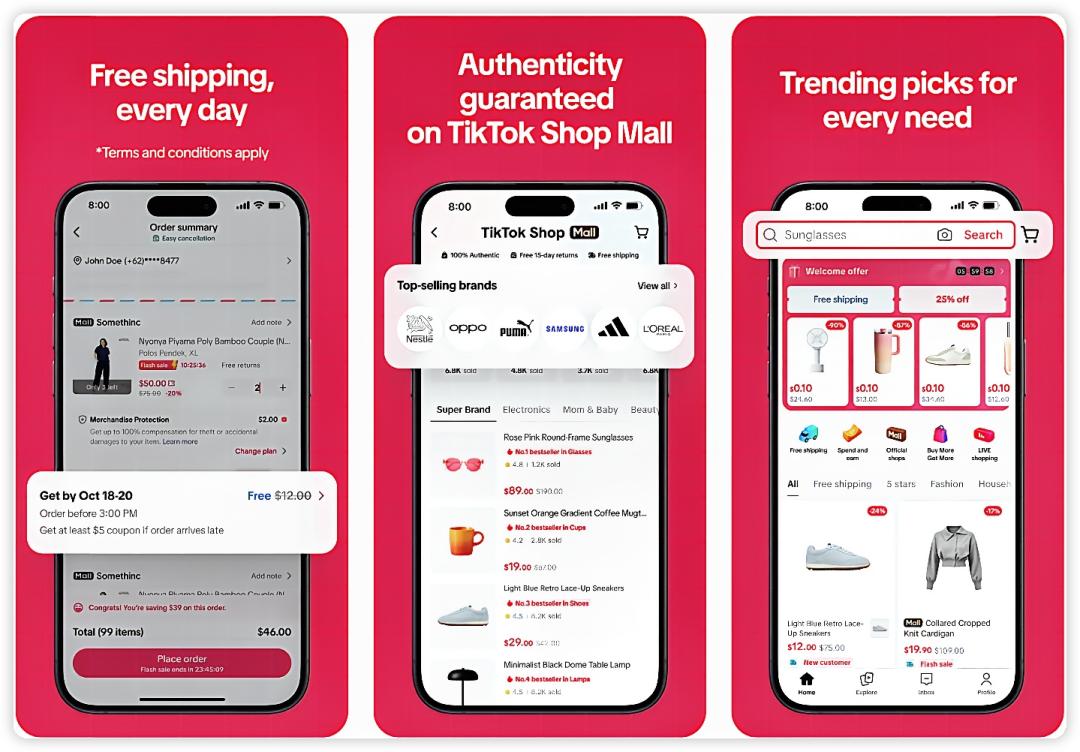
At present, the TikTok Shop App has been launched in Singapore, Malaysia, Thailand and the Philippines, and is available for download on both iOS and Android app stores.
The launch of the standalone App by TikTok is an important step forward from the "content e-commerce" model to the integrated "content + shelf" model.
In the past, TikTok relied on its short videos and live streams to drive consumers to "passive product discovery + impulse purchasing", which was mainly a "product finds user" model. Now, after the launch of the standalone TikTok Shop App, it will take on more "user finds product" businesses, further get rid of the constraints and limitations of the main TikTok app, and make full efforts to compete more strongly with shelf e-commerce platforms such as Shopee, Lazada and Temu.
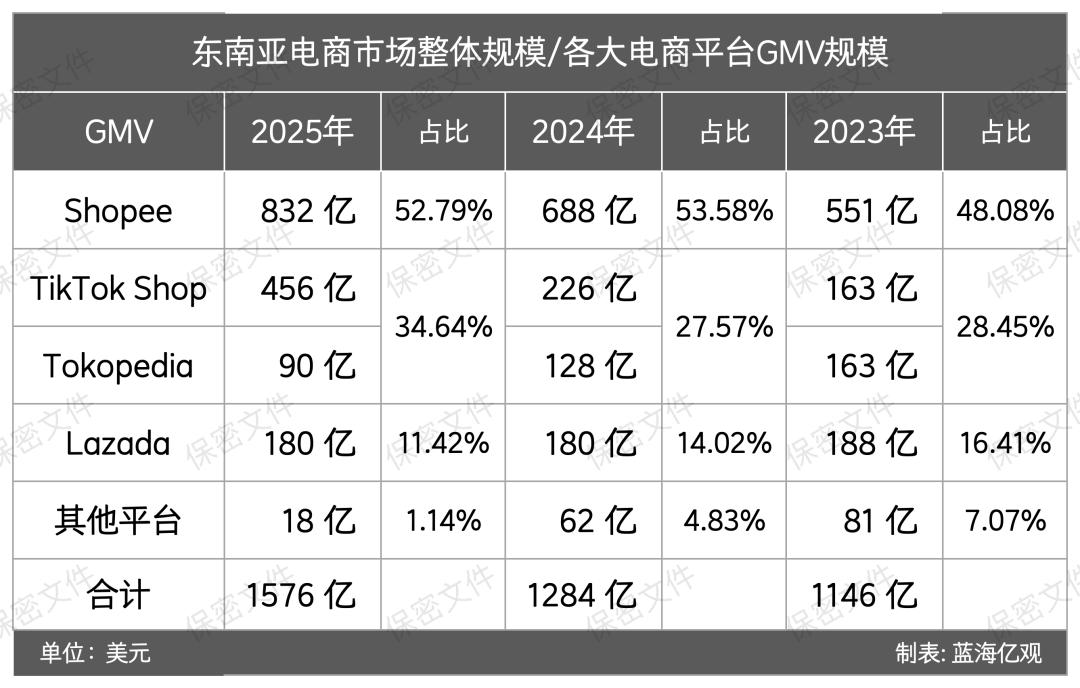
In Southeast Asia, TikTok and its Indonesian subsidiary Tokopedia have surpassed rivals including Lazada to become the second largest e-commerce platform only after Shopee . In 2025, the combined market share of the two in Southeast Asia reached 34.64%.
As the leading e-commerce player in Southeast Asia, Shopee has always been on guard against the rapid growth of TikTok. In the first quarter of 2026, Shopee's parent company SEA Group stated that "the adverse impact brought by TikTok Shop has been included in its financial considerations".
Of course, after the launch of the standalone TikTok Shop App, to compete head-on with comprehensive platforms such as Shopee and cultivate users' mental awareness of "opening the TikTok Shop App whenever they want to buy something", it will also face a series of pressures and challenges.
It is High Time to Launch a Standalone Mall App
For TikTok Shop, it is the perfect time to launch the standalone App right now.
In recent years, the transaction structure of TikTok Shop has undergone rapid changes. The proportion of GMV contributed by short videos, which used to dominate, has started to decline, while the GMV contribution from the Shop mall has gradually increased.
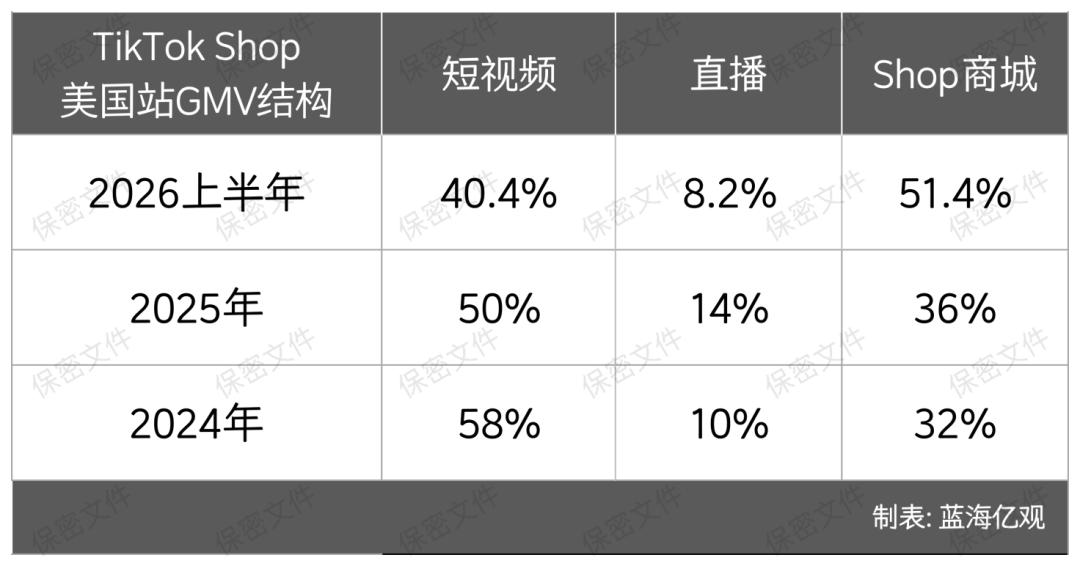
Take the US site as an example. In 2025, the proportion of TikTok Shop's GMV from short videos and live streams dropped by 8% year-on-year, while the proportion of GMV from the Shop mall increased by 4 percentage points year-on-year.
In the first half of 2026, this change became more obvious. For TikTok Shop US, the GMV proportion from the Shop mall reached 51.4%, exceeding the 40.4% proportion from short videos for the first time and becoming the largest source of GMV contribution.
This means that the Shop mall is becoming an increasingly important transaction scenario, and a large number of consumers have begun to actively enter the "shelf e-commerce" scenario for shopping.
On the other hand, TikTok's native "content ecosystem" has become a "double-edged sword". While diverting traffic to TikTok Shop, it has also created certain obstacles to its further development, which is one of the reasons why TikTok Shop focuses on deploying "shelf e-commerce".
Many users open TikTok mainly to watch short videos and live streams, and usually do not have clear shopping needs. Only when they are occasionally attracted by embedded content, will they further click on the product link to complete the purchase.
This model has certain limitations.
Whether a product can get exposure largely depends on content recommendation, and whether consumers will develop purchase interest is also affected by factors such as video quality, creator performance and live stream atmosphere. Many users swipe to the next video after only a few seconds, without stopping for the product at all.
In contrast, "shelf e-commerce" focuses more on product display, search and comparison. Consumers can actively search for products, compare prices, check reviews and then decide whether to make a purchase according to their own shopping needs.
For example, when the filter element of a household water purifier expires, consumers with "clear demand for replacing the filter element" will enter shelf e-commerce platforms such as Amazon and Shopee, search for the corresponding model, compare prices and product parameters, and finally select the right product to place an order.
By launching the standalone shopping App, TikTok is precisely to separate the "shelf" from the short video feed of the main application, providing users with a browsing and search interface closer to traditional e-commerce, while retaining short videos and live streams as traffic entrances.
In fact, TikTok has long begun to develop "shelf e-commerce". In 2023, TikTok set up the Shop mall entrance in its main US application, allowing consumers to actively browse and search for products in addition to shopping through short videos and live streams.
However, this mall has always been embedded in the TikTok App, and is closely linked to the product planning and traffic distribution of its main application, which prevents TikTok Shop from making greater progress in its shopping business.
Both TikTok and TikTok Shop belong to parent company ByteDance, but they are actually relatively independent business departments, with independent profit and loss accounting, return on investment requirements and business objectives respectively.
First of all, their business objectives are not completely consistent.
TikTok is a social entertainment platform, which needs to continuously recommend attractive content to users, extend user stay time, and take into account businesses such as advertising monetization at the same time.
The core goal of TikTok Shop is to facilitate product transactions. It not only hopes that consumers can discover products and generate purchase interest through short videos and live streams, but also hopes that consumers will actively open the platform to shop and form continuous repurchases when they have no demand for watching videos or live streams.
This means that the two are complementary, but there is also a certain degree of competition at the same time.
The more traffic TikTok Shop's "shelf e-commerce" obtains, the more shopping content will be pushed to the main TikTok application, which will weaken users' entertainment experience.
At the same time, if TikTok Shop wants to obtain more traffic from the main application, it also needs to pay corresponding costs. According to ByteDance's internal settlement mechanism, TikTok Shop needs to pay traffic fees to TikTok. As the investment in traffic procurement increases, its own customer acquisition cost will also rise accordingly.
In addition, according to insiders, adjustments to TikTok Shop's shopping experience often require coordination and approval from TikTok's headquarters. This means that even if TikTok Shop wants to add more shopping entrances and adjust the product recommendation method, it also needs to consider the product planning and business objectives of the main App.
For TikTok, increasing the transaction volume of TikTok Shop does not necessarily mean that the ROI of the main application will also increase.
Therefore, the main TikTok application will not increase product recommendations infinitely. Short videos, advertisements and e-commerce content are all competing for users' limited attention. If a large number of adjustments are made to the feed to increase shopping transaction volume, it may affect users' original entertainment experience, and will also compress the display space of other content and advertisements.
Against this background, TikTok's launch of the standalone shopping App is equivalent to adding an independent product entrance for TikTok Shop, which will help balance the business priorities between the two, allowing TikTok Shop to focus on selling goods, while TikTok focuses on its entertainment attributes and sells goods incidentally.
However, it will take time for TikTok Shop to gradually convert the temporary purchase behavior generated by users when watching videos into the habit of actively opening the shopping application, continuously browsing products and making repeated purchases, and it is bound to face a series of challenges.
The Battle Between TikTok Shop, Shopee and Lazada
At present, Southeast Asian consumers do not lack shopping Apps.
Shopee and Lazada have been operating locally for many years and have accumulated a large number of merchants and consumer users. Shopee has taken the leading position in the market with its product supply, search, payment and logistics systems, while Lazada has its own advantages in brand merchants and genuine product guarantee.
The standalone shopping App launched by TikTok Shop is precisely to compete with these established platforms for the existing share of the "shelf e-commerce" market.
At present, in terms of market size, there is still a considerable gap between TikTok Shop and Shopee.
In 2025, the GMV of Southeast Asian e-commerce platforms reached 157.6 billion US dollars. Among them, Shopee ranked first with a GMV of 83.2 billion US dollars, followed by TikTok Shop (GMV of about 45.6 billion US dollars), and Lazada (GMV of about 18 billion US dollars).
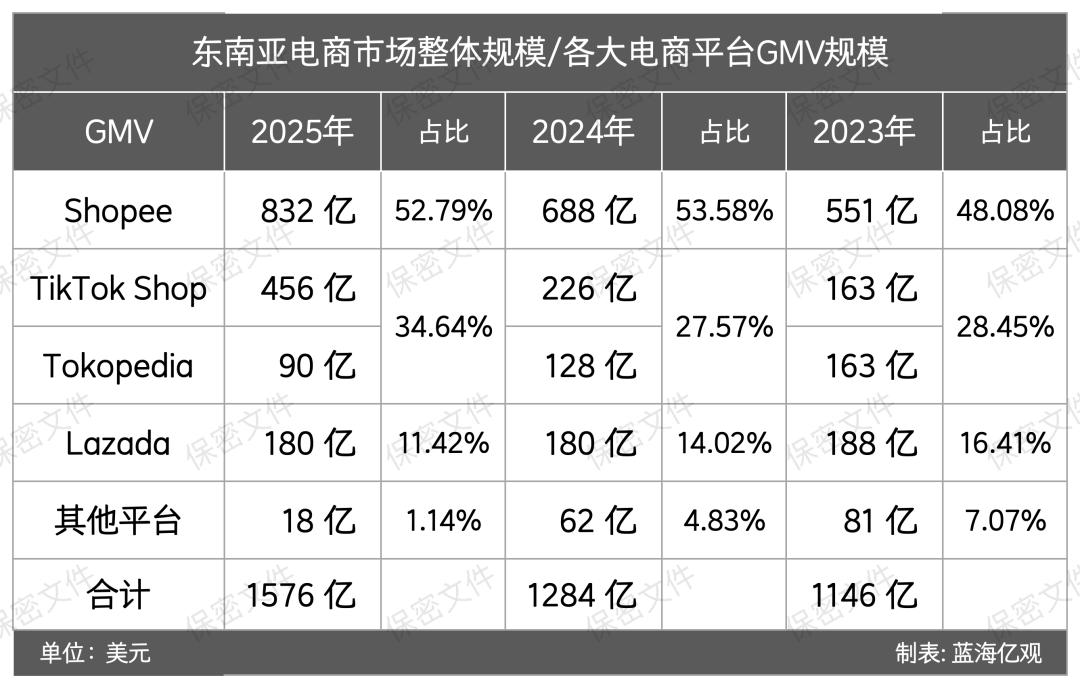
If TikTok Shop is combined with its controlled Tokopedia for calculation, the combined GMV of the two reaches 54.6 billion US dollars, equivalent to 65.7% of Shopee's.
In terms of traffic, Shopee also occupies a dominant position. From January to October 2026, the total visits to Shopee's main site reached 31.51 million, far exceeding Lazada (8.559 million) and TikTok Shop (7.285 million).
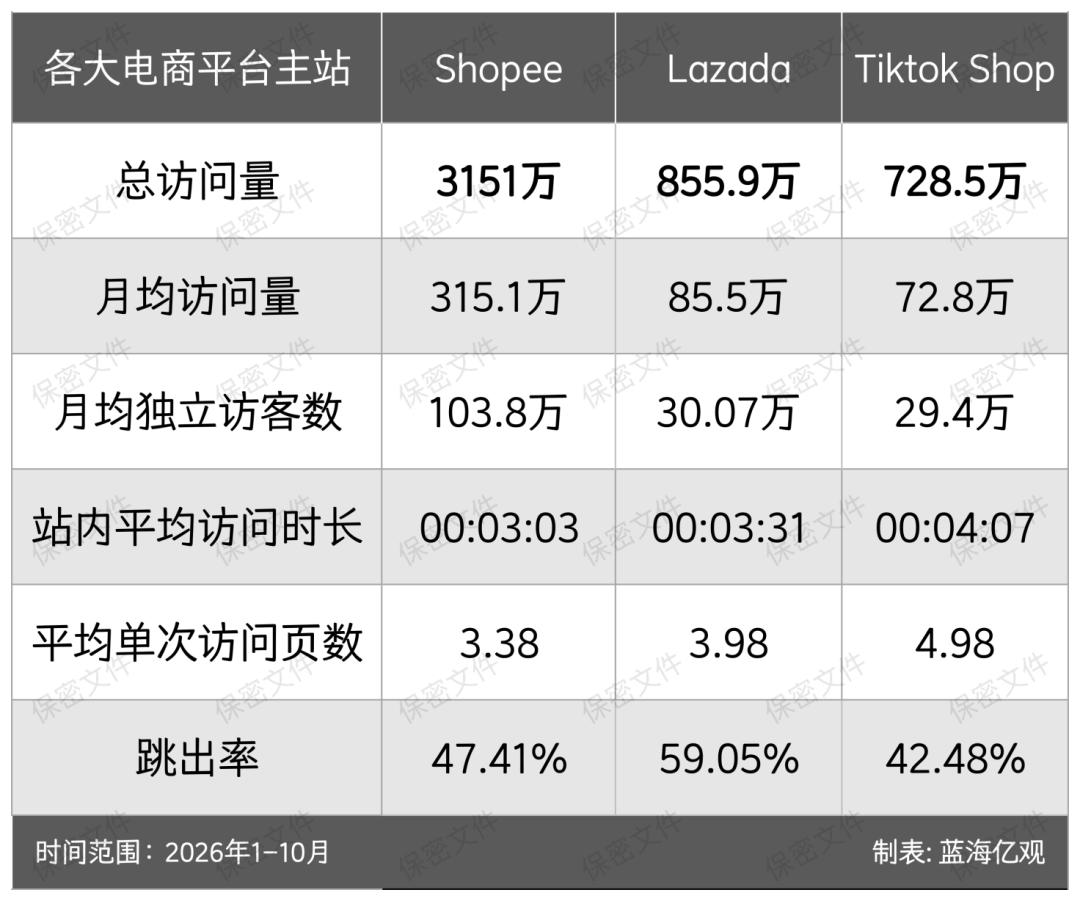
However, this gap is narrowing. In September 2026, the total visits of TikTok Shop in six Southeast Asian countries was about 462 million, reaching 97.5% of Shopee's. This means that TikTok Shop has grown from a latecomer in the Southeast Asian e-commerce market to an important competitor second only to Shopee.
Shopee's real advantage lies in its product supply and transaction system accumulated over many years. A large number of consumers have been accustomed to searching for products, comparing prices, checking reviews and then completing orders on Shopee. For people with clear shopping needs, this set of services is already quite familiar.
In contrast, although TikTok Shop can arouse the immediate purchase interest of some consumers through creators and short videos, to make consumers form continuous shopping habits, it still needs to continue to invest in links such as product search, reviews, repurchase and performance, and provide a sufficiently good experience.
Lazada, through businesses such as LazMall, continues to attract brand merchants to settle in, and has certain advantages in categories that focus on brand and genuine product guarantee such as electronic products and home appliances.
In addition, Shopee does not only stick to the traditional advantages of shelf e-commerce, but also increases investment in "content e-commerce".
In the Southeast Asian market, the influence of "content e-commerce" is expanding. Data from Momentum Works shows that the GMV of Southeast Asian "content e-commerce" reached 49.7 billion US dollars in 2025, accounting for 32% of the platform e-commerce GMV, higher than 20% in 2024. Shopee is also competing for this part of the market.
At present, Shopee is increasing its investment in short videos, live streams and other aspects, and has achieved certain results. Data from Shopee's parent company Sea shows that in the third quarter of 2026, orders brought by Shopee's live streaming and short video businesses increased by more than 45% year-on-year, accounting for more than 25% of its physical product orders in Southeast Asia.
This means that content e-commerce is not TikTok Shop's unique competitive advantage. As Shopee increases its layout of related businesses, TikTok Shop not only needs to compete with its rivals for the "shelf e-commerce" market, but also faces the catch-up of its rivals in the field of content e-commerce.
In addition to the adjustments on the product side, TikTok is also further consolidating the foundation of its local e-commerce business.
In December 2023, TikTok reached a strategic cooperation with Indonesian GoTo Group to integrate TikTok Shop's Indonesian business with Tokopedia. In January 2024, the two sides announced the completion of the transaction, and TikTok obtained 75.01% controlling stake in the merged PT Tokopedia.
This cooperation allows TikTok Shop to carry out business in the Indonesian market with the help of Tokopedia's original merchant resources, product supply and local operation foundation, reducing the burden of building a local e-commerce system from scratch.
On the whole, whether TikTok Shop can further narrow the gap with Shopee depends not only on whether its standalone shopping App can make consumers actively open TikTok Shop when they have shopping needs, but also on whether its experience in product supply, search experience, price competitiveness, logistics performance and other aspects can keep up, all of which remain to be verified by time. (Blue Ocean E-View)
Note: Part of the data is based on surveys and studies of certain samples; website access data and sales data will fluctuate in different periods and are for reference only.
This article is from the WeChat official account "Blue Ocean E-View (ID: egainnews)", written by Blue Ocean E-View, and authorized for release by 36Kr.