After getting crushed by leverage, the "AI stock guru" has switched to a new betting strategy.
This summer, Leopold Aschenbrenner, the "AI Stock God" once hailed by Wall Street as a new generation investment myth, and his fund Situational Awareness LP experienced a dramatic rise and fall dramatic enough to be recorded in the investment history books.
In our 13F tracking reports for Q1 and Q2, we witnessed how he pushed the fund's public positions to a peak of over 20 billion US dollars through extreme bets on AI infrastructure (storage, power, computing power). However, shortly after the end of the Q2 reporting period, the sharp correction of the AI sector in July, superimposed on an excessively high leverage ratio, dealt a heavy blow to Situational Awareness. Leopold was eventually forced to liquidate his positions at a loss, selling the vast majority of his public market stock portfolio at a discount to Citadel under Ken Griffin.
The story did not end there. In September this year, sources familiar with the matter revealed that Leopold had returned to the investment battlefield. During the recent sharp correction in the US stock market, rumors even spread for a time that Leopold had "blown up his positions a second time" — the rumors have not been confirmed, and many details were speculated based on the Q2 position report that has lost reference value — but since the disclosure window for Q3 13F had not yet opened, the outside world could never see the real cards of this former myth after the July catastrophe.
On November 17, Beijing time, Situational Awareness finally submitted its 13F position report as of September 30, 2026 to the U.S. Securities and Exchange Commission (SEC). This long-overdue report card finally reveals his current layout for us.
Who is the "AI Stock God"? (Skip if you are familiar with the background)
In March this year, we first introduced Leopold in the article "The Young Associate of SBF Turned 225 Million into 5.5 Billion in One Year" (https://www.odaily.news/zh-CN/post/5209583).
Leopold worked at Future Fund under FTX in 2022, and stayed on the team until FTX collapsed. In 2024, Leopold wrote a 165-page super paper titled "Situational Awareness: The Decade Ahead", and founded the fund of the same name Situational Awareness in the same year, serving as its Chief Investment Officer.
Situational Awareness focuses on investment opportunities in the AI industry chain. The fund's public position size in Q4 2024 was "only" 225 million US dollars; in the Q4 2025 position disclosure announced in February this year, this figure skyrocketed to 5.5 billion US dollars; when the Q1 positions were disclosed in May this year, the figure had risen to 13.7 billion US dollars; and it even reached a peak of 20.2 billion US dollars in the Q2 disclosure... but all these figures are meaningless now.
Odaily Note: It should be noted that in the statistical caliber of the US stock market's 13F filings, the market value displayed for option assets is usually the "Notional Value" of the underlying stock corresponding to it, not the actual option premium cost paid by the fund.
With explosive investment returns, Leopold and Situational Awareness rose to fame, once becoming one of the most watched AI investment vane across the entire network, and Leopold was given the title of "AI Stock God" by the market that is keen on creating myths.
Position Shrank by 92%: Plunged from 20.2 Billion to 1.58 Billion
In terms of fund size, after the "big discount sale" in July, the position size of Situational Awareness has been greatly reduced.
According to the newly disclosed Q3 13F filing, as of September 30, 2026, the disclosed 13F position value of Situational Awareness has plummeted from approximately 20.24 billion US dollars at the end of Q2 to approximately 1.58 billion US dollars, with a single-quarter shrinkage rate as high as 92.2%.
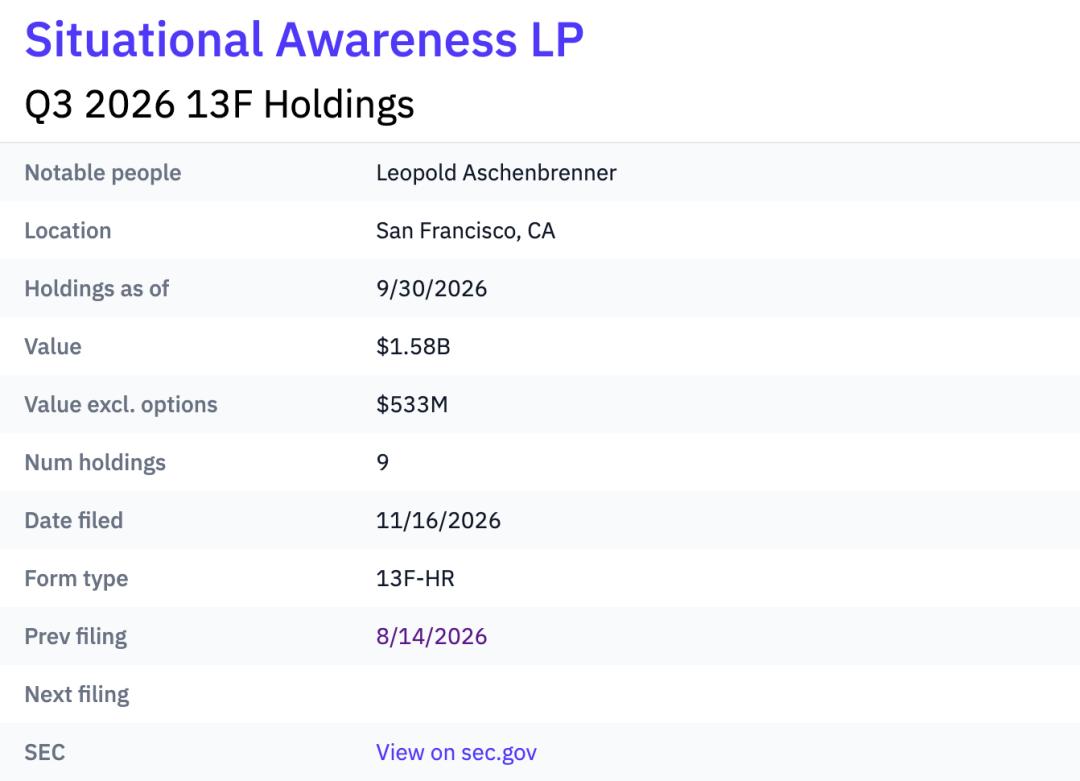
If we further break down the position structure, this change becomes even more obvious:
Excluding option positions, the value of regular stocks shrank extremely sharply: the fund held as much as 20.17 billion US dollars of regular stocks at the end of Q2; by the end of Q3, the total value of its regular stock positions was only 533 million US dollars, and the size of regular stocks shrank by 97.4%.
Positions are extremely streamlined: the number of position targets was directly cut from 42 in Q1 and 26 in Q2 to 9 in Q3.
The concentration of top five heavy positions is as high as 94.2%: out of the total notional exposure of 1.58 billion US dollars, the top five positions contributed a total of approximately 1.485 billion US dollars, accounting for 94.2% of the entire investment portfolio.
In short, after surviving the liquidation crisis in July, Situational Awareness is no longer a 10-billion-level giant ship in the secondary market that relies on its huge size to cover multiple tracks and dozens of targets. Instead, it has greatly reduced its fund size and highly concentrated the remaining chips on a small number of core targets.
Core Position Breakdown: Fully Shift to Options, SHAZ Becomes the Only Heavy Position in Regular Stocks
In the total notional position of 1.58 billion US dollars, what exactly did Leopold buy back?
The answer is still his familiar formula — AI computing power cloud, data center power, and AI storage; at the same time, Leopold's specific trading model has changed significantly — from "hoarding large amounts of regular stocks" to "deploying call options".
In the Q2 report, as much as 99.6% (20.17 billion US dollars) of Situational Awareness's 20.24 billion US dollar positions were real stock spots, and the two storage giants Sandisk (SNDK, 28.0%) and Micron (MU, 27.5%) alone took up half of the total. In the Q3 report, the proportion of regular stocks was compressed to only 33.7% (about 533 million US dollars), and the remaining 66.3% (about 1.047 billion US dollars) of the notional exposure was all composed of call options.
The following is the breakdown of Situational Awareness's core positions as of the end of Q3 2026.
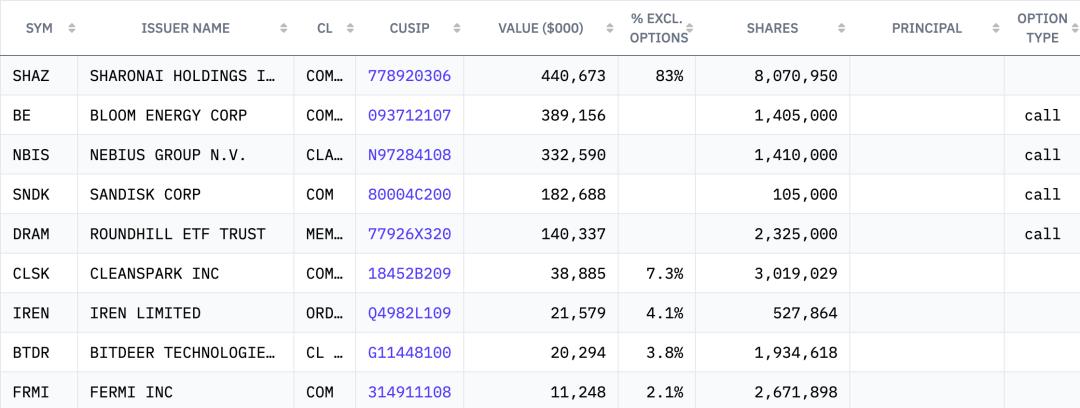
Specifically, the top five heavy position targets in Q3 (accounting for a total of 94.2%):
The largest heavy position: SharonAI (SHAZ) regular stocks, with a position market value of about 441 million US dollars, accounting for 27.9%. This is the only heavy regular stock target of the fund at present. Now, Situational Awareness holds more than 21% of the outstanding shares of this Australian AI computing power cloud service provider.
The second largest heavy position: Bloom Energy (BE) call options, with a notional value of about 389 million US dollars, accounting for 24.7%. The logic of betting on the power supply bottleneck of data centers continues, but the position method has been replaced from regular stocks in Q2 to call options.
The third largest heavy position: Nebius Group (NBIS) call options, with a notional value of about 333 million US dollars, accounting for 21.1%. It is also a representative of the emerging computing power cloud (Neocloud) that Leopold has long been optimistic about, and continued to maintain high exposure with call options in Q3.
The fourth and fifth largest heavy positions: SanDisk (SNDK) call options, with a notional value of about 183 million US dollars, accounting for 11.6%; Roundhill Memory ETF (DRAM) call options, with a notional value of about 140 million US dollars, accounting for 8.9%. On the core storage track, Leopold liquidated his positions in Micron (MU) and SanDisk (SNDK) regular stocks in Q2, and instead used SNDK call options paired with call options of the memory industry ETF (DRAM) to continue betting on the rise of the storage cycle.
In addition to the top five positions, Situational Awareness also holds a small amount of common stocks of CleanSpark (CLSK), Iren (IREN), Bitdeer (BTDR) and Fermi (FRMI). Among them, the first three have been significantly reduced, and FRMI is a new position built this quarter.
Has the Leverage Been Reduced?
After huge losses in July, did Leopold reduce his leverage?
Although the 13F filing does not directly disclose the margin debt borrowed by the fund from prime brokers, through the switch of position instruments, we can still clearly see the change in its leverage form — using the "implicit leverage" inherent in options to replace the "explicit financing leverage" that will trigger forced liquidation.
In other words, 13F will not disclose the actual leverage ratio of Situational Awareness, but the market has at least seen that the position risk structure of the fund has changed.
After suffering huge losses in July, Leopold stated in a letter to investors that the fund had removed leverage from the portfolio. When re-entering the market in September, relevant insiders also revealed that he had switched to option trading with full premium payment to avoid the previous risk structure that relied on financing and easily triggered margin calls.
Bringing in the Q3 13F, the total notional value of the underlying assets corresponding to the four call options (BE, NBIS, SNDK and DRAM) disclosed in the report is about 1.045 billion US dollars, accounting for as high as about two-thirds of the total position value. It should be noted that this 1.045 billion US dollars is not the actual premium paid, but the notional value of the corresponding underlying stocks (since 13F does not disclose the specific strike price, expiration date and purchase cost of the options, we cannot accurately calculate how much principal the fund paid for these positions). If these positions are call options bought in full with own funds, the decline of the underlying assets will usually not directly trigger a margin call like buying stocks on margin, and the maximum loss is basically limited to the premium that has been paid.
This does not mean that the risk has disappeared. Call options still face the decline of underlying asset prices, time value decay and implied volatility changes, but at least it will not push Leopold into the dilemma of July again. The reason why Situational Awareness was forced to sell at a discount to Citadel before is exactly that buying regular stocks with borrowed money will trigger brokers' margin calls and serial forced liquidation during a sharp plunge. After switching to directly buying call options, there is no forced liquidation mechanism for margin calls in this structure, and the maximum loss upper limit is locked as the invested premium at the moment of purchase — considering that the market has fallen sharply again recently, this may help Leopold dodge another incoming bullet.
Leopold is still bullish on AI, but he changed his gameplay
Combined with this Q3 13F, we can see that Leopold's belief has not changed, but his investment style has changed significantly — Leopold is still the firm AI bull, but after the fiasco in July, he began to try to add a safety cushion to his aggressive investment style.
However, this 13F only records the position situation on September 30, and cannot reflect the trading changes in the past one and a half months. After the market weakened again recently, whether Leopold has reduced positions, stopped losses, or even encountered new liquidity pressure, remains to be verified by subsequent information.
In July, Leopold lost to leverage; now, he is trying to take back the initiative with options. But this time, whether he can survive before the AI investment logic is realized is still an unknown.
This article is from the WeChat Official Account "Odaily" (ID: o-daily), author: Azuma, editor: Hao Fangzhou, published with authorization from 36Kr.