Certain positive changes have taken place in the real estate market.
The National Bureau of Statistics of China has recently released the national economic and real estate market data for October, with an explicit official tone: Certain positive changes have emerged in the real estate market, while the real estate markets in some regions still remain under pressure.
Breaking down the specific data, positive signals have been clearly concentrated:
1、Active second-hand housing transactions. In the first 10 months of the year, the nationwide online signing area of second-hand housing rose by 11.4% year on year, staying higher than that of new commercial residential properties for several consecutive months. The steady rise in second-hand housing transactions is the most positive signal of the current market, indicating that market demand remains stable.
2、The year-on-year decline in commercial residential property prices continues to narrow, and the number of cities with rising new home prices year on year hits a new high in nearly a year.
3、The inventory of newly built commercial properties has declined for 8 consecutive months, with the area of properties available for sale for less than 3 years decreasing by 5.3%, and the destocking speed is faster than that of the overall newly built commercial properties.
4、Expectations for the real estate market have improved to some extent. According to a survey by the National Bureau of Statistics, nearly 70% of real estate practitioners expect housing prices to remain stable or rise in the next six months, 4 percentage points higher than the previous month.
5、Development investment shrinks moderately, and the monthly investment scale in October has narrowed to a dynamically reasonable range.
In a nutshell: Confidence is gradually recovering, and the market bottom is taking shape slowly.
01
There are two intuitive changes in the sales data of new and second-hand housing in the first 10 months.
For one thing, the sales area (613.58 million square meters) and sales revenue (5855 billion yuan) of new housing are still declining year on year, but the declines have narrowed by 0.6 and 0.5 percentage points respectively compared with the January-September period. In addition, the monthly sales revenue in October fell by 18.6% year on year, and the decline narrowed by 1.5 percentage points from the previous month.
For another, the online signing area of second-hand housing reached 679.71 million square meters, up 11.4% year on year.
The current real estate market has shifted from the previous new housing-dominated pattern to a parallel development of new and second-hand housing. Calculated based on the statistical caliber of newly built commercial properties from the National Bureau of Statistics and the caliber of second-hand housing from the Ministry of Housing and Urban-Rural Development, the total transaction volume of new and second-hand housing reached 1.29 billion square meters in the first 10 months of 2026, with a slight year-on-year decline of 2.1%, and the overall trading volume remains in a stable range.
The proportion of second-hand housing transactions is still rising, accounting for 52.6% in the first 10 months, up 0.4 percentage points from the previous month, and its year-on-year increment is equivalent to 5.3% of the base period in 2025. According to the monitoring data of Puruishuzhi covering 20 key cities, the proportion of second-hand housing transactions has approached two thirds. Second-hand housing has become a key pillar supporting the stability of the industry's transaction scale.
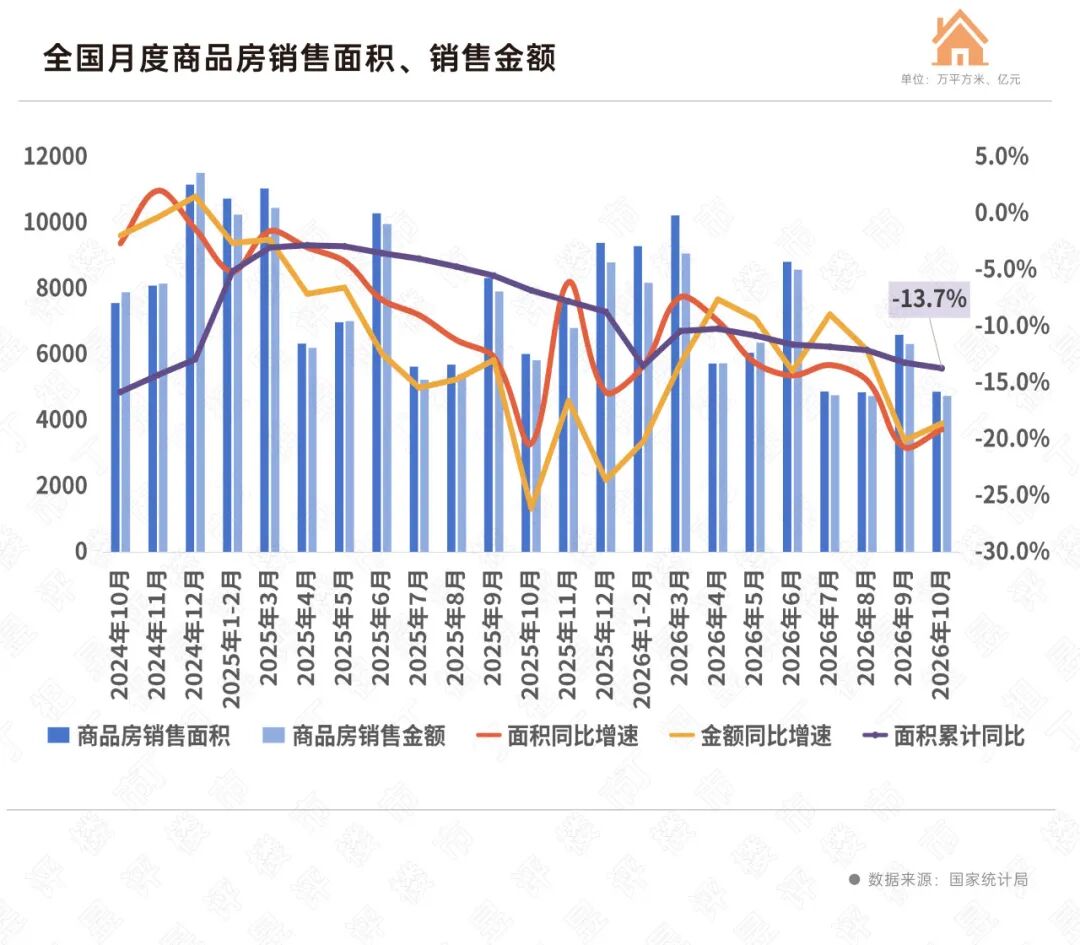
Inventory indicators continue to improve. At the end of October, the area of newly built commercial properties available for sale stood at 740 million square meters, down 1.7% year on year, marking 8 consecutive months of year-on-year decline. This is a relatively optimistic figure. The area of properties available for sale for less than 3 years reached 540 million square meters, down 5.3%, with the decline expanding by 0.3 percentage points from the end of September, and the destocking pressure of short-term "active inventory" continues to ease.
02
Housing prices continue to release positive signals.
Among the housing prices of 70 large and medium-sized cities, the sales prices of commercial residential properties in first-tier cities generally rose month on month, while those in second and third-tier cities declined month on month, and the year-on-year declines in first, second and third-tier cities continued to narrow.
14 cities saw new home prices rise month on month, 3 fewer than the previous month, and 7 cities recorded flat prices, 3 more than the previous month. Among them, Nanjing led the rise across the 70 cities with a 0.5% month-on-month increase.
In terms of year-on-year performance, new home prices in 7 cities including Shanghai, Shenyang, Dalian, Nanjing, Hangzhou, Ningbo and Hefei rose year on year, the largest number in nearly a year. Shanghai led the 70 cities with a 2.7% year-on-year increase.
The number of cities where second-hand home prices stopped falling reached 12, the highest since the second half of the year, of which 7 cities recorded month-on-month price increases, 2 fewer than the previous month. Shanghai and Xuzhou led the 70 cities in month-on-month second-hand home price growth, both rising by 0.5%. In year-on-year terms, following Shanghai's positive year-on-year growth last month, Shenyang also saw its second-hand home price stay flat year on year, adding one more city to the list of cities where second-hand home prices stopped falling year on year.
A more positive signal is that expectations for the real estate market have improved to some extent.
A questionnaire survey on housing prices conducted by the National Bureau of Statistics in 70 large and medium-sized cities shows that in October, the proportion of real estate market practitioners who expected the sales prices of newly built commercial residential properties to remain stable or rise in the next six months was close to 70%, 4 percentage points higher than the previous month.
It can be seen that the superimposed effect of loose monetary environment and demand-stabilizing policies is continuously releasing, and the downward pressure on housing prices is continuously easing. The support for the market bottom is constantly consolidated, the year-on-year decline of housing prices in cities of all tiers continues to narrow, and the signal of indicators stabilizing is more clear. With the further emergence of the policy transmission effect, it is expected that housing prices in more cities will stabilize later.
03
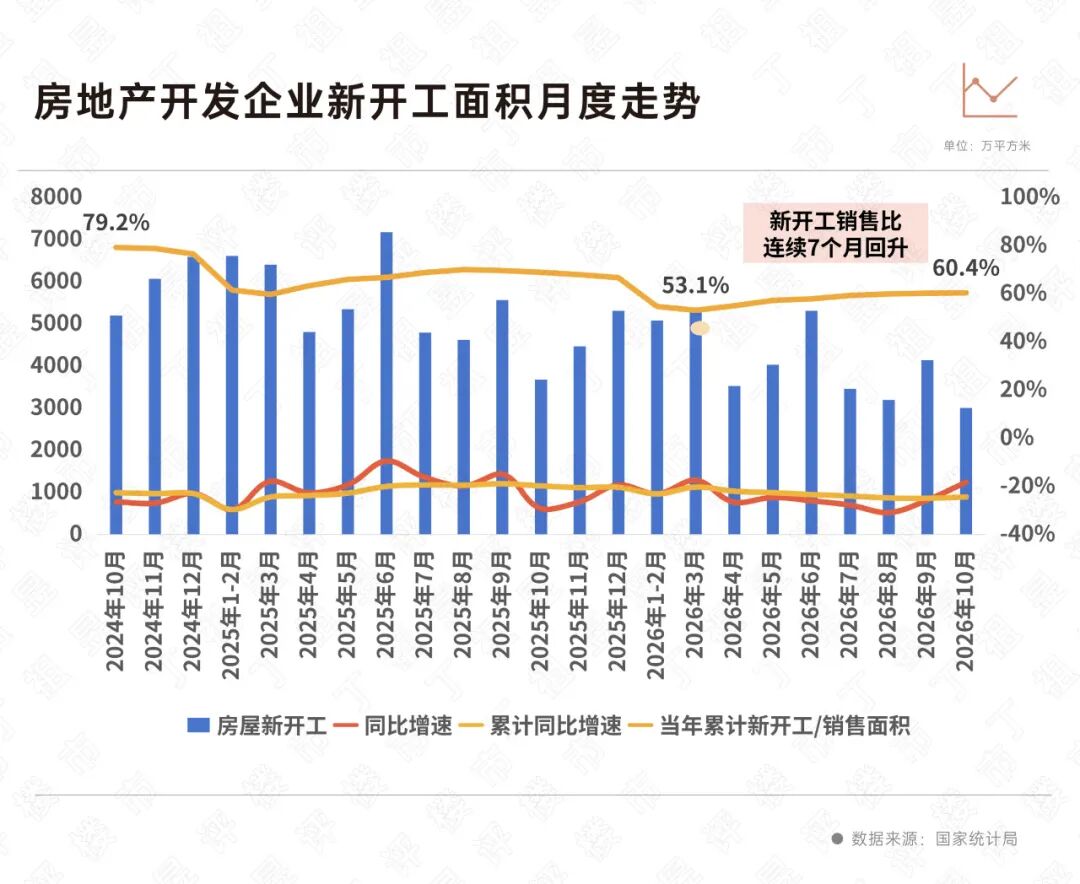
From January to October, the newly started housing area reached 370 million square meters, down 24.4%. Among them, the newly started residential area was 270 million square meters, down 24.9%.
The scale of new construction is dynamically bottoming out. In the first 10 months, the scale of newly started housing accounted for 60.4% of the new housing sales scale, up 0.2 percentage points from the first 9 months, marking a rise for 7 consecutive months. The industry is accelerating toward a new supply-demand balance range.
However, referring to the experience of the industry's healthy development cycle in the past, the ratio of new construction to sales will be in a reasonable and healthy range when it rises to 110%—120%, and it will take some time for the supply side to recover.
Development investment shrinks moderately. Data from the National Bureau of Statistics shows that from January to October, national real estate development investment reached 5.72 trillion yuan, down 21.6% year on year, with the decline expanding by 0.3 percentage points from the previous month; among which residential investment was 4.41 trillion yuan, down 21.4%.
In terms of single month performance, real estate development investment in October reached 385.1 billion yuan, down 33.2% year on year. The monthly development investment is equivalent to 81% of new housing sales, and the investment scale has narrowed to a dynamically reasonable range.
On the whole, the real estate industry is in the process of confirming the market bottom. As the detailed rules for the "828" existing home sales enter the intensive local implementation period, restricted by the development cycle of residential projects, the substantial impact of the new policy on the transaction side will be postponed to 2027. Its greater value lies in the systematic reconstruction of the sales system, which will take the lead in forming a positive guidance for market price expectations, resonating with the current price stabilization, and becoming an important institutional support for housing price stabilization.
The subsequent industry recovery is expected to proceed along three main lines:
First, the scope of stabilized housing prices continues to expand, and cities with stopped falling prices will extend from core cities to more second and third-tier cities, making the overall price bottom support more solid.
Second, the supply-demand structure continues to optimize, second-hand housing continues to play the role of ballast for transactions, the ratio of new construction to sales rises steadily, and the supply side gradually moves towards the equilibrium range.
Third, basic systems such as existing home sales are implemented steadily, promoting the industry to smoothly transition to a new high-quality development mode at an accelerated pace.
This article is from the WeChat Official Account "Ding Zuyi Comments on Real Estate Market", written by the Editorial Department and Puru Research, authorized to be released by 36Kr.