From boom to ebb, why is U.S. battery investment fluctuating?
The U.S. battery manufacturing industry is digesting production lines formed by the previous round of expansion, and adjusting subsequent factory construction plans. At the same time, amid the divergent growth trends of the electric vehicle and energy storage markets, it is reselecting battery products and technical routes.
In the past few years, the electrification plans of U.S. automakers, federal tax credits and state investment promotion incentives have jointly driven a wave of battery factory investment. These projects have extended from the traditional automotive industrial heartland of the Midwest such as Michigan and Ohio to southern manufacturing bases including Kentucky, Tennessee, Georgia and the Carolinas, forming the U.S. "Battery Belt".
In August 2022, the Inflation Reduction Act (IRA) promoted by the Biden administration came into effect, supporting electric vehicle consumption as well as the construction of electric vehicle and battery production capacity through purchase tax credits and local manufacturing incentives. After the Trump administration took office in 2025, policies related to clean energy took a sharp turn: the purchase tax credits were terminated early, and electric vehicle sales fell immediately. Automakers cut production lines for pure electric models, and battery companies also adjusted their investment plans accordingly.
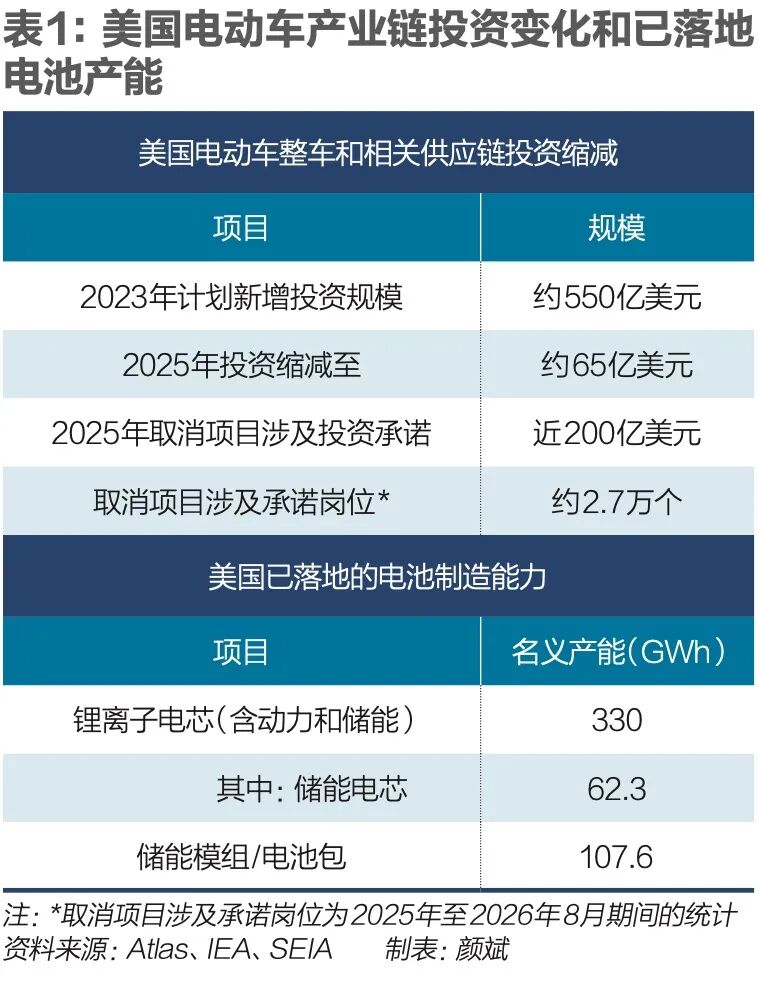
According to statistics from the U.S. think tank Atlas, the total new investment in full electric vehicles and their supply chains across the United States plummeted from a peak of about 55 billion U.S. dollars in 2023 to about 6.5 billion U.S. dollars in 2025. In 2025 alone, formally canceled electric vehicle-related projects involved nearly 20 billion U.S. dollars in originally committed investment. From the beginning of 2025 to August 2026, the canceled projects involved a total of about 27,000 committed jobs.
Against the backdrop of overall investment contraction, completed battery factories are also facing choices over product routes: slowing demand for electric vehicles and considerable growth in the energy storage market are attracting enterprises to switch production lines to seek short-term orders to absorb idle capacity; the requirements of next-generation electric vehicles for low-cost, high-energy-density batteries are also driving subsequent technology investment.
The adjustment of Ultium Cells, a joint venture between General Motors and LG Energy Solution, is the most typical case. Its factory in Spring Hill, Tennessee, was originally built to support GM's electric vehicles, with a planned power battery capacity of over 45 GWh. In June 2026, it completed a 70 million U.S. dollar renovation to switch to producing pouch-type lithium iron phosphate (LFP) cells for energy storage systems (ESS).
Three months later, GM announced at the end of September that it would add production capacity for lithium-rich manganese-based (LMR) prismatic cells for next-generation electric vehicles at this plant. The related facility renovation is expected to start in 2026 and be completed in 2028, adding about 500 new jobs. The product portfolio of the factory covers both energy storage and automotive applications.
GM stated that the designed energy density of lithium-rich manganese-based batteries is 33% higher than that of LFP batteries, with comparable manufacturing costs, and Ultium Cells is expected to become the world's first enterprise to achieve commercial mass production of LMR prismatic cells.
This swing reflects the current situation of the U.S. battery manufacturing industry: terminal electric vehicle demand falls short of expectations, forcing completed factories to switch to energy storage production to save themselves; in order to overcome cost bottlenecks and maintain medium and long-term competitiveness, automakers still have to push ahead with continuous investment in new technology routes.
01
Policy Shift, Investment Recession
The explosive expansion of the U.S. "Battery Belt" was jointly driven by federal legislation, state government investment promotion and radical transformation of traditional automakers: U.S. auto giants are eager to restructure the local supply chain, Asian battery companies from Japan, South Korea and other regions need to be close to North American vehicle customers to provide supporting supplies, and midwestern and southern state governments are eager to use new energy bases to retain manufacturing jobs lost due to the decline of fuel vehicles.
The battery construction boom was launched between 2019 and 2022. According to public statistics, half of the 52 major battery projects in the United States had their sites selected or investment implemented before the IRA took effect in August 2022.
The IRA injected a strong stimulus to both the supply and demand sides of the boom: on the supply side, qualified locally manufactured cells are eligible for advanced manufacturing tax credits of up to 35 U.S. dollars per kWh, and module manufacturing enjoys an additional 10 U.S. dollars per kWh credit. On the demand side, new energy vehicles that meet the localization thresholds for North American assembly, critical minerals and battery components are eligible for a federal new vehicle purchase tax credit of up to 7,500 U.S. dollars. Combined with low-cost land, infrastructure expansion and employment subsidies from various states, automakers and battery companies' expectations for future electric vehicle shipment scales were pushed to the peak.
Investment expectations shifted immediately in 2025 with the Trump administration taking office. In July 2025, the U.S. Congress passed legislation to cancel compliance fines for Corporate Average Fuel Economy (CAFE) standards. Previously, increasing sales of pure electric models could raise the overall average fuel economy of automakers, reducing the fine pressure brought by selling high-fuel-consumption pickup trucks and large SUVs. Two months later, the federal tax and expenditure legislation was adjusted, and the maximum 7,500 U.S. dollar federal tax credit was completely terminated for vehicles purchased after September 30.
The buying spree before the tax credit expiration pushed the penetration rate of new pure electric vehicles in the U.S. to a high of 10.6% in the third quarter of 2025, after which the market cooled rapidly. According to data from Cox Automotive, from the fourth quarter of 2025 to the second quarter of 2026, the penetration rate of new pure electric vehicles in the U.S. hovered between 5.7% and 5.8%, with year-on-year sales declines of 36%, 27% and 20.5% respectively in each quarter.
In 2026, the United States further relaxed fuel vehicle regulations. In February, the Environmental Protection Agency revoked the motor vehicle greenhouse gas endangerment finding and related emission standards; in September, the federal government lowered fuel economy requirements and clarified that CAFE credit trading between automakers will be canceled from 2028. These adjustments have reduced the compliance pressure on automakers to sell fuel vehicles, and also weakened their motivation to meet regulatory requirements by increasing the production and sales of pure electric models.
On the other hand, the advanced manufacturing tax credit policy, as the profit pillar of battery factories, has strengthened penetrating review of foreign investors and supply chains. In February 2026, the U.S. Internal Revenue Service issued guidelines extending the review of "Foreign Entities of Concern (FEOC)" to foreign shareholders, debts, supply chains and technologies of battery enterprises. When applying for tax credits, enterprises need to verify the qualifications of investors and suppliers, trace material costs, and prove that their production, operation and technical cooperation arrangements meet the "actual control" requirements, which increases the compliance costs of financing, procurement and technology introduction.
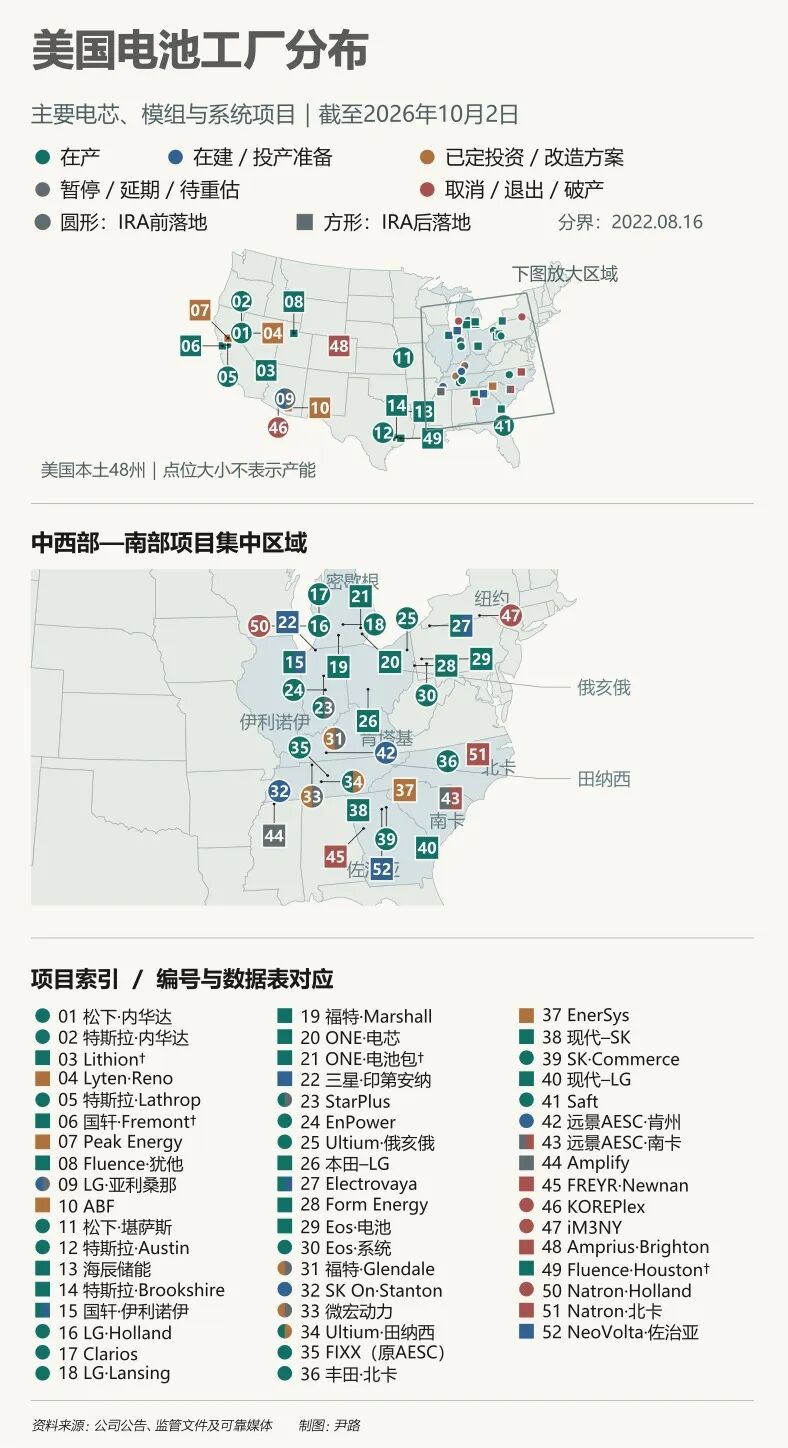
As demand cools down, automakers and battery companies have changed their original capacity expansion plans one after another.
Large bases that are completed or nearly completed mainly adjust operations by splitting joint venture assets, transferring equity, reducing production loads and switching to energy storage production. The most typical example is the BlueOval SK project, a joint venture between Ford and SK On: Ford took over the Kentucky campus, converted the first-phase power battery plant to energy storage production and halved its capacity, while the second-phase plant is reserved for other uses; the Tennessee plant is independently owned and operated by SK On, with its production launch postponed.
Projects that have started civil construction or completed plant construction mostly choose to cut investment, capacity and job scales, and postpone equipment installation and production launch to reduce subsequent capital expenditure. For example, Ford's wholly-owned BlueOval LFP battery plant in Michigan reduced its committed investment from 3.5 billion U.S. dollars to 2.5 billion U.S. dollars, planned capacity from 35 GWh to 20 GWh, and committed jobs from 2,500 to 1,700.
Projects in the early stage of planning or capacity expansion mainly exit by canceling construction, terminating leases or selling sites. Norwegian battery company FREYR and U.S. battery company KORE Power respectively canceled their originally planned 34 GWh and 12 GWh cell projects; silicon anode battery enterprise Amprius terminated the expansion of new bases, retaining existing R&D and small-scale manufacturing facilities; U.S. battery enterprise iM3NY declared bankruptcy and sold its assets afterwards; Natron Energy, which focuses on sodium-ion batteries, closed its existing facilities and terminated new plant plans due to capital chain rupture.
The vast majority of hundreds of GWh of new capacity planned in the previous boom was not supported by real vehicle orders from the very beginning. Canceling the unimplemented capacity expansion commitments on paper is a correction and stop-loss for irrational bubbles.
In terms of capacity supply and demand, according to statistics from the International Energy Agency (IEA) in its *Global Electric Vehicle Outlook 2026*, by the end of 2025, the nominal manufacturing capacity of completed lithium-ion batteries in the United States has reached about 330 GWh (including power and energy storage). If estimated based on the annual sales of about 1 million pure electric vehicles across the country with a battery capacity of around 70 kWh per vehicle, the annual demand for power cells from local automakers is less than 80 GWh, accounting for only about a quarter of the nominal capacity.
02
Automakers Reassess Electric Vehicles
Ford officially announced a major adjustment to its electrification strategy in December 2025, listing "lower-than-expected demand, high structural costs and changes in the regulatory environment" as the three main reasons. It will comprehensively cut capital expenditure on electrification, and shift resources to fuel vehicles, hybrid models and next-generation pure electric platforms with stronger price competitiveness.
Since the second quarter of 2025, General Motors has accrued about 10.9 billion U.S. dollars in total electric vehicle-related asset impairment and restructuring expenses; when Ford announced the contraction of its electrification strategy in December 2025, it accrued more than 19 billion U.S. dollars in one-time related expenses.
In the third quarter of 2026, General Motors sold about 25,000 electric vehicles in the United States, down 62% year-on-year. Ford sold about 6,000 units, down 80% year-on-year; the much-anticipated F-150 Lightning pure electric pickup truck sold only 289 units in the single quarter, and has now been announced to discontinue production.
However, amid the recession trend, the heads of the two major U.S. automakers insisted on stating that "they have not abandoned electric vehicles".
Mary Barra, CEO of General Motors, publicly admitted in 2026 that without federal subsidies, the popularization of electrification will take longer, but General Motors will still reach that stage, and internal data shows that consumers who have bought electric vehicles are 80% more likely to repurchase electric vehicles. She said General Motors still believes that electric vehicles are the final destination, and the mission of transformation remains unchanged.
Jim Farley, CEO of Ford, set the conditions for continued investment in electric vehicles on specific cost and competitiveness. He recently stated publicly that Ford's internal disassembly and calculation found that the battery procurement cost of BYD's equivalent vehicle is about 20% lower than that of Ford's next-generation mid-size electric pickup truck Fathom. To narrow the vehicle cost gap, Ford's countermeasure is to redesign motors, reducers and inverters, improve electric drive efficiency, and achieve the same cruising range with a smaller battery pack. Farley also admitted that it is not easy to launch this vehicle according to the established scale, cost and schedule, and the mass production engineering solution has not been finally finalized.
Automakers first need to adapt to the sales scale after the withdrawal of subsidies. According to quarterly data from Cox Automotive, in the first three quarters of 2026, quarterly sales of pure electric vehicles in the United States remained at more than 200,000 units, with a market penetration rate of about 6%, roughly returning to the level between 2022 and 2023.
Subsequent product development pays more attention to the optimization of selling price and cost. In the previous round of investment, full-size pure electric pickup trucks and large SUVs occupied an important position, and some models were equipped with high-nickel battery packs of 100 kWh to 200 kWh, resulting in high vehicle costs and selling prices. These models were most affected by the tax credit policy. Automakers have turned to focus on a product system with higher cost-effectiveness and lower battery cost: for example, Ford plans to control the starting price of Fathom below 30,000 U.S. dollars and adopt LFP batteries; General Motors is promoting solutions such as LFP and lithium-rich manganese-based batteries to serve entry-level models and large electric vehicles that balance cost and cruising range respectively.
Automakers are also adjusting the proportion of investment in cell manufacturing assets. In 2025, GM sold its joint venture equity in the Lansing cell plant in Michigan to LG Energy Solution, and in August 2026, transferred the equity of the under-construction battery plant in New Carlisle, Indiana to Samsung SDI; after Ford took over the Kentucky joint venture campus, it shifted it to the energy storage market.
Through equity transfer and business divestiture, automakers transfer the depreciation pressure and capacity utilization risk of heavy-asset cell manufacturing to professional battery manufacturers and the energy storage market, and retreat to vehicle platforms and system integration.
03
Exploring Production Conversion Paths
Despite the shrinking of new investment commitments, many of the stock projects that started construction intensively in previous years crossed the acceptance nodes between 2025 and 2026 and entered the production or commissioning period. IEA data shows that the nominal manufacturing capacity of lithium batteries in the United States increased by about 50% year-on-year in 2025, reaching a nominal capacity of about 330 GWh at the end of the year. This includes about 60 GWh of cell capacity already built in the United States by multinational automakers and Asian battery giants before this boom.
The U.S. Energy Storage Association (SEIA) supply chain tracking in September 2026 shows that the operational energy storage and dual-purpose cell manufacturing capacity across the United States is 62.3 GWh per year, while the downstream energy storage module and battery pack assembly capacity reaches 107.6 GWh per year. A large number of factories are located in the module and system integration links with lower capital expenditure and shorter construction cycles, and the core cells are still highly dependent on external procurement or imports.
Fully shifting to the battery energy storage market is the most mainstream "self-rescue" channel for battery production lines originally planned to support electric vehicles. As power batteries face sluggish demand, the transformation of the U.S. power grid and the expansion of artificial intelligence data centers are driving high growth in local energy storage installations. Data from SEIA and Benchmark shows that new battery energy storage installations in the United States reached 57.6 GWh in 2025, and 30.8 GWh in the first half of 2026, of which the single-quarter installation in the second quarter reached a record 20.2 GWh. Institutions generally predict that the total new installations in 2026 are expected to be close to 70 GWh.
Huge energy storage demand has become the "receiver" of idle power production lines. In addition to the aforementioned GM Ultium Tennessee plant switching to producing pouch LFP energy storage cells in June 2026, the L-H Battery plant in Ohio, a joint venture between Honda and LG Energy Solution (originally planned for 40 GWh of automotive power cells), has taken the lead in mass-producing LFP energy storage cells in July 2026; the Lansing plant in Michigan, which is wholly owned by LG Energy Solution, started production in August 2026, also prioritizing the production of pouch LFP energy storage cells, and has scheduled the mass production of prismatic LFP energy storage cells for 2027; together with the Holland plant in Michigan that launched LFP energy storage mass production in May 2025, LG Energy Solution has densely laid out an energy storage manufacturing network in North America.
Other camps are also accelerating their entry. The