Shortly after dangling an annual pay package of 3.3 million yuan to attract top talent, OpenAI has abruptly disbanded its robotics team, indicating that the industry landscape is poised for a major upheaval.
Just expanded robotics positions, then disbanded the independent team — what on earth is OpenAI planning to do?
On November 13, at the Conference on Robot Learning (CoRL) held in Austin, USA, Booth No. 208 booked by OpenAI was empty.
The exhibition floor map of the conference still marked OpenAI, but no company logo or product display was visible.
Shortly afterwards, OpenAI confirmed to Fortune that it had disbanded its independent robotics research team.
Former robotics researchers moved to the core research department led by Chief Research Officer Mark Chen, while robotics application and hardware personnel were transferred to the Applied division headed by President Greg Brockman.
The company stated that robotics remains a critical part of its long-term technical vision, and this adjustment is made to accelerate R&D progress.
The news came rather abruptly.
Back in September this year, OpenAI was still recruiting robotics R&D personnel on a large scale, with some positions offering a base annual salary as high as 500,000 US dollars. At the start of the year, the company's robotics data collection lab in San Francisco already had around 100 staff members, and it was also planning a second lab.
Sam Altman had previously stated publicly that an impressive robotics demonstration is expected to be presented in 2027.
While investing in labs and hiring hardware engineers, it disbanded the independent research team at the same time — how exactly does OpenAI intend to develop robotics? Where will the previously invested R&D resources go?
01
How much has OpenAI invested in the embodied intelligence field?
OpenAI has actually gone through the experience of disbanding a robotics team once before.
In 2019, the company demonstrated the Dactyl robotic hand solving a Rubik's Cube. Researchers used large-scale simulation and reinforcement learning to enable the robot to master complex object manipulation capabilities.
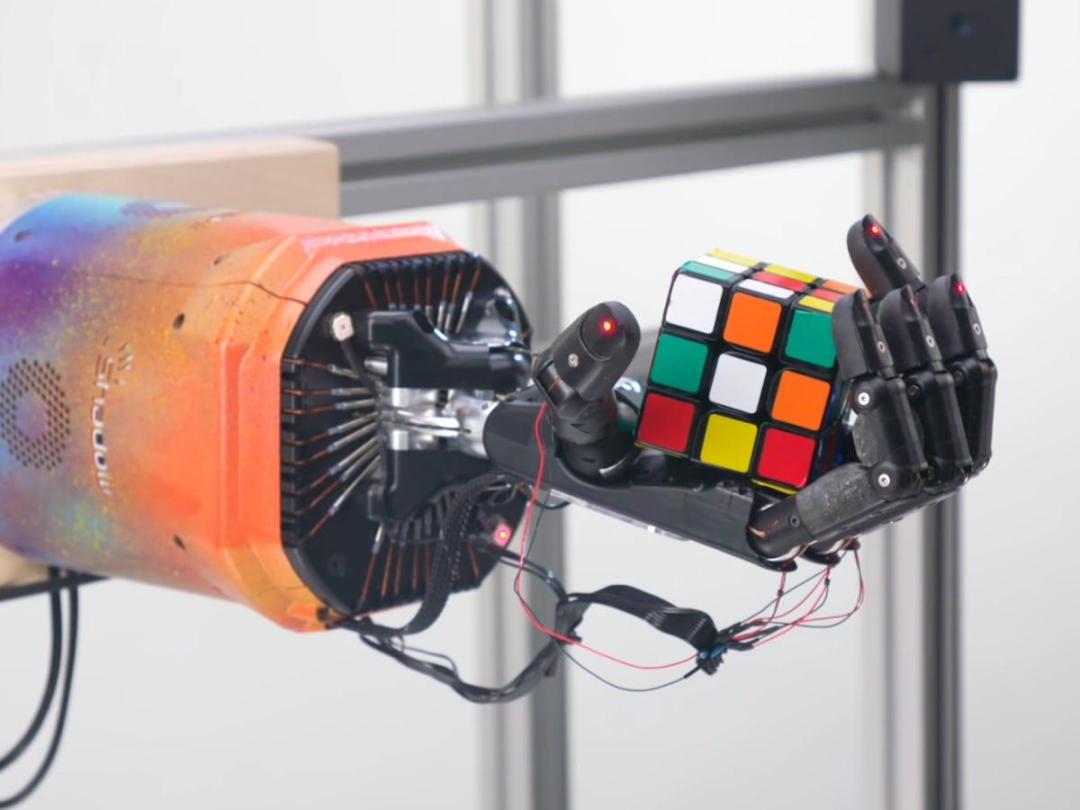
Figure | In 2019, OpenAI demonstrated its research achievement of using reinforcement learning to control a robotic hand to solve a Rubik's Cube.
In 2020, OpenAI wrapped up its first round of independent robotics research and shifted more of its focus to large-scale language models, a route that later gave birth to ChatGPT.
In 2024, the company reorganized its robotics team and cooperated with humanoid robot enterprise Figure to develop AI models. The partnership ended in February 2025, with Figure shifting to self-developed robotics models, while OpenAI continued to expand its internal R&D.
This past January, Business Insider conducted an investigation into OpenAI's robotics data collection lab located in San Francisco. The lab started construction in February 2025, and has since expanded its scale by more than four times, with around 100 data collection staff working in three shifts.
Staff members use 3D-printed GELLO teleoperation controllers to operate Franka robotic arms to complete tasks such as folding clothes and putting bread into toasters. The system records the scenarios and operation processes through cameras, accumulating data that can be used for robot model training.
The early tasks of the lab were quite simple, including putting a rubber duck into a cup, and the operation difficulty was gradually increased later.
The report also mentioned a detail: although there is a humanoid robot-like device in the lab, most of the data collection work is still completed by robotic arms.
OpenAI also plans to build a second lab in Richmond, California.
For embodied intelligence companies, data collection is a considerable expense. Language models can leverage the massive amount of existing text and images on the internet, while robots need to learn physical operations such as grasping, touching and moving. Completing such data collection requires equipment, personnel, maintenance and on-site management.
OpenAI was building its own data production system at that time, and the recruitment scale was also gradually expanding.
According to statistics from Business Insider in September this year, the number of robotics-related job openings at OpenAI increased from 11 in May to 27, covering directions including machine learning, robot control, electronic engineering, actuators, firmware and data collection, with some positions offering a maximum base annual salary of 500,000 US dollars.
As of November 14, a query on the official website by Phoenix Tech found that OpenAI still publicly lists multiple robotics-related engineering positions.
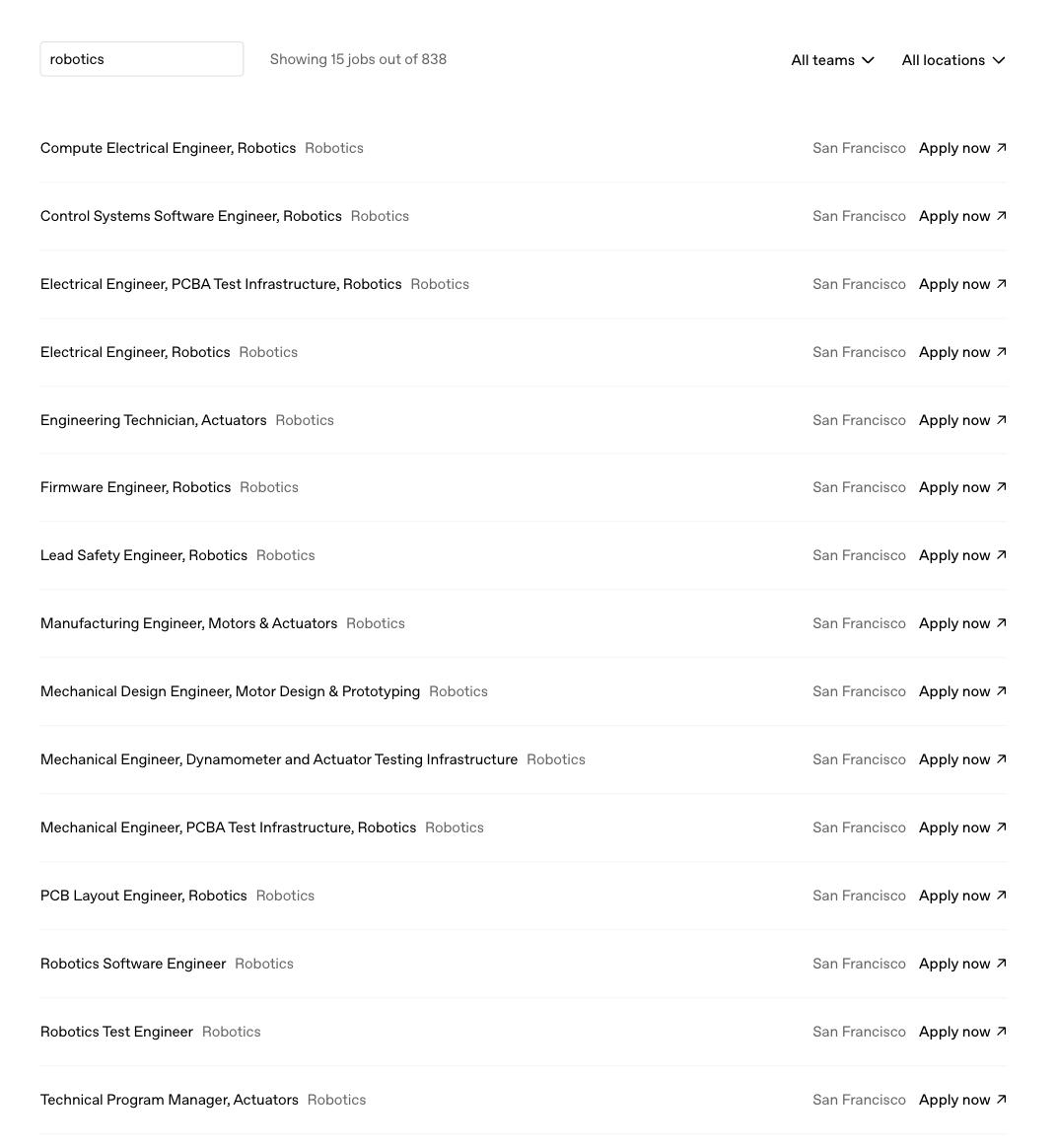
Figure | As of November 14, OpenAI's official website is still recruiting for embodied-related positions including on-board computing for robots, control software, motors and actuators.
Previously, the company was also advancing supply chain preparation. This past January, OpenAI launched a call for U.S. manufacturing suppliers, listing robotics alongside data centers and consumer electronics as part of its hardware supply chain layout.
The scope of solicitation covers key components such as motors, gearboxes, reducers and power electronics. According to the original document, OpenAI planned to select suppliers in 2027, but the amount of related procurement contracts has not been disclosed so far.
In addition to engineering R&D, the funding arrangement for the robotics business has also been discussed by the management.
In May this year, The Wall Street Journal disclosed that Sam Altman had considered spinning off the robotics and consumer hardware businesses for independent operation, allowing the related entities to raise financing from external investors separately.
The plan was not eventually implemented. One of the reasons is that, even if the business is spun off, the related assets and profit and loss may still need to be included in the consolidated financial statements of the OpenAI group.
These records show that OpenAI's investment in the robotics field over the past year has covered data collection, model research, hardware engineering and supply chain preparation.
After confirming the restructuring on November 13, OpenAI has not announced the specific allocation of budget, personnel and computing power, nor has it clarified whether the data collection lab and prototype projects will be adjusted.
02
Wang Xingxing said that the biggest mistake in the past decade was not believing in AI enough
OpenAI explained the technical background of this adjustment to Fortune. Earlier this year, the company's researchers originally believed that using video generation models such as Sora to learn the laws of the physical world was an important path to advance robot intelligence.
However, general models such as GPT-6 Astra later demonstrated the capability to directly control robots. OpenAI decided to merge the relevant researchers into the general foundation model team, so that robotics research can leverage the latest progress of existing models.
Two speeches delivered by Wang Xingxing, founder of Unitree Robotics, in the past month also align with this trend.
On October 12, during the roundtable discussion at the Shanghai Industry Fair, Wang Xingxing mentioned that after the release of GPT-6, Unitree has connected it to various robots to perform tasks, and the actual effect exceeded previous expectations.
He frankly stated: "The biggest mistake I have made in the past ten years is that I did not believe in AI enough."
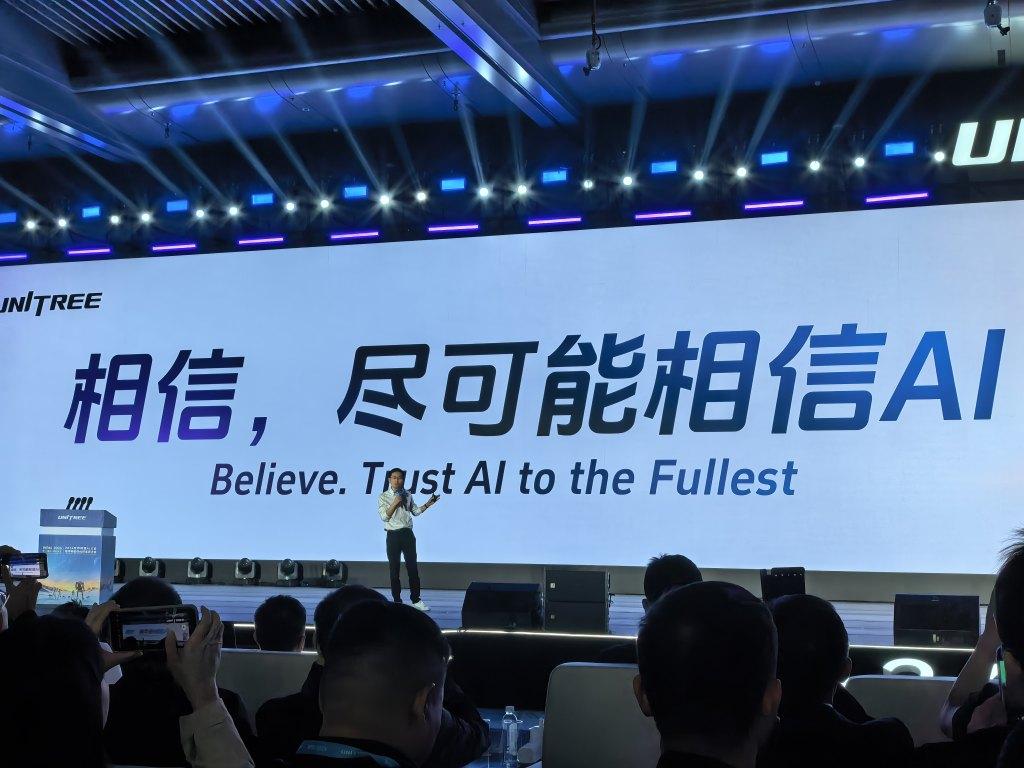
Figure | On October 22, 2026, Wang Xingxing shared the progress of general large models controlling robots at the World Physical AI Conference. Image source: The Paper.
Wang Xingxing believes that AI models will make obvious progress almost every one or two months. If GPT-7 continues to achieve breakthroughs, the technical critical point of embodied intelligence may arrive in the next one to two years.
On October 22, at the World Physical AI Conference, he demonstrated an experiment in which Unitree's robot used GPT-6 to complete painting. The robot was placed with a reference painting, blank paper, paint and clean water. It picked up the brush to paint, switched colors during the process, and even cleaned the brush by itself. Unitree also demonstrated other tasks such as the robot playing chess at the same time.
Wang Xingxing repeatedly emphasized that the team did not conduct special training for these tasks, nor did they write complex motion programs.
The robot itself still requires motion control and hardware systems, but general models are already able to organize part of the operation steps based on the images and task requirements.
Previously, many robotics tasks required developers to collect specialized motion demonstrations before training the corresponding operation strategies. Now general models can handle part of the visual understanding, spatial reasoning and task planning work.
Anthropic recently released Claude Fable 5.2, which also provides experimental data.
On November 9, Anthropic demonstrated the process of Claude controlling a robotic arm to solve a Rubik's Cube, screw bottle caps and draw pictures.
In the RoboDojo Sim simulation benchmark, internal tests run by Anthropic show that Fable 5.2 achieved an average success rate of 64.9%, compared to 27.6% for the previous generation Fable 5.1, and GPT-6 Astra scored 29.8% under the same test framework.
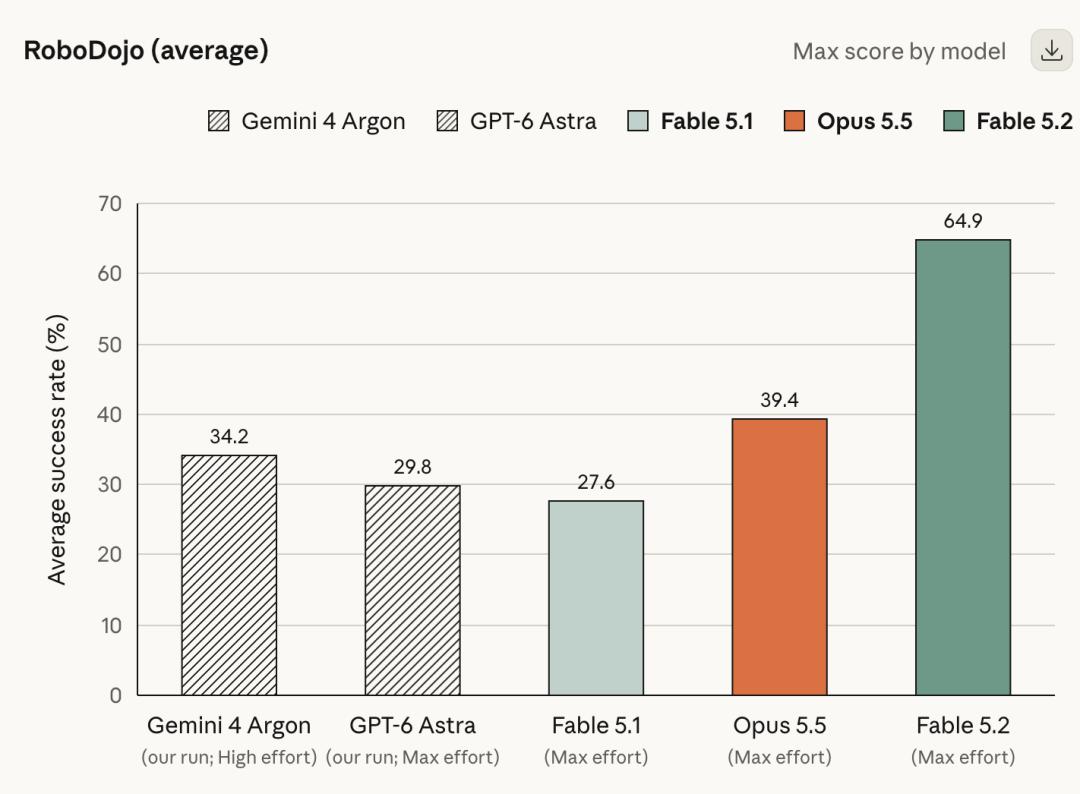
Figure | In the RoboDojo Sim simulation evaluation released by Anthropic, Claude Fable 5.2 achieved a score of 64.9%. Image source: Anthropic.
The Astranomy research released by NVIDIA in October directly used GPT-6 Astra to control simulated robots.
In the RoboLab-120 test, the direct control scheme achieved a task success rate of 66.3%. After researchers added mechanisms such as continuously recording operation history and checking execution results, the agent control scheme reached 74.8%, which is higher than the 51.0% score of the previous optimal dedicated robot model on this benchmark.
Although these experiments use different test environments, they all demonstrate the progress of general models in physical operation.
Guanya Shi, a robotics researcher at Carnegie Mellon University, pointed out in an interview with Fortune that OpenAI may be regarding robotics as a downstream application of general intelligence.
For OpenAI, directly leveraging general models means that part of robotics intelligence research can share the training results of the core models. The return on investment of independently developing a full set of robotics foundation models therefore needs to be re-evaluated.
However, the NVIDIA experiment also exposed another problem: the computational overhead of general models is quite high.
In the Astranomy research, the GPT-6 Astra direct control scheme took an average of 18.56 seconds per inference.
Although the agent scheme improved the success rate, each successful task round consumed an average of about 30.9 million Tokens, corresponding to an estimated API cost of 36.40 US dollars.
These costs come from simulation tests and cannot be directly taken as the operating cost of real robots. But in an actual factory, the longer the robot takes to perform a task, the higher the cost per unit output may be.
The more troublesome issue is latency. The simulation environment can pause when the model is making inferences, but the conveyor belts, equipment and workpieces in a real factory will not stop and wait for more than ten seconds.
Robots still require systems with faster response that can directly control the ontology movements. This is also one of the reasons why other technology companies continue to train dedicated robotics models.
03
Google, NVIDIA and Unitree are still training dedicated models
On November 10, Google DeepMind announced an experiment in which the Apollo 2 humanoid robot worked at a Mercedes-Benz factory.
The robot grabs metal brackets from material bins and places them into designated containers in the production sequence. The test sites include Mercedes-Benz's factories in Sindelfingen, Germany and Kecskemét, Hungary. Google announced that the success rate of this component sorting task reached 96%.
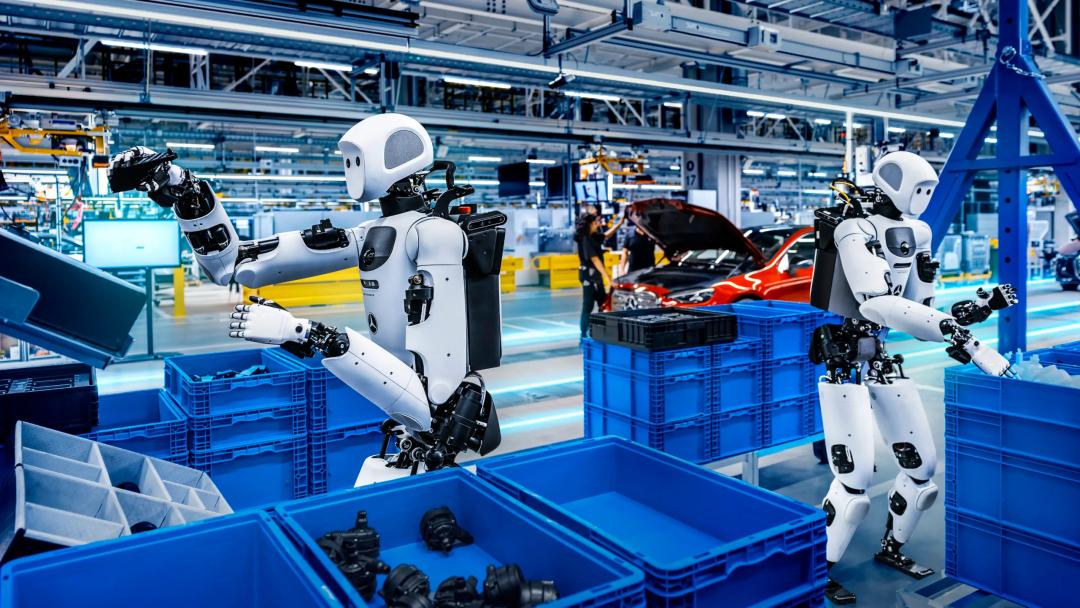
Figure | The Apollo 2 humanoid robot conducts component sorting tests at the Mercedes-Benz automobile factory. Image source: Google DeepMind.
During the operation process, the two sets of models perform their respective duties.
Gemini Robotics ER is responsible for understanding the production process and judging task progress; Gemini Robotics 2.5, trained on robot motions, is responsible for the actual operation of the arms and dexterous hands. Google also uses Gemini 4 Argon to help build simulation environments and analyze failed cases.
Jeff Cardenas, CEO of Apptronik, stated that Apollo 2 achieved obvious improvement after several weeks of training, with minor performance degradation after being migrated to the Mercedes-Benz production line.
This is a scenario-limited proof of concept, and the long-term operation failure rate and production cost have not yet been disclosed. But Google has demonstrated how general reasoning models and dedicated motion models can collaborate to complete factory tasks.
GR00T 2, released by NVIDIA in November, focuses on the training cost of robots after they enter new scenarios.
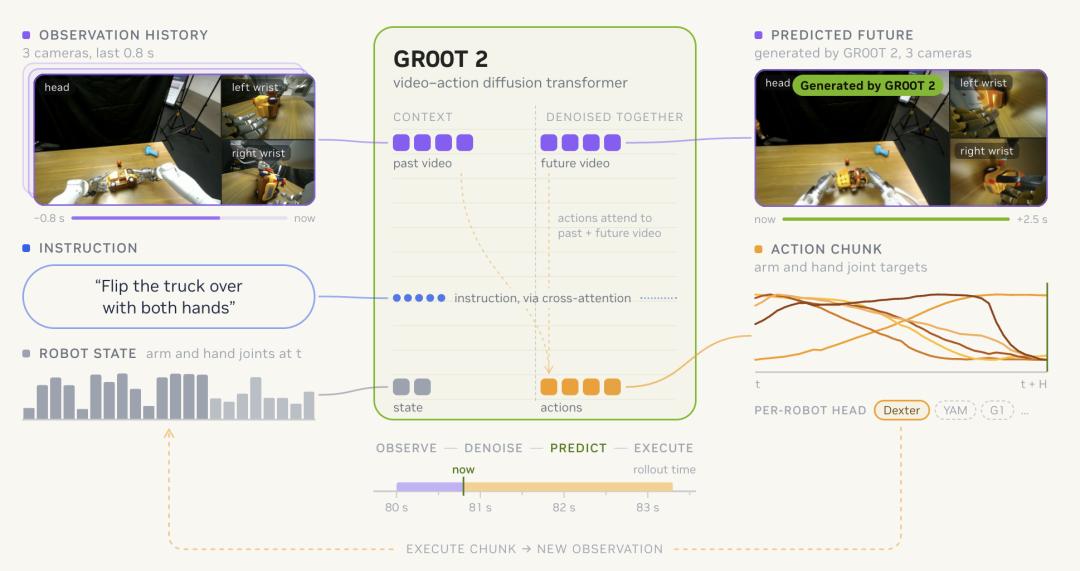
Figure | GR00T 2 reads the latest videos, instructions and robot status, denoises future video and motion segments, executes the motion segments, and then repeats this process.
Among 50 tasks that have not been trained for the target robot before, GR00T 2 achieved a zero-shot average success rate of 40%. After researchers added 5 operation demonstrations and less than 3 minutes of robot data for each task, and then used a single RTX 5090 for fine-tuning for about 30 minutes, the success rate increased to 95%.
When robots arrive at a new factory, they often need to re-adapt to the placement of items, grasping sequence and specific equipment. Completing task adaptation with only a small number of demonstrations has the potential to reduce investment in data collection, on-site debugging and on-site engineer support.
But robots still need to solve the physical errors in precision operations.
On November 5, Wang Xingxing mentioned at the Hongqiao Forum of the China International Import Expo that current top multimodal models already have