Sense of control matters: five consumer trends worth understanding in 2027
In the past few years, discussions about consumer trends have often revolved around emotional value, brand loyalty, social media product seeding and other topics. However, in 2027, what is truly worth paying attention to may not be the new preferences added by consumers, but some long-taken-for-granted business rules that are loosening. Institutions including Euromonitor International, NIQ and Shopify have recently successively released outlook reports on the 2027 consumer market. These surveys have identified several seemingly contradictory phenomena, for example, "people who buy expensive products" and "people who buy cheap products" are the same group; AI can help select products, but has not yet gained the trust to press the purchase button; the more information there is, the scarcer credible recommendations become... Behind these phenomena, there is a common thread running through the 2027 consumer market. Consumers are demanding more sense of control in every scenario. The following are the five changes that we believe are most worthy of re-understanding.
The Same Person Bets on Both Ends of the Spectrum
Consumers buy high-end products while skillfully looking for affordable alternatives, and neither "consumption upgrading" nor "consumption downgrading" can fully explain today's consumption patterns.
In its 2027 Global Consumer Outlook, NIQ points out that the global fast-moving consumer goods (FMCG) sector is experiencing "growth at both ends": in the 52 weeks ending June 14, 2026, across 26 covered markets, more than 23 billion U.S. dollars in value share has shifted from mainstream products to value-oriented and premium products. The survey also shows that when asked "what most determines whether a household or grocery purchase is worthwhile", 34% of respondents chose quality and performance, and 31% chose affordability, marking the first time that quality has outweighed price in weight. This survey covered more than 21,000 respondents across 31 countries and regions.
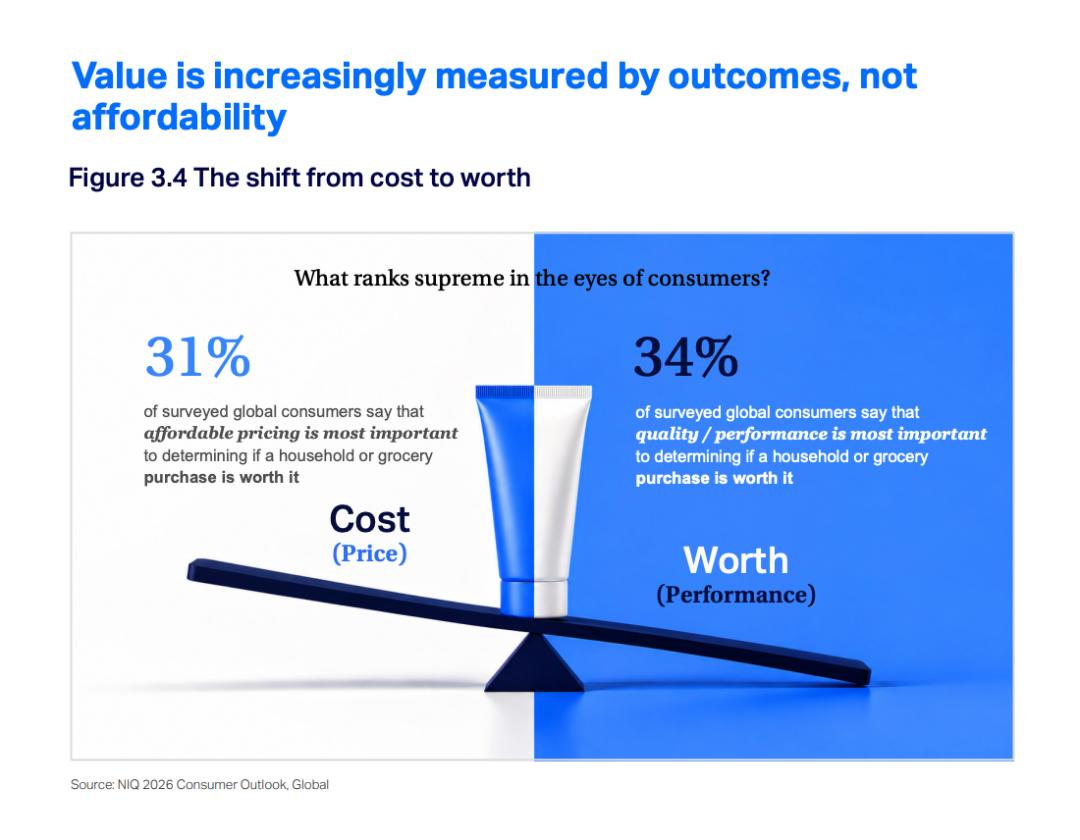
This is a reallocation of budgets: the same person can buy expensive products for health and personal care, but choose cheap daily consumables such as paper products and cleaning agents. What is really being squeezed out are products that have neither obvious differentiation nor price advantages.
Consumers are increasingly adept at calculating opportunity cost — what am I giving up by buying this?
"Pressure on the mid-market" does not mean mid-tier brands have no opportunities, but that the positioning of "balanced price, quality and brand" no longer holds automatically. NIQ's survey clearly breaks down this mindset. 67% of consumers say they will choose to save money if a product has no obvious advantages, 56% say they will pick a clear premium product if they are to spend more, and 55% believe mid-tier options need to give clear reasons to be worth choosing.
In the future, every brand will have to answer two questions: Why are consumers willing to spend more money on you? If consumers want to save money, why don't they choose you? Brands cannot only prove that they are "good enough". In specific purchase decisions, you are either worth upgrading to, or cost-effective enough. Vague sense of value is losing its market.
What Consumers Want Is "No Regrets Easily"
Uncertainty has become the norm, and stability itself has become a scarce commodity.
In its 2027 Global Consumer Trends report, Euromonitor International refers to this trend as "Shelf Assured" — consumers do not just prefer familiar brands, but hope that daily purchases are predictable: always available, quality and specifications do not change easily, prices do not fluctuate frequently, and experience does not collapse even when the environment changes.
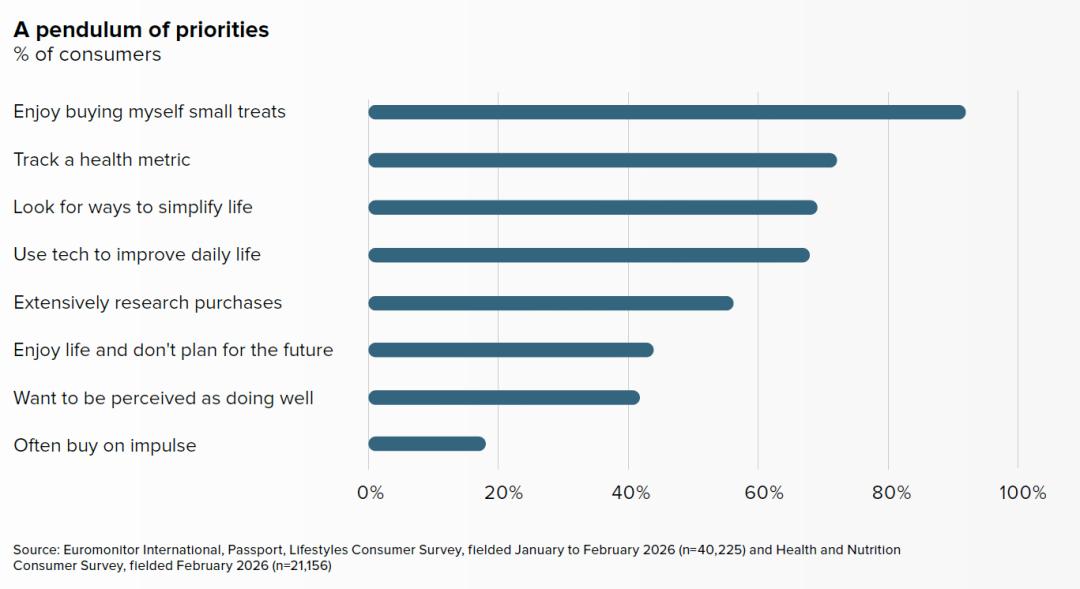
Euromonitor International's survey shows that 72% of global consumers are worried about rising prices of daily necessities, 54% only buy brands they fully trust; in addition, 56% will extensively research products and services before purchasing, and one third would rather buy fewer items but of better quality. One experience that falls below expectations is enough to make people abandon a brand they have used for many years.
Traditional brand loyalty relies on emotional recognition, cultural recognition and identity recognition, but today consumers' dependence on brands is more pragmatic: I know its quality and approximate price, I won't step into a trap after buying it, so I don't have to compare again every time. This is a more daily form of trust, and therefore more fragile. It does not rely on grand narratives, but purely on repeated experiences that do not disappoint.
NIQ's survey in the consumer technology and durable goods sector finds that durability, quality, reliability and practical utility determine value judgment. What consumers buy is a lower probability of regret. Therefore, for enterprises, the focus of competition has changed: it is not only about making consumers choose you for the first time, but also about making them not have to re-choose you next time. Especially for high-frequency and long-cycle products, stable experience, transparent prices and continuously available services can accumulate compound returns better than constantly creating novelty.
Consumers are becoming more and more cautious, and reliability is no longer just a passing line, but the most solid source of premium.
AI Has Not Yet Earned the Trust to Make Decisions for Consumers
The next battle for entry points will take place before consumers open shopping platforms. AI is entering the decision-making chain faster than it is earning trust.
Euromonitor International data shows that 81% of global consumers have used generative AI to assist their daily life. From January 2025 to July 2026, shopping traffic brought by AI has increased by 376%. But at present, only 19% of consumers consider AI a highly reliable source of shopping information.
Consumers are forming a new relationship with technology: they are willing to let AI do the work, but are unwilling to hand over the right to judge. Comparing parameters, reading reviews, looking for discounts, filtering options according to needs — these tedious, time-consuming tasks that are suitable for machines can all be handed over to AI. But the moment the purchase button is pressed, the human is still there.
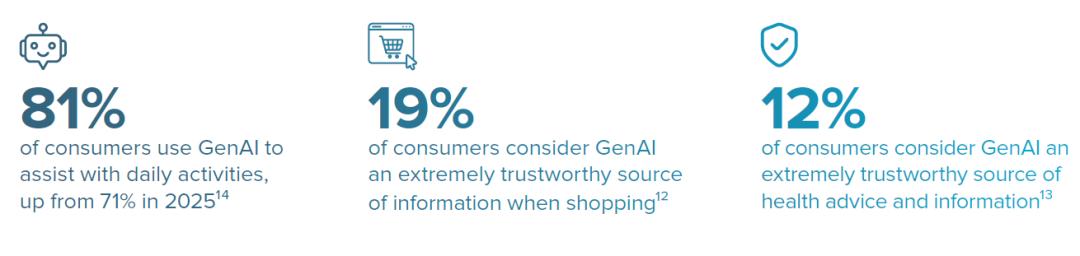
AI will not immediately replace consumers to make decisions, but it will first rewrite consumers' choice range. Therefore, the real change is: AI begins to intervene in the "consumer candidate list".
NIQ data shows that 55% of consumers say their FMCG purchases have been influenced by AI recommendations, and another 27% have used AI-powered tools to assist purchase decisions. In the past, when brands competed for attention, they had to be seen first to be possible for comparison. AI shopping assistants have completely reshuffled this order: consumers directly put forward their demands, and AI only gives a few options. Brands that do not make this list do not even have the qualification to be compared.
Future competition in the consumer sector is not only about similar products on shelves and search pages, but also about other answers that AI considers "more suitable". But currying favor with algorithms is not enough. AI can help consumers discover products, but cannot build trust for products. The accuracy of information, clarity of specifications, authenticity of reviews, and consistency of statements across channels determine how AI perceives you and whether it dares to recommend you.
AI will also broaden the boundary of competition: consumers originally only choose from familiar categories, but AI may provide an alternative that they have never thought of. Competition is no longer divided by category, but centered around a specific demand.
Credible Recommendations Are Becoming Scarce
When everyone can create content, what is scarce is not recommendations, but credible recommendations. Social media has made consumption information richer than ever, but it has not made decision-making easier.
Euromonitor International states that nearly three quarters of consumers around the world trust recommendations from friends and family when making purchases. Another study shows that in social shopping scenarios, 47% of consumers trust customer reviews and peer comments; for 39% of people, the more reviews there are, the stronger their purchase confidence.

The real change is that consumers are re-looking for credible relationships behind information. Platforms solve the problem of "what to see", while communities solve the problem of "whether to trust". Euromonitor International calls this trend "Peer Powered": identity recognition is becoming more collective, consumers still advocate individuality, but more and more express themselves through communities that can reflect their values, interests and experiences, and offline gatherings strengthen this connection. Data shows that 49% of consumers believe that actively participating in communities is important to them, 40% say they will be more involved in communities in the next five years, 36% say face-to-face exchanges with friends will affect where they shop, and 34% expect their daily activities to return to offline scenarios more.
What consumers want is no longer just more "people recommending products", but more information that can help them judge: people who can provide usage context, share real experiences and answer specific questions.
Creators' recommendations bring attention, but if it is impossible to verify whether the product is suitable for themselves, traffic cannot be converted into trust. A community with a small scale, continuous communication between members and shared experience is more likely to form stable consumer influence.
Therefore, communities have new commercial implications: it is not just a channel for user acquisition, activities and fan operation, but a network where consumers jointly verify products, exchange experiences and share decision-making risks.
To figure out how business models can make use of communities, first look at three questions: Are users willing to share real experiences? Can different opinions be seen? When someone raises a question, is there a credible answer? The most important thing to guard against is turning the community into another advertising space. Once discussions are filled with marketing, the most valuable thing of the community — independent judgment and real trust — will disappear.
Future influence does not necessarily belong to the loudest voices, but to people who are truly worth listening to in specific scenarios.
Efficiency Is No Longer the Only Goal
In the past decade, efficiency and self-improvement have been one of the main engines of consumption: completing tasks faster, managing time more efficiently, and living a more disciplined life. Brands have also been promising to help you become better.
Euromonitor International puts forward a new trend called "Mode-Switching": the pursuit of optimization has evolved from a personal ambition to a cultural expectation, but this continuous improvement is also causing burnout, and people are starting to rethink what "progress" really means. Consumers switch back and forth between high-intensity engagement, active recovery and strategic indulgence. Data shows that 42% of consumers constantly feel the pressure to finish what they are doing, 69% are actively looking for ways to simplify their lives, exceeding the proportion in 2025.
While global spending on health products and services is expected to exceed 2.8 trillion U.S. dollars in 2027, what is more noteworthy than "this market is still growing" is that the definition of "good life" has broadened. Relaxation after high intensity, stepping away from the flood of information, real connection with others, and physical and mental recovery have all become worth paying for.
The market is likely to interpret such demands as emotional consumption or compensation for stress. A more accurate statement is the reallocation of rhythm: when to speed up and when to stop should be decided by oneself.
Behind this allocation is the declining deterministic expectation for the future. Euromonitor International data shows that only one fifth of people around the world hold retirement savings accounts, and only 26% of people have cash on hand to cope with emergencies. Under such expectations, consumers prefer immediate and visible value rather than distant long-term commitments.
Putting the two things together, there will be a misalignment that enterprises must pay attention to: consumers want more sense of control, but are unwilling to wait indefinitely for an uncertain future. Many business models that rely on long-term commitments will therefore be rewritten. Whether users will renew their subscriptions depends not only on long-term value, but also on how quickly they can feel the effect. Membership, subscription, education and health management all need to redesign "when value is delivered".
Long-term vision is still important, but you cannot collect money only by relying on it. Consumers want to get real returns in every use, every service and every stage.
New opportunities in the lifestyle sector also lie here: helping consumers rest better, live a lighter life, and regain control of their time. When efficiency is no longer the only goal, helping people step back from the pursuit of efficiency is a form of value in itself.
What Consumers Really Want Is a Sense of Control
These trends are not isolated changes. When shopping, consumers want to reduce the risk of buying the wrong product; when facing AI, they want to get help but retain the right to make decisions; they look for trustworthy judgments in communities; and in life, they want to regain control of their time and rhythm.
From products to information, and then to lifestyles, there is a common keyword behind it all: a sense of control. This may be an important thread to understand the 2027 consumer market.
Consumption differentiation does not just mean that consumers have become more frugal, but that they have begun to decide more strictly where their budgets should go; AI has not only changed the way of shopping, but also how consumers discover and filter products; the value of communities is not only influencing purchases, but helping consumers build judgments in a complex information environment; the pursuit of rest and immediate value means that consumers are rearranging their time and lives.
These changes put higher demands on enterprises.
Products need to have sufficiently clear value to let consumers know why they are worth buying; brands need to provide stable, transparent and verifiable experiences so that consumers do not have to doubt repeatedly; technology needs to truly reduce decision-making costs rather than create new uncertainties; business models also need to make value delivered in a more timely manner.
The 2027 consumer market may not reward enterprises that are best at creating demands, but will favor enterprises that truly understand why consumers hesitate, why they make choices, and why they are willing to stay continuously.
References
Euromonitor International Top Global Consumer Trends 2027 (November 2026);
NIQ Consumer Outlook: Guide to 2027 (September 2026), A Tale of Two Consumers;
Shopify 9 Consumer Behavior Trends Shaping 2026.
This article is from the WeChat official account "HSG Insights" (ID: Sequoiacap), written by Hong Shan, published with authorization from 36Kr.