This sector, which has remained sluggish for four years, is now witnessing a massive large-scale buying spree.
What Huang Jie, Executive Vice President of Urit Group, did not expect was that the current round of market clearing in the IVD industry would last so long, with no signs of easing in sight yet.
The peak number of domestic IVD manufacturers was around 2500, and 600 to 700 of them have been eliminated in the past two years. The industry is still in a continuous phase of clearing excess production capacity and market entities. According to his judgment, the total number of domestic IVD manufacturers will shrink to around 300 in the future.
This long-drawn industry adjustment is not unique to the Chinese market. The global IVD track also presents a highly contrasting pattern: on one hand, secondary market valuations remain under pressure, financing and IPO channels in the primary market are tightened, and the whole industry is in a cold cycle; on the other hand, private capital is bucking the trend to continuously deploy high-quality overseas diagnostic assets, with a number of high-value mergers, acquisitions and privatization transactions landing one after another.
Recently, EQT, together with Abu Dhabi Investment Authority (ADIA) and Canada Pension Plan Investment Board (CPP), announced an all-cash offer of 46.50 euros per share to privatize molecular diagnostics giant QIAGEN, corresponding to an enterprise value of about 12.1 billion US dollars. After the transaction is expected to be completed by mid-2027, QIAGEN will be delisted from the New York Stock Exchange and the Frankfurt Stock Exchange.
Not only QIAGEN, Thermo Fisher Scientific's microbial diagnostics business and Hologic, the global leader in women's health, were also acquired by capital parties this year, with the buyers being European private equity firm Astorg and Blackstone respectively.
This deviation between sector pricing and industrial capital actions has also become the most noteworthy entry point for understanding the current IVD M&A logic.
01
IVD Is Sustained at a Discount
After 2020, the global IVD sector has experienced a long round of valuation correction.
Secondary market investors are increasingly focusing on revenue growth rate. Most mature IVD enterprises have bid farewell to the explosive growth stage, with revenue entering the low single-digit growth range. Coupled with the pressure on overseas testing service prices and intensified channel competition, the central valuation of the sector continues to move downward.
The current IVD valuation contraction is the result of the resonance of three pressures: payment-side reform, demand-side contraction, and the high base during the pandemic. In China, the DRG/DIP payment reform has turned hospital laboratory departments from revenue items into cost items, and hospitals' motivation to actively control costs has outweighed their motivation to increase test orders; volume-based procurement continues to advance, and the industry's gross profit margin is returning to a reasonable range for the manufacturing sector.
The traditional path of domestic IVD enterprises is to follow foreign-funded players (Roche, Abbott, etc.): imitate reagents, then imitate instruments, then tackle upstream raw materials, and compete on imitation speed, cost and commercial operation capabilities.
Against the background of volume-based procurement, both low price and high performance are required, leading to intensified internal competition; foreign-funded enterprises have also begun to adopt the "low price + high quality" strategy to re-compete for the domestic market, squeezing the living space of domestic enterprises.
A business director of an IVD enterprise in Sichuan, combining his three years of work experience in the industry, said that volume-based procurement is "adding insult to injury" to the IVD industry which is already under pressure. Before 2019, the industry's profitability level was about 75 points, and it rose to over 90 points in the 2020-2022 period, pushing the industry's profitability to a high level. After the market cooled down, the industry's profitability directly dropped to 40-50 points. The huge performance gap is the underlying background of the industry's predicament.
Huang Jie also mentioned that policies such as volume-based procurement and DRG/DIP directly compress the market capacity of the domestic industry; coupled with excess industry supply, many enterprises that can no longer sustain operations choose to launch price wars, the business model that used to obtain premiums through channel relationships is no longer viable, and the market price system tends to be transparent. The industry is also exploring and establishing a new business logic.
The demand side is also contracting: the mutual recognition of test results is gradually being promoted, the unbundling of test packages and the "minimum sufficient" principle have reduced the space for repeated and excessive testing, and the overall domestic IVD sector showed a trend of "both volume and price falling" in 2025.
At the same time, the extraordinary growth in 2020-2022 left fixed assets and inventory after capacity expansion, which turned into a burden on the income statement after the demand receded.
From the perspective of industry insiders, domestic IVD enterprises generally obtained a large amount of cash flow in the previous upward cycle of the industry, and then launched aggressive expansion: recruiting a large number of master's and doctoral R&D personnel, investing heavily in acquiring cutting-edge technology targets such as mass spectrometry and single-cell sequencing, pushing the "initial speed" of enterprise development to an extremely high level.
When the industry's prosperity recedes, enterprises are forced to step on the brakes, and the "braking cost" brought by rapid expansion is very high, not only personnel reduction, but also supporting hardware investment, project budgets, and strategic trial and error will generate high hidden losses.
This Sichuan-based IVD enterprise had more than 3,000 employees in 2022, and the number has shrunk to around 1,500 by 2026; the number of doctors has dropped from more than 80 to single digits, and the total number of masters and doctors has dropped from nearly 500 to more than 100. Personnel optimization has been the core annual work for many consecutive years, and the cutting-edge technology targets acquired for hundreds of millions of yuan in previous years have also caused losses of over 100 million yuan due to market reversal. Hardware investment, project budgets and strategic trial and error matching high-end R&D personnel have also brought hidden losses higher than labor costs.
Huang Jie shares the same view. He added that the industry's overcapacity not only comes from the self-expansion of IVD enterprises, but also the cross-border industrial forces and massive capital inflows have further inflated the industry bubble.
The combination of these pressures has changed not only the current income statement, but also the growth function of enterprises. The growth driven by personnel, mergers and acquisitions and capacity expansion during the expansion period is no longer sustainable after the demand recedes; cost rigidity and impairment losses have also lengthened the repair cycle.
As a result, what the capital market sees is not just a performance decline for one or two quarters, but a downward shift in the center of revenue growth, weakened profit elasticity, and extended repair time. In recent years, the growth of representative overseas IVD enterprises has continued to be sluggish.
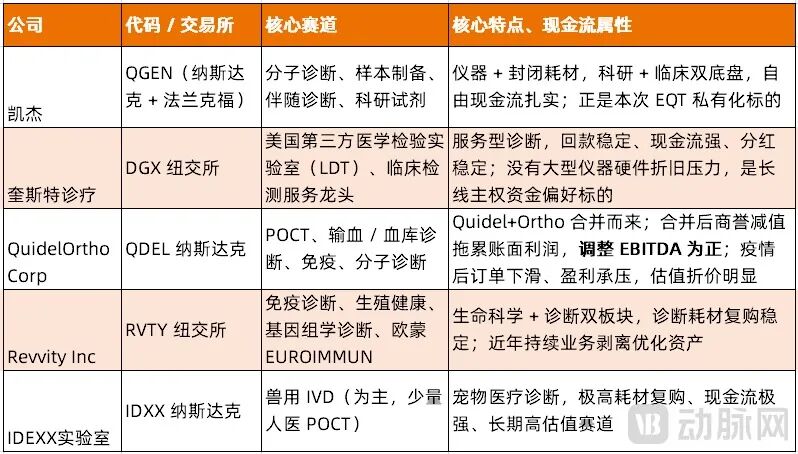
Representative overseas independently listed IVD enterprises (Source: Organized by vcbeat)
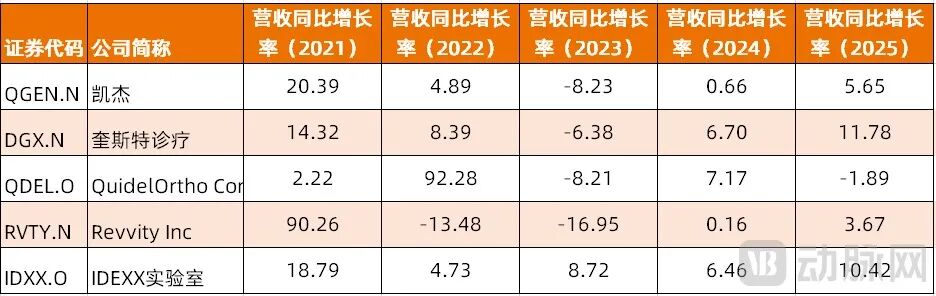
The revenue growth rate of overseas independently listed IVD enterprises hovers at single digits (Source: Choice, organized by vcbeat)
The same is true for the domestic IVD industry, where the revenue and net profit of listed IVD enterprises remain sluggish.
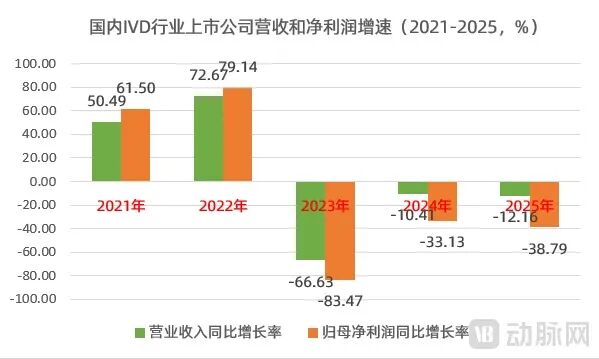
Year-on-year growth rate of revenue and net profit of domestic IVD sector (Source: Choice, organized by vcbeat)
The financing side also feels the chill. The supply of primary market projects for IVD enterprises is decreasing, and investors are less willing to invest in platform-based diagnostic assets that lack explosive growth expectations; the number of overseas IVD IPOs continues to shrink.
Judging from the pace of overseas IVD IPOs (US stock markets + European main boards), 2021 was the high point of this cycle, with a total of 13 IVD enterprises completing IPOs on US and European main boards; after that, IPOs on the track shrank rapidly, dropping to 4 in 2022, only 1 IVD company listed on the public market in 2023; there were 2 deals in total in 2024 (including SPAC merger targets); the number rebounded to 5 in 2025.
Overall, the public listing window for IVD continues to tighten, and the supply of new shares has shrunk significantly.
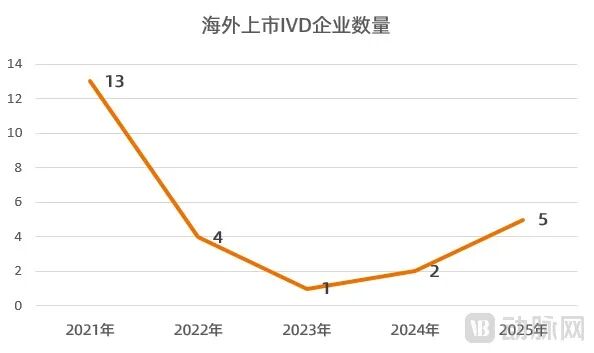
Number of overseas IVD new share listings (US stock markets + European main boards) (Organized by vcbeat)
The secondary market stock price performance also confirms the reality of sustained discount in the IVD sector.
Since the capital high point in 2021, the stock prices of mainstream overseas listed IVD companies have generally been under pressure: QuidelOrtho's stock price has retreated by more than 90% since the beginning of 2021, due to the receding pandemic demand and asset integration pressure, and its profitability has continued to be damaged; platform enterprises like QIAGEN, whose fundamentals are supported by routine diagnostic consumables and testing services, have seen a relatively moderate pullback, with a decline of 10%-20% in the range. Its problem is not cash flow, but valuation suppression brought by low growth expectations.
IVD new shares listed after 2021 are in a more difficult situation, most of the targets break as soon as they go public, with long-term deep discounts.
The secondary market is willing to give premiums to high-growth innovative drugs and cutting-edge biotechnologies, but for mature IVD platforms with gentle growth and relying on consumable repurchases, the pricing scale continues to tighten.
It is precisely this long-term discount in the public market that allows PE and sovereign capital to see opportunities for privatization.
02
Industrial Capital Builds Puzzles, Financial Capital Buys Cash Flow
For a very long time in the past, large-scale IVD M&As were basically dominated by industrial giants, with Danaher, Roche and Thermo Fisher Scientific being the main buyers, and the core logic of acquisition was business synergy and supplementing the business layout.
Danaher's series of acquisitions is a textbook example. In 2011, it acquired Beckman Coulter for 6.8 billion US dollars, obtaining the biochemistry, immunology and hematology assembly line fundamentals for central laboratories of large hospitals, which directly consolidated its position in the central laboratory track; in 2014, it acquired Radiometer, the leader in blood gas analysis, to supplement the emergency and operating room scenarios, forming an in-hospital diagnosis closed loop with the biochemistry and immunology product lines; in 2016, it acquired Cepheid for 4 billion US dollars, obtaining the GeneXpert molecular POCT platform, supplementing the capabilities of rapid molecular testing, tuberculosis and infectious disease diagnosis.
After the acquisition is completed, the target assets are merged into the group, relying on the Danaher Business System (DBS) to continuously optimize the channels, supply chain and gross profit margin, and the instrument plus closed consumables model is highly compatible with the original fundamentals.
The essence of industrial capital acquisition is to add a key puzzle piece to its own business layout, pursuing the synergy effect of 1+1>2.
However, the "puzzle logic" of industrial capital is giving way to the "focus logic" in 2025-2026. In August 2026, Thermo Fisher completed the sale of its microbial diagnostics business to European private equity firm Astorg for a consideration of about 1.075 billion US dollars. The business had a revenue of 645 million US dollars in 2025 with a growth rate of less than 2%, and Thermo Fisher would rather bear the short-term dilution of earnings per share than divest it.
Danaher's work focus in the same period is not to launch new large-scale platform acquisitions, but to cope with the decline in respiratory testing revenue, digest the price pressure from domestic volume-based procurement, and carry out in-depth integration on the cost side.
Industrial giants are willing to pay premiums for new technology platforms and strategic synergy, but are not willing to pay control premiums for overall assets with "low-to-medium single-digit growth + mature consumable fundamentals". This has pushed platform-based IVD enterprises like QIAGEN to the negotiation table of financial capital.
The acquisition of QIAGEN led by EQT follows a completely different path. ADIA and Canada Pension Plan Investment Board in the buyer consortium are both long-term sovereign and pension funds. What they value is not the synergy with their own business, but QIAGEN's independent hematopoietic capacity.
In simple terms, industrial capital buys business puzzles, while PE and long-term sovereign capital buy assets that operate stably and continuously generate cash. The two sets of valuation scales run in parallel in the same track.
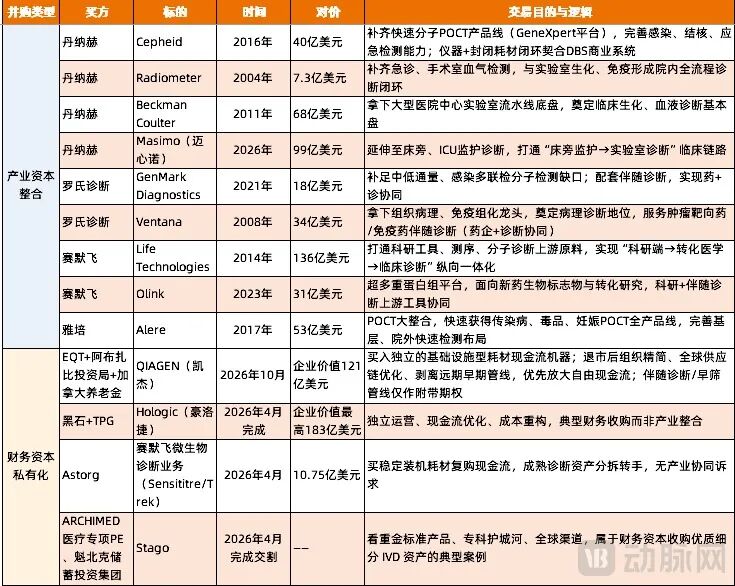
Representative industrial capital integration and financial capital privatization cases (Organized by vcbeat)
For the recent large overseas IVD privatization transactions, Huang Jie reminded that such acquisitions do not represent a recovery in industry prosperity. Part of the assets are diagnostic assets divested by industrial groups that are no longer optimistic about them; financial capital mostly judges that asset valuations have fallen to low levels, and seeks subsequent exit returns through integration and transformation after acquisition, only some transactions have business synergy considerations.
He also pointed out that cost control has become a global trend. In the future, the global IVD industry will show a situation where the testing volume rises with aging population, but the overall market size of the industry continues to shrink, and price bubbles will be continuously squeezed out. The fundamental reason for this is the economic downturn.
Entering 2026, the number of financial investment cases in the IVD field has increased significantly, and QIAGEN is not an isolated case.
On October 21, 2025, the same day the QIAGEN transaction was announced, Blackstone Group and TPG announced the privatization of Hologic at a maximum price of 79 US dollars per share, with an enterprise value of up to 18.3 billion US dollars. The transaction is expected to be completed in the first half of 2026. Hologic has a larger scale than QIAGEN, and also has platform-based assets for diagnostics and medical technology. The transaction also took place during the window when the secondary market's pricing of diagnostic assets is shrinking.
When the two transactions are placed side by side, "PE sweeping goods" is no longer an isolated arbitrage event, but a concentrated re-pricing of a type of cash flow assets that are systematically undervalued by the public market by a type of long-duration capital.
What makes QIAGEN unique is its buyer structure: the long-duration combination of sovereign funds plus pension funds has a longer holding period than pure PE, and is less dependent on short-term exit.