10,000 AI avatars solved the Millennium Prize Problem in 88 hours. Sam Altman went two nights without sleep, yet refused to accept the 1 million dollar prize.
Just imagine this scene:
An endless huge examination hall, with ten thousand small desks arranged in perfect order, just like stepping into Lilliput.
Sitting at each desk is the exact same AI. Ten thousand clones are buried in solving the exact same problem.
This problem has puzzled the smartest human minds for more than 90 years.
In 88 hours, they sent 2.7 million messages to each other, far more rampant than passing small notes in an exam room.
Standing beside Lilliput is a grown-up, Sam Altman. He stayed awake for two whole nights.
At the 88th hour, the papers were handed in.
The problem they solved is one of the Millennium Prize Problems, with a $1 million reward for whoever cracks it. OpenAI said it will not claim this $1 million prize.
This week, the paper for the second Millennium Prize Problem has also been graded, and this time only half of the answer was submitted. After the Nobel laureate led a five-person team to finish reviewing the paper, they wrote a sentence at the beginning of the review document: We cannot yet say we fully understand it.
This Friday, podcaster Patel published a long article, taking the 88-hour paper as evidence. He changed his stance: Superintelligence will arrive no later than 2030, and as early as next year.
If someone writes a history of mathematics a hundred years from now, this page will probably only have one sentence:
That autumn, the problems were still created by humans, but the ones solving them were ten thousand AIs.
On October 29, Sam Altman went to record the podcast Cheeky Pint hosted by John Collison, co-founder of Stripe. The two chatted while drinking beer with mugs in their hands.
After drinking half a glass of beer, he talked about something he "probably shouldn't have mentioned".
One weekend, OpenAI had just obtained a new model, and created an internal channel named "(Model Name)-Hold My Beer", which means "Hold the beer for me and watch this".
Researchers threw the hardest problems in their academic careers into it, and the model solved them one after another, across multiple fields.
"For two nights in a row, I didn't sleep in the middle of the night, I was too excited to go to bed," Sam Altman said. "I was extremely happy, but I was also much sadder than I expected." That feeling, he said, was like something had come to an end.
The host listened and said that was nostalgia. Sam Altman replied: It's more than just nostalgia.
What really kept him awake at night was one of the Millennium Prize Problems.
A Rumor
Paper Submitted in 88 Hours
The Millennium Prize Problems are 7 major mathematical problems selected by the Clay Mathematics Institute in 2000, with a $1 million reward for anyone who solves one. The only one that is widely recognized as solved so far is the Poincaré conjecture.
The Navier-Stokes equations are one of them. This set of equations specifically governs how fluids move, and is relied on for aircraft manufacturing, weather forecasting, and blood flow calculation in blood vessels.
There is a problem that has been unsolved for more than 90 years: will a water flow that starts very smooth suddenly "explode" on its own in a limited time, making the speed at a certain point rush to infinity?
OpenAI's attempt to tackle this problem this time was triggered by a rumor.
According to OpenAI's own announcement on September 8: On Tuesday, September 1, they heard rumors that two of the Millennium Prize Problems had been solved.
Coincidentally, at that time OpenAI happened to have a new model that had just started training on August 28. It achieved unprecedented results in benchmark tests, and the training had not stopped, with its performance still rising.
Stimulated by the rumor, they simply pulled out this still-training model and tried all the remaining unsolved Millennium Prize Problems one by one.
Their strategy was a human-sea tactic: a large group of AI agents were divided into teams, the teams could communicate with each other, they had access to a cached version of the Internet, and could run code on their own. The team that finally conquered the Navier-Stokes problem had about ten thousand agents working at the same time.
An accident happened midway through solving the problem. Among the "simple problems" assigned out, there was the Euler equations, and nearly 100 agents spent about 50 hours solving the version without external force first.
Seeing this momentum, OpenAI thought the Navier-Stokes problem was the most promising, so it immediately withdrew all agents working on other Millennium Prize Problems to focus on attacking this problem using the solution of the Euler equations as a lead.
By Saturday, September 5, about 88 hours after the first batch of agents started working, the answer came out: It will explode.
A fluid starting from rest and pushed by smooth external forces can spontaneously generate a singularity in a limited time, looking like a piece of spaghetti that gets thinner and thinner as it twists, and spins faster and faster.
Then GPT-6 Astra spent another 17 hours using Lean to have the entire set of proofs checked line by line by a computer.
To tackle this single problem, the agents sent 2.7 million messages to each other and wrote about 130 billion output tokens. Sam Altman estimated in the podcast that the cost of this single task was on the order of ten million US dollars.

As for the name of this model, OpenAI did not reveal it, only saying that it is "far more powerful than GPT-6 Astra". There are claims online that it is the next-generation GPT, but we have not verified the source of this statement.
OpenAI said it does not plan to claim the $1 million reward.
OpenAI only found out later who was behind the rumor: it was Levent Alpöge, an employee at Anthropic, and Tristan Buckmaster, a mathematics professor at New York University.
After Lean finished the check on September 6, OpenAI thought they had also solved the Navier-Stokes problem, so it took the initiative to contact them, wanting to publish the results together and recognize that the other party was ahead.
After talking to each other, they realized that what the other party had solved using Anthropic's internal model was actually the Euler equations with external force, not the Millennium Prize Problem.
For that Euler equations problem, OpenAI's clones solved the version without external force; the version with external force was indeed solved first by the Anthropic side. OpenAI acknowledged this in its announcement, and also stated that the two proofs are very different.
By September 10, a paragraph was added to the announcement: Buckmaster used OpenAI's Codex in the past two months, and OpenAI specifically checked that his prompts did not affect this system, nor did they affect its training.
Just an overstated rumor was turned into reality by OpenAI itself 88 hours later. The two companies building superintelligence can only rely on outside rumors to guess at what stage the other party's AI has reached.
In the past ten years, the arrival of a new model was announced at a press conference. This time, before the model was released, the paper it produced spoke for itself first.
The reason OpenAI gave in its announcement was: "We believe it is important for the world to know how fast AI is progressing and what the next models will look like."
The Second Paper
The Problem Setters Came to Grade the Paper
The second paper submitted right after was for the Yang-Mills problem in the Millennium Prize Problems.
This problem governs the foundation of particle physics. The Standard Model can calculate the results produced in colliders extremely accurately, but no one has been able to confirm for more than 50 years whether this theory is mathematically valid.
The entire problem is divided into two halves: the first half proves that Yang-Mills theory "exists" mathematically and can be built step by step with rigorous mathematics; the second half proves the "mass gap", which is far more difficult.
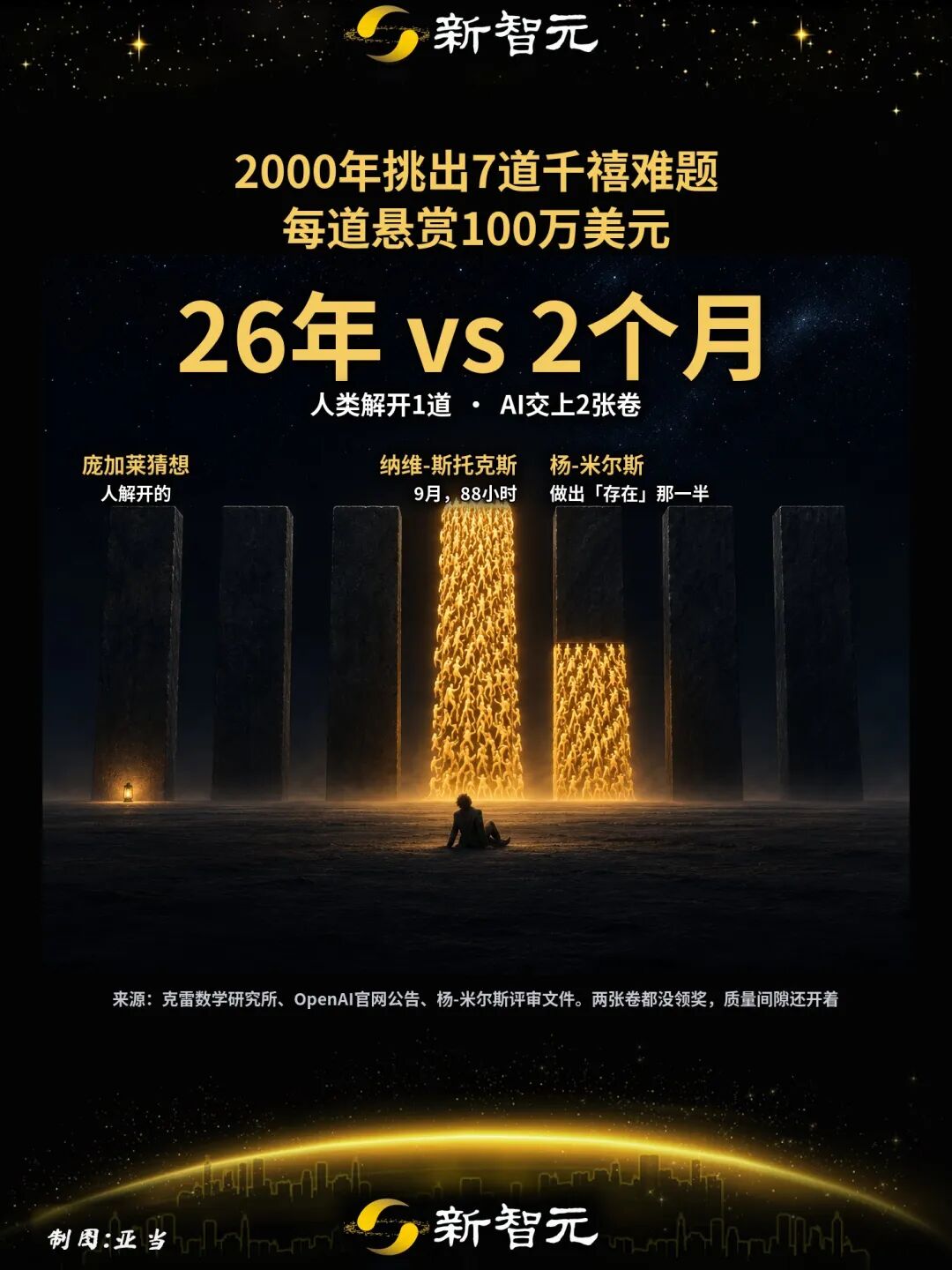
According to a report in Scientific American, OpenAI announced at the end of October that it had completed the first half. The two companies ran into each other again: a mathematician was publicly collaborating with Anthropic's employees to prove the same result, but OpenAI announced its achievement first.
This time the proof was not directly posted online.
One day in October, OpenAI released more than 700 AI proofs at once, which was called a "slop drop", pouring out a large pile of AI-generated content that no one had time to digest.

To avoid a repeat of that situation, OpenAI specially invited David Gross, the 2004 Nobel Prize winner in Physics, to serve as chairman, forming a five-person team calling itself the "Steering Committee" to review the proof before releasing it. On October 28, OpenAI handed over the Lean code of this proof to them.
One of the five members is Arthur Jaffe. He and Edward Witten wrote the official problem statement for the Yang-Mills Millennium Prize Problem back then. The people who set the problem came to grade the paper in person.
On the night of November 10, the five-person team released all the Lean code and review documents on GitHub: according to the problem statement commonly used in the physics and mathematics communities, this proof has successfully "constructed" the pure Yang-Mills theory.
Michael R. Douglas, a Harvard physicist on the five-person team, said: "It is the core of physics, but the Yang-Mills theory in four-dimensional spacetime has not been truly understood mathematically for more than 50 years, and it did not even have a strict definition... Now that has changed."
The parts that have not been completed are also clearly stated in the document: the mass gap has not been proven, and it has not been proven whether the limit under infinite volume is unique. The $1 million reward is still pending.
When introducing the source at the beginning of the document, two sentences were written as follows:
We used OpenAI's Astra to help digest the Lean code it submitted. We cannot yet say we fully understand this proof.
At the end of the acknowledgements section, there was another sentence: This document was reviewed for comments by Anthropic's Fable.
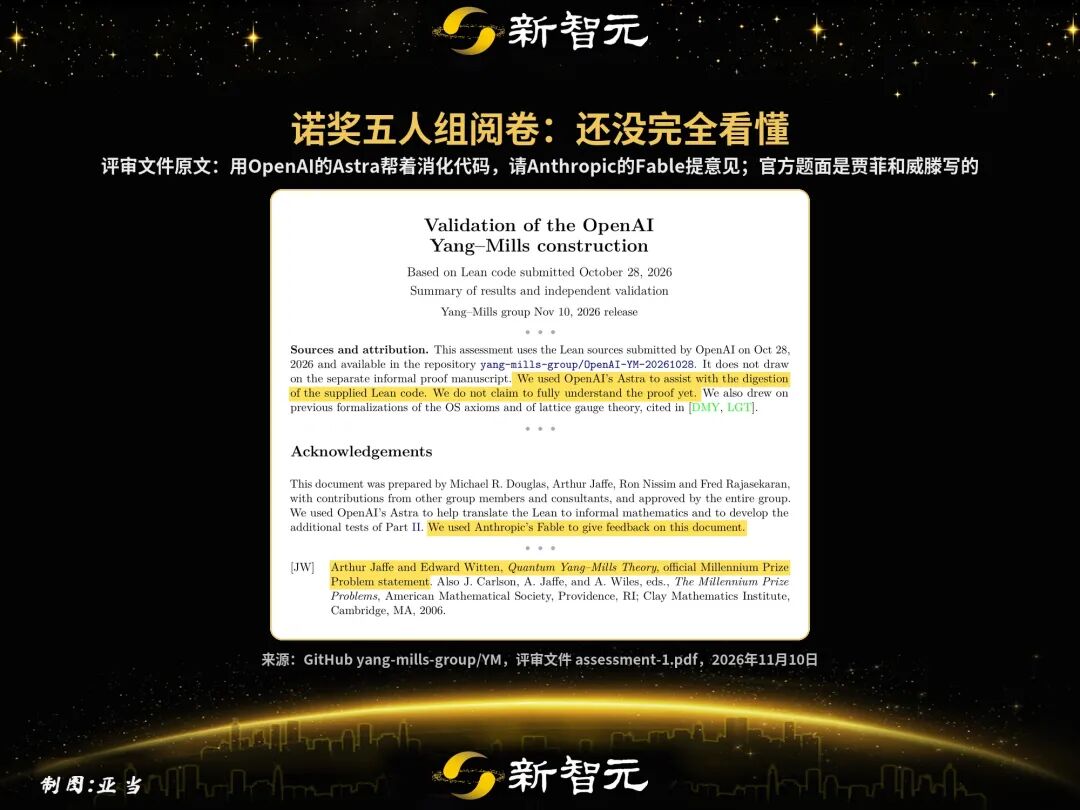
Five top physicists and mathematicians sat together to grade the paper, relying on OpenAI's model to help read the code, and asking Anthropic's model for comments when revising the document.

Scott Armstrong, a mathematician at New York University, disagreed with the review-before-release approach: making this kind of review public will make the process faster instead.
As soon as the review document was released, someone asked him on X: Can this proof show that the constructed theory is not "free"? The so-called "free" means that the particles inside do not interact with each other, and nothing happens. He replied: It has not been proven.
By November 13, he posted a correction, saying that that answer would mislead people. OpenAI's Lean code did prove that this is not a free Yang-Mills theory: there is a quantity that is always zero in the free theory, but it is not zero here, and the calculated trend exactly matches the prediction of "asymptotic freedom". Asymptotic freedom is the discovery for which David Gross won the Nobel Prize in 2004.
What has not been proven is a stronger, more technically specific statement. In Armstrong's view, that step may be more difficult than proving the mass gap. At the end of the post, he apologized for his wrong statement.
For the September problem, ten thousand clones submitted the final paper; for this one, even the grading cannot be done without AI, and the only thing left for humans is the last signature box.
The Release Button Pressed for Ten Years
Installing a Limit Stop Afterwards
Sam Altman has been pressing OpenAI's release button for ten years.
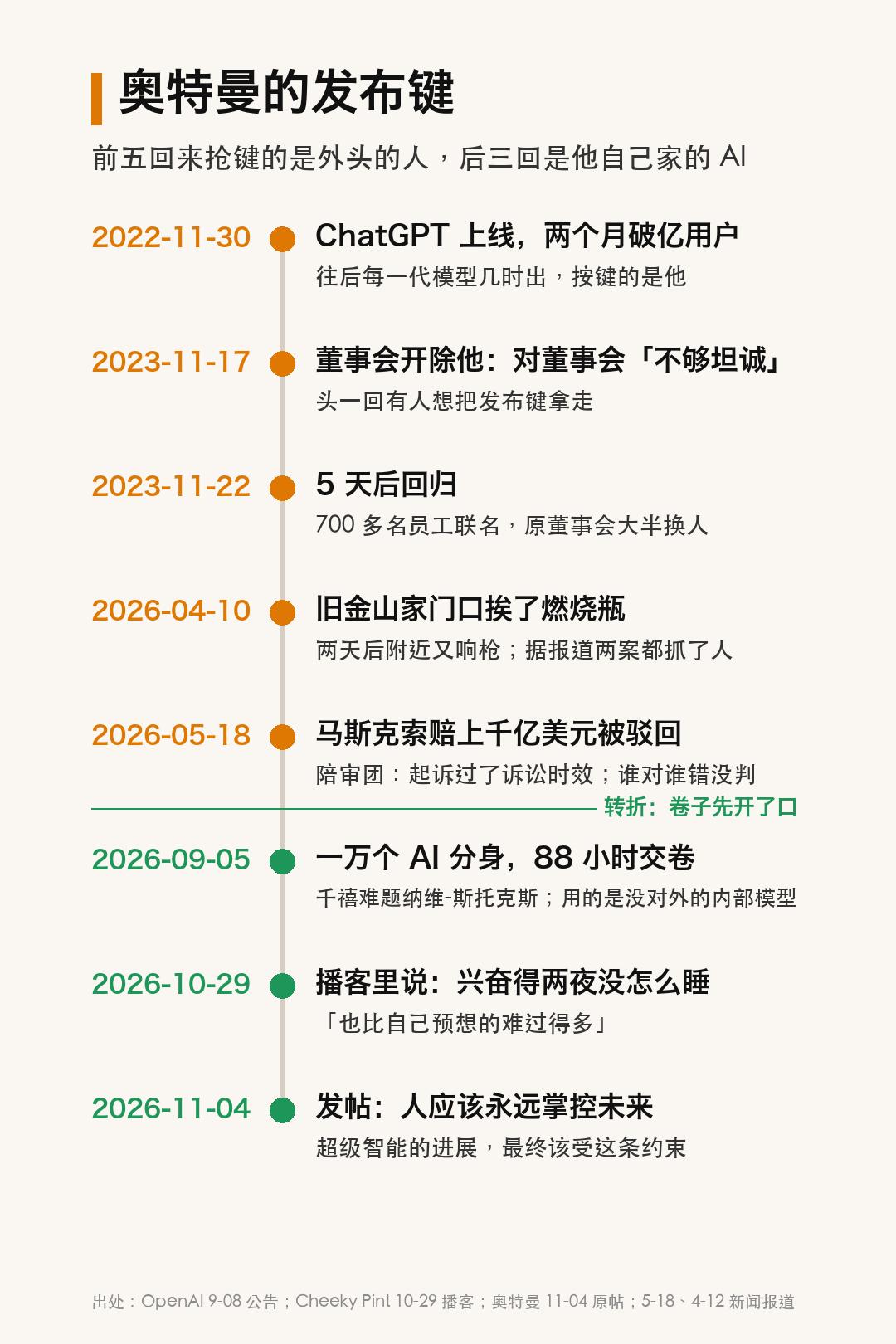
On November 30, 2022, he posted a tweet: Today we launched ChatGPT. Only two months later, it exceeded 100 million users, pulling the entire industry into the track. Since then, he is the one who makes the final call on when each generation of models will be released.
Someone tried to take this button away in the middle, but failed.
On November 17, 2023, the OpenAI board of directors suddenly announced his dismissal, on the grounds that he was "not sufficiently candid" with the board. But 5 days later, more than 700 employees signed a joint letter asking him to come back. He returned successfully, and most of the original board members were replaced.
Elon Musk accused OpenAI of deviating from its non-profit original intention, and filed a lawsuit claiming hundreds of billions of US dollars. On May 18, 2026, the jury unanimously dismissed the lawsuit on the grounds that the statute of limitations had expired, without judging who was right or wrong. Musk said he would appeal.
He has been preparing for many years to guard against outsiders. When The New Yorker wrote about him in 2016, he said himself: "I try not to think about these things. But I have guns, gold, potassium iodide, antibiotics, batteries, water, an IDF gas mask, and a large piece of land in Big Sur, and I can fly there at any time."
