Have young people who prefer living in their cars burst the homestay bubble?
Tao Yuanming once wrote, "I build my cottage amid the haunts of men, yet no noise of cart or horse disturbs my ear" — a scene that was only possible back in the slow-paced old days. People today no longer have such luxury, so they move their homes into their vehicles, using the heavy metal shell to shut out the outside world.
As a result, cars have become the modern people's "cottage". In the underground parking lot of office buildings, some people spend the night in their cars; at service areas, once you raise the roof tent, you get an "aerial bedroom"; for more people, they can only sit in the car for half an hour after work before going upstairs. This 4-square-meter space, once the door is closed and locked, becomes a small world completely under their own control.
Cars were originally just tools to transport people from point A to point B. The fact that they have evolved into the "fourth space" ultimately comes down to the overcrowded and overly noisy reality. Solitude is not only a state of self-cultivation, but also requires sufficient physical support: rental apartments are tiny; you have to pay for a seat in a coffee shop, and even deal with sales pitches; while this 4-square-meter space is the cheapest legal private space ordinary people can own. Here, you don't have to reply to messages, nor do you need to play the role of an employee, partner or parent with stable emotions.
Automakers will never miss this emotional demand of consumers. From mini fridges to large screens, from "house layout design" to "usable space ratio", from roof tents to king-size beds that can be laid down with one click, buying a car is increasingly similar to purchasing a fully furnished single room.
Hundreds of thousands of posts about "bed cars" on social platforms wrap the romance of distant places in an extremely light package. However, the reality is that Shenzhen Bay has begun to evict RVs, and parking lots in Sanya and Dali have repeatedly issued eviction orders for RVs. People living in their cars keep moving between unwelcoming spots, while managers are caught in a dilemma between public complaints and grievances. The mobile home has no property right after all, and you may be woken up at any time.
When someone packs their entire life into the carriage, what do they get in return — the freedom of the wilderness, or a fallback when there is nowhere to go? Automakers have no answer to this question, and cities do not have one for now either.
A cottage does not need a yard, nor does it have to be built on the ground. Perhaps once the door is closed, the fallback becomes freedom. But the moment you open the door, all the problems are still right in front of you.
For Chinese people, buying a car has never been as easy as it is today.
Sales networks extend everywhere: elevator light boxes, mobile app splash screens, huge street billboards, advertisements are overwhelming. As long as you want, you can book a car on the first floor of a shopping mall, the official brand website or even a live stream room, as easily as buying a piece of clothing. You no longer have to go to the "4S store" — the space that left countless grievances for the previous generation of car owners — to go through a thrilling bargaining process to test the bottom price.
As the "Kingdom of Bicycles", China had around 500 million bicycles in the 1980s and 1990s, dozens of times the stock of cars. By the first half of 2026, the number of cars in China had reached 371 million, which speaks volumes about the popularization of automobiles over the past decades.
But for Chinese people, what kind of car to buy has perhaps never been as confusing as it is today.
Some media have counted a set of data: more than 600 new cars were launched in the domestic market in the first half of this year, and the iteration speed of automobiles exceeds that of mobile phones. With "three meals a day" plus a "midnight snack", nearly four new car models are launched every day, "each meal is different". "95% of new products cannot achieve scale effect, they can only divert the existing stock rather than expand the market." These words from Cui Dongshu, Secretary-General of the Passenger Car Market Information Joint Committee of China Automobile Dealers Association, reveal the helplessness and inefficiency of the involution in the auto market.
How to choose from those dazzling yet identical cars? This is one of the annual topics for countless families.
In any case, at the end of 2026, a "great automobile era" has arrived in full swing. It has penetrated into different dimensions of Chinese people's lives, and reshaped our imagination of space, distance, configuration and time. There are not many moments like this: you close the car door, roll up the window, the surroundings fall into silence, and you have full control over the direction and speed. Or you don't go anywhere, just sit for a while, lie down for a while, and stay alone for a moment wrapped in the most trendy comfortable configurations.
Shut off the world, then observe the world again; hide in the car, then understand automobiles again.
01
Another kind of time, another kind of room
At the end of this year, the discussion about "time poverty" is all the rage: it is said that most of Chinese people's daily time has been occupied by mobile phone screens, among which short dramas take up the largest share. Similarly, we can also re-examine our "space time": home, office, outdoor, in the car... How do we divide the 24 hours of a day and 365 days of a year?
Although there is no precise statistic as detailed as the mobile phone screen usage duration, it is a common feeling that Chinese people are spending more time in their cars. The primary reason, of course, is the growing number of cars — the average retail price of passenger cars has dropped to around 170,000 yuan. For more and more families, buying a car is no longer a major expense that requires great financial strain.
At the same time, the traditional concept of "buy a house first, then buy a car" has been reversed among young people to a certain extent: buying a house is a faraway thing; buying a car first for commuting on workdays and traveling on holidays is not only a rigid demand, but also a kind of enjoyment-oriented consumption.
A set of rather unexpected comparative data shows that with the road network renovation, improvement of public transport, and the implementation of traffic restriction and peak-shifting policies, the congestion index in big cities is generally declining slowly, while car owners in small and medium-sized cities and counties have all joined the traffic jam queues. Traffic jams have changed from an "exclusive feature of big cities" to a common phenomenon in cities of all sizes. Driving has also evolved from a specific skill to a lifestyle covering the whole population, so Chinese people's driving time has naturally been extended.
However, what is mentioned above is only the narrow sense of "automobile time". No matter how you race against time in the morning peak, or stop and go in the traffic jam, no matter how much the assistance of intelligent driving and the comfort of configurations soothe you, you still feel somewhat out of control. If there are several work messages or a work phone call in the middle of the trip, the drive will become even more hectic and overwhelming.
The broad sense of "automobile time", apart from the point-to-point transportation from A to B, should also include those active parts. You drive to the place you want to go, and control the rhythm yourself; or you don't go anywhere, just eat, rest, have fun, or zone out in the car.
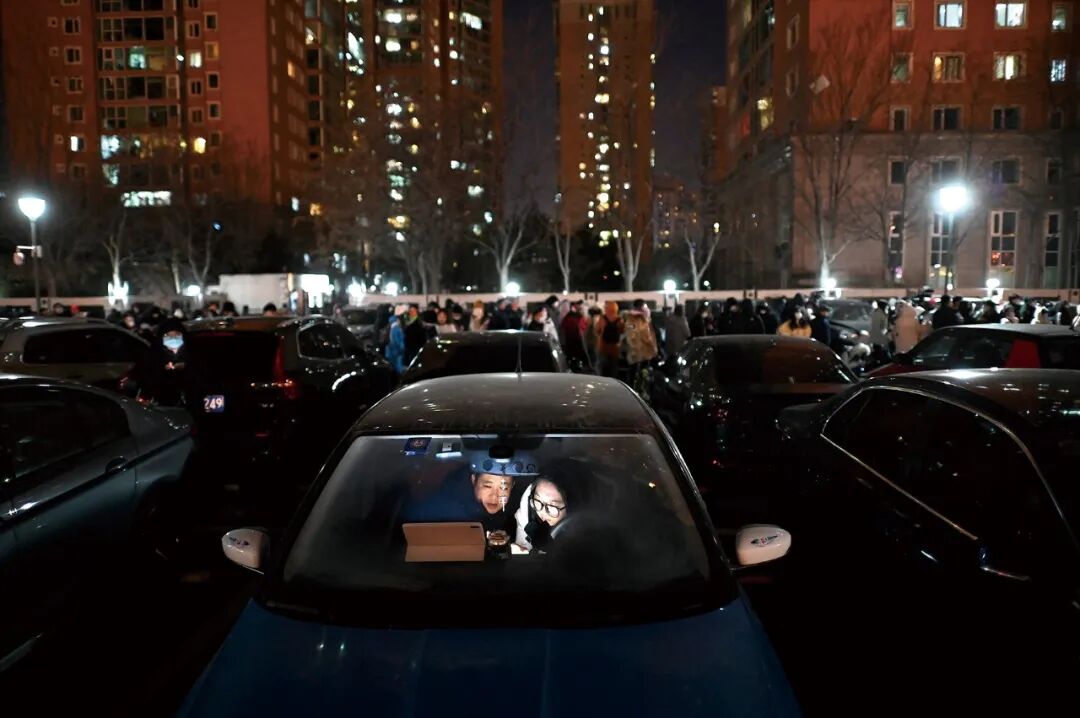
On February 20, 2022, during the fireworks show at the closing ceremony of the Beijing Winter Olympics, some people sat in their cars and watched the performance on the screen. (Photo / AFP)
Last year, Autohome released a survey showing that nearly 50% of users said their staying time in the car had increased significantly, and the proportion of new energy vehicle owners was even higher. Many car models have integrated the "home philosophy" at the initial design stage, making it more suitable for users to do daily trivial things other than driving in the car. New technologies support these new configurations, and the rapid popularization of new energy has also greatly reduced the cost for people to stay in the car.
"A car is just a car. Why don't you go back upstairs to watch TV, sleep and play games?" The fundamentalist "nostalgic driving faction" has a lot of complaints about this, but the fact is that cars are far more than just cars now.
Automobiles have evolved from transportation tools to another room besides home and office, a special room that is free, self-focused, quiet, and mobile at the same time.
02
From bare-bones cars to fully furnished cars
The other side of the longer "automobile time" is the change of automobiles themselves.
30 years ago, Li Shufu, who was in the early stage of starting his business, said that "a car is nothing more than four wheels with two sofas", which was more like a heroic statement to encourage himself and other entrepreneurs in the fledgling era. Of course, making cars is not that simple, nor is buying and driving cars — automobile manufacturing is a cutting-edge industrial field that Chinese enterprises need to learn and catch up with; buying a car is a goal that most families have to strive to reach; driving is one of the so-called "essential skills for the 21st century". In China, a car has always been attached with various social meanings, and brand positioning, price, size and appearance all exist as labels.
With the arrival of the market tide, the right to drive and ride in cars has been popularized, so buying a car has been put on the agenda. For a long time, the decision-making importance of buying a car is no less than buying a house, because cars are real "big-ticket items". At the beginning of the 21st century, Xiali, the representative brand of domestic cars, had been running as taxis on the streets and alleys of northern cities, with the price dropping to 50,000 to 80,000 yuan. Even so, that sum of money was enough to buy a room of more than 10 square meters in a not-so-remote area of Beijing at that time, and the car replacement cycle for Chinese families was generally more than 10 years back then.
In other words, buying a car meant investing a sum of money at the level of buying a house, which would affect the travel experience of the family for more than 10 years in the future, so its degree of solemnity can be imagined.
But the configurations of cars at that time were quite simple. Functions that have almost become standard today, such as seat ventilation and heating, steering wheel heating, and tire pressure monitoring, were all "exclusive to luxury cars" 20 years ago, which ordinary family cars could not even dream of. In the decade around the turn of the 21st century, the new cars people bought were often "bare cars", with cheap fabric interiors, no central control audio, no reversing radar, and even many cars did not even have a radio.
Car decoration came into being. Going straight to the decoration shop in the auto parts city after buying a new car, and decorating the car like decorating a house, became the standard process for people to buy a car.
Today, bare-bones cars have become fully furnished cars, and the car decoration business has almost disappeared. Falling car prices and excess configurations are no longer new topics. The car replacement cycle for Chinese families has quietly changed from more than 10 years to 6 to 8 years, and the replacement cycle for new energy vehicles is even shorter. From luxury goods to family big-ticket items, and then to mass consumer goods, household appliances and communication devices have all gone through this process, and now it is repeating itself in the automotive field.
This is of course the progress of life. More and more people sit in more and more comfortable cars with a more casual state of mind, and a new social space is thus generated.
03
The bustling automotive market
"Chinese cars are getting heavier", this observation once attracted widespread attention.
Data from the Ministry of Industry and Information Technology shows that the average curb weight of new domestic passenger cars in 2024 reached 1704 kg, an increase of nearly 400 kg compared with 2012. Some people attribute it to batteries: in the first four months of 2026, the average curb weight of new energy passenger cars has reached 1939.3 kg, higher than the industry average; some attribute it to configurations: coffee machines, refrigerators, large color TVs and even toilets have been moved into cars; others attribute it to size: large six-seater and large seven-seater cars are prevailing, and the concept that "a larger car equals a better car" leads to waste of space and energy.
More often, the increase in weight is also a metaphor. Although cars are no longer unattainable luxury goods, the desires and meanings attached to them have not decreased, but have been continuously superimposed —
Buying a certain technology represents a certain value orientation: fuel car owners are old-fashioned, pure electric car owners are trendy, and extended-range electric car owners want the best of both worlds. Who is more convenient, who is wiser? Electric car owners take advantage of policies, while fuel car owners are moving forward under heavy burden? Should autonomous driving be used? Endless topics make people argue endlessly.
What brand to buy is almost like choosing a camp, or even a star-chasing behavior targeted at entrepreneurs. For joint-venture cars and domestic cars, netizens first depict the user portraits, and then attack each other: car owners of which brand like to park randomly? Car owners of which brand like to drag race? Buying a certain brand makes you a conservative old fossil? Pure consumption behavior has long been no longer pure.
Not to mention that automotive public opinion events and public relations battles run through the whole year, and frequently hit the hot search lists. In a sense, automobiles have replaced electronic products, beauty products and clothing, and have become the most bustling and most talked-about consumer product in Chinese society. Even people who are not familiar with cars will not pay no attention to these public events at all.
In the 1920s, "putting America on wheels" became a trend, and the United States became a "country on wheels" in 30 years. For Chinese people, this process is more rapid and more complicated: we dislike traditional cars, and we are also worried about hastily made cars; we are afraid of insufficient functions, and we are also distressed by over-design; we deconstruct the glamour of automotive brands, and we are also keen on configuration comparison.
Beneath all the bustle, we urgently need to sit in the car and calm down for a while.
04
The "small building" in the car
I don't know since when, sitting quietly in the car for a while before going upstairs home has become a fixed plot in Chinese TV dramas and movies to depict the distress of middle-aged people. If the use of automotive space only stops at this point, it is really a waste.
Located between public and private, static and dynamic, we can have a sense of relaxation that is freely under our control only when we sit in the car. We can take a nap, have fun, or start the engine at any time. The world is outside the window, the future is ahead, and the direction is in our own hands. No matter noisy or quiet, it is all up to us. The people in the car are free, even if this freedom is fleeting, or even self-deceptive, it is already extremely precious.
In the autumn of 2020, Su Min, a housewife, decided to leave home. She drove a small white Polo from Zhengzhou, Henan Province, and set off on the road alone, recording her trip with the account "50-year-old aunt's self-driving tour". A few years later, a movie adapted from her story was released, named Determination to Leave.
In April 2025, Zhang Yunlai became famous. This ordinary office worker parked his car in the parking lot of Shenzhen Bay Park every workday. He did not rent a house, but chose to sleep in his own car, and drove home on weekends to finish his cross-city work and reunite with his family.
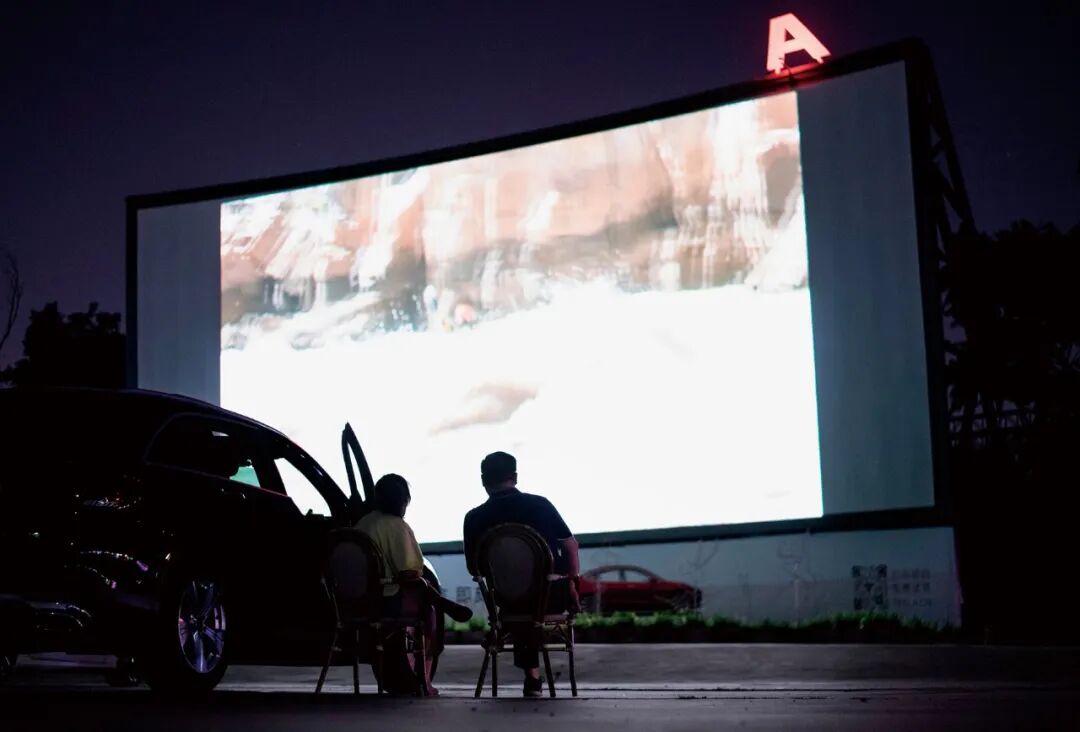
On August