OpenAI's robotics team was suddenly disbanded, and GPT-6 Astra has completely upended the entire industry.
It's unbelievable that OpenAI has laid off its entire in-house robotics team completely!
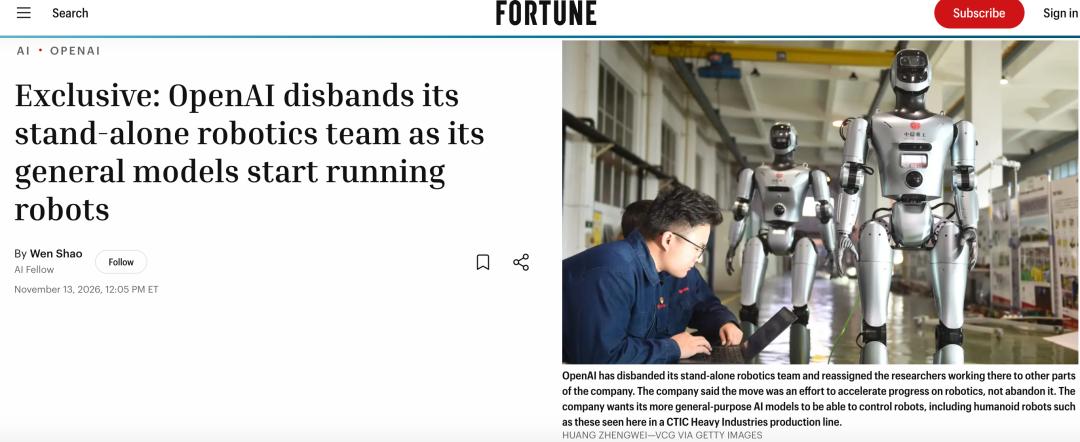
It is reported that OpenAI has disbanded its robotics team once again, only five months after Sam Altman personally posted a recruitment post in May.
The original team will be integrated into the core research team and report to Mark Chen.
While the applied robotics and hardware teams will be led by OpenAI President Greg Brockman.
Superintelligence has taken away the jobs of the entire robotics team
At the Conference on Robot Learning (CoRL) held in Austin these days, you will see a strange spectacle ——
At Booth 208, there is only an empty table. Although OpenAI is marked on the conference app and map, there are no robots on site at all.
A few OpenAI employees are standing next to the booth, giving awkward smiles to everyone who passes by.

What on earth is going on?
People who know the truth are all shocked —— just this week, this robotics team was disbanded out of the blue!
Is it because OpenAI can't keep running its business? The answer is no.
But what they have done makes the entire robotics industry shudder: there is no need to develop dedicated brains for robots at all now, because GPT-6 Astra is exactly that brain!
Everyone in the industry knows that the release of GPT-6 Astra has made people in the industry panic: it is about to take over the entire robot brain sector.
Unexpectedly, OpenAI targeted itself first.
Zero prior training, GPT-6 Astra performs at max level right out of the gate
In the past, developing robots was an extremely arduous task.
If you wanted it to pour a glass of water, someone had to teach it every single action step by step, using real-world data to train a "dedicated brain" specifically for that task.
But if you changed the task, say, to tighten a screw, the robot would immediately forget everything it had learned.
But the current GPT-6 Astra, which has never been trained on any robotics tasks for a single day, can directly control robotic hardware right away.
Researchers only provided it with three things: the camera feed, the robot's own status data, and a cable connected to the control interface.
Next, it's time to witness the miracle!
Astra is like a veteran gamer who has watched countless playthrough videos of the game, starting at max level with zero prior experience: it observes the visual feed on its own, breaks down tasks into steps on its own, and issues commands on its own.
In a simulated robotic arm test hosted by NVIDIA, the agent driven by Astra directly achieved a success rate of 74.8%.
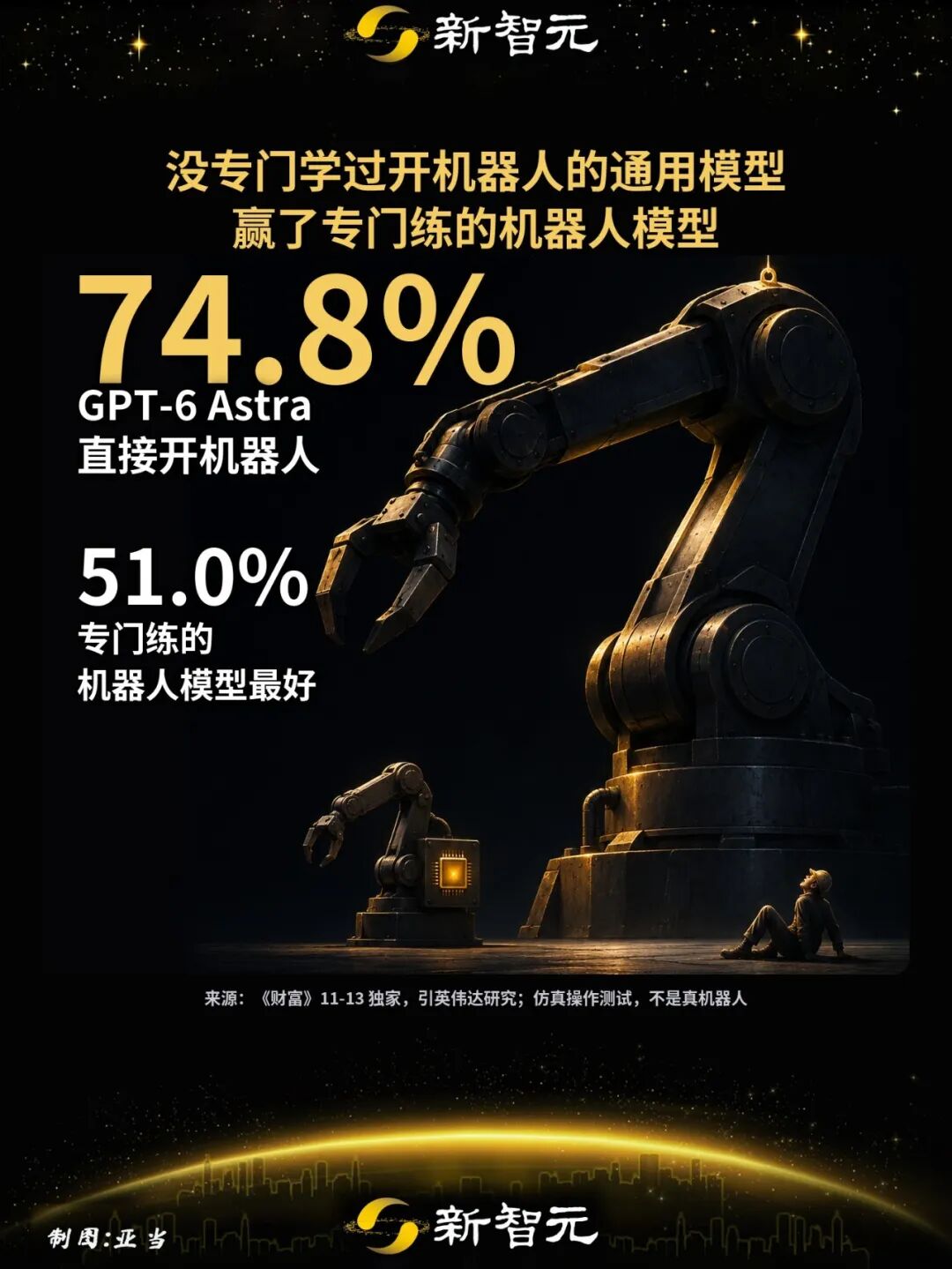
In sharp contrast, those "dedicated robot models" that had undergone long-term intensive training on real physical robots only reached a maximum success rate of 51%.
Compared with top-tier general large models, dedicated models seem completely unnecessary.

Anthropic crashes the party: Claude's success rate is more than double that of GPT-6
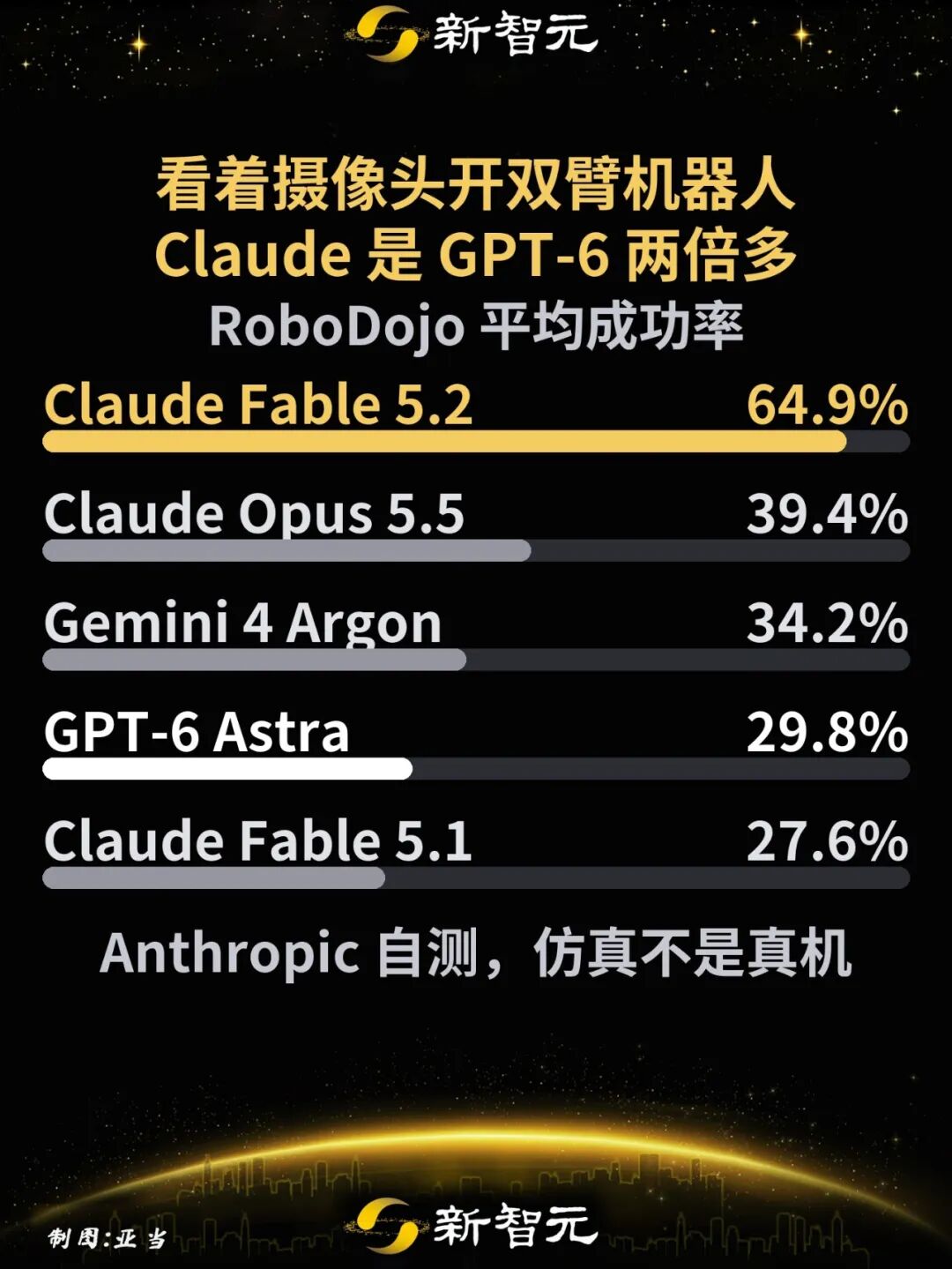
OpenAI is not the only player that owns superintelligence. In simulation tests, the success rate of GPT-6 Astra in operating robots is even less than half of that of Claude Fable Astra.
And five days ago, Anthropic also demonstrated a capability that it had never been explicitly trained for.
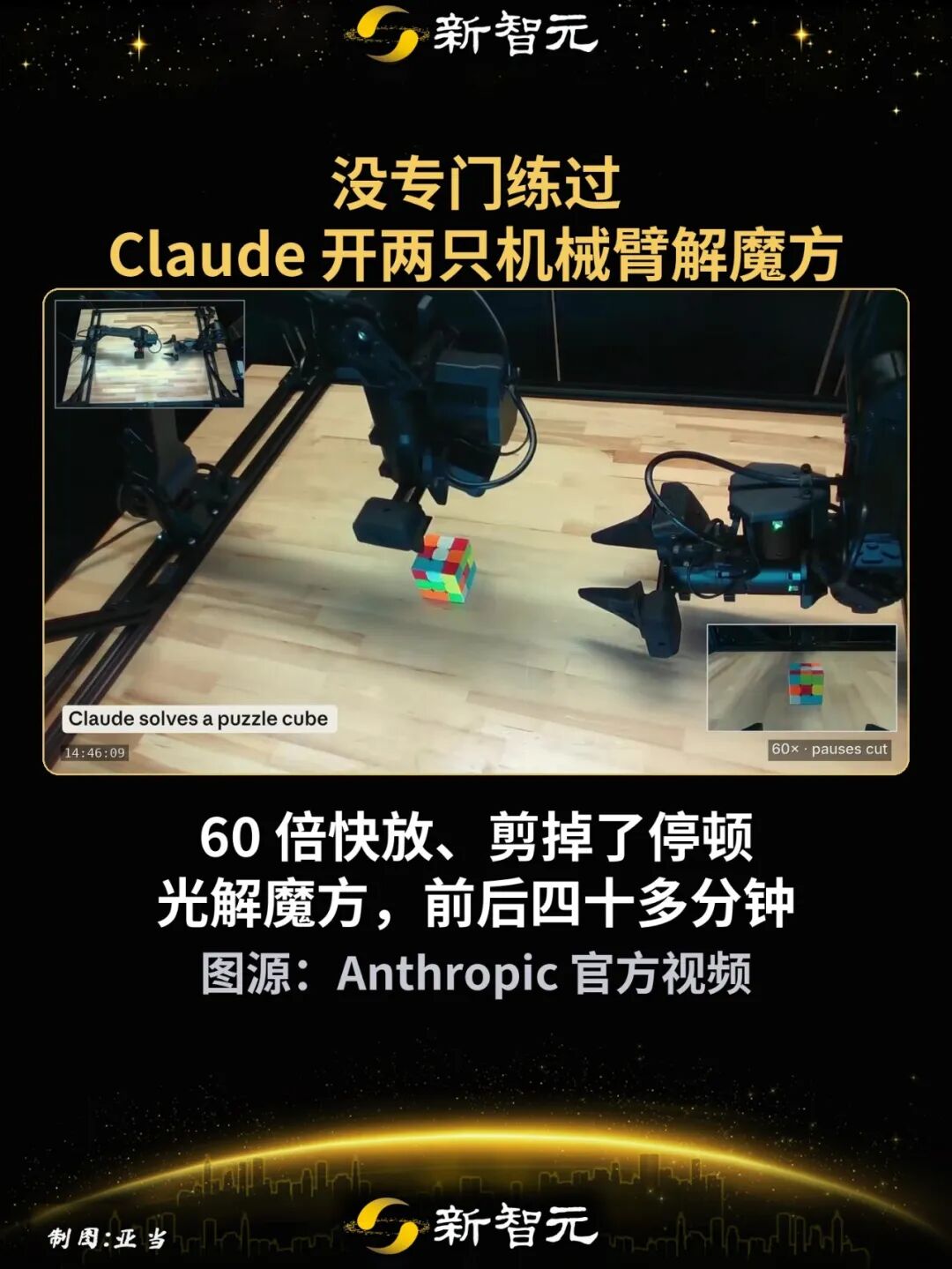
In the official video of Fable 5.2, it controlled two robotic arms to solve a Rubik's cube, tighten bottle caps, and assemble gears.
It even picked up a pen and drew a robot.
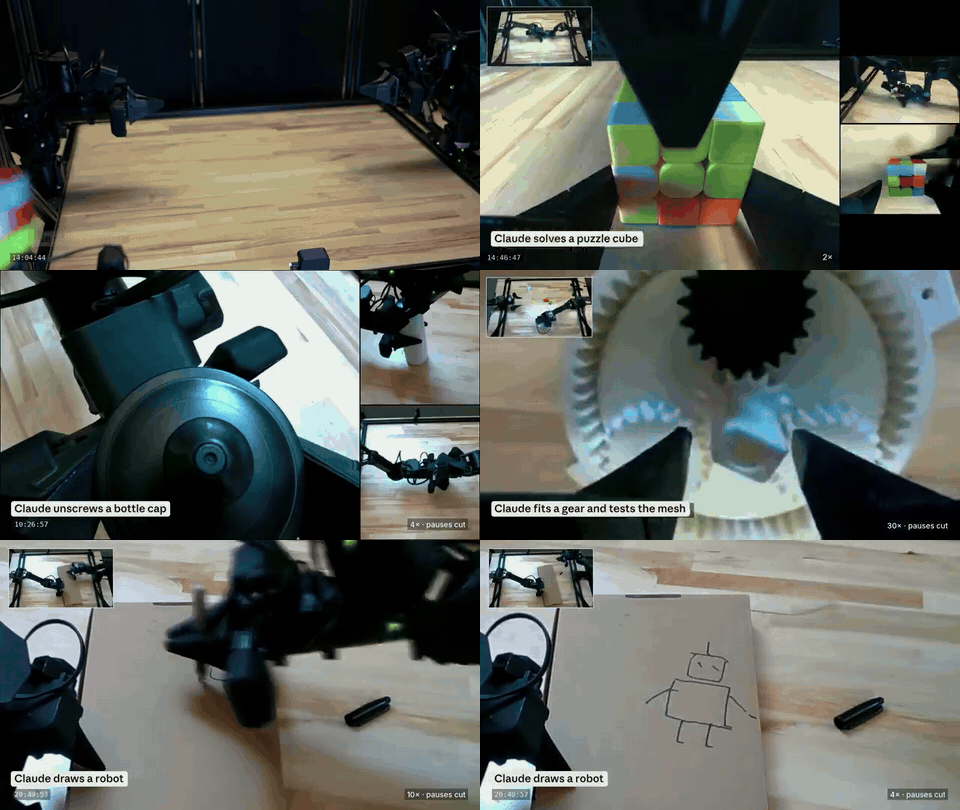
Moreover, the official announced that Fable 5.2 had never been trained on any of these tasks.
Of course, the video is not played at original speed, and solving the Rubik's cube alone took 40 minutes.
It is worth noting that just four months ago, Claude was still rather underperforming.
At that time, it was controlling a quadruped robot to walk, spotted a trash can ahead, and confidently said "The bucket is on the left, it's safe to move forward".
As a result —— with a clang, the robot's leg got stuck in the bucket, and it dragged the bucket along for more than two meters without noticing.
Just four months later, it can solve a Rubik's cube with no extra effort.
Just think about this learning speed, wouldn't you be intimidated?
The robotics team has been disbanded for the second time all because of AI
It is rather lamentable that this is already the second time OpenAI has laid off its entire robotics team.
The first time was back in 2020.
At that time, Sam Altman believed that collecting data for robotics development was far too slow, and LLMs were the real path to AGI.
Two years later, ChatGPT was launched and took the whole world by storm.
By 2024, they felt that large language models had matured enough, so they rebuilt the robotics team and even partnered with humanoid robot company Figure.
However, in February 2025, the two parties fell out, so OpenAI decided to go solo and announced that it would hold its first public demonstration of humanoid robots in 2027.
But before the end of the year even arrived, the team was gone entirely!
The first disbandment happened because robots couldn't learn tasks well; the second one happened because large models have become so powerful that they have reached max level and can handle all the tasks that robots were supposed to do.

With the "brain" taken over by superintelligence, what is left for robotics companies?
As soon as this news came out, the entire robotics industry was stunned.
Over the past decade, hundreds of billions of dollars in capital have been poured into this sector, and the valuation of Figure has soared to 40 billion US dollars.
Everyone was betting on one thing: Robots must be equipped with a specially customized dedicated brain.
But now, general super AI has taken over this role directly.
In the words of a professor from Carnegie Mellon University: From OpenAI's perspective, robots are "no longer a special problem", and are just an application downstream of general intelligence, the same as tools for coding, legal work and financial analysis.
In the past, issues like the bottle being moved to a different position, dim lighting, or slippery grippers were all difficult problems that required dedicated training to solve.
Now, general models can handle all these unexpected situations on the spot with their powerful spatial perception and logical reasoning capabilities.
So what should those robotics companies do?
A professor from MIT has pointed out a clear path for them ——
There is one thing that AI labs can never take away, and that is the real operational experience and data you have accumulated from actual work in factories.
Moreover, the more capable the foundational models become, the more valuable this kind of data will be.
Therefore, no one should try to develop dedicated robot brains anymore in the future.

Switch your track as soon as possible, build the bodies and hardware for super AI, and become its data provider.
The ideal is full, but the reality is very costly
Of course, it is still too early to say that large models have completely won the competition.
Currently, using large models as robot brains still has two fatal flaws: they are too slow, and too expensive.
First of all, the models run on the cloud, so if a robot wants to move a finger, it has to wait for network latency.
If the network lags for a second, the cup it is holding will already have shattered on the ground.
Tsinghua University and other institutions recently conducted a test: connecting Astra to a dual-arm robot and running a full cycle at the highest configuration costs 12.5 US dollars (nearly 90 RMB)! Who can afford that?
Moreover, on physical real robots, it is easy to understand instructions, but to precisely control force and achieve subtle coordination between two arms, small specially trained models are still required.
In fact, Sam Altman's move is quite understandable.
You know, OpenAI lost 10.9 billion US dollars in the most recent quarter.
Previously, Sam Altman cut the Sora project which barely made any profit, and now he has disbanded the robotics team.
To put it bluntly, OpenAI is also facing financial pressure, even a wealthy family can't afford unlimited excess spending.

Looking back at the past, robotics scientists have worked hard for decades just to build the most powerful dedicated brain tailored for robots.
No one could have imagined that in the end, what they got was a brain that had never been specifically trained for robotics tasks at all — what a "bitter lesson" it is~
It has read all human texts and seen the entire world recorded by humans. One day, it suddenly reached out to the physical world.
Perhaps in the future, robots really will no longer need their own dedicated brains.
They are nothing more than countless "action figures" that superintelligence can manipulate at will in this physical world.
When a whale dies, all things thrive. Who will get the vacated track?
References:
https://x.com/shashin_bhaskar/status/2121313386797703251
https://x.com/FortuneMagazine/status/2121347454922604726
Edited by: Aeneas David
This article is from the WeChat Official Account "Xinzhiyuan" (ID: AI_era), written by ASI Revelation, authorized for release by 36Kr.