The number of incoming freshmen at U.S. universities has suffered a catastrophic plunge, which colleges and universities can survive?
Cole Rotondo grew up in Norristown, near Philadelphia, and originally assumed he would stay in the Northeast for college. During an internship with his cousin who works at a large insurance firm, he developed an interest in risk management and insurance. Several of his cousin's colleagues graduated from the University of South Carolina's Darla Moore School of Business and spoke extremely highly of the institution, so he submitted his application. When it came time to choose between Pennsylvania State University and the University of South Carolina, he took a campus tour of the USC campus in Columbia — a trip less than an hour's drive from his grandfather's home. That visit sealed his decision.
"By comparison, I just liked the USC campus way more," said Rotondo, who is now a senior and serves as president of the university's student government. During the admitted students' visit event back then, the school matched him with several potential roommates. After the event, these prospective roommates, all from the South, "got together and made a funny video listing all kinds of reasons why I should come to USC," he recalled. "The fact that they put in that effort to convince me to enroll said everything. I paid my enrollment deposit that same night."
Equally critical: the University of South Carolina offered him an academic merit scholarship (now $11,500 per year), which made the total cost of attendance "almost identical" to staying in-state at Penn State, which did not offer him any financial aid at all, Rotondo said. As for the Wharton School of the University of Pennsylvania, the widely recognized top-ranked undergraduate business program across the U.S.? He never even considered applying, convinced he would not get into that Ivy League school.
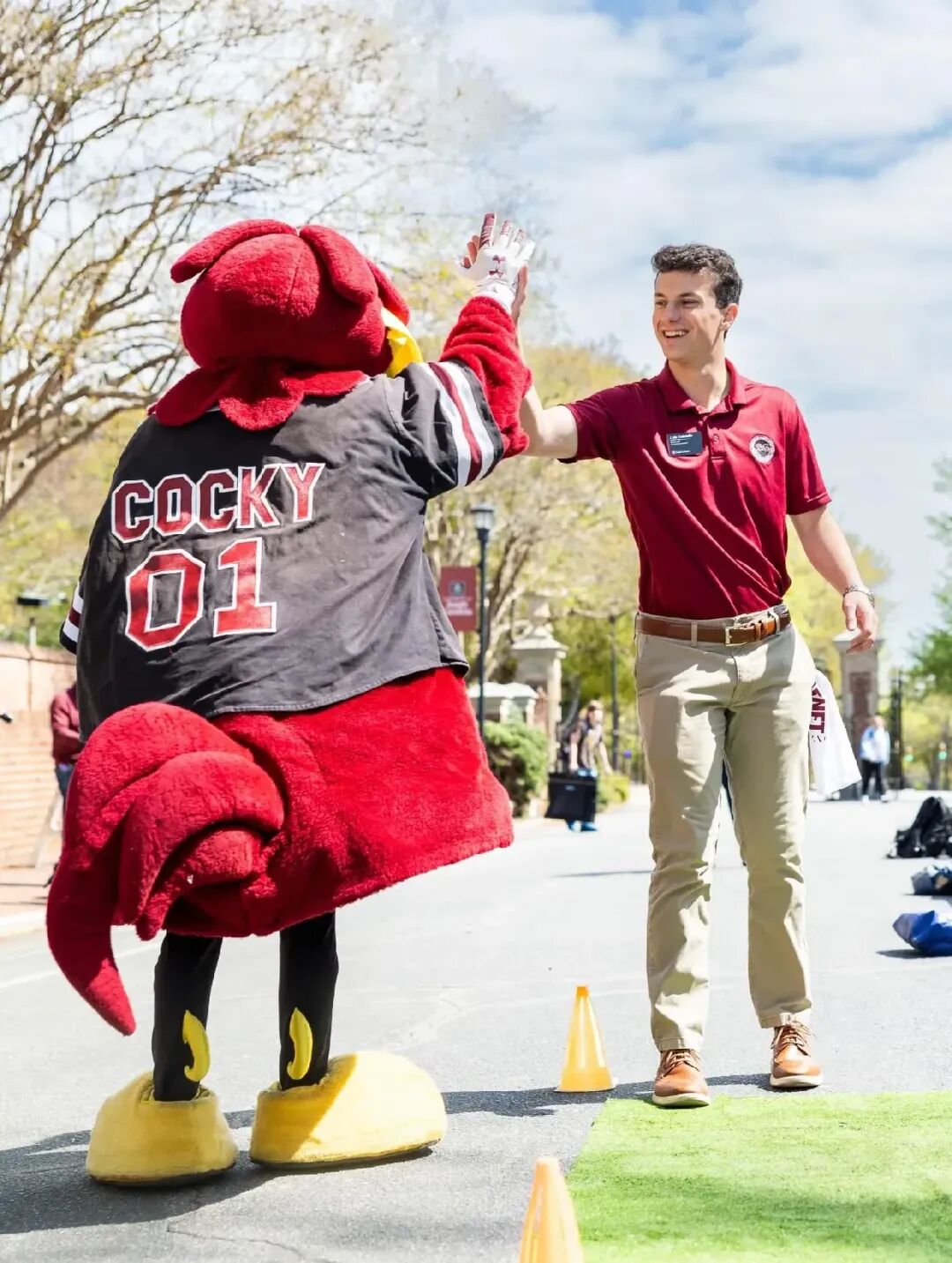
Cole Rotondo poses with Cocky, the University of South Carolina's mascot. The school's sports teams are known as the Gamecocks.
Image source: COURTESY COLE ROTONDO
Rotondo is just one of a growing number of students choosing to attend out-of-state colleges, with the Southern region drawing a massive influx of students from other parts of the country. Federal data analyzed by Forbes shows that between 2018 and 2024, the number of new freshmen enrolled at Southern higher education institutions rose by nearly 36,000, the largest absolute increase of any region in the U.S. In terms of growth rate, the South and West saw increases of 5.7% and 6.8% respectively, while the Northeast and Midwest posted declines of 3.1% and 2.1%. (Our analysis excludes institutions that primarily offer online instruction.)
This partly reflects underlying demographic shifts: the South is the fastest-growing region in the U.S. in terms of population, with particularly prominent growth in the children and youth demographic. But at the same time, the number of Northeastern students heading to out-of-state institutions in the South is also on the rise. According to our analysis of data from the Integrated Postsecondary Education Data System (IPEDS), 11.9% of Northeastern high school graduates in 2024 chose to enroll at Southern colleges, up from 10.2% in 2018.
Robert Alexander is Vice Provost for Enrollment Management at the University of Rochester, located in snowy Upstate New York. He believes some Northeastern students are looking to escape both the local academic pressure and the frigid climate. "These high schoolers are fed up already," he said at a college admissions trends panel he co-hosted at the annual National Association for College Admission Counseling (NACAC) conference in October. "Some of the pandemic-era effects have faded, and parents are now more willing to support their children going to the Southeast — because many of those parents themselves are considering moving there after retirement." He also noted that major institutions in the Southeastern Conference (SEC) have built extremely strong brands, promoting their campus life through football games, campus traditions and social media outreach. "We live in an increasingly brand-focused society," Alexander told Forbes in an interview after the panel.
As U.S. colleges collectively face the "enrollment cliff" — the result of a sharp drop in U.S. live births following the 2008 Great Recession — this cross-regional flow of student applicants has become even more pronounced. According to analysis from the Western Interstate Commission for Higher Education (WICHE), the number of U.S. high school graduates peaked at 3.9 million in 2025, and is projected to fall to 3.4 million by 2041. Coupled with a decline in international student applications during Donald Trump's second term, competition for student applicants has intensified further.
Another factor amplifying competition: today's students appear far more willing to travel long distances to attend four-year universities.
Analysis from Washington D.C.-based education consulting firm EAB Global shows that across all students attending in-state and out-of-state four-year institutions, the median distance between a student's family home and their college campus was 183 miles in 2024, up from 139 miles in 2017. EAB found that institutions represented by large public flagship universities are continuously expanding their cross-state recruitment reach, while large, prestigious private universities have long held this kind of cross-state appeal.
Students who do choose to pursue out-of-state education travel even farther, with an average distance ranging from 500 to 750 miles, and are no longer limited to institutions in neighboring states. Data from EAB shows that states with rich and diverse public higher education resources such as California, Texas and Florida are attracting students traveling from faraway places, while these states are also retaining more of their local student population. At the same time, the local student retention rate in states like New York and Illinois continues to decline.
Top Schools by Region
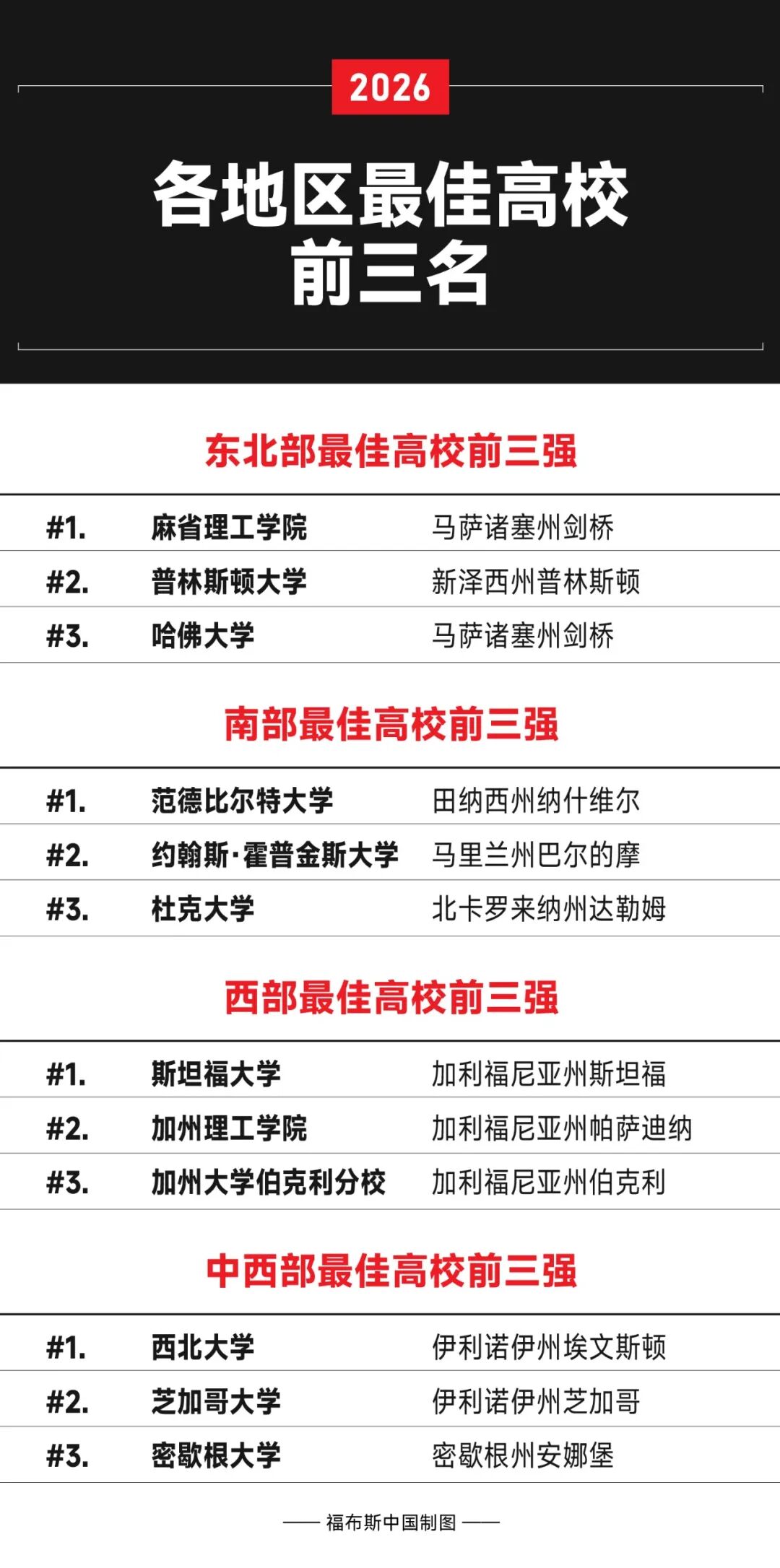
To provide a reference for high school students looking to step outside local institutions and choose colleges across regions, we have selected the 25 best institutions in each of the four major U.S. Census Bureau regions: the South, Northeast, Midwest and West. The rankings are based on Forbes' 2027 Top 500 U.S. Colleges rankings, evaluated around institutional outcomes that cover metrics reflecting students' long-term development achievements, including graduation rates, alumni earnings and student debt levels.
These regional rankings largely reflect the vastly different educational landscapes across the U.S. The Northeast, for example, is home to only 17% of the total U.S. population, but accounts for 32% of the institutions on the Forbes Top 500 U.S. Colleges list, with the top five spots (Massachusetts Institute of Technology, Princeton University, Harvard University, Columbia University, University of Pennsylvania) all located in the region. Due to the dense concentration of long-established elite private institutions and fierce competition in the Northeast, not a single public state university appears in the Northeast Top 25 rankings. (In fact, only two public institutions in New York across the entire Northeast made it onto Forbes' 2027 list of the Top 25 Public Universities in the U.S.)
By comparison, 16 of the West Top 25 are public institutions, 11 of which are based in California; the University of California, Berkeley ranks first among public universities and third overall, behind only Stanford University and the California Institute of Technology. The South and Midwest Top 25 lists feature a balanced structure with roughly equal shares of public and private institutions.
Employment and the Southern College Selection Boom
Out-of-state student inflows bring substantial benefits to higher education institutions, and South Carolina serves as a highly representative example. Forbes' analysis of IPEDS data shows that between 2018 and 2024, the number of new freshmen at public and non-profit private institutions in the state rose by roughly 3,100, of whom about 2,400 (78%) came from out of state. Data from WICHE shows that the size of South Carolina's local high school graduate population remained largely flat during this period, while our analysis found that the number of new freshmen coming from the Northeast surged by 63%.
Scott Verzyl, Vice Provost for Enrollment Management and Director of Undergraduate Admissions at the University of South Carolina, says the strong interest from Northeastern students in his institution stems from a combination of geographic location, campus culture and cost of attendance. The university is accessible via direct flight or car drive from most parts of the Northeast; SEC sports events, plus the fact that many students have relatives and friends in the state, further boost the school's appeal. Merit scholarships also make the cost of attending USC competitive with the public in-state universities students would otherwise attend. Rotondo says that of the roughly 380 high school graduates in his cohort from the Philadelphia area, six ended up going to USC, which is no small number.
Job opportunities in the booming metropolitan areas across the South are another major draw. Heath Einstein, Vice Provost for Enrollment Management at Texas Christian University based in Fort Worth, says in-state students make up less than half of the university's incoming freshmen. "Over the past decade, the region where we've seen the most noticeable growth in our student base is the Southeast, particularly Atlanta and Nashville, and the Northeast is also a major source." New York and Connecticut are now among the university's top ten sources of students. Einstein believes the strong economy of the Dallas-Fort Worth region is another major draw, with many graduates choosing to stay and work locally after graduation.
There are also students who decide to build their careers in the South after enrolling. Rotondo, who is scheduled to graduate in May 2027, originally planned to return to Pennsylvania to work in Philadelphia. Now he plans to first take a position at the University of South Carolina or with the South Carolina state government, before attending local law school later.
Against the backdrop of a weak entry-level job market and the impact of artificial intelligence, geographic factors have arguably become even more important when students choose where to attend college. The reason is that as resume screening is now handled by AI and hiring paces have slowed down, both employment experts and job seekers agree that networking, in-person socializing and hands-on experience accumulated through internships are more critical than ever to landing a job.
The Battle for Student Applicants
Dee Voss, Vice Provost for Enrollment Management at The New School in New York, does not deny the appeal of the South. "People are moving out of New York — I grew up in Ohio, which is also facing population outflow — everyone is moving to places like the Carolinas, Florida, Georgia and Texas," she said at a panel session during the NACAC conference. Some families move south as a whole, but many students head south alone for college while their families remain in their original home areas.
But she also points out that even the South cannot completely avoid the impact of the enrollment cliff. "No region is immune," she said. "The total population is shrinking, and overall demand for college education is declining." Voss adds that families are now becoming more prudent and selective when investing in higher education, forcing colleges and universities to work harder to demonstrate their value, while rolling out more generous tuition discount policies.
In response, colleges and universities are drastically expanding their recruitment scope far beyond their traditional territories. TCU's Einstein mentions that the recruitment market in Texas is becoming increasingly crowded, with institutions from across the U.S. dispatching admissions officers to Dallas, Houston, Austin and San Antonio to compete for local students. "Other institutions' recruitment networks have blanketed the entire state, and so have ours," he said.
The University of Rochester has adopted a similar strategy. Alexander says the university has dispatched experienced enrollment professionals to California, Texas, Chicago and the New York metropolitan area. Nationwide recruitment is a long-standing strategy at the University of South Carolina that has been in place for more than 20 years. "If you're just starting to worry about the enrollment cliff now, it's already too late," Verzyl said.
Running nationwide recruitment requires resources that not all institutions possess. Large public universities, especially top flagship campuses, often hold advantages in institutional reputation (including fame brought by strong sports programs), academic program offerings and recruitment reach. "Large universities can build the sense of community that small colleges have, but small colleges cannot replicate the scale and depth of a large university," Verzyl explained. Comprehensive universities can not only offer a wide range of academic programs and facilities, but also build small communities on campus to support students' growth.
The state of Michigan offers a clear demonstration of the trend toward stronger institutions getting even stronger amid the current competitive landscape. According to our analysis of IPEDS data, between 2018 and 2024, new student enrollment at Central Michigan University, Eastern Michigan University and Western Michigan University fell by 20%, 34% and 17% respectively. Meanwhile, new student enrollment at the flagship University of Michigan campus in Ann Arbor rose by 7.5%. Over the past five years, the university's total applications have risen by 29%, reaching a record 115,125 applications for Fall 2026 admission. This is no coincidence. The University of Michigan, which boasts both strong research and sports programs, ranks third on Forbes' list of top public universities in the U.S., behind only the University of California, Berkeley and the University of California, Los Angeles.
Financial pressures and gaps in financial resources have jointly intensified competition among higher education institutions. Public universities facing continuous cuts in state government funding are actively recruiting out-of-state students, who pay higher tuition rates. At the same time, wealthy private institutions are offering generous financial aid and tuition discounts to attract applicants. Many other institutions are improving their competitiveness by adding new academic programs, expanding their sports programs and upgrading campus facilities.
Some institutions have chosen an expansion path. For example, Texas Christian University plans to expand its undergraduate population from roughly 11,450 to 14,900 over an eight-year period, while adding new programs that align with the economic needs of North Texas and expanding student dormitories. According to data released by the University of South Carolina, applications to the school stood at roughly 31,000 in 2018, and are expected to surge to over 70,000 in the current admissions cycle. The university is building new dormitories to meet the growing enrollment demand.
But against the backdrop of a continuous decline in the college-age population across the U.S., heavy investment in facility expansion and recruitment promotion also carries hidden risks.
What This Trend Means for Students
Alexander said at the NACAC conference: "The trend is clear: students are increasingly willing to travel far away to pursue their education. The number of applicants coming from more than 500 miles away is growing in the vast majority of states."
For families choosing colleges, this represents both more opportunities and more complex decision-making. As more and more institutions recruit across regions, students will have a wider range of options and the chance to access more generous financial aid packages. But at the same time, the already labor-intensive college selection process — comparing institutions, submitting multiple applications, weighing different financial aid offers — will become even more cumbersome. Families should still focus on the actual educational outcomes of the institutions: a rising level of popularity or the existence of merit scholarships does not mean a school offers the best teaching quality or the highest return on educational investment. Families may also take regional economic growth rates and local employment opportunities into account when selecting colleges.
Rotondo once advised his younger brother not to limit his college search to Pennsylvania, and his brother eventually enrolled at the University of Alabama. He shared his advice for students who are hesitating about whether to travel far away for college. "If you stay in your comfort zone the entire time you're in college, you're missing the whole point," he told Forbes. "College is about spreading your wings and seeing how far you can fly."
This article is from the WeChat official account "Forbes" (ID: forbes_china), author: Forbes, 36Kr is authorized to distribute this content.