What should we do if our core key personnel resign?
On the day Jensen Huang announced his resignation, his direct competitor AMD's stock price rose by 5.86%, Broadcom by 5.54%, network equipment maker Arista by 5.06%, and Google also followed suit with a 1.79% increase. The capital market's evaluation of Mr. Huang is so unadorned and straightforward.
NVIDIA itself was busy stabilizing the situation. In the same announcement, Colette Kress, who had served as CFO for 13 years, took over as interim leader, veteran director Harvey Jones was appointed chairman, and the search for a formal CEO will continue.
The board of directors routinely gave the market a reassurance: it has full confidence in Kress and the management team, and expects the company's operations, customer commitments and product roadmaps to proceed as usual.
Phrases like "full confidence" and "proceed as usual" are just like the saying "Mathematics is a subject that the Chinese people are good at" — you can just take them with a grain of salt. In the first minute of trading, NVIDIA's stock price fell by 14%. It then started to rebound, and finally closed down 4.34%.
The opening price reflected a knee-jerk reaction, while the closing price reflected psychological adjustment. Wall Street seemed to be comforting itself: Jensen Huang is gone, but NVIDIA is still here.
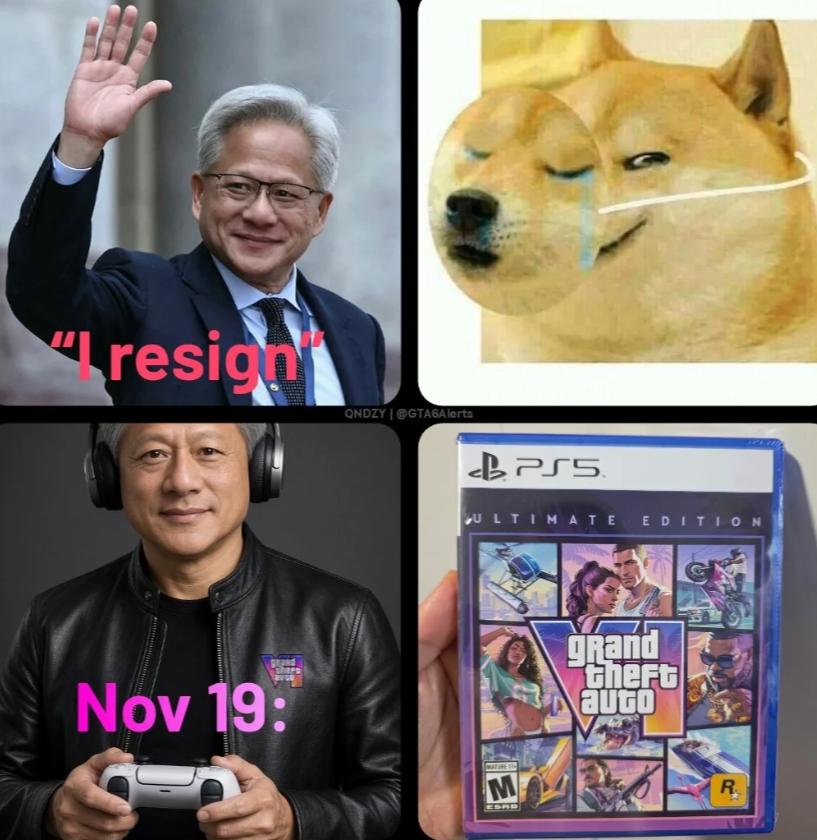
But the market obviously underestimated the cost of Jensen Huang's departure.
The Man Who Dug the Moat
Many media outlets have pointed out the problem with NVIDIA's organizational structure:
NVIDIA has a very special structure with no actual "second-in-command". Jensen Huang, a master of time management, receives reports from dozens of executives at the same time, each of whom is in charge of a segmented business, and no one oversees the overall situation.
In a 2024 interview, Jensen Huang mentioned that his leadership team had 60 people, and they rarely had one-on-one communications, yet everyone knew what the other 59 people were doing.
Mr. Huang is an energetic person who can catch a flight to China at the last minute, and spends the time that Elon Musk spends on Twitter handling business. The book *The Nvidia Way* states that NVIDIA employees send emails once every one or two weeks listing the most important things they are working on, and Jensen Huang reads hundreds of such emails every day.
Many Twitter users mentioned in their posts supporting Jensen Huang that Mr. Huang would respond to business needs immediately.
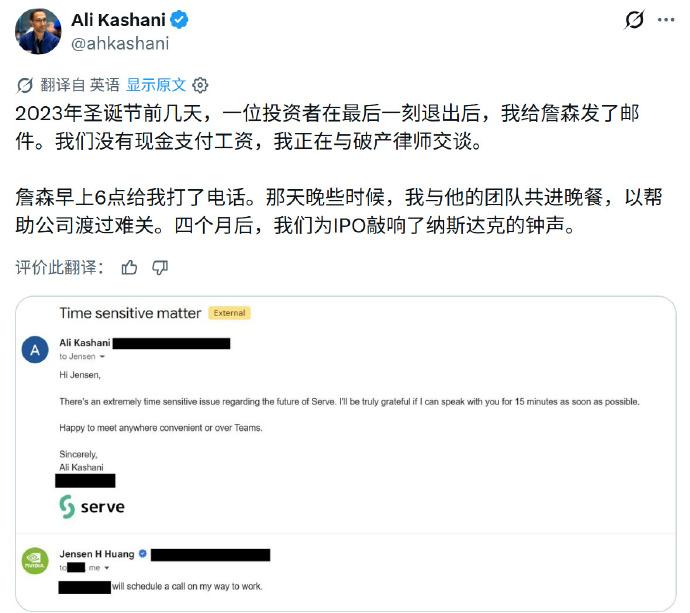
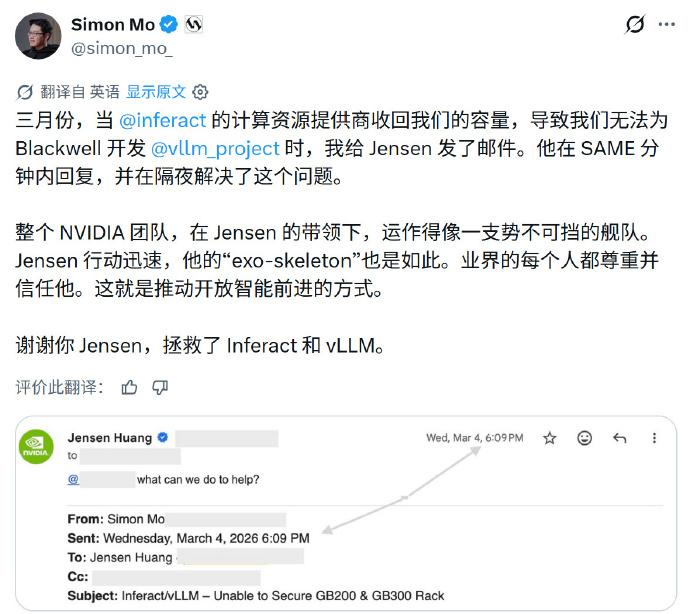
This special organizational structure is also related to NVIDIA's product attributes.
In 2023, Jensen Huang said on the Acquired podcast: The architecture of the company (to me) is a computer with a computing stack.
In Jensen Huang's philosophy, NVIDIA sells a complete system with GPU as the core, so the company's architecture should also be like a computer with a complete computing stack, where each layer including architecture, chips, software and upper modules corresponds to a specific person in charge.
Earlier this year, Jensen Huang was interviewed by Lex Fridman, who asked: How do you organize experts in the fields of memory, network, optics, power supply, heat dissipation and other fields? Jensen Huang immediately replied that this is why his direct team is so huge.
Jensen Huang calls it "extreme co-design": the company is like a product. If NVIDIA wants to create a computing system that works in synergy, it must first turn its organizational structure into a system that can work in synergy.
NVIDIA's moat is far more than the CUDA ecosystem. Take NVIDIA GB200 NVL72 as an example: one cabinet contains 36 Grace CPUs and 72 Blackwell GPUs, which also need to work together with HBM memory, NVLink interconnection, liquid cooling and software systems.
The efficiency of the collaborative work of these links determines the overall computing power cost for customers, and each link has a specific person in charge. NVIDIA's advantages include not only various technologies, but also the experience and ability to make these technologies adapt to each other.
Jensen Huang's job is to determine where NVIDIA's moat should be dug.
In 2019, NVIDIA acquired Mellanox for 6.9 billion US dollars. Mellanox is a company that makes network communication products. Jensen Huang believes that future AI requires a large number of servers to work in synergy, and network communication capabilities are the key. Therefore, NVIDIA must enter the high-performance network communication field in advance.
In 2021, NVIDIA announced the development of Grace, a data center CPU. As large models and data keep growing, the efficiency of GPUs will be dragged down by the data of CPUs and memory. Therefore, NVIDIA needs to design a CPU that closely cooperates with GPUs, and renovate the memory and interconnection system at the same time.
In 2023, the GH200 composed of Grace and Hopper GPUs entered full production.
NVIDIA's core business is "computing". For 30 years, Jensen Huang has been constantly predicting where the bottleneck of future computing systems will be, turning this prediction into a technology R&D direction, and then spending billions of dollars to dig a solid moat in advance.
A skilled warrior wins without making spectacular exploits, and Jensen Huang is NVIDIA's most important asset.
The Succession Issue
Has Mr. Huang ever considered the succession issue? So far, it seems that he has not.
In the interview with Lex Fridman, Mr. Huang said that he would continuously pass on knowledge and experience in daily work, showing the reasoning process to the team instead of handing over everything only when he leaves. But he also said that he hopes to keep working until the end of his life.
The power transition in technology companies is a major event that requires extreme prudence.
In 2005, Apple appointed Tim Cook as COO, when Cook was already in charge of global sales, operations, and the Macintosh division.
In the appointment announcement, Steve Jobs wrote a very interesting sentence, to the effect that Tim had actually been doing this job for more than two years, and the promotion was just a formal recognition to go through the process.
In 2009, Steve Jobs took medical leave and let Cook take charge of daily operations, while he himself participated in major strategic decisions. In August 2011, Cook officially became CEO. When Steve Jobs resigned, he asked the board of directors to "execute the succession plan", indicating that the successor had been clearly arranged.
The move of designating a successor in advance is very common in high-tech companies.
Amazon CEO Andy Jassy mentioned in an interview in 2015 that he had served as Jeff Bezos' technical assistant for a full 18 months, a position they internally called shadow role.
Andy Jassy had to attend all meetings including one-on-one meetings with Bezos, observe how Bezos worked, how he interacted with executives and subordinates, and distill Bezos' experience in person. After the distillation was completed, Andy Jassy was sent to AWS to gain experience. In 2021, Bezos stepped down as CEO and became chairman to oversee the company from behind the scenes.
This is a standard template for succession in high-tech companies: identify the right person, let him build his own team in the core business of the future, and the founder serves as chairman to complete the transition.
Why do they do this? Technology companies need to judge future technology directions and make bold investments when the prospects are unclear.
But inside the company, debates over technical routes are commonplace. In a place full of talents, there is no lack of well-reasoned but completely opposing opinions.
The long-term execution of technology strategies is highly dependent on personal prestige. Titles can be modified with one click, but prestige cannot be imported in batches. Therefore, before veteran leaders step down, they will always help their successors get on the right track and tilt resources to them.
To quote the lines from the TV series *In the Name of the People*: The "Han University Clique" may not exist subjectively, but it must exist objectively. The consequences of frequent changes at the helm have been demonstrated many times by Intel and Manchester United.
Before Sundar Pichai took over as CEO of Google, he first made achievements in the Chrome browser division, and then took over Android, Google's core business of the future. In 2015, Pichai took over as CEO, and Larry Page served as CEO of parent company Alphabet for another four years before stepping down with full confidence.
TSMC's succession arrangement is even more cautious. In 2013, Morris Chang, who returned to the company for the second time, began to plan for succession, appointed Mark Liu and C.C. Wei as co-CEOs. In 2018, the two took over as chairman and CEO respectively, and the dual-insurance operation has been maintained ever since.
It was not until 2024 that Mark Liu stepped down as chairman and handed over full power to C.C. Wei.
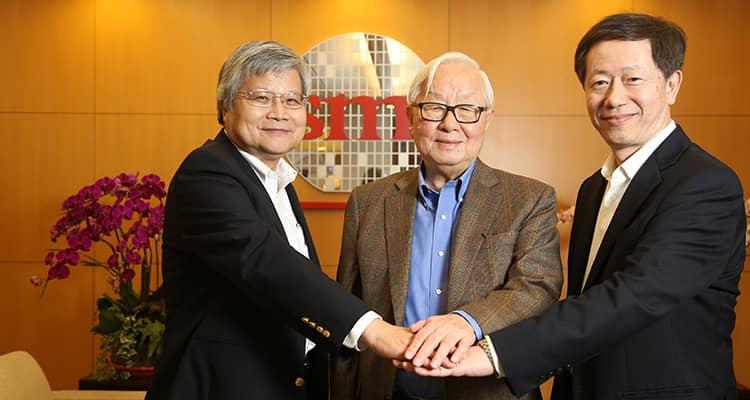
Morris Chang and his two successors
None of similar moves have appeared at NVIDIA.
Jensen Huang is a typical charismatic leader. NVIDIA does not have a dual-class share structure. Mr. Huang runs the company with less than 4% of the equity, relying on his proven track record of more than 30 years, and he can win the support of all employees without relying on formal power.
On October 14 this year, Jensen Huang was interviewed by Bloomberg. This time he did not talk about life and death, but said that he would continue to work healthily for another 20 years: Twenty years later, I hope I am still healthy and can still prove that I am worth staying here with my own contributions.
Mr. Huang is 63 years old this year, which is considered prime age in the semiconductor industry where experience brings greater advantages. So less than a month before his resignation, Mr. Huang was still talking about his working life 20 years later.
In the last month of his tenure as NVIDIA's CEO, he was extremely busy.
What Will Jensen Huang Do
What kind of situation will NVIDIA's successor take over?
NVIDIA's revenue in the second quarter reached 96.2 billion US dollars, a year-on-year increase of 106%. Revenue from its core data center business was 89 billion US dollars, a year-on-year increase of 117%. The revenue guidance for the third quarter is 108 billion US dollars, with a fluctuation range of plus or minus 2%.
According to the management's guidance, revenue in the next fiscal year will grow by 70%. Jensen Huang explained that this is the supply-side caliber, that is, the current production capacity can only support 70% growth, and the growth will be much higher if the production capacity is sufficient.
This is indeed the case. As NVIDIA's customers, all cloud computing companies are increasing capital expenditure to snap up NVIDIA GPUs.
During GTC this March, Amazon announced that it would expand its NVIDIA GPU fleet by 1 million units this year. In August, it announced that it would deploy 2 million GPUs by 2028, covering Blackwell Ultra, Rubin and Rubin Ultra, because the demand exceeded previous expectations.
All customers are expanding their capacity, and large model companies are queuing up behind to wait for computing power delivery. The new CEO does not need to do anything extra: customers will continue to urge delivery, the supply chain will steadily expand production, and growth can last at least until 2028.
On the surface, it is a guaranteed win situation, but as mentioned earlier, Jensen Huang's role is to judge the computing bottleneck in advance, turn it into NVIDIA's moat, and ensure the certainty of the company's operation. The fact that orders are scheduled for the year after next only shows that Jensen Huang did a great job in previous years.
This work will not end with Jensen Huang's departure.
Three months before Jensen Huang resigned, NVIDIA announced the NVHBM solution, which moves the memory controller from the computing chip to the memory chip, shortening the signal path, increasing memory bandwidth, and meeting the extreme demand of AI for data throughput efficiency.
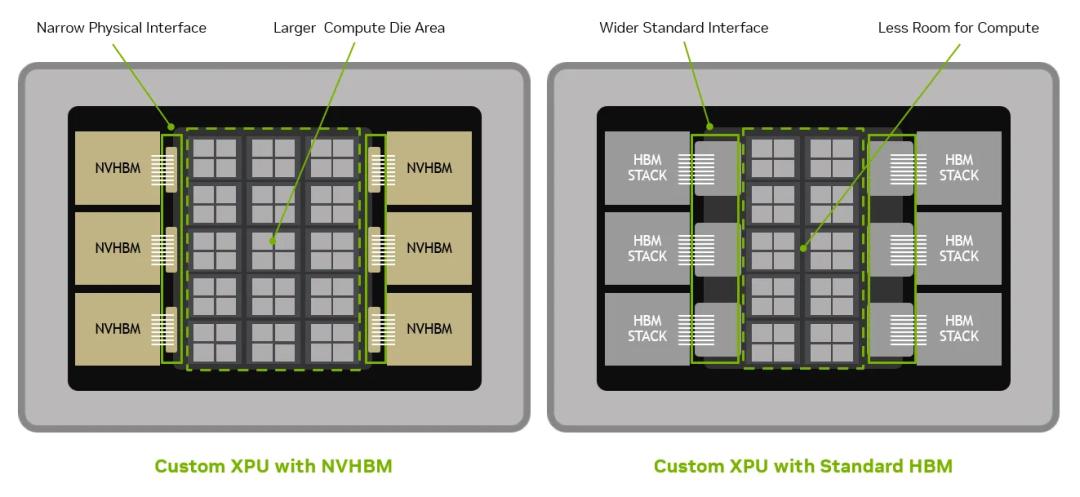
NVHBM Solution
In May this year, NVIDIA began to promote 800V DC power supply. According to NVIDIA's roadmap, the power density of a single cabinet under the RubinUltra architecture in 2027 will exceed 1MW, and the existing 54V rack power supply architecture will no longer be sufficient.
For the Feynman architecture chips in the next generation, NVIDIA will apply CPO (co-packaged optics) on a large scale, which will undertake the system connection task together with copper interconnection.
The implementation of these technical solutions requires large-scale R&D investment, coordination with dozens or hundreds of suppliers for adaptation and verification, and a large number of investments and acquisitions, all of which will determine whether NVIDIA can continue to deliver a revenue guidance of 70% growth five years later.
NVIDIA's success relies on a mature product roadmap and the stable operating supply chain system behind it, and this work is highly bound to Jensen Huang's personal capabilities.
Who can take over this responsibility? Is it Tim Cook, who is recognized by Trump as a smooth and sophisticated operator? Is it Rene Haas, a long-time NVIDIA employee who led ARM's IPO as reported by the media? Or the members of NVIDIA's board of directors, who are all outstanding but none of whom have a background in GPU architecture and chip design?
Steve Jobs believed that after Walt Disney passed away, people at Disney always held meetings to guess "what Walt would do" and could not give full play to their abilities. He did not want Apple to fall into this situation, so he told Cook when handing over the company: "Don't ask what I would do, just do the right thing."
But I think no matter who takes over as NVIDIA's CEO, he will definitely call Jensen Huang immediately: Jensen, what would you do?
References:
[1] NVIDIA Announces CEO Transition,NVIDIA Newsroom
[2] NVIDIA CEO Jensen Huang,Acquired
[3] Jensen Huang: NVIDIA — The $4 Trillion Company & the AI Revolution,Lex Fridman Podcast #494
[4] The Nvidia Way: Jensen Huang and the Making of a Tech Giant,Tae Kim,W. W. Norton & Company
[5] Andy Jassy: Amazon’s $6 Billion Man,CRN
[6] Q2 FY2027 Earnings Call Transcript,NVIDIA Investor Relations