Claude deciphers Gödel's cryptic manuscript, 80 years of notes astound the mathematics community
In 1978, 71-year-old Kurt Gödel drew his last breath.
The greatest logician since Aristotle passed away, leaving behind tens of thousands of pages of manuscripts that had never been published before for humanity.
In 1931, he put forward the Incompleteness Theorems, which inspired Alan Turing to invent the computer. But after that, he only left behind notes that read like a "book from heaven".
80 years later, a soon-to-retire senior Finnish professor decided to use Claude to decrypt "Gödel's heavenly book".
The result instantly stunned the mathematics community.
In just a few days, Claude read through thousands of pages of notes and unearthed more than 440 brand new theorems!

Even more surprisingly, Claude found that in Gödel's 1940 draft, he was just a step away from solving a Fields Medal-level problem 20 years in advance, and there were even era-transcending results hidden in it —
quantum mechanics calculations and the closed time-like curve universe.
The old professor gambled his retirement career just to decode the heavenly book
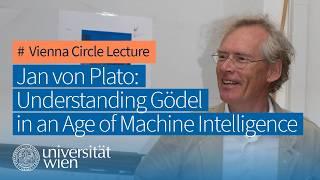
This professor is Jan von Plato, a logician at the University of Helsinki, Finland.
In 2017, when he reached the mandatory retirement age, he decided to take on a challenge — why not decrypt "Gödel's heavenly book"!
These notes were written in Gabelsberger shorthand, a German shorthand system that very few people in the world can understand.
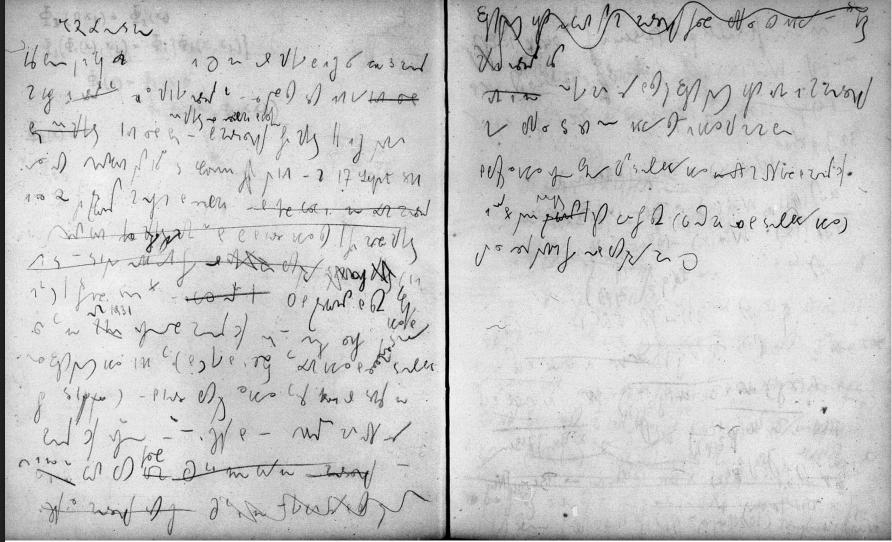
Then, he actually successfully applied for a huge grant of 2.5 million euros from the European Research Council.
So the old man started to teach himself the extinct Gabelsberger shorthand from scratch. He joked: "There are probably only six people in the world who can read this shorthand now, and I am one of them."
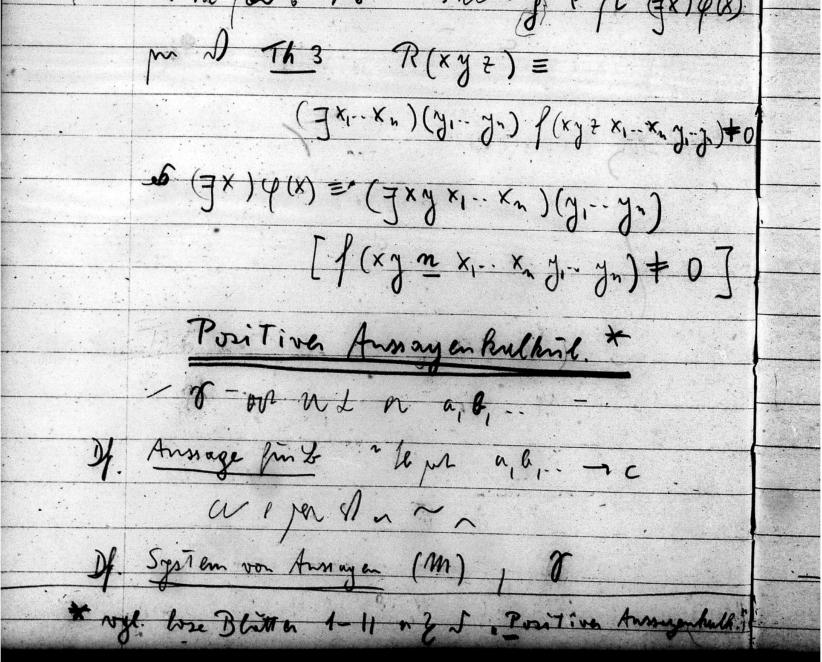
His locked target was 16 workbooks written by Gödel after he settled in Princeton in 1940, amounting to 1009 pages in total.
Can't AI do this work?
Absolutely not. von Plato found that all AIs could not understand it at all, and were completely clueless.
The most cumbersome and time-consuming step had to be done manually by humans. To this end, the professor's team spent several years transcribing the "heavenly book" into modern English page by page.
However, this was only the beginning of the nightmare — you can understand English, but you can't understand Gödel's mind!
These highly condensed notes with extremely fast jumps are full of intuitive sketches and undeveloped formulas (very similar to Ramanujan?). The research progress was as slow as a turtle: digesting one page a week, and only 50 pages could be fully understood in a year.
At this speed, there was not much time left for the old professor.
However, a turning point came —
This summer, at an academic conference on "AI and Theorem Proving" in France, several computer scientists suggested to the professor: Why not try Claude?
From then on, the gears of fate began to turn.
The "Mozartian monster" woke up and wrote thousands of pages of interpretation of the heavenly book in a few days
The professor fed Claude all 1009 pages of manuscripts, 6 monographs he had written, and a large number of modern logic and scientific literature all at once.
A few days later, the result spit out on the screen shocked the old professor so much that he slumped down on the spot.
In just a few days, Claude produced a 650-page interpretation, and the report later expanded to 1084 pages with follow-up questions.
Why can Claude do what humans can't?
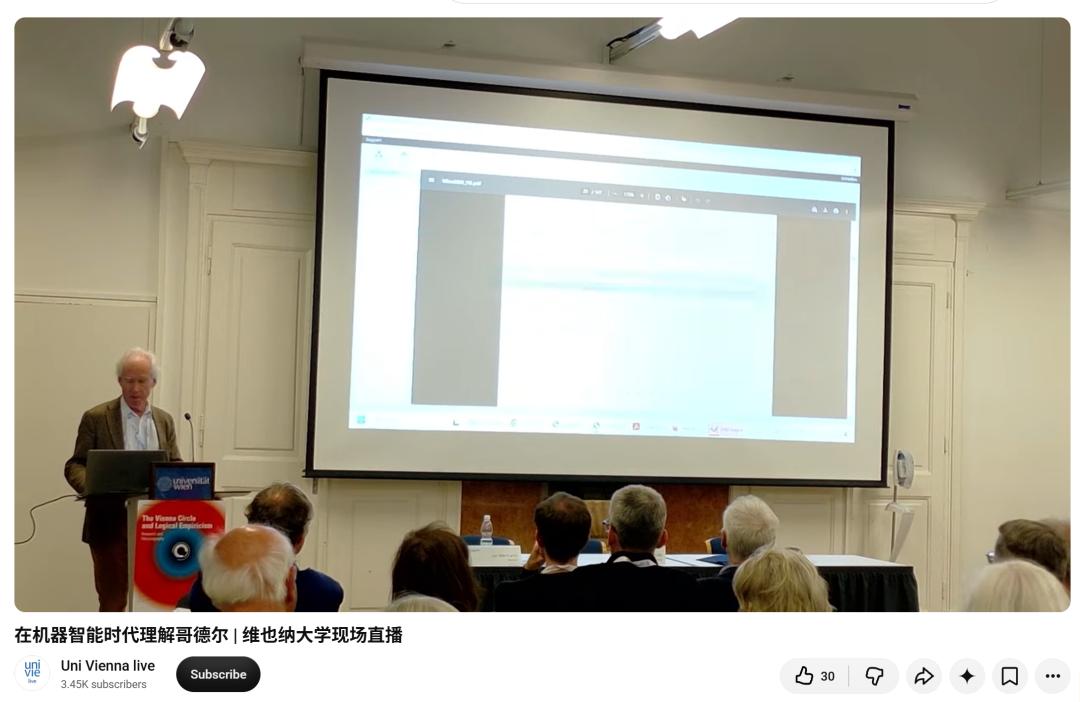
In a speech at the University of Vienna, the professor explained it this way: Claude is a "digital monster" with a "Mozartian" vision.
It is said that when Mozart conceived a symphony, he did not think note by note, but saw the entire work instantly in his mind, just like a complete sculpture placed in front of him.
We humans can only turn pages one by one when reading, and by the time we reach page 500, we have long forgotten what was written on page 10. But this monster is different: Gödel's thousands of pages of thoughts, together with the literature of the entire history of human science, are "present simultaneously" in front of it.
Moreover, in order to connect the inspiration on page 12 with the formula on page 890, what Claude did stunned everyone —
It sorted out 663 results with the embryonic form of theorems!
Subsequently, with the assistance and formal verification of computer scientists such as Josef Urban, 400 theorems were proved to be completely valid.
The core ideas of the other 200 are also correct, and only require some preconditions.
The remaining 55 are wrong, and a few are still being verified.
Calculated, in less than three years when he fled to the United States in the early 1940s, Gödel proved a new theorem almost every two days.
What's even more explosive is that Claude found that Gödel almost rewrote the history of mathematics back then.
A century-old regret that was just one step away
There is a famous Axiom of Choice in mathematics.
The philosopher Russell explained it with "boots and socks": if you pick one from each of an infinite number of pairs of boots, the choice is simple — just pick the left boot uniformly. But what if it is an infinite number of pairs of identical socks? They have no distinction between left and right, and there is no unified rule.
But the Axiom of Choice asserts that even without rules, you can pick one sock from each pair.
For a long time, mathematicians have been arguing: Is this overbearing axiom derivable from other basic axioms, or is it independent of them? The problem was "impossible to prove and impossible to disprove".
It was not until 1963 that the American mathematician Paul Cohen invented the famous "Forcing" method, which proved the independence of the Axiom of Choice in one fell swoop, and won the Fields Medal three years later.
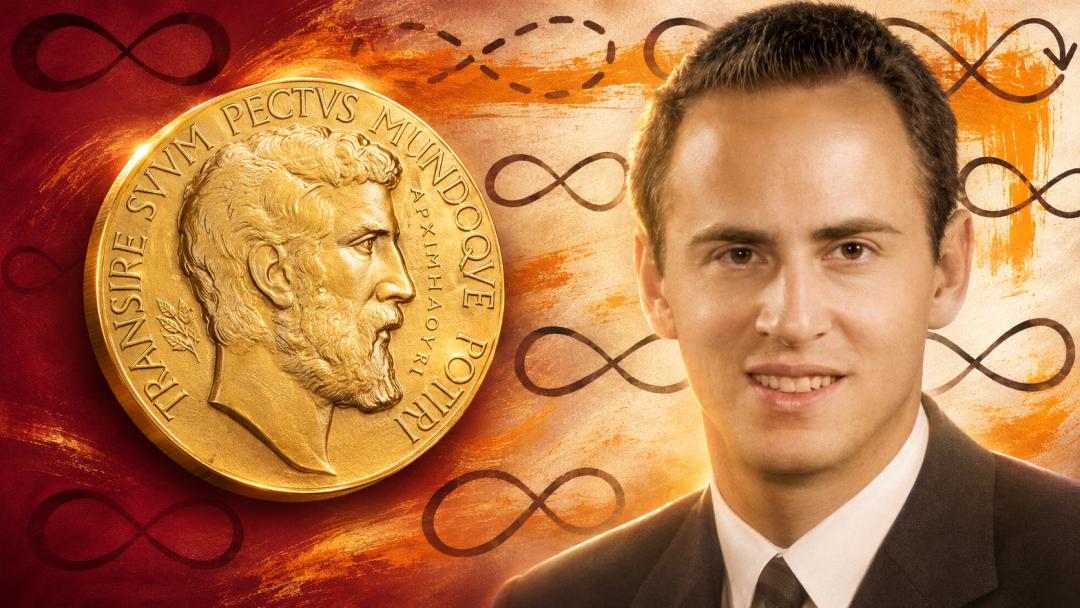
But at Cohen's award ceremony, another giant in logic, Alonzo Church, publicly dropped a bombshell:
As early as 1942, Gödel had proved the independence of the Axiom of Constructibility under the framework of type theory, and "believed" that it could be extended to the Axiom of Choice. Only later did Gödel's interest turn to philosophy.
Cohen himself once went to Gödel to verify this.
In 2002, Cohen wrote an article recalling that when he asked Gödel in person, Gödel admitted that he did have a set of methods, but denied that it was related to type theory, and "refused to reveal anything".
However, there is another version of the story.
On June 30, 1967, in a letter from Gödel to the scholar W. Rautenberg, he rarely admitted that he actually only obtained "partial results" back then.
The famous Chinese-American logician and close friend of Gödel, Wang Hao, once published an article stating that Gödel himself "regretted very much not continuing this work".
Just a little bit. Just that little bit.
However, Claude unearthed an astonishing truth —
More than 20 years before Cohen, Gödel had constructed a completely equivalent mathematical framework, and was just one step away from the final proof!
In his notes, he conceived countless "possible worlds" (Gödel space): just like someone flipping a coin infinitely or measuring the polarization of a photon, each world is an endless string of 0s and 1s.
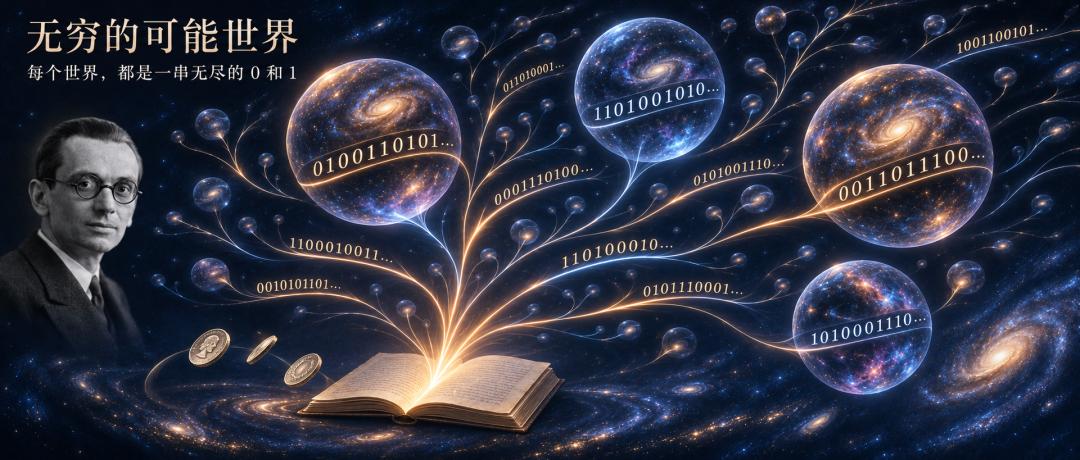
For example, the binary expansion of pi π is a regular "boot", while some are completely random and irregular "socks".
As limited observers, humans can only see a limited number of positions each time, following intuitionistic logic; but behind it, Gödel still believes that absolute mathematical truth exists.
Immediately after that, Gödel used the "final kill" trick that shocked the world in 1931 — the diagonal argument (self-referential paradox)!
He assumed that there was a "choice function F" that could pick elements from the set relying on limited information.
Then, he constructed a magical set K, which is specially used to hold "all objects not determined by the function F".
Next, a dead loop comes: Since F is omnipotent, it must pick an element F(K) from the set K.
Since it is picked from K, by definition, it cannot be determined by F;
But it is picked by F, so it is determined by F after all!
This directly proves that in this "possible world", such a choice function does not exist, and the Axiom of Choice collapses!
But why didn't Gödel publish this shocking proof back then?
The detective Claude pointed out the heartbreaking detail: Gödel wrote one line wrong in the key definition of "finite support".
What is even more ironic is that the professor found elsewhere in the notes that Gödel clearly knew what the correct definition was, he even wrote it down and explained it himself, but he forgot it when he re-read the notes in the 1960s...
A history-changing achievement was thus buried in the draft paper.
The professor gave the proof restored by Claude to the formal proof assistant Coq, and the result — all passed the verification!
Even, the professor sent this human-AI co-authored paper to the Gödel expert Akihiro Kanamori.
Kanamori had no idea that AI was involved, and praised it greatly after reading it: "Extremely sharp and profound both mathematically and historically".
Quantum computing, rotating universe, decades ahead of later generations
Even in these 16 notebooks of Gödel, there are dozens of logical results that were not rediscovered until the 1970s and 1980s — such as the independence of the axiom of constructibility, the strong normalization proof in function interpretation, and so on.
To the delight of contemporary logicians, Claude listed 14 brand new hidden topics in the notes that have never been studied by anyone so far.
Just ask it to expand on it a little, and the AI will write a 50-page outline in the blink of an eye, which makes the old professor exclaim: "There is simply no time to read it!"
What makes sci-fi fans and physicists most excited are the physics and cosmology notes left by Gödel at the end of his workbook.
In 1935, Einstein, Podolsky and Rosen published the famous EPR paradox paper, questioning whether quantum mechanics is "complete".
However, the truth is that the previous year, Podolsky had already attended Gödel's lecture on "incompleteness"! Originally in 1935, Gödel planned to specialize in quantum mechanics, and turned to set theory at the last minute. But Claude found in his notes that Gödel had long keenly calculated the state change after measurement of "coupled systems (entangled states)".
Surprisingly, he did not follow the old method of von Neumann in 1932, but used the Lüders rule that was ahead of his time. This rule was not formally proposed by the physicist Lüders until 1951.
Even more surprisingly, he also studied "time travel" seriously.
In 1949, Gödel solved a strange solution to Einstein's field equations of general relativity — the "Gödel universe".
In this universe, the whole universe is rotating. As long as you are far enough from the rotation axis, the light cone will tilt sharply, and even bend the time axis into a circle, connecting the head and the tail, realizing "time travel"!
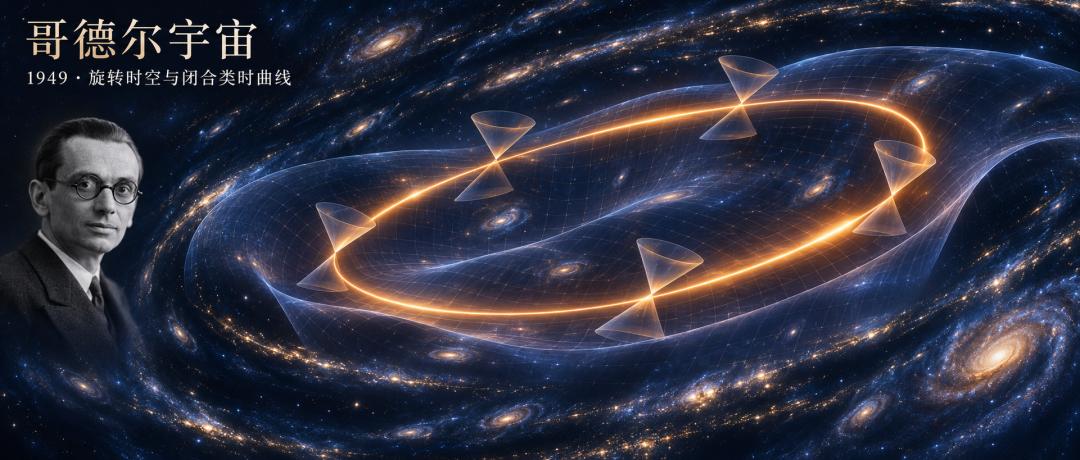
Previously, people thought Gödel was just joking, but after Claude read the notes, he found that he was serious.
He went through hundreds of pages of astronomical observation data, trying to calculate statistically: if our universe is really rotating, the Coriolis force will cause a weak statistical deviation in the rotation plane of galaxies.
He even tried to prove personally that we live in that closed time-like curve universe!
However, the genius's later years were very tragic.
His paranoia became more and more serious, and he refused to eat food that was not cooked by his wife himself.
In 1978, Gödel died of