Nvidia's leadership reshuffle: why isn't the automotive sector panicking?
"For decades, Chief Qiao led the Beggars' Sect with full dedication, and successfully built it into the top largest sect across the martial arts community. However, Quan Guanqing fabricated a rumor of his improper affair with Madam Ma, and labeled him as a collaborator of the Liao regime, writing off all of Chief Qiao's contributions completely, and even expelled him from the sect! Where is the justice? Where are his supporters? Doesn't he have his own loyal core team?"
With China's extremely long-standing history and cultural heritage, the country has truly practiced the saying that "there is nothing new under the sun". Recently, a series of events centered on the rumored extramarital affair of Jensen Huang once again inspired Chinese netizens. Even more interestingly, a commenter in the comment section wittily wrote back: "There is no way, who made him not a native of the Song Dynasty."
All these changes happened so abruptly, because this figure used to be regarded as a key core trusted official in the US political circle.
Back at the start of this year, Jensen Huang was talking enthusiastically at CES about "strong demand from Chinese customers for H200", and promised to hand over 25% of the sales revenue to the national treasury if the US Department of Commerce approves the release of products to China. When Trump visited China in May, he was specially notified to rush over halfway to join the entourage. Even just over a month ago, he was still speaking freely at the NVIDIA GTC conference in Berlin that "AI factories have cut on-site deployment time from six months to 14 days". As for the $193.7 billion data center revenue in FY2026 that pushed NVIDIA's market cap to $4 trillion, these are all obvious achievements visible to everyone on the table.
The fall from the position of the helm of the top tech giant driving the AI revolution, and the patriot who tried his best to reduce the national deficit, only took a little more than a week. The apology letter, independent investigation, external lawyers, new revelations involving direct subordinates, reports of the board preparing to remove him, and calls from members of Congress landed one after another. Following Jensen Huang's departure, NVIDIA's stock price fell by more than 13% at the opening, and nearly $500 billion of market value evaporated during the trading session.
However, what is interesting is that compared with the fierce public opinion in the US and the great fun of domestic onlookers, the automotive industry is unusually quiet, which feels a bit out of place. Although a few individual executives took this incident as a topic of conversation at dinner parties, in reality, no automaker held an emergency meeting overnight, let alone urgent consultations and adjustments of project teams. The designated project orders are proceeding as usual, and OTA updates are being pushed as scheduled.
Do not mistake this calmness for sluggishness, because NVIDIA's penetration into China's automotive industry is almost deeply rooted in every aspect.
According to the integrated information from multiple public databases, between January and September this year, the total installed volume of NVIDIA's three mainstream products in China's domestic intelligent driving domain control chips for passenger vehicles exceeded 2.2 million units, with the market share approaching 40%. At NVIDIA GTC 2026, representatives from General Motors, Toyota, Mercedes-Benz, and Hyundai all attended the event, and BYD and Geely were also on the attendance list.
Deeper than chips are the computing power cards provided by NVIDIA and various supporting development tools. DriveOS, CUDA, Omniverse and DRIVE Sim are built on the same set of environment, with cloud-side DGX for training, OVX for simulation, and vehicle-side AGX for inference. Perception debugging, synthetic data and virtual verification of in-vehicle design are all carried out on this system. Tesla's Cortex 1 is equivalent to more than 100,000 H100 chips, Xpeng has a cluster of more than 10,000 cards, and most of the cost of each iteration of the large intelligent driving model is counted here. Domestic independent giants such as BYD and Geely have also joined NVIDIA's self-driving development platform NVIDIA DRIVE AGX Hyperion.
Such a company suddenly changed its helm in such a bizarre way and at such a rapid speed. How could the automotive industry not be affected? Why are domestic vehicle enterprises and even related supply chain enterprises so calm?
01 Critical "Infrastructure", But Not the Only Option
When NVIDIA launched the DRIVE platform in 2015, what automakers bought was essentially a computing power board. But after ten years of development, what has been delivered is a complete set of systems.
On the vehicle side, from Orin's 254 TOPS to Thor's 2000 TFLOPS, there are DriveOS, DriveWorks and Halos safety systems in between. In January 2026, NVIDIA open-sourced the Alpamayo chain-of-thought model, AlpaSim simulation tools and physical AI datasets together. NuRec can restore road test videos into editable 3D scenes, modify trajectories, change weather conditions, and generate dozens of training samples.
Even the underlying models are completely open for free, and NVIDIA's expected returns fall on the demand for computing power. Chinese vehicle enterprises have benefited the most from this dividend.
Li Auto AD, Xpeng XNGP and other urban navigation-assisted driving systems are all developed on the NVIDIA platform. BYD's "God's Eye B" uses a single Orin-X chip on Han L and Tang L models, while "God's Eye C" uses Horizon Robotics Journey series chips. Xiaomi SU7 and YU7 use Orin and AGX Thor chips.
According to statistics from Gasgoo, from January to September this year, among domestic intelligent driving domain control chips, Orin-N accounted for 15.6% with about 929,000 units, Thor-U accounted for 13.0% with about 777,000 units, and Orin-X accounted for 8.8% with about 528,000 units. The three models together firmly occupy the top position in the installation volume of intelligent driving chips. In comparison, the installation volume of Huawei Ascend 610 is roughly 860,000 units, accounting for 14.4%.
Of course, based on the experience since 2016, for systems that cannot be fully controlled by ourselves, China has been working on alternatives. Our alternative efforts did not start only on November 12. The unusual quietness not only shows that people keep silent due to the sensitivity of the incident, but also reflects that we are not unprepared, so there is no need to hold an overreacting attitude that "the sky is falling".
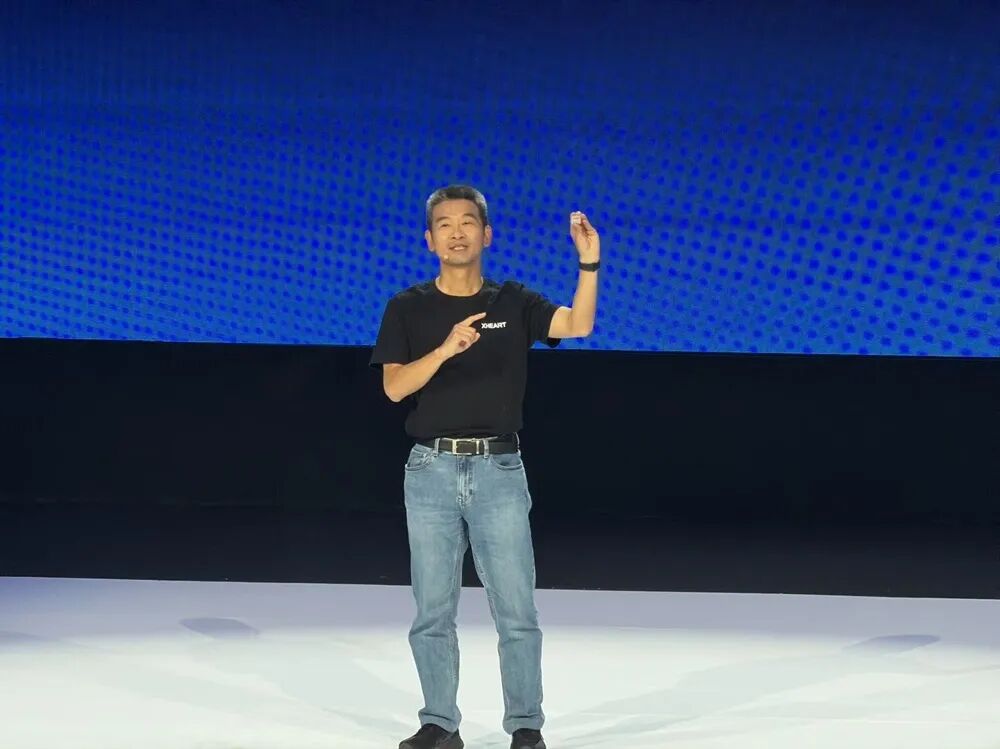
Picture | At the end of 2026, independent computing power and self-developed chips have become an absolute consensus in China. The picture shows the launch site of XHEART X7 Ultra
In the full-level intelligent driving chip market for self-owned brand passenger vehicles in the first half of 2026, Horizon Robotics ranks first with 31.94% market share, and ranks second with 22.82% among urban NOA high-level suppliers.
According to Horizon Robotics, the Journey 6 series has now received designated orders from more than 25 automakers for over 100 vehicle models in China. The data from NE Times New Energy I found shows that Horizon Robotics shipped 183,583 chips in a single month in September, and its market expansion is accelerating.
In addition, self-developed chips from Xpeng, NIO, Li Auto and BYD will also be gradually installed on vehicles in the future. Huawei Qiankun ADS has achieved full-stack closed loop relying on its self-developed MDC platform and Ascend automotive-grade chips, with its supply chain completely separated from NVIDIA. Xiaomi's Xuanyie D100 is scheduled to be launched in 2027.
According to the caliber of China Association of Automobile Manufacturers, the localization rate of automotive-grade chips has risen from 4.7% in 2022 to 11.9% in the first quarter of 2026. At present, the shortcoming is that China's self-sufficiency rate of high-end computing power SoC is still less than 10%. We must admit the gap in high-end products, but the overall market share gap is constantly narrowing.
02 No One Can Block Our Pace
NVIDIA's official announcement clearly states that operations, customer commitments and product roadmaps will not be interrupted. Up to today, no automaker has disclosed that its supply has been affected.
So we can roughly judge that this turmoil will not cause a cliff-like supply cut of existing short-term orders. The key point is that it will inevitably affect the access permission and technical iteration of the next generation DRIVE platform — that is, the next round of designated order placement.
It takes two to three years for chips to go from designated order to vehicle installation, and the already designated projects have long-term framework contracts, with replacement costs so high that no automaker will disrupt its existing plans. Similarly for NVIDIA, for the vehicle-side chips that have already signed contracts, which do not break the existing rules of the US Department of Commerce and whose breach may face huge compensation, it is natural to continue to execute the contracts.
In particular, when a large number of Chinese enterprises are already trying to get involved in and provide alternatives in this field, NVIDIA will definitely not carry out any sudden "supply cut" in order to optimize its financial data as much as possible to support its stock price after this incident.
But the core problem still falls on the computing power cards. Without new additional computing power, how can automakers and intelligent driving suppliers complete various simulation, algorithm training and other work? In fact, relatively positive changes have taken place in this aspect in the past year.
According to data from IDC, in China's data center AI chip market in the first half of 2026 counted by shipment volume, NVIDIA shipped about 678,000 units, accounting for 34% of the market share, down about 44% compared with the first half of 2025. In comparison, Huawei's Ascend series reached 28% market share with 572,000 units. The gap between the two has shrunk from 31 percentage points a year ago to 6 percentage points.
Ascend supports model migration through the CANN ecosystem, Hygon and Cambricon have landed in different scenarios, and migrating cloud training to domestic clusters is no longer a backup plan.
Of course, we cannot only talk about the good side. After all, this "stability" does not come without cost. At present, domestic computing power is still constrained by production capacity, interconnection bandwidth and ecosystem maturity. The CUDA barrier cannot be broken in the short term, and the tool chain needs to be polished for a certain period of time. At the same time, restricted by semiconductor processing equipment, our alternative products still have disadvantages in transistor density and energy consumption. In fact, this problem has always existed, so in the past two years, China has generally adopted a parallel strategy of external procurement, independent R&D, and domestic substitution.
Some media people have made it very clear in the past two days that the stable supply of domestic computing power cards in the past year largely relied on Jensen Huang's previous personal balance within the boundary of the US Department of Commerce's rules. We did rely on his personal efforts to retain a lot of existing orders and signed contracts. However, Cress, who takes over, will definitely put compliance and risk control first when facing the current situation, and most likely will not continue this set of flexible mediation. Even the remaining existing supply quota, fine-tuning quota and version iteration space may be tightened.
In this situation, domestic computing power will change from a supplementary pilot and standby backup option to a mandatory risk control requirement that has to be implemented.
For automakers, the current optimal solution is to accelerate the independent R&D and domestic substitution plan while ensuring the execution of the still valid overseas solutions.
03 The Elegy of North American Chinese Elite
After the NVIDIA board of directors removed Jensen Huang, an open letter signed by hundreds of employees spread quickly online, with radical wording demanding all directors step down and Jensen Huang come back. However, this letter is not credible. Some media compared its wording with the letter from OpenAI employees forcing the board to step down in 2023, and found that it was almost copied. What's more revealing is that the letter said the board fired him, while the announcement and the 8-K document submitted to SEC both stated that he resigned.
The real situation is not that dramatic, but carries more weight. Wired magazine found a post from a senior engineer in the intranet suggestion box, which received more than 1,600 comments below, most of which asked to bring the boss back. Someone sent a group email to all employees asking to clarify the decision-making process, and someone placed flowers in front of the headquarters logo. On the anonymous workplace community Blind, 232 registered employees showing their employer as NVIDIA, nearly 90% of them believe that Jensen Huang should continue to stay in his position. Many people even said that the enterprise they have worked in for more than ten years has had its "central axis" removed by this official announcement.
It is not an exaggeration to use the word "central axis" to describe the relationship between Jensen Huang and NVIDIA. The most counter-intuitive point of this enterprise is that there is no second-in-command. Thirty-six executives report directly to Jensen Huang, with no COO, no one-on-one reporting mechanism, and no formal succession plan. Jensen Huang once explained the reason: GPU, memory, network, power supply, heat dissipation and software need to be optimized together. If an extra filtering layer is added in the middle, the joint design cannot be realized. Information is told to everyone at the same time, and the rhythm of one generation of products per year is tied to this set of operation methods.
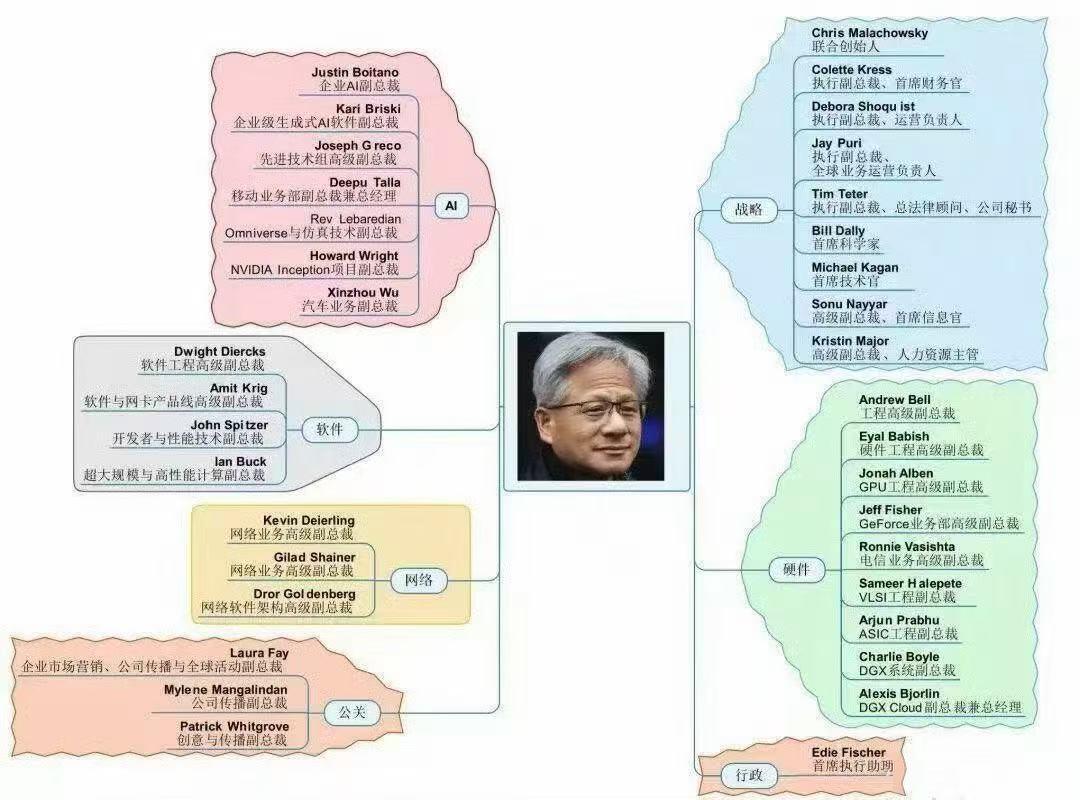
And the problem arises here. The fact that these 36 people report to one person at the same time does not mean that any one of them can replace this person. No one except Jensen Huang has been given the authority to integrate across business lines, and no one has been systematically trained as a backup. Although this CEO who loves to wear leather jackets only holds a small number of shares and does not even have super voting rights, he is indeed the irreplaceable core of NVIDIA, the "central axis" of all operations. He has managed this enterprise for 33 years not by the articles of association, but by the daily operation system that takes him as the bus. The flatter the structure, the cleaner the cut will be.
Cress, who took over, has served as CFO for 13 years, which is enough to stabilize the transition period. But he is good at managing accounts, while stepping on the accelerator is a completely different matter. NVIDIA has a set of operation methods that rely on personal credit: invest in customers first, and then customers will get money back to buy chips. If the management is replaced by a manager who puts compliance first, this kind of investment will definitely be reduced. The new management will most likely set up a COO, and integrate dozens of reporting lines into a regular hierarchy. But can the problem really be solved just by a board resolution and a meeting?
A person who brought the company to a $4 trillion market cap and ran around for licenses for his own chips was proven to have handed over all his positions within a week before the investigation conclusion came out. A scholar from Fudan University put it bluntly that this incident reminds non-white elites that there is a visible ceiling for the American Dream. We will stop here.
After Qiao Feng was expelled from the Beggars' Sect, the sect still exists, but no one can make a final decision on all matters at a glance in the future. NVIDIA will not stop functioning without Jensen Huang, after all, its product line has been scheduled for several years later. But what about several years later?
And here we are also very curious about a question: after Jensen Huang falls, who will be the next "little yellow man", is it "Lisa Su"?
On November 13, 2026 Beijing time, Reuters revealed that Jensen Huang had an intimate relationship with another NVIDIA employee, which is the third one exposed in the past week. The turmoil is not over yet, and it has evolved into a situation of extreme persecution.