Will NVIDIA's new chief hit the brakes on AI financing? She once slashed the $250 billion data center guarantee by half, was derided by Jensen Huang as "nothing but a finance person", and is nicknamed the "jumpy deer".
The existing commitments are highly likely to be honored, but "without Jensen Huang's vision, connections and convening power, the next round of multi-party ecosystem investment of the same scale will be more difficult to land." At a time when high debt levels, circular financing and return uncertainties have been widely questioned, Jensen Huang's departure may trigger a repricing of the overall risk premium of the AI ecosystem — "This is not yet a financing crisis, but it could act as a catalyst for broader risk repricing."
Jensen Huang's sudden exit not only marks the end of an era for NVIDIA, but also shakes the financing foundation that the entire AI ecosystem relies on to operate.
Over the past three years, NVIDIA, led by Jensen Huang, has played the role of the "Central Bank of AI", weaving a circular financing network worth over 500 billion U.S. dollars through equity investment, credit guarantees and lease backstops, continuously transfusing capital to this industry that is still burning cash. Now, the founder has left in disgrace amid an extramarital affair scandal, and the successor is none other than Colette Kress, the Chief Financial Officer whom he once publicly humiliated as a "startled deer" and dismissed as someone who "only knows how to do finance".
According to reports from The Wall Street Journal, it was Kress who previously took the initiative to cut NVIDIA's backstop commitment for OpenAI's Ohio data center from the initially negotiated 2.5 trillion U.S. dollars to about 1.05 trillion U.S. dollars, and it was also her who repeatedly questioned how to price guarantees and calculate investment returns during the rapid expansion of the financing guarantee program.
In the market's view, this new leader has made NVIDIA's balance sheet safer, but has plunged all AI companies that are counting on NVIDIA's next check into deeper uncertainty. Goldman Sachs analyst James Schneider pointed out that existing commitments are highly likely to be honored, but "without Jensen Huang's vision, connections and convening power, the next round of multi-party ecosystem investment of the same scale will be more difficult to land".
A Circular Financing Network Worth Over 500 Billion U.S. Dollars
To understand the impact of Jensen Huang's departure, you first need to understand how large the financing machine he built is.
According to NVIDIA's 10-Q filing dated July 26, the total size of the company's contingent liabilities and commitments has reached 5.305 trillion U.S. dollars. This figure does not cover newly signed transactions after July, nor the maximum 125 billion U.S. dollars — 25% of the total backstop — that NVIDIA promised to provide for the AI computing financing platform with a target size of 5 trillion U.S. dollars announced by Jensen Huang in August.
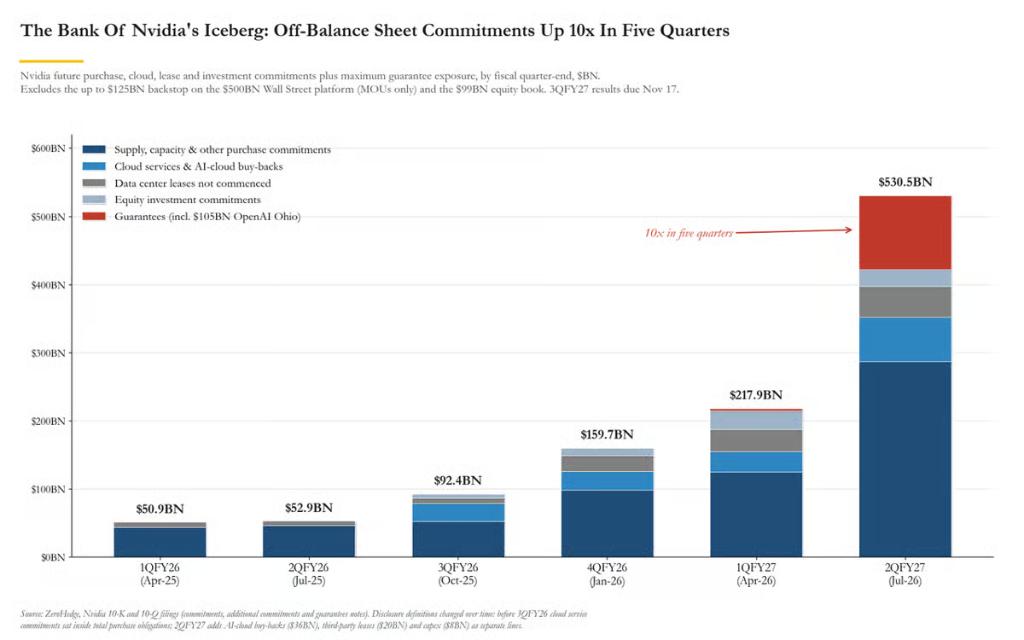
The mechanism is almost unchanged: NVIDIA buys equity or provides guarantees, and the beneficiaries commit to purchase NVIDIA's hardware, with funds flowing back in the form of GPU orders. Safe Superintelligence has not launched any products yet, but has obtained large-scale computing power commitments for the Vera Rubin architecture; Meta has placed additional orders for Vera Rubin, Spectrum-X and BlueField-4; Nebius has signed a 5GW deployment agreement with IREN — money flows out in the form of equity and comes back in the form of revenue.
The Ohio data center project is the most extreme manifestation of this logic. According to The Wall Street Journal, NVIDIA finally provided OpenAI with 1.05 trillion U.S. dollars in lease credit guarantees, with an option to add 3.8GW of computing power. According to NVIDIA's own CFO, each generation of infrastructure deployment in the Ohio park is equivalent to about 1.5 million GPUs, corresponding to NVIDIA's revenue of about 150 billion to 200 billion U.S. dollars — in other words, NVIDIA used a 1.05 trillion U.S. dollar guarantee to obtain up to 200 billion U.S. dollars in chip sales, repeating the cycle for 20 years.
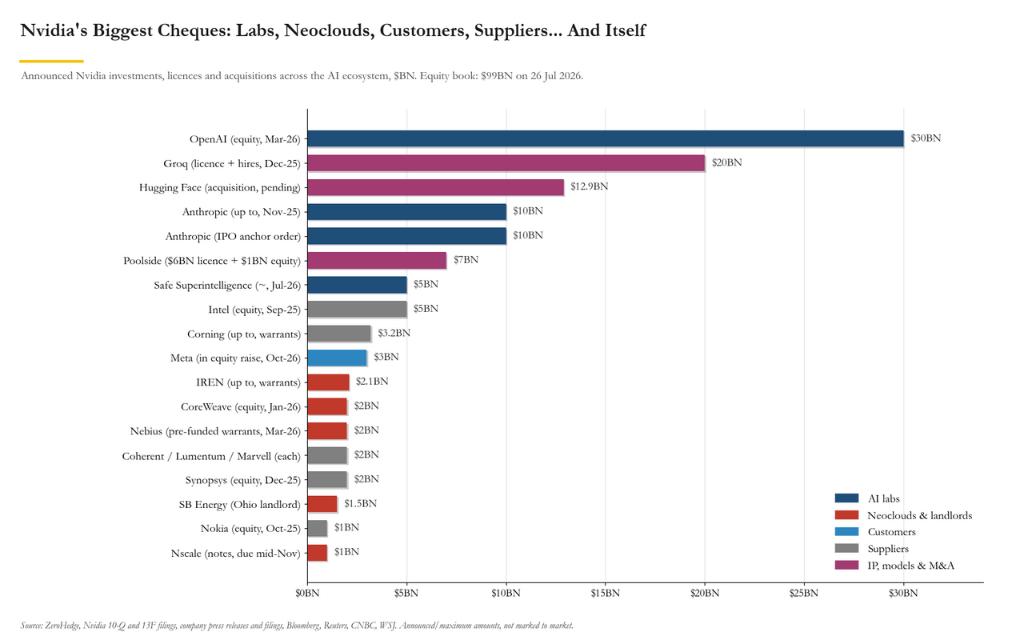
Bloomberg, citing a warning from Panmure Liberum, said that the "NVIDIA Bank" is the moat of this chip company, and also a source of credit risk — limited free cash flow is largely committed to an industry that is still striving to achieve commercial monetization.
Jensen Huang Pressed the Brake Himself, Kress Has Long Been the Behind-the-Scenes Braking Force
Jensen Huang himself had noticed the hidden dangers of this expansion before he resigned.
According to The Wall Street Journal, in August this year, he gathered top financial executives in his office and stated bluntly that NVIDIA was in "trouble": the company was negotiating to provide guarantees with a large number of companies that were unable to pay for chips, and some transactions were led by his son-in-law Nico Caprez, who was promoted to vice president in January this year. Caprez and another vice president Raj Mirpuri promised potential partners in the spring that NVIDIA could complete the credit support arrangement within a few weeks, on the condition that the other party agreed to share a certain percentage of revenue, and dozens of companies immediately queued up for the service.
At this meeting, Jensen Huang also interrupted Kress's report on the spot, calling her a "startled deer", nothing more than a "reporting CFO" rather than someone who can participate in strategic decision-making. At the same time, he described the real crisis facing the company: large cloud service providers are accelerating their shift to alternative chips and reducing their dependence on NVIDIA, while a large amount of wafers and memory that NVIDIA has committed to purchase are coming "like an avalanche". According to NVIDIA's financial report, relevant supply commitments surged from about 58 billion U.S. dollars to about 279 billion U.S. dollars in just three months.
Shortly before Jensen Huang issued the "avalanche warning", Kress quietly launched the braking action.
According to The Wall Street Journal, it was she who reduced the guarantee size of NVIDIA for OpenAI's Ohio project from the initial negotiated 2.5 trillion U.S. dollars to the final 1.05 trillion U.S. dollars, and continuously questioned the pricing logic and return measurement of guarantee projects internally. In late August, NVIDIA announced the suspension of some revenue-sharing credit support transactions, requiring all new transactions to be reviewed by the executive team and the board of directors. In October, when Jensen Huang met with CEOs of several major customers in Berlin, he used the story of a Japanese ramen master as a metaphor to send a clear signal to the cloud company executives present: "You are not deciding the value of my products."
500 Billion U.S. Dollar Financing Platform: High-profile Debut, Zero Deals Closed
In August this year, Jensen Huang, wearing his iconic leather jacket, announced the financing platform surrounded by executives from six of the world's top asset management institutions, trying to turn GPUs into an asset class available for financial institutions to invest in — the idea is similar to the securitization of real estate or toll roads, turning fast-depreciating hardware into securable infrastructure assets.
However, according to Bloomberg, the platform has not closed any transaction so far, and the six institutions have only signed preliminary memorandums of intent with NVIDIA, and no final agreement has been formed.
One of the obstacles is the backstop ratio. The upper limit of residual value support currently provided by NVIDIA is 25% of the transaction size, while its competitor Broadcom has provided about 86% backstop for Anthropic's 35 billion U.S. dollar debt transaction in May this year, and will provide about 72.5% guarantee for another 63 billion U.S. dollar transaction. Facing such a huge gap, some customers and Wall Street partners have pressured NVIDIA to increase the backstop ratio. According to Bloomberg, the platform may not announce its first transaction until January next year at the earliest — on the premise that Jensen Huang's departure does not affect the relevant process.
Sunaina Sinha Haldea, head of global private capital advisory at Raymond James, told CNBC that the management change provides all participants with a natural "pause button" to re-examine the transaction terms. She does not think capital will withdraw completely, but warned that "they may demand higher returns for this uncertainty". She also expects lenders' inquiries to spread across the entire AI infrastructure transaction market: Who is actually bearing the risks in these structures?
Kress Takes Over: Tightened Grip, Complex Situation
From the "reporting CFO" despised by Jensen Huang to the first female interim CEO in NVIDIA's history, Kress's rise to power is full of drama. People familiar with NVIDIA's investment decisions said that Kress had previously raised objections to many transactions promoted by Jensen Huang, and it is expected that she will not push new transactions at a pace close to that of Jensen Huang.
Goldman Sachs analyst James Schneider pointed out after downgrading NVIDIA's target price, NVIDIA will honor all announced commitments, but the next round of large-scale multi-party ecosystem investment will be more difficult to advance due to the lack of Jensen Huang's personal resources and appeal. Goldman Sachs also specifically noted that NVIDIA's stock has been trading at a discount before, partly because the market is worried that once NVIDIA or its competitors stop providing financing, the growth of AI infrastructure will slow down sharply.
UBS analyst Tim Arcuri listed "financing" as the first of the three core impacts of Jensen Huang's departure in his report, and estimated that a large part of NVIDIA's 500 billion to 600 billion U.S. dollars in quarterly free cash flow is flowing back to customers, suppliers and emerging cloud vendors, and even a short pause could siphon more than 50 billion U.S. dollars out of the AI ecosystem — at a time when interest rates are rising and liquidity in the credit market is tightening.
William Blair analyst Sebastien Naji believes that existing contracts will survive after the CEO change, but what is threatened is the next round of transactions, as well as NVIDIA's ability to defend its market share in 2027 and beyond. With Jensen Huang leaving or being subject to investigation, competitors such as Broadcom and AMD may gain greater market space.
Confirmed and Uncertain: Which Transactions Will Be Impacted
The outside world currently believes that investments that have signed legally binding contracts are expected to be unaffected. The transactions in which NVIDIA plans to invest 5 billion U.S. dollars in Safe Superintelligence and invest about 2.5 billion U.S. dollars in Thinking Machines Lab founded by Mira Murati have been signed several months ago and are expected to be implemented as scheduled.
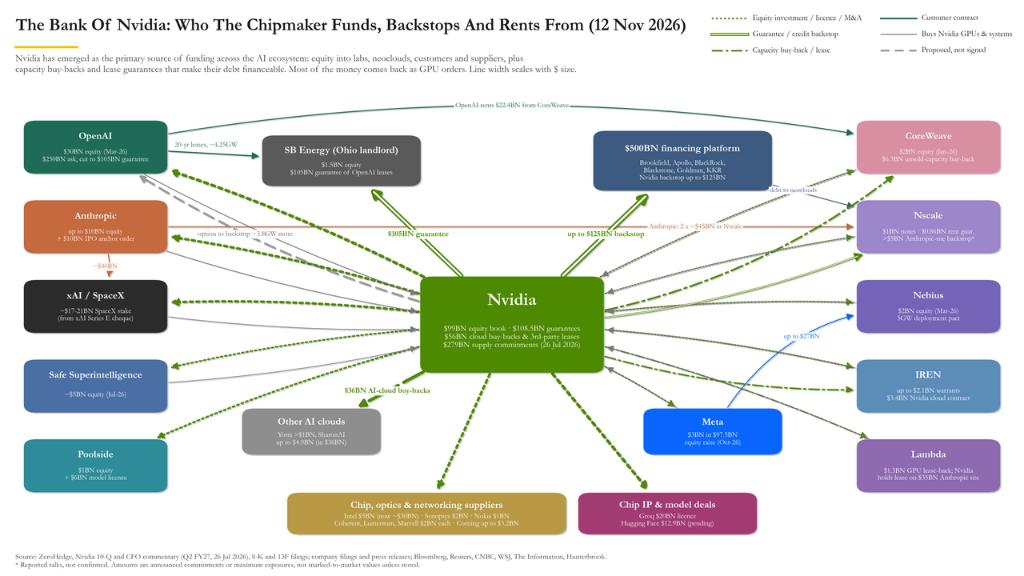
Transactions that are still in the negotiation stage are more severely affected. NVIDIA's planned 10 billion U.S. dollar investment in Anthropic's upcoming IPO is uncertain whether it will continue; previously NVIDIA has provided Anthropic with 1.05 trillion U.S. dollars in data center lease credit guarantees. The agreement under negotiation to provide more than 5 billion U.S. dollars in credit guarantees for Nscale has not been signed as of the end of October. Australian cloud vendor Firmus is seeking at least 2 billion U.S. dollars in private financing after withdrawing its IPO, and NVIDIA has previously participated in negotiations with uncertain results. Humanoid robot company Figure AI is reportedly discussing an additional 1 billion U.S. dollar investment with NVIDIA, and the latest progress is unknown.
Charu Chanana, chief investment strategist at Saxo, pointed out, The real risk is not the collapse of individual partnerships, but at a time when high debt levels, circular financing and return uncertainties have been widely questioned, Jensen Huang's departure may trigger a repricing of the overall risk premium of the AI ecosystem — "This is not yet a financing crisis, but it could act as a catalyst for broader risk repricing."
Kress will host NVIDIA's Q3 earnings call on November 17, when analysts will inevitably ask her how she views the 5 trillion U.S. dollars in commitments and whether NVIDIA will continue to play the role of the "Central Bank of AI". This will be the most direct test of whether the circular financing machine can continue to operate after Jensen Huang's departure.
This article is from "Wallstreetcn", author: Xu Chao, authorized for release by 36Kr.