Changan transfers 10% equity stake in Avatr for 3.2 billion yuan to pave the way for its IPO
At the critical stage of its IPO sprint, 10% of Avatr's equity will be transferred.
On the evening of November 12, a public announcement from Changan Automobile broke the calm of the automotive industry: it will publicly list and transfer its 10% equity stake held in Avatr Technology through the Shanghai United Assets and Equity Exchange, with a reserve price of 3.1828 billion yuan, and the information disclosure period will last until December 10. Roughly converted based on the reserve price, the overall valuation of Avatr is about 31.8 billion yuan, which is basically in line with its post-money valuation after the Series C financing. After the transaction is completed, Changan Automobile's shareholding ratio will drop from 40.994% to about 31%, but it will still remain the largest shareholder.
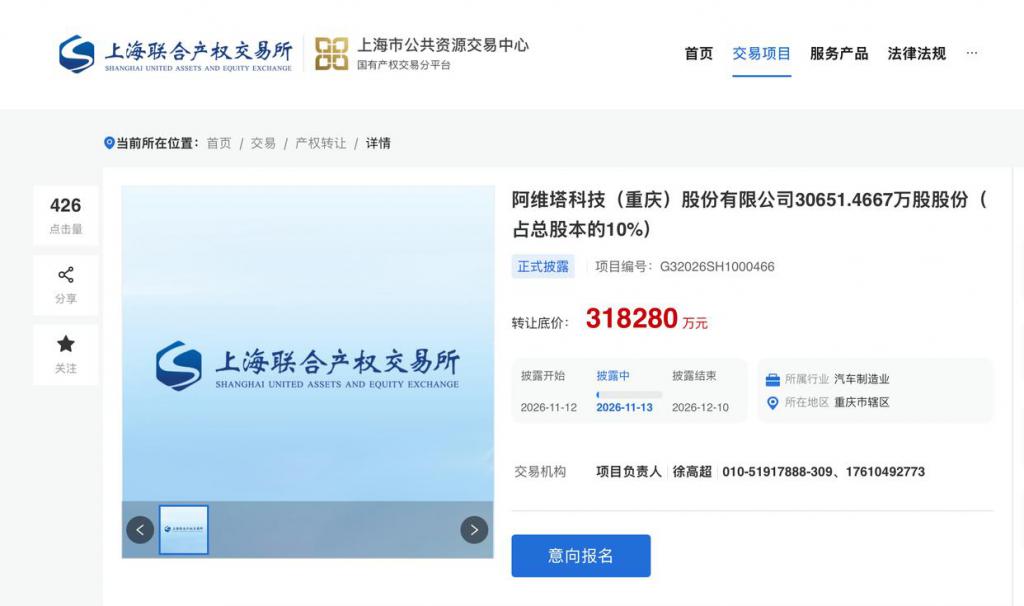
This is not the first time that Changan has diluted its stake in Avatr. When Avatr was first established, Changan held as high as 95.38% of the shares. After several rounds of strategic financing, CATL, National Green Development Fund, BOCOM Investment and other institutions joined in successively, and Changan's shareholding ratio gradually dropped to 40.99%.
According to the statements of both Changan and Avatr, this transaction is packaged as a "continuation" of the market-oriented reform of Avatr's equity structure.
Changan stated that after the transfer, it will continue to provide full-link support in core fields such as technology R&D, complete vehicle manufacturing and supply chain; Avatr said that the brand has entered the "parallel stage of high-end development and globalization", and its core demands have shifted from financial support to industrial resource synergy matching its product lineup and overseas layout, and the new investor will focus on providing assistance in high-end brand channel expansion and overseas market development.
In short, before Avatr submits its second listing application to the Hong Kong Stock Exchange and its IPO enters a critical window period, Changan intends to bring in a shareholder with channel and overseas resources to make the listing story more complete.
Avatr's IPO process itself is a story full of twists and turns.
On November 27, 2025, Avatr submitted its first listing application to the Hong Kong Stock Exchange, positioning itself as "the first new energy central enterprise stock on the Hong Kong Stock Exchange". In its prospectus, it put forward an ambitious target of 400,000 global sales and 100 billion yuan of annual revenue by 2027. However, six months later, the first version of the prospectus expired automatically on May 27, 2026 due to the expiration of its validity period.
Avatr defined this as a "common technical procedure in the IPO process", and quickly resubmitted the prospectus on June 30, with CITIC Securities and China International Capital Corporation as joint sponsors. However, the title of "the first new energy central enterprise stock on the Hong Kong Stock Exchange" was taken by Voyah back in March that year. Avatr has changed from the player that defined the track to the one that is catching up with the pace.
At the time of the second submission of the listing application, the prospectus contained a set of not-so-optimistic half-year data: less than 28,000 units delivered in the first half of the year, with an average monthly delivery of 4,032 units, and the completion rate of the annual target was only 12.6%. In a market where the monthly sales threshold of leading new energy vehicle startups has steadily reached 30,000 units, it is imaginable how difficult it is to convince investors of its "sustained operating capability" with such scale data.
An unavoidable fact is that the timing of this transaction just falls at the stage when Avatr's sales are under the greatest pressure and its cash flow is consumed the fastest.
In October 2026, Avatr delivered 7,056 units, a year-on-year decline of 47.8% and a month-on-month drop of 13.8%. In the "Golden September and Silver October" window when most new energy vehicle startups saw a month-on-month sales recovery, Avatr was one of the few brands that posted declines in both year-on-year and month-on-month performance. The 8,183 units delivered in September was once regarded as a phased recovery, but the October data directly shattered this assumption.
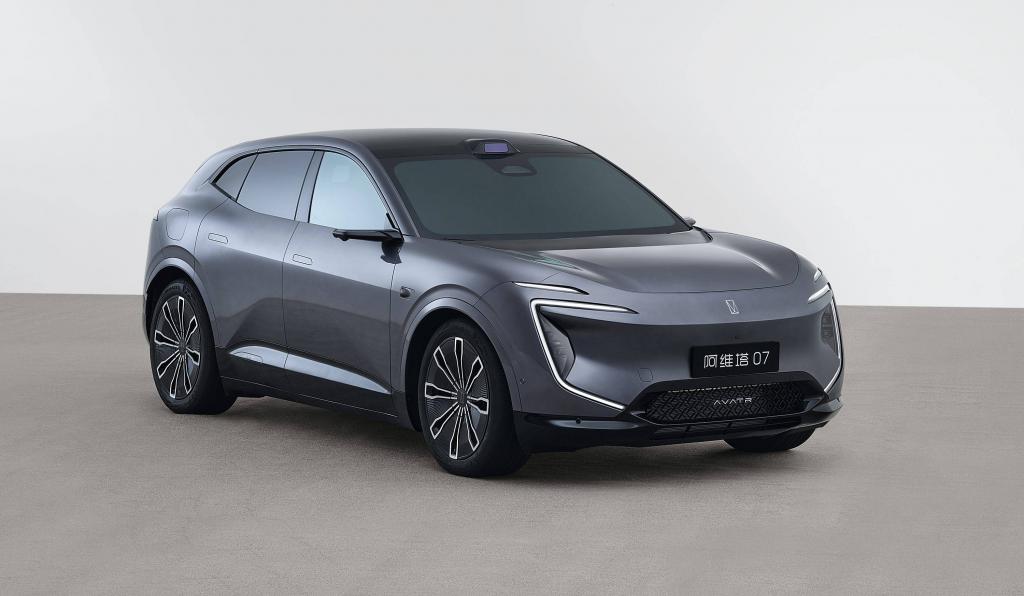
In the first 10 months of this year, the cumulative delivery reached 62,413 units, and the completion rate of the initial annual target of 220,000 units was only 28.4%. As a reference, although the overall new energy market in 2026 also saw a double-digit decline, Avatr's nearly halved year-on-year drop is more than three times that of the overall market. The gap is more obvious in horizontal comparison: Leapmotor delivered 106,127 units in October, both XPeng and Xiaomi exceeded 50,000 units, and even Voyah, which is also from a central enterprise and adopts the HI model, delivered 13,030 units.
Avatr's financial data is not all negative. Its total annual revenue in 2025 was 25.631 billion yuan, a year-on-year increase of 68.7%; its gross profit margin rose from 6.3% in 2024 to 9.4%; its operating cash flow recorded 2.315 billion yuan, turning positive for the first time in recent years. Its net loss also narrowed from 4.018 billion yuan in 2024 to 3.489 billion yuan. Since the disclosure of data started in 2022, Avatr's cumulative loss in four years has exceeded 13.2 billion yuan.
However, the speed of loss narrowing is far behind the speed of cash outflow. At the end of 2024, Avatr's book cash and equivalents were still 19.323 billion yuan, which shrank to 9.687 billion yuan at the end of 2025, and further dropped to 6.249 billion yuan by the end of April 2026. The current ratio dropped from 1.3 to 0.6, the quick ratio dropped from 1.1 to 0.5, and the net current liability changed from a net asset of 4.712 billion yuan to a net liability of 8.285 billion yuan. The prospectus clearly reminds that if the company fails to obtain financing in time under reasonable conditions, it will have a significant adverse impact on business operations and strategic expansion.
Avatr does have revenue and gross profit, but its sales volume is still an order of magnitude away from achieving "self-sustaining operation". What Changan can do is to help Avatr extend the window period to stay in the market for a longer time before it "breaks through" on its own.
The equity transfer consideration of 3.1828 billion yuan, in the context that Changan's attributable net profit in the first three quarters of 2026 plummeted by 98% year-on-year and it recorded a single-quarter loss of 758 million yuan in the third quarter, is a rational cost allocation for a long-term loss-making asset. For Avatr, the new shareholder brings not only capital, but also the possibility of channels and overseas resources. The next chapter of Avatr's story can no longer be written by Changan alone.