Taking off the leather jacket, NVIDIA has its first chairman ever.
For a long time, NVIDIA had no chairman of the board, but now it does.
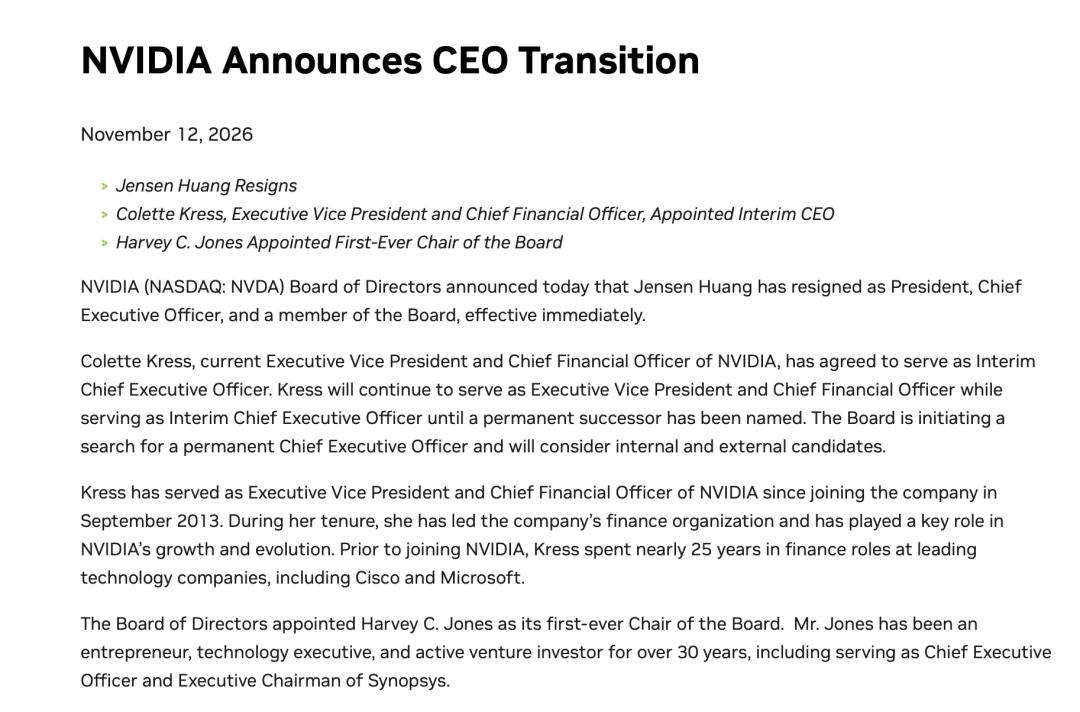
On the evening of November 12 Beijing time, NVIDIA released an announcement titled "NVIDIA Announces CEO Transition" on its official website.
The announcement states: NVIDIA announces that Jen-Hsun Huang has resigned from his positions as President, Chief Executive Officer and member of the Board of Directors, effective immediately. In addition, NVIDIA also announced the succession plan for Jen-Hsun Huang: Colette M. Kress, Executive Vice President and Chief Financial Officer, has been appointed Interim Chief Executive Officer, and Harvey C. Jones has been appointed as NVIDIA's first Chairman of the Board.
This transition announcement has brought two long-time colleagues to the forefront.
One is the CFO who has worked with Jen-Hsun Huang for 13 years, and the other is a "veteran" who joined the board of directors at the very beginning of NVIDIA's establishment. Under this new arrangement, Kress will temporarily take charge of operations, and Jones will preside over the board of directors.
Of course, the board of directors will also look for a formal CEO from inside and outside the company. Jones stated that the board of directors expects that the company's operations, fulfillment of commitments to customers, and advancement of the product roadmap will all continue without interruption.
On October 29, The New York Times reported on the exchanges between Jen-Hsun Huang and Alice Huang, a former executive of NVIDIA's customer Megaspeed. On November 8, Jen-Hsun Huang wrote in a letter to employees, "I have been unfaithful to my wife", without naming the other party. On the same day, the board of directors announced the launch of an independent investigation. On November 11, The New York Times, citing people familiar with the matter, reported that Jen-Hsun Huang had an extramarital relationship with a NVIDIA executive who reported directly to him. The leadership change announcement released the next day did not disclose the conclusion of the investigation.
On October 28, NVIDIA's closing price was $215.38. By November 11, the closing price had dropped to $173.73. After the leadership change news was announced on the 12th, the stock price fell to a minimum of $148.80 during the intraday trading, and finally closed at $166.19, down 4.34% from the previous trading day.
The CFO who has worked with Jen-Hsun Huang for 13 years becomes the interim CEO
"Just as I can be fired, the next CEO must also be appointed by the company."
On October 14, Jen-Hsun Huang responded to media inquiries in this way (this interview was broadcast on November 9). He hoped that the next CEO would already be inside the company.
In less than a month, these responses seemed to have become a kind of confirmation. Jen-Hsun Huang stepped down as CEO, and his successor has always been inside NVIDIA.
On November 12, NVIDIA submitted an 8-K document to the U.S. Securities and Exchange Commission disclosing this personnel change. The document shows (translated):
On November 11, 2026, the Board of Directors of NVIDIA Corporation (hereinafter referred to as the "Board of Directors") accepted the resignation of Jen-Hsun Huang. Jen-Hsun Huang resigned from his positions as President, Chief Executive Officer and Director of NVIDIA, and the resignation took effect immediately.
After Jen-Hsun Huang's resignation, the Board of Directors appointed Colette M. Kress (59 years old), NVIDIA's Executive Vice President and Chief Financial Officer, as Interim Chief Executive Officer to perform her duties during the period when the Board of Directors searches for a new Chief Executive Officer. Kress has served as NVIDIA's Executive Vice President and Chief Financial Officer since 2013, and will continue to hold these two positions concurrently during her tenure as Interim Chief Executive Officer.
On November 11, 2026, the Board of Directors appointed Harvey C. Jones (73 years old) as Chairman of the Board. Jones has served as a director of NVIDIA since 1993, and has been the Managing Partner of the private family office Square Wave Ventures since 2004. He has more than 30 years of experience in entrepreneurship, high-tech enterprise management and venture capital.
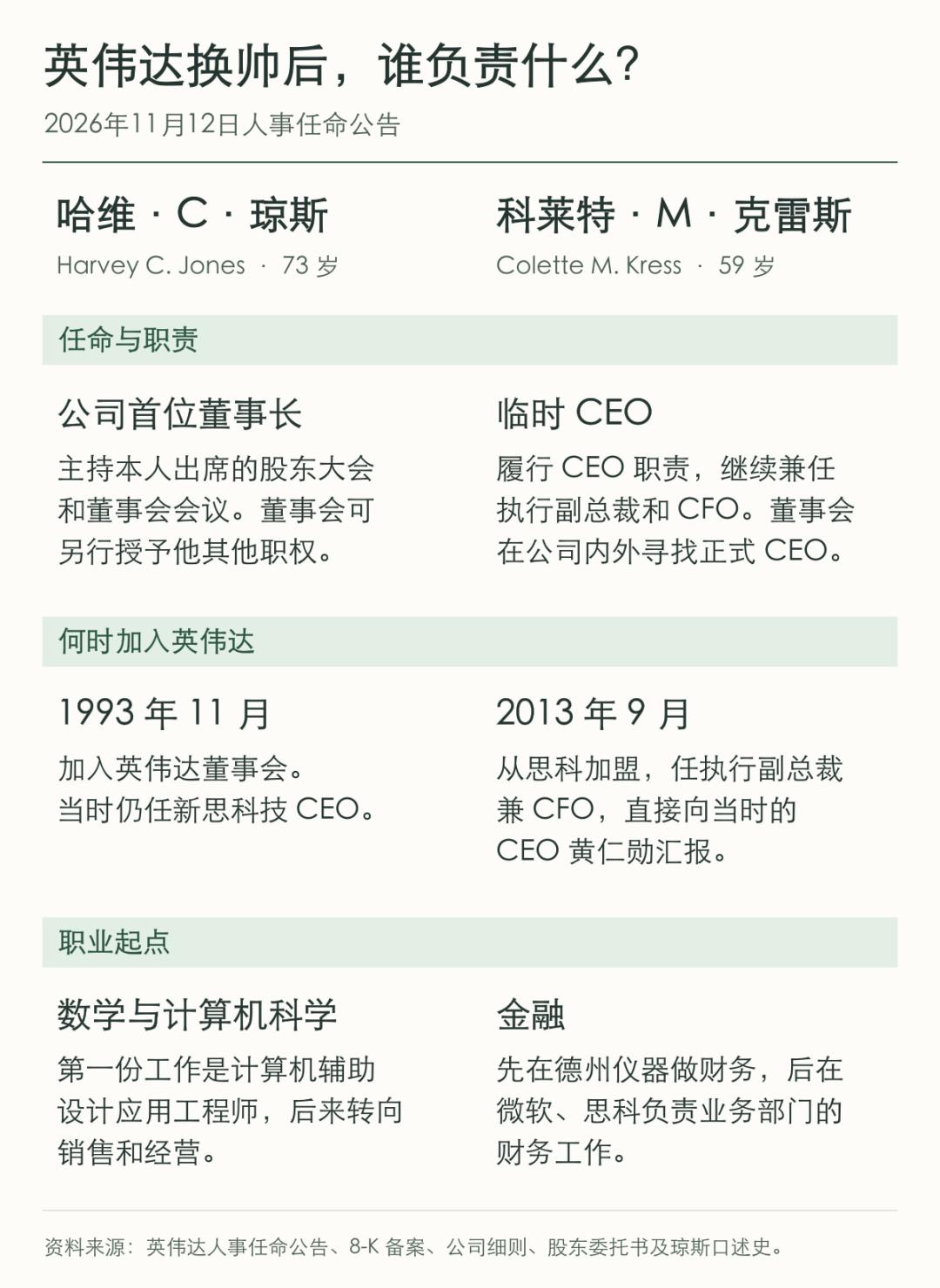
The signatory of this document announcing Jen-Hsun Huang's resignation is Kress. Three titles are listed under her name: Interim Chief Executive Officer, Executive Vice President, and Chief Financial Officer. She has held the latter two positions since September 2013, and has just taken over the first one.

Item 5.02 of this report adds a qualification to this appointment, she will perform her duties while the Board of Directors "searches for a new Chief Executive Officer". The announcement on the same day made it clearer that the Board of Directors will consider candidates both inside and outside the company at the same time.
Kress's career originally started in a finance position at Texas Instruments. After working in finance at Texas Instruments for eight years, Kress joined Microsoft in 1997. In 2006, she became the CFO of Microsoft's Server and Tools Division, responsible for financial planning, reporting and business development. In 2010, she moved to Cisco, where her financial work covered business divisions, engineering and operations.

At Microsoft and Cisco, she successively served as the CFO of the divisions. In September 2013, 46-year-old Kress began to be in charge of NVIDIA's company-wide finance, reporting directly to Jen-Hsun Huang.
In April 2022, she recalled in an interview with Fortune that NVIDIA was the smallest company she had ever worked for when she joined. After arriving at NVIDIA, as the enterprise expanded, the work that was originally done manually in finance, human resources, sales, operations and IT needed to be digitized.
Jen-Hsun Huang also still remembers a question she asked in her first week at work.
In the interview program "A Bit Personal" broadcast this January, the host mentioned that Jen-Hsun Huang had interviewed 22 CFO candidates before Kress.
Jen-Hsun Huang recalled at that time that about a week after Kress took the job, she came to ask how long she was expected to be the CFO? Jen-Hsun Huang replied, "As long as we are both alive." He then added that if one day she herself felt that this place was no longer suitable for her, that would be a different matter.
In fact, for people who have long paid attention to NVIDIA, Kress may not be unfamiliar. Kress often answers related questions in NVIDIA's quarterly earnings calls.
On the evening of May 20, after the earnings call ended, a media interviewed Kress alone. During the interview, he was asked: You booked memory so far in advance, is the price also locked?
Kress said that NVIDIA will discuss with three memory suppliers what configuration is needed for the next generation of products, and also negotiate the price in advance. At this time, what can be discussed is the price range. Only when we have a clear grasp of how much of each type of memory to buy can the price be negotiated more specifically.
There have been two different outcomes in technology companies when the CFO takes over the CEO's job first.
On August 6, 2010, Mark Hurd, the head of HP, resigned. While managing finance, CFO Cathie Lesjak temporarily managed the company. When she accepted the appointment, she clearly withdrew from the selection process for the formal CEO. In November, Léo Apotheke from outside HP took office. Intel took another path. In June 2018, CFO Bob Swan took the position of interim CEO. Seven months later, after the board of directors inspected internal and external candidates, they issued the appointment letter to him.
The first chairman comes from the earliest board of directors
What really breaks NVIDIA's convention is another appointment.
As recently as this May, in the section "Board Leadership Structure" on page 23 of the 2026 Shareholder Meeting Proxy Statement, it was written that "We believe the current structure is in the best interests of our shareholders and there is no need to appoint a chairman."
At that time, Jen-Hsun Huang was responsible for the company's operations and strategy, and the lead independent director Stephen Neal was responsible for coordinating independent supervision. Every quarter, the independent directors had a closed-door meeting without Jen-Hsun Huang, and Neal was the host.
Six months later, the board of directors appointed a chairman for the first time, and the candidate was Harvey C. Jones.
Originally, when NVIDIA's founding team came to look for Jones, he was serving as Chairman and CEO of Synopsys, a chip design software company.

He studied mathematics and computer science at Georgetown University, and after graduation he worked as an application engineer at Calma, a computer-aided design company, and later switched to sales. In December 1987, he joined Synopsys as President and CEO. In December 1992, he stepped down as President and became Chairman and CEO. In January 1994, he handed over the position of CEO and continued to serve as Executive Chairman.
Synopsys' software can convert the circuit functions written by engineers into digital logic. According to Jones' recollection, engineers worried that switching to new tools would slow down the chip design progress. Synopsys asked them to take a completed circuit design to test, while their ongoing projects proceeded as usual.
Jones once talked about the method back then in his oral history: ask customers to take the already designed circuit, run it with the new tool first, and then compare the result with the original design. In 1992, Synopsys went public.
On November 6, 2009, Jones was interviewed by the Computer History Museum in Mountain View, California. During the interview, he talked about why he joined NVIDIA.
Jones' answer started with Sun Microsystems, an early customer of Synopsys. According to his recollection, among those engineers who used Synopsys' tools, some later participated in the founding of NVIDIA. After the new company received investment from Sutter Hill Ventures and HSG, the investors suggested that the founding team invite someone who had personally run a company to join the board of directors.

Jones remembered, "It was the founders who came to ask me if I would like to join the board of directors." NVIDIA's 2007 shareholder proxy statement listed the month when he took his seat, November 1993.
Jones is indeed familiar with the way Jen-Hsun Huang deals with crises.
In 1995, Microsoft launched Windows 95. At that time, NVIDIA had already launched NV1 and was developing NV2 for Sega, both of which used the quadrilateral graphics architecture. Microsoft chose the 3D graphics interface Direct3D which was based on triangles, and the official version was released in June 1996.
Jones recalled that computer manufacturers that originally intended to adopt NVIDIA's technology backed down when they heard that Microsoft did not support it. Jones believed that NVIDIA might have had reasons to sue Microsoft at that time. He later explained the cost of litigation in this way: Even if NVIDIA won ten years later, the company might not have survived long ago.
In an interview with HSG, Jen-Hsun Huang also recalled this past event: to abandon the old architecture, he had to first get over the hurdle of a customer.
Sega had already asked NVIDIA to design chips for its new game console. If they delivered the goods as agreed, the team would have to continue developing along the path that was no longer promising. If they stopped halfway, they might not get the money to keep the company running. Jen-Hsun Huang recalled that he proposed to Sega to lift the delivery obligation, and at the same time asked the other party to continue to pay.
Irioka Shoichiro, a former Sega executive, later recalled to Jiji Press that he had persuaded the headquarters to invest in NVIDIA. NVIDIA's prospectus recorded the two sums of money separately: the NV2 partner paid the development fee, and in July 1995, it spent another 5 million US dollars to subscribe for NVIDIA's preferred shares. NVIDIA did not terminate the NV2 development until 1996, and later launched the RIVA 128 with the new architecture.
Before Jen-Hsun Huang resigned, NVIDIA had 11 directors, five of whom took their seats earlier than the company's listing in 1999. After Jen-Hsun Huang stepped down, four of these five are still on the board, and Jones is one of them.
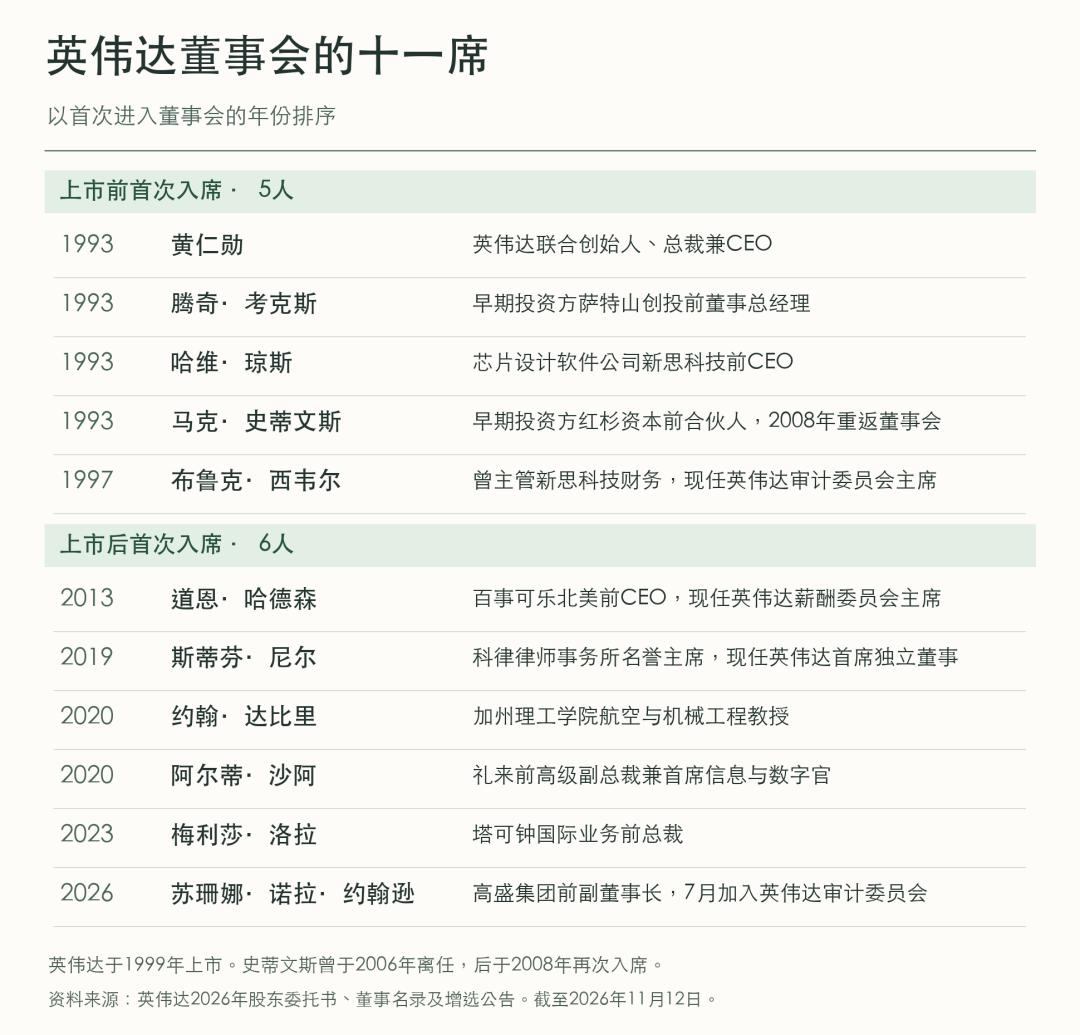
He did invest his own money. The prospectus shows that in August 1997, he invested nearly $128,000 to subscribe for NVIDIA's preferred shares. Since 2004, he has also served as the Managing Partner of the private family office Square Wave Ventures.
Being a director also means that he has to participate in the assessment of Jen-Hsun Huang. NVIDIA's 2003 shareholder proxy statement clearly states that Jen-Hsun Huang's target bonus for fiscal year 2003 was $800,000. Since the agreed performance target was not met, the actual bonus was zero. The first signatory of the Compensation Committee report was Jones, the chairman of the committee.
NVIDIA takes off its leather jacket
At the earnings call on August 26, Vivek Arya, an analyst at BofA Securities, first reported a number. He added up the commitments and guarantees disclosed by Kress for the next few years, and estimated that it was about 500 billion US dollars.
He wanted to know if there