Three workers have died from poisoning, and India's Tata plant has deeply disappointed Apple, which has begun to look for the next alternative supplier and is set to nurture Turkey as its new production partner.
The Tata Electronics plant in Tamil Nadu has added another disastrous entry to Apple's Indian supply chain.
According to reports from the Global Times, a fatal safety accident occurred at an electronics factory under the Tata Group of India located in Tamil Nadu on November 9.
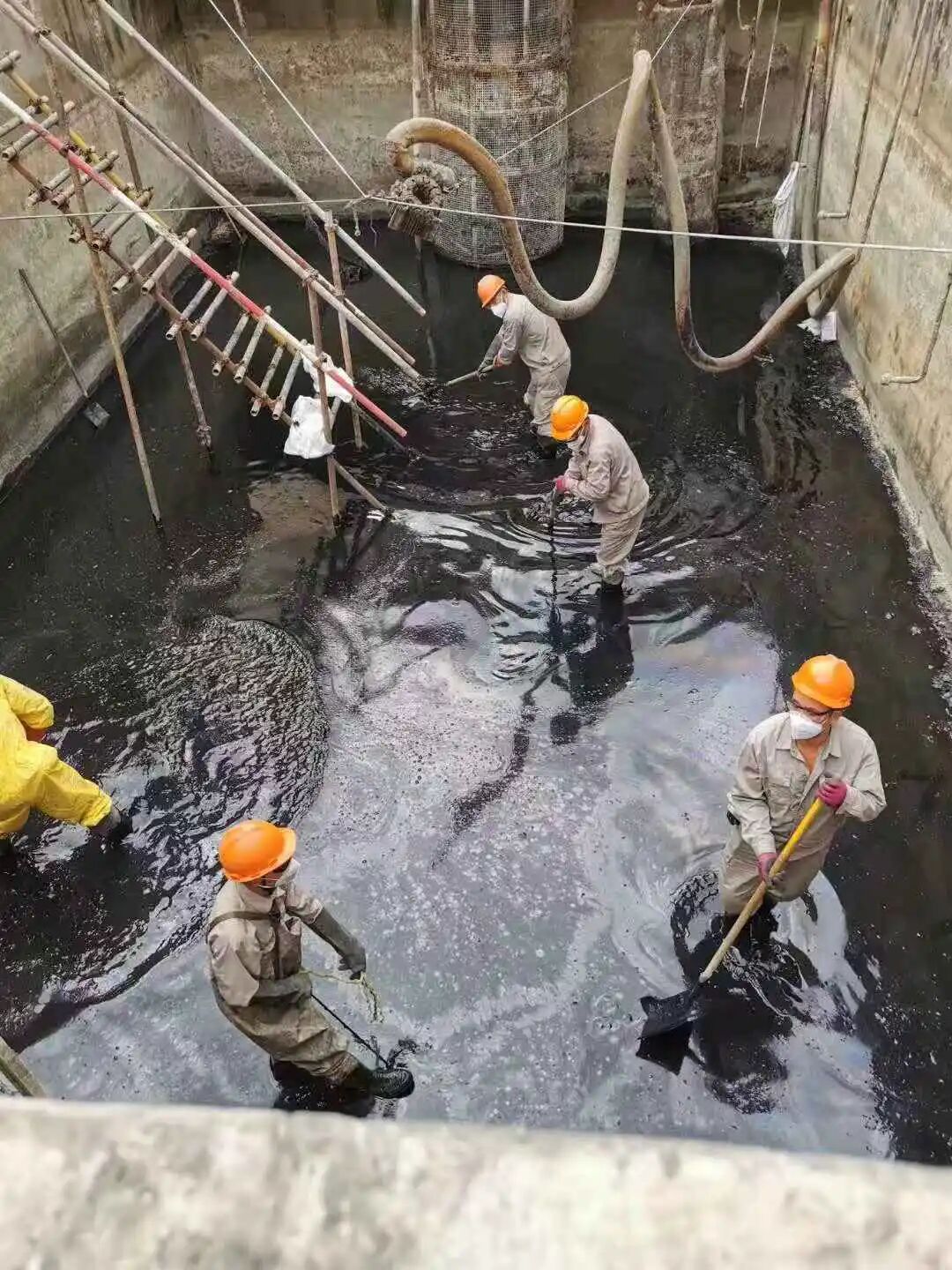
Three workers were dispatched to clean the wastewater storage facility at the Tata plant and died on the spot after inhaling toxic gas. The Centre of Indian Trade Unions directly called for a thorough investigation into the safety responsibilities of Tata's management.
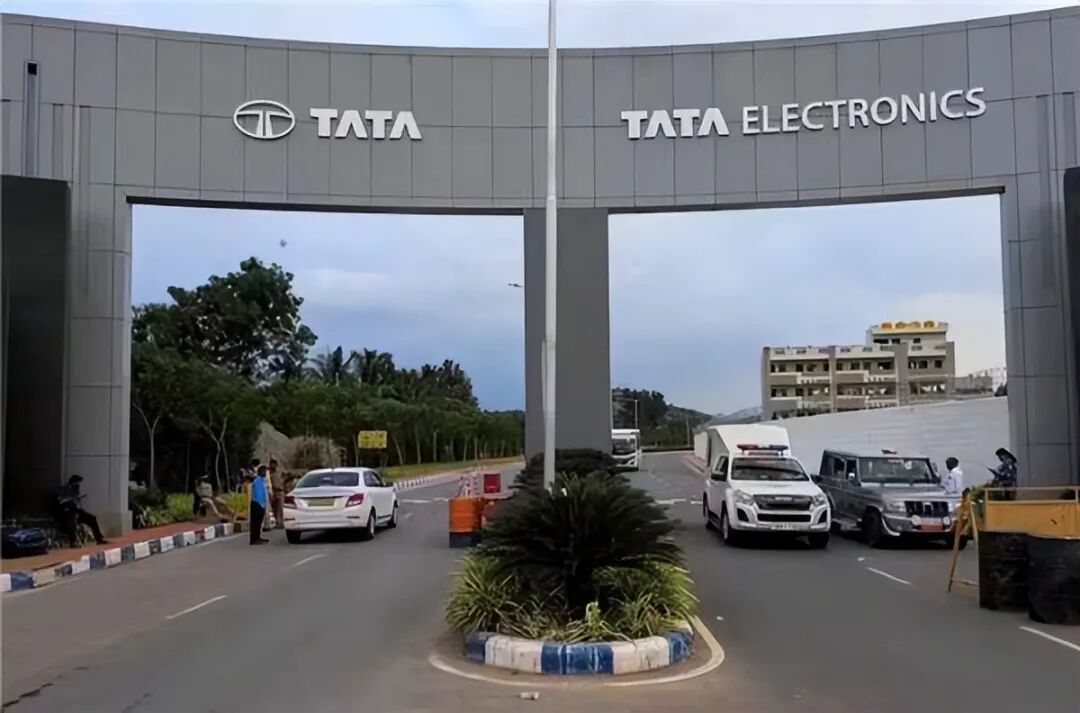
India's Business Standard stated bluntly that this worker death incident is the latest blow to Apple's Indian supply chain. Since the Indian supply chain is critical for Apple to get rid of its reliance on the Chinese supply chain, Tata Group is Apple's main contract manufacturer in India, and this is the third time Tata has crossed the red line in half a year.
In June this year, it was warned by the Tamil Nadu government for polluting surrounding farmland due to wastewater leakage; earlier, Tata also leaked 200,000 sensitive pieces of supplier information, and fully leaked 630GB of confidential files of Apple's iPhone 18 Pro, which became the most serious leak incident in Apple's history.
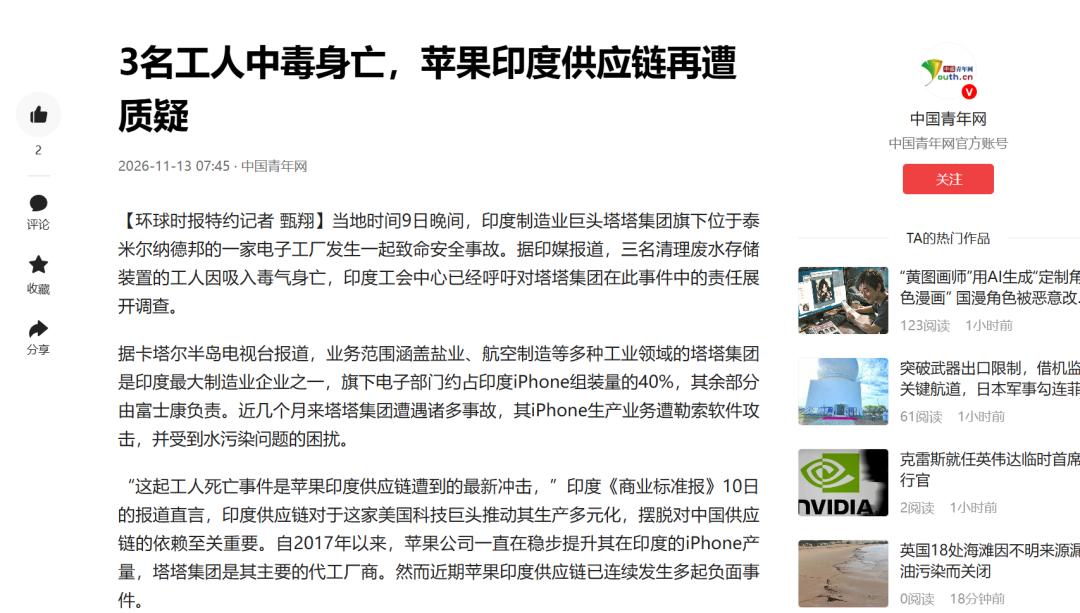
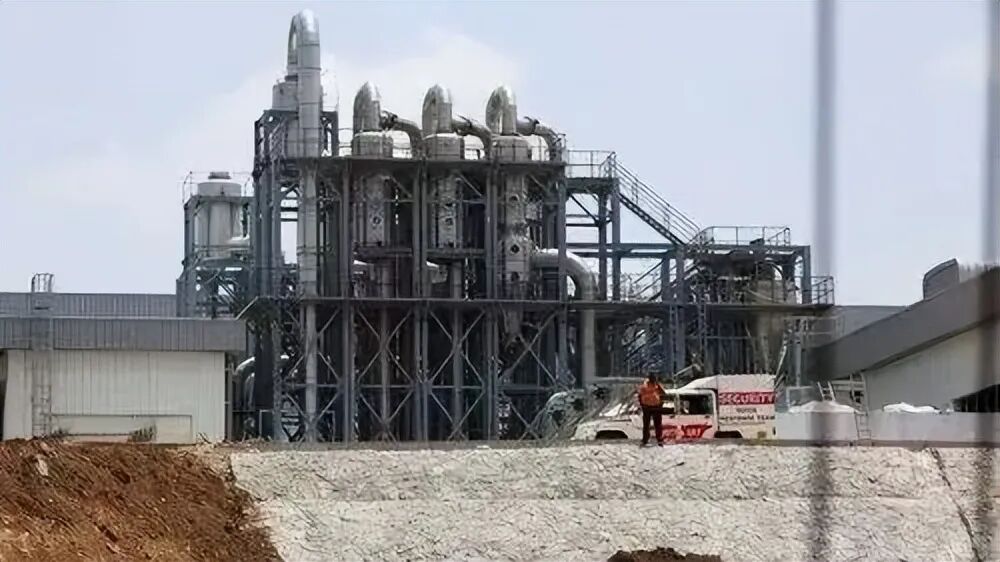
This time, the three Indian workers entered a confined space — the nanofiltration tank in the wastewater treatment system, where hydrogen sulfide, methane or oxygen-deficient air may have accumulated.
This plant was warned by the state government half a year ago for polluting farmland due to wastewater leakage. Its wastewater pretreatment system has long been cutting corners, and high-concentration sewage is directly discharged into the storage tank.
The closed tank has not been desilted for a long time, and the sludge at the bottom ferments in an anoxic environment, continuously generating highly toxic gases such as hydrogen sulfide — at high concentrations, one breath can paralyze the respiratory nerves, and people will fall to the ground before they have time to call for help.
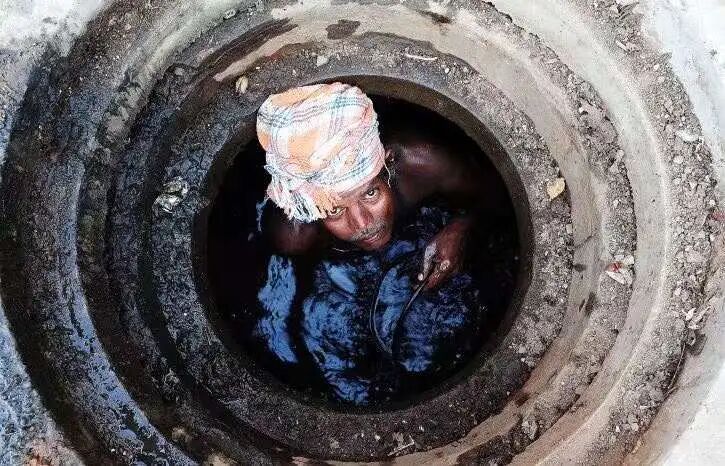
Cleaning a closed storage tank is a high-risk confined space operation. This kind of work has a set of strict rules in any decent industrial system: conduct gas detection first, run forced ventilation first, have a guardian watching outside, wear a respirator, and fasten the rescue rope. But the local official's exact words were that "appropriate safety protection measures were not taken".
In other words, it is very likely that there was no pre-ventilation, no toxic gas detection, no protective equipment, and the workers probably did not even receive basic safety training, and went down the tank with ordinary masks or even bare hands.
This may lead to the first person being poisoned and falling, and the people behind blindly rescue without protection, eventually leading to the tragedy of all three people dying.
Who is in charge of this sewage treatment facility?
It is not operated directly by Tata, but outsourced to Nalco Water Industrial International.
The three deceased workers were contract workers hired by Nalco's subcontractor. Tata is the plant owner, Nalco is the facility operator, there is a subcontractor under Nalco, and the workers who do the work are under the subcontractor.
Every time the responsibility chain is extended one more layer, the safety standards are diluted one layer.
Indian Supply Chain: Tata Plant Has Deeply Disappointed Apple
In June this year, the Tamil Nadu Pollution Control Board accused Tata of discharging wastewater into rainwater pools, which overflowed and polluted the well water of nearby farmland, and warned that the plant might be shut down and cut off power.
This incident in November saw workers suffocate while inspecting the wastewater tank. One is an environmental compliance issue, and the other is an operation safety issue. Although they were not triggered by the same fuse, they occurred in the same plant and during the lifecycle of the same wastewater management system.
The warning in June shows that the wastewater treatment link of this plant has already been a risk point in the eyes of regulators. This shows that the same person is in charge of the same set of affairs, and neither end of these affairs — the compliance of outward discharge nor the safety of inward entry — has been taken seriously.
These accidents reveal the common problems of the entire Apple supply chain in India.
The deaths of the three workers are not the first entry on the ledger of Apple's Indian supply chain, nor will it be the last.
In September 2023, the Pegatron iPhone assembly plant that had not yet been acquired by Tata ceased operations for a period of time after a fire; in February of the same year, the Foxlink plant that produced data charging cables for Apple also suspended production operations after a fire. In September 2024, the chemical storage area of the same Hosur plant caught fire, and production was interrupted.
During the 2026 Spring Festival, Chinese engineers returned to their home countries for the holiday, and the Indian production lines stopped directly. Apple chartered civil airliners to send people back to fix the problems.
These incidents linked together point to a more severe problem than "worker quality" or "extensive management": India has received hardware orders, but the supporting software facilities are full of loopholes everywhere.
What are software facilities? Mandatory procedures for confined space operations, safety responsibility traceability on the outsourcing chain, environmental compliance and data permissions are all software. Tata is a top-tier enterprise in India, and even the top player is like this, not to mention the quality of the small and medium-sized suppliers below.
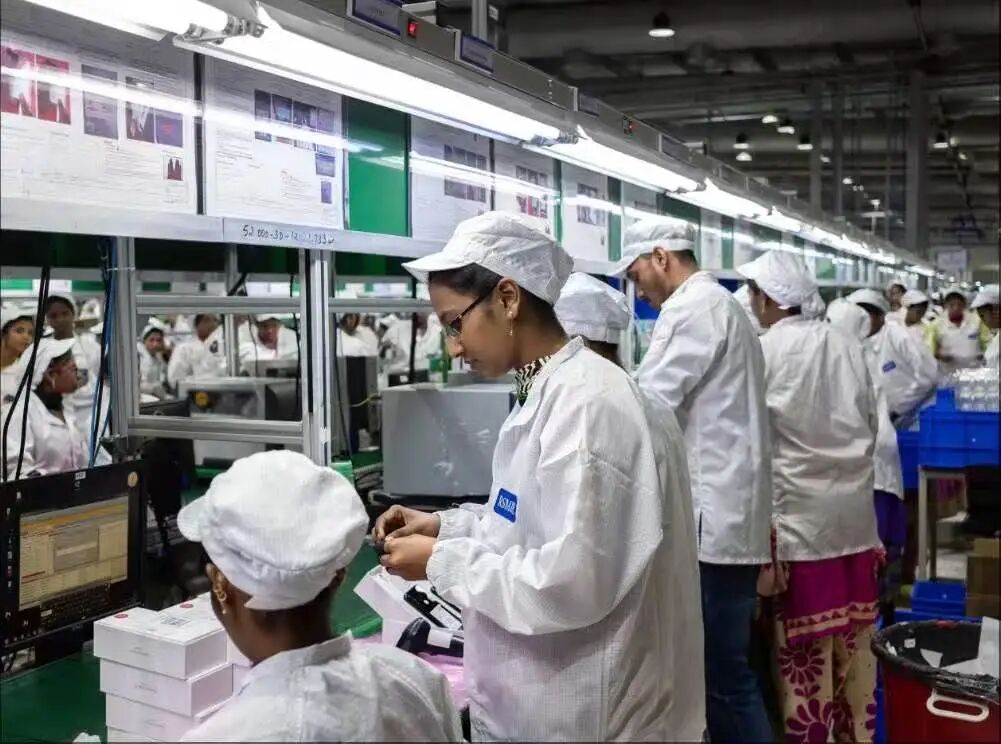
Apple is not unaware of this. In 2025, India assembled about 22% of iPhones, and the proportion is expected to reach 26% in 2026. But the first practical thing Apple's new CEO did after taking office was to stop the aggressive expansion of Indian production capacity and hold the share back from rising further.
Why? Because the frequent safety accidents in the Indian supply chain, one after another, have deeply disappointed Apple, not to mention that product quality control is still far from Apple's near-zero defect requirements.
More than 90% of the core production equipment still has to be shipped from China. Once Chinese engineers leave, the equipment operation rate drops below 60%. Apple shipped the machines across the sea, built the factories, and translated the SOP into English and pasted it on the wall, but Apple found that what cannot be moved over is the set of things that make the SOP truly implemented.
Turkey Becomes the Next Backup Option
The Indian supply chain keeps breaking down one after another, and Apple is not idle, quietly looking for the next backup option.
According to news from US magazine Computerworld, Apple has announced that it will build 5 Apple Developer Academies, 1 Developer Center and 1 Manufacturing Academy in Turkey, laying out talent and industrial arrangements. This shows that Turkey is the next key manufacturing and R&D branch that Apple will focus on cultivating after India.

Turkey has a superior geographical location, spanning Europe and Asia, adjacent to the European market. Products entering the EU can enjoy tariff preferences, which saves time and money compared with sea shipping from India. Secondly, it has a certain industrial foundation, and labor costs are much lower than that of Western Europe. Although the political situation is not completely stable, compared with the chaotic management in India, there are rules to follow at least.
The Manufacturing Academy is not a factory or an assembly line. What Apple teaches Turkey is "how to train people to become talents who can understand automated equipment". Turkey's manufacturing industry accounts for 16.8% of its GDP, and medium and high-tech products account for more than 40% of its exports, with a better foundation than India.
The three deaths at the Tata plant have torn apart the embarrassment behind "Made in India": the demographic dividend that has been boasted for so many years is still stuck in the primary stage of low-end, extensive and high-risk operations. This makes Apple realize that it needs more backup options and cannot put all its eggs in the Indian basket.
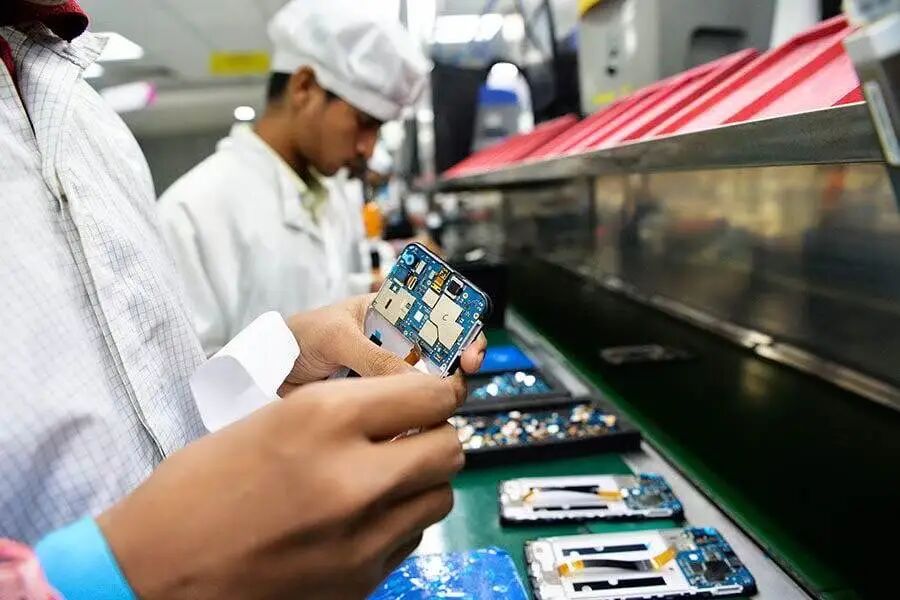
India originally had the opportunity to make Apple pull the share curve of Indian production steeper, but obviously, India has disappointed Apple.
Apple opening academies in Turkey means that Apple is looking for the next place in the world that can run the "supporting software" at the same time for its "hardware standards".
If it does not work, Apple will continue to keep the most cutting-edge work in China, let India assemble standard models, open academies in Turkey to cultivate talents slowly, and at the same time use Turkey's tax leverage to gain some negotiation chips for the future.
Apple no longer expects India to fully replace China. It is buying time for itself, using different maturity levels of different countries to piece together a risk-diversified supply chain map.
The poor performance of India's supply chain links is making it lose the opportunity to attract more mid-to-high-end Apple manufacturing links to settle in. India has always wanted to become the next world factory, but a world factory is a network woven together by industrial categories, engineer density, regulatory execution and accumulated failure experience, this network cannot be achieved overnight, it can only grow slowly.
Tata is in a hurry to take orders, but it has not built a complete industrial supporting system for safety and privacy. The result of being overanxious for quick success is that after deeply disappointing Apple, Apple is in a hurry to find the next backup option.
This article is from the WeChat Official Account "Hot Comment" (ID: redianweiping), written by Wang Xinyu, and published with authorization from 36Kr.