Bank ETF, "capital magnet"
On November 12, the net capital outflow of stock ETFs exceeded 240 billion yuan, with sectors such as banking attracting large capital inflows
On November 12, the A-share market as a whole trended higher before pulling back. The ChiNext Index rose by nearly 2% at one point during the trading session, but finally closed down by more than 2%, with a total trading volume of 1.93 trillion yuan across the two markets.
Against the volatile market, the net capital outflow of all stock ETFs (including cross-border ETFs) in the market on that day exceeded 240 billion yuan. Among them, broad-based ETFs tracking the ChiNext Index, as well as industry-themed ETFs covering banking, China Concept Internet and other sectors ranked top in terms of net inflow amount.
This marks the third consecutive trading day of net capital outflow this week, with a total "capital loss" of over 300 billion yuan. However, from the 5-day observation perspective, the capital inflow to the semiconductor material and equipment index has exceeded 63 billion yuan, and that for the sci-tech innovation semiconductor material and equipment sector has exceeded 48 billion yuan.
Net capital outflow exceeds 240 billion yuan, ETFs in sectors such as banking attract large capital inflows
According to Wind data, as of November 12, 2026, the total size of 1623 stock ETFs across the market reached 3.64 trillion yuan.
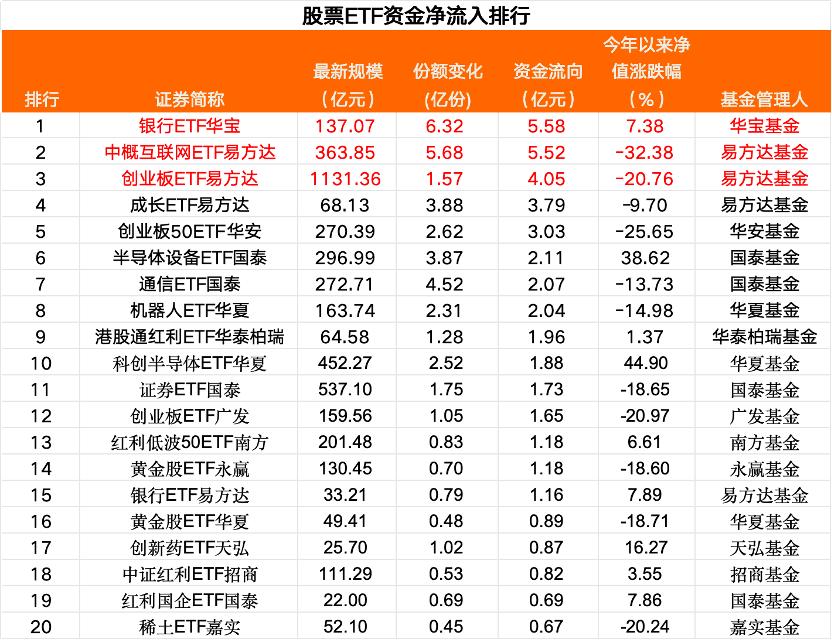
Wind data shows that the total share of the stock ETF market decreased by 137.05 billion units on November 12. Estimated at the average transaction price, the net outflow amount on that day reached 243.88 billion yuan. Among them, 15 stock ETFs recorded a net inflow of more than 100 million yuan, with Huabao Bank ETF, E Fund China Concept Internet ETF, and E Fund ChiNext ETF ranking top three in net capital inflow.
On November 12, the total net capital outflow across the market was 316.1 billion yuan. By major categories, global market ETFs and commodity ETFs took the lead in net inflows, reaching 7.24 billion yuan and -0.33 billion yuan respectively; broad-based ETFs recorded the largest net outflow, reaching 228.41 billion yuan. In terms of size change, the size of broad-based ETFs decreased by 365.7 billion yuan.
Data from E Fund shows that the top 5 sectors with capital inflows are exchangeable bonds/convertible bonds (net inflow of 8.8 billion yuan), ChiNext (net inflow of 8.1 billion yuan), banking (net inflow of 6.3 billion yuan), China Concept Internet (net inflow of 5.9 billion yuan), and growth (net inflow of 3.4 billion yuan).
Specifically at the index dimension, the CSI Convertible Bond and Exchangeable Bond Index recorded the highest single-day net inflow on November 12, reaching 6.1 billion yuan, while the Sci-Tech Innovation 50 Index recorded the highest single-day net outflow, reaching 58.48 billion yuan. From the 5-day observation perspective, recent capital inflow to the semiconductor material and equipment index has exceeded 63 billion yuan, and that for the sci-tech innovation semiconductor material and equipment sector has exceeded 48 billion yuan.
ETFs under leading public fund firms attract large capital inflows
Data shows that some ETFs under leading fund companies continue to see steady net inflows.
As of November 12, the latest size of E Fund's ETF business reached 7318.7 billion yuan. Among them, the size of E Fund China Concept Internet ETF stood at 363.85 billion yuan, with a net inflow of over 5.5 billion yuan; the size of E Fund ChiNext ETF reached 1131.36 billion yuan, with a net inflow of 4 billion yuan; the size of E Fund Growth ETF was 68.13 billion yuan, with a net inflow of over 3.7 billion yuan; the size of E Fund Bank ETF reached 33.21 billion yuan, with a net inflow of 1.16 billion yuan; the size of E Fund Semiconductor Equipment ETF stood at 159.06 billion yuan, with a net inflow of 0.45 billion yuan.
For China Asset Management's ETF business, on November 12, ChinaAMC Robot ETF and ChinaAMC Sci-Tech Innovation Semiconductor ETF recorded the highest single-day net inflows, reaching 2.04 billion yuan and 1.88 billion yuan respectively, with their latest sizes hitting 163.74 billion yuan and 452.27 billion yuan respectively. The corresponding tracking indices recorded an average daily turnover of 6.96 billion yuan and 64.12 billion yuan respectively in the recent month.
For Southern Asset Management, Southern Dividend Low Volatility 50 ETF recorded a single-day net inflow of 1.18 billion yuan, and a net inflow of 7.43 billion yuan in the recent 5 days, with its current size reaching 201.48 billion yuan. In addition, Southern Battery ETF recorded a net inflow of 0.51 billion yuan in the recent 5 days; New Energy ETF recorded a net inflow of 0.38 billion yuan in the recent 5 days; Southern Innovative Drug ETF recorded a net inflow of 0.19 billion yuan in the recent 5 days; Southern Sci-Tech Innovation Chip ETF recorded a net inflow of 0.13 billion yuan in the recent 5 days.
Pang Yaping, fund manager of E Fund, said that after the previous market adjustment with shrinking trading volume and further valuation digestion, the market recovery still needs the cooperation of incremental capital and fundamental improvement. With the conclusion of the third quarterly report overlapping with the November policy window, the index is likely to show a trend of consolidation amid shocks and structural differentiation. Investors can pay attention to core assets with strong performance certainty, as well as thematic investment opportunities during the performance vacuum period. From a half-year perspective, the A-share market still has the foundation for shock recovery, but the recovery pace depends on policy effects and earnings improvement.
BOC Investment believes that the short-term rebound and recovery market is expected to continue. On the one hand, the result of the US midterm election is better than pessimistic expectations. Although the Democratic Party won both chambers of Congress, Trump's statements on the election result and the situation in the Middle East are better than the market's pessimistic expectations. The risk of accelerated contraction of global financial conditions in the short term has decreased. Crude oil prices and US bond yields have both dropped significantly from their recent highs, and the macro environment is improving marginally. On the other hand, the adjustment of the current A-share market may have been sufficiently thorough. In addition, the State Council executive meeting has once again set the tone to improve the market stabilization mechanism and enhance the inherent stability of the stock market, and the heads of China and the US may meet for the third time this year at the APEC Summit in Shenzhen in late November. The market is likely to be in a window period of recovering risk appetite in the short term.
This article is from the WeChat Official Account "China Fund News" (ID: chinafundnews), written by Tian Xin, and authorized for release by 36Kr.