Jensen Huang's mistake lies in the lack of a successor.
At 9:30 a.m. Eastern Time on November 12, Nvidia's stock once fell by 14% after the market opened. A month ago, the company's market value stood at 5.5 trillion U.S. dollars. By the close, the decline narrowed to 4.34%, closing at $166.19 with a market value of 4.01 trillion U.S. dollars. The single-day market value shrank by about 182 billion U.S. dollars, equivalent to about 1.2 trillion yuan.
This V-shaped trend itself is a "diagnosis report". The market spent half a day selling off "Jensen Huang", and then another half day buying back "Nvidia".
The four-day timeline is extremely tight. Based on public reports, "Business Show" sorted out exactly what happened in these four days.
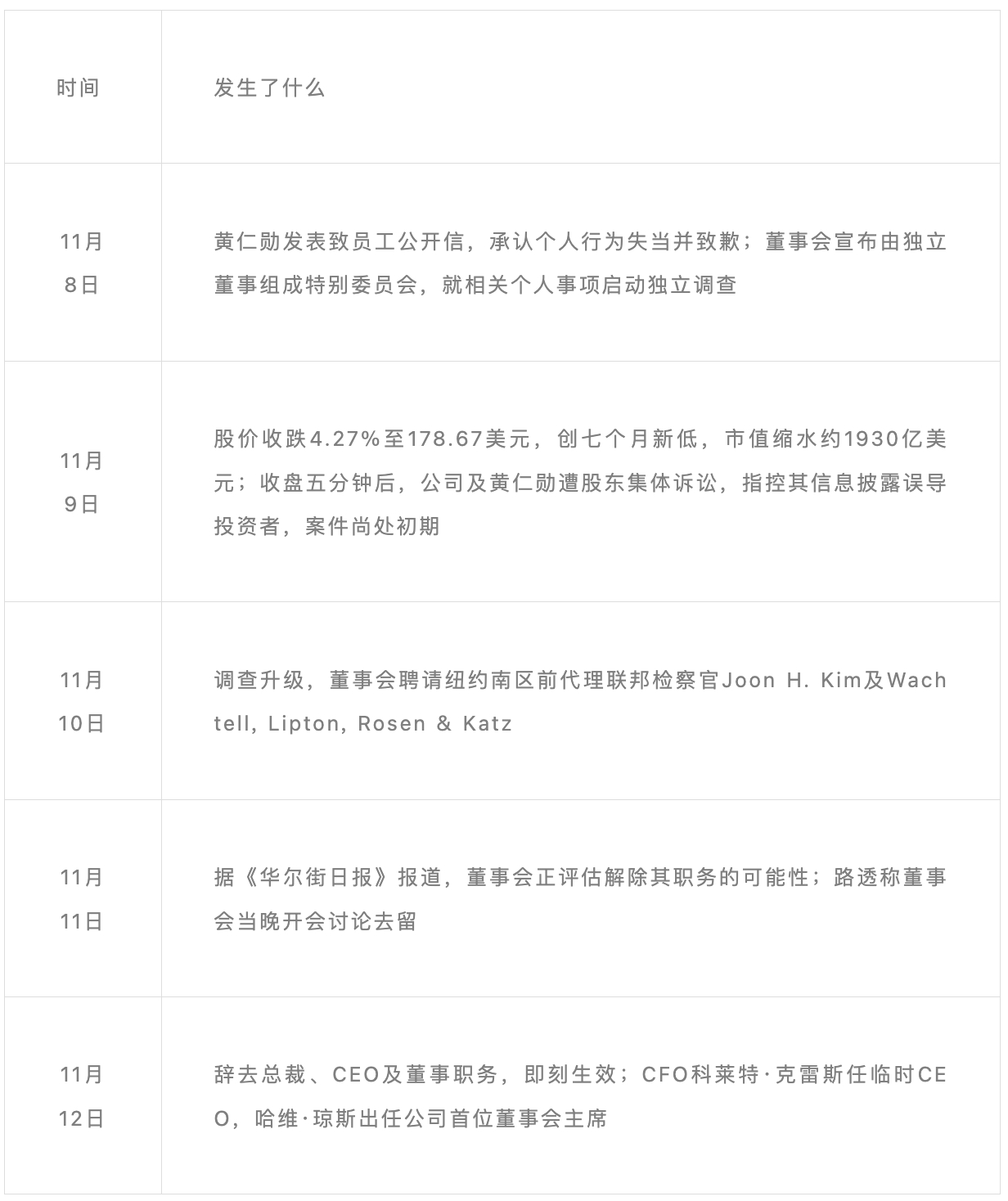
The personal-level controversies surrounding Jensen Huang are not within the scope of this article. Therefore, there is only one business question left in this incident: Why could a $5.5 trillion company lose its decision-making capacity in just four days?
The answer is not in that open letter, but perhaps back in 1993.
01 A Company With No Backup
In April 1993, at a Denny's restaurant in San Jose, California, Jensen Huang, Chris Malachowsky, and Curtis Priem decided to develop graphics chips, while HSG and Sutter Hill invested 20 million U.S. dollars.
Three years later, the company was on the verge of collapse. NV1 bet on the wrong technical route, and the cash on the books was only enough to last for a few months. A sentence that Jensen Huang repeatedly mentioned later was "We were only 30 days away from bankruptcy". By 1997, RIVA 128 gambled all its assets, sold one million units in four months, and the company survived.
On January 22, 1999, Nvidia went public with an issue price of $12. In October of the same year, GeForce 256 was defined as "the world's first GPU".
The real watershed came in 2006.
The release of CUDA enabled GPUs to perform general-purpose computing. This was a completely unreasonable decision at the time, with an annual investment of hundreds of millions of U.S. dollars for nearly a decade in a row. Wall Street asked every year "When will this thing make money?", and the profits from gaming graphics cards were eaten up by R&D expenses little by little.
It was not until 2012 that the University of Toronto trained AlexNet with two GTX 580s.
In 2016, Jensen Huang personally delivered the first DGX-1 to OpenAI. At that time, OpenAI had been established for less than a year.
The subsequent story has been told too many times by the outside world. Nvidia acquired Mellanox for 6.9 billion U.S. dollars in 2020, its market value exceeded 1 trillion U.S. dollars in May 2023, it completed a stock split in June 2024, its market value exceeded 4 trillion U.S. dollars in July 2025 and 5 trillion U.S. dollars in October 2025, and its stock price hit $243.37 on October 6, 2026, with a market value of 5.5 trillion U.S. dollars.
What is worth mentioning is not these numbers, but the common point of these decisions: none of them came out of a rigid process.
CUDA was a financially negative asset in its first seven years. If Nvidia in 2008 had a strong independent board of directors, a succession plan that "focused on core business", and a set of return on capital assessment rules, CUDA would most likely have been cut off. Nvidia's current moat is stacked by a series of "seemingly irrational" bets over 33 years. Such bets can only be undertaken by one person, and can only be vetoed by one person.
But what is really worth looking at is not what he has achieved, but whether there is a second person in this system.
In March 2026, Jensen Huang made it very clear when he was a guest on the Lex Fridman podcast. He does not believe in formal succession plans, "If you are troubled by the succession issue all day long, what should you do? Deconstruct everything. If you really care about the future of the company after you leave, the most important thing is to pass on knowledge, information, insights, skills and experience to the team as frequently and continuously as possible."
He regards succession as a continuous process of passing on knowledge, rather than a position that can be appointed.
The organization was built according to this concept. In 2024, he said that 60 executives in the company reported directly to him. By November 2026, this number still stood at 33. On the board of directors, he is the only internal director; the board did not have a permanent chairman before, only a lead director elected by the majority of directors every year. He holds about 3.58% of the shares, is the fifth largest shareholder, and has no special voting rights.
In other words, his control over this company does not come from equity or the articles of association, but from his personal presence.
Nvidia itself wrote about this risk in its 2026 fiscal year annual report. Failure to ensure effective succession planning, knowledge inheritance, and smooth transition of executives and key employees may affect the company's strategic planning, execution and long-term development. This is a standard annual report wording, which has become literal after November.
From November 8 to 12, what the board of directors did was, in a very large sense, to find a copy of a document that had been written for 33 years and never backed up.
They could not find it. Jeff Christian, CEO of headhunting firm Christian & Timbers interviewed by The New York Times, said that even it is not easy to pick someone who can temporarily manage the company within Nvidia, most current executives are only responsible for specific product or technical fields, and have no experience in managing thousands of people.
Dan Ives, a tech analyst, put it more directly as quoted by Reuters: "Jensen is not replaceable, there is no second person in the management who can seamlessly take over as CEO."
Newman, CEO of Futurum Group, told The Wall Street Journal that in many ways, Jensen Huang is Nvidia's Steve Jobs. The difference is that there was Tim Cook after Steve Jobs, while there is only one name on Nvidia's list.
So what happened in these four days is not "the board made a decisive cut", but perhaps "the board found that it had no second option".
02 Assets Not Recorded in Financial Statements, and Liabilities Not Recorded in Financial Statements
Judging only from the balance sheet, Nvidia is unusually clean, with a gross margin of 75%, abundant cash, and no shortage of money on the books.
But in the $5.5 trillion valuation, at least three things have never been recorded in the accounts.
The first one is the political access.
Jensen Huang is not just a CEO. In the past three years, he is one of the few people in Silicon Valley who can walk into the White House, Mar-a-Lago and the royal palace in Riyadh at the same time. As former deputy chief of staff of the U.S. Department of Commerce Secretto put it, "He is a unique force in the geopolitics of artificial intelligence".
This asset has a clear record of realization. According to reports from Reuters and other media, at the end of 2025, the Trump administration agreed to allow the sale of H200 to China, for which Jensen Huang had lobbied for a long time. For a company whose China business has been mostly cut off by export controls, this is the only remaining gap.
The size of this gap is clearly reflected in the numbers. The proportion of China's revenue in Nvidia's total revenue dropped from 26.4% in fiscal 2022 to 9% in fiscal 2026; in the first quarter of fiscal 2026 (as of April 2025), the company did not ship a single data center Hopper chip to mainland China, accrued a $4.5 billion impairment, and expected that the H20 sales restriction would bring $8 billion in revenue loss.
According to IDC data, Nvidia's share in China's data center AI chip market dropped to 34% in the first half of 2026, Huawei's share was 28%, and a year ago, the gap was 31 percentage points.
9% is not the end, it is the residual part.
And now, this gap is being welded shut from the other end. On November 4, the three Republican chairmen of the U.S. House Foreign Affairs Committee, the Select Committee on the Chinese Communist Party, and the Intelligence Committee jointly requested Jensen Huang to hold a closed-door briefing on November 18; Senate Democrats asked Commerce Secretary Lutnick to save all records of interactions with Nvidia and Jensen Huang.
Baird analyst Tristan Gerra judged that the license for H200 is likely to be revoked, Blackwell and subsequent architectures will be completely excluded from the Chinese market, and the re-export path through "new cloud" in Southeast Asia will be blocked.
This incident does not affect the $108 billion revenue in the next quarter, but affects the addressable market in 2028. And the addressable market is the part of the $5.5 trillion valuation that is the hardest to falsify and the easiest to discount.
The other end of the access is connected to the supply chain. According to a Reuters report on November 12, partners from South Korea to China's Taiwan region are redrawing their plans, TSMC fell by 2% that day, and SK Hynix fell by 1.6%.
An executive of a supplier in China's Taiwan region said, "We will support whatever production capacity Nvidia needs, but the new CEO may not be as aggressive as Jensen". Neil Shah, vice president of research at Counterpoint, judged that without him, Nvidia's ecosystem-level investments and bilateral AI infrastructure transactions will slow down.
The second one is circular financing. In 2026, Nvidia announced that the scale of such transactions exceeded 5.4 trillion U.S. dollars. Together with the frameworks with OpenAI and SK Group, the total exceeded 7.5 trillion U.S. dollars, which is about 3.5 times its revenue in fiscal 2026.
The structure is not complicated. In July, media reported that Nvidia was negotiating with OpenAI to provide up to $250 billion in financing guarantees for the latter's 10GW, $50 billion data center project in Ohio, and at the same time discuss providing up to $350 billion in financing for OpenAI's chip procurement.
Earlier, the company also joined forces with Wall Street to build a $5 trillion third-party capital platform, providing up to 25% of the project scale in financing support by itself. In June, Nvidia issued bonds for the first time in five years, with an issuance size of $25 billion and a subscription amount of $85 billion, four times oversubscribed.
Suppliers are simultaneously shareholders, guarantors, and order beneficiaries. Michael Burry, who became famous for shorting subprime mortgages, wrote on social media: "Spinning around and around. Nvidia is guaranteeing the money that ChatGPT spends on Nvidia chips." Jim Chanos put it more directly, "Nvidia has to provide financing guarantees for two-thirds of the cost of the chips it sells to data centers."
Jensen Huang's response was "absurd". His logic also holds: what AI infrastructure lacks is not money, but electricity, land, and transformers. Nvidia's capital contribution ratio is very low, third-party capital will conduct independent due diligence, and the demand is real.
It must be admitted that the demand is real. The total capital expenditure guidance of the four major cloud vendors in 2026 is 720 billion to 740 billion U.S. dollars, a year-on-year increase of 78%; Microsoft Azure grew by 48% in a single quarter, Google Cloud grew by 103%, and AWS grew by 39%; Nvidia's data center gross margin is 75%. The first four rounds of "AI bubble theory" have all been falsified by performance, because they questioned the demand.
The fifth round is different. It questions "who is paying for the demand".
Data shows that Google's free cash flow in the second quarter was -5.9 billion U.S. dollars, the first time it turned negative in 22 years of listing; Meta's free cash flow in the third quarter was -2.1 billion U.S. dollars. When buyers start to pay for capital expenditures with liabilities, the seller's accounts receivable becomes the credit exposure of the entire industry. Nvidia's CDS has more than tripled from mid-year to November 12, which does not reflect the rise of its own default probability, but the risk premium of this entire chain.
There is also a maturity mismatch. The duration of data center debt is usually arranged for ten years, and the economic life of GPUs is depreciated over three to five years. Jensen Huang's rebuttal is that the 2020 A100 is still running at full load today, and its economic life may be close to ten years. The difference between the two calculation methods is the real impairment risk of this batch of assets, and also the most vulnerable part of the "using chips as collateral" practice.
The third one is Jensen Huang's personal credit. The $250 billion guarantee is signed against Nvidia's balance sheet, but what supports it is "this person will not leave". After he leaves, Cress can continue to sign the documents, but he cannot sign with the same level of trust.
This is not a financial problem, but a governance problem. You cannot build the leverage of half the industry on one person's personal credit, and then pretend that it is "third-party capital".
The hidden assets are cleared much faster than the hidden liabilities are exposed. This is also the most easily overlooked thing in these four days.
03 Who Is Pricing the $5.5 Trillion Company?
External competition is often simplified as "AMD is catching up". In the five trading days before November 12, AMD rose by 21%. That is the sentiment of capital, not market share.
The real change actually lies in the customer structure. Data shows that about half of Nvidia's data center revenue comes from the largest hyperscale customers. In fiscal 2026, two customers contributed 22% and 14% respectively, totaling 36%. In the first half of fiscal 2027, three customers each exceeded 10%, totaling 44%. In fiscal 2023, no single customer exceeded 10%.
These customers are also making their own chips at the same time. For example, Google's TPU shipments in 2026 are expected to be 6 million units, and Nvidia's GPU shipments are 7 million to 7.5 million units. In Google's own AI servers, self-developed ASICs account for 70%, and Nvidia only accounts for 30%. For another example, Broadcom's AI ASIC business revenue exceeded 20 billion U.S. dollars in fiscal 2025.
JPMorgan Chase predicts that the customized AI ASIC market will reach 600 billion to 700 billion U.S. dollars in 2026, and the proportion of ASIC/XPU in accelerator shipments will rise to 54% in 2027, surpassing GPUs for the first time.
Nvidia's share in the AI accelerator market is expected to drop from about 80% to 75%. This is "the cake is getting bigger, and there are more knives to cut it", not "selling less", the absolute revenue is still growing.
But the nature of the loss has changed. Losing an order from a customer and losing all the increment from a customer are actually two different things. When Google, Amazon, and Microsoft put all their new computing power on their own chips, Nvidia can only get a share of the external market.
And this transition happens exactly in the inference era. Training is a one-time capital expenditure, while inference is an operating cost that is burned every day. Training competes for peak computing power, while inference competes for the cost per token.
The calculation from SemiAnalysis shows that the total effective operation cost of TPU is 20% to 50% lower than that of Nvidia's flagship, and the performance per dollar is up to 4 times higher. This is not "slightly worse performance", but a structural difference in the business model.
CUDA's moat still exists, but it protects training and