Fei Hao from the University of Oxford: What problems can the "cognitive symbiont", the other half of physical AI, solve for ordinary people?
When talking about physical AI, the first thing that comes to most people's minds is robots. They have independent bodies and perception capabilities, and can complete physical work for humans in factories, warehouses and homes.
However, many difficulties people encounter in daily life cannot be solved by robots. When you meet a collaborator you haven't contacted for many years, you can't recall their name for a moment; when you reply to a tutor with an email with sensitive wording, you are still not satisfied after repeated revisions; your father mentioned a month ago that he would go for a check-up, but you forgot to ask about the result. Most of the information needed to solve these problems exists in the personal experience of the person concerned, but the AI assistant at hand does not know who he is, where he is at the moment, what he is experiencing, nor can it give timely prompts without interrupting him.
Recently, Hao Fei, senior researcher in the Department of Computer Science at the University of Oxford, published a 59-page perspective article on the arXiv preprint platform, putting forward a systematic set of assumptions for such problems. In his view, there will be two equally critical intelligent individuals in the world of physical AI: embodied robots are one type, and AI-augmented humans are the other.
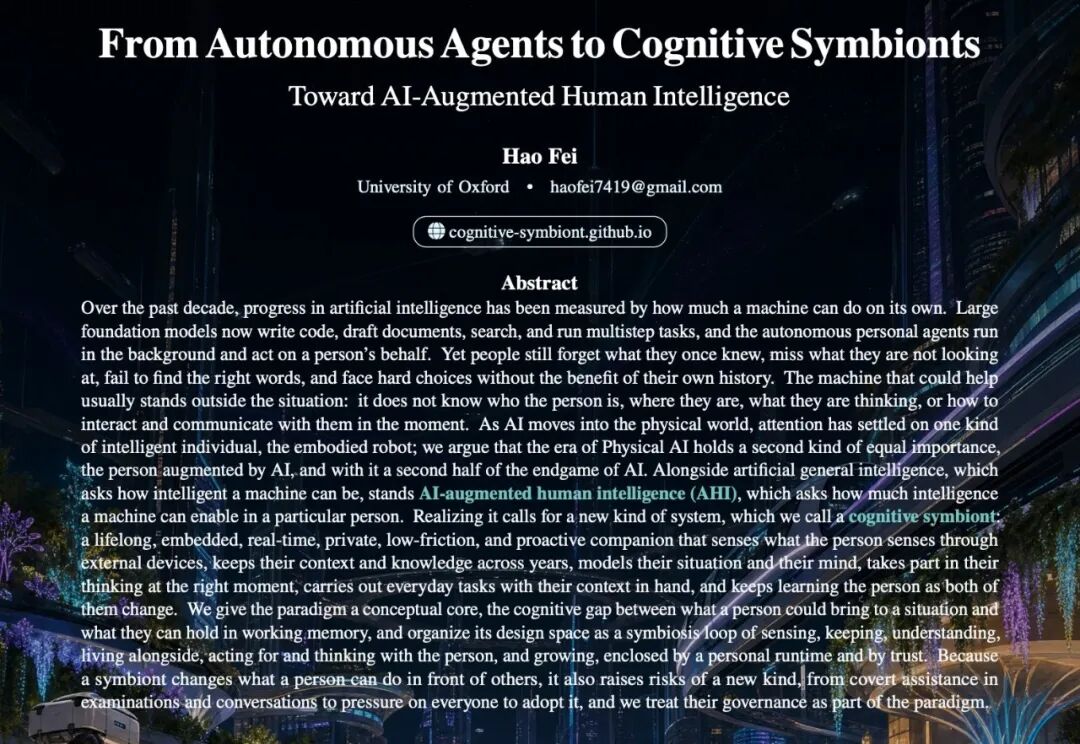
Paper link: https://arxiv.org/abs/2611.05376
Project homepage: https://cognitive-symbiont.github.io
Correspondingly, the author proposes another research direction beyond AGI, called AI-augmented human intelligence (AHI), and the system undertaking this task is called Cognitive Symbiont. In this set of comparisons, AGI asks how intelligent the machine itself can be, while AHI asks how much more a specific individual can accomplish with the help of machines.
In the era of physical AI, what two types of intelligent individuals will emerge?
According to the division of the article, there are two existing forms of intelligent individuals in the future physical world.
One is "AI as an individual", namely embodied robots, which have independent bodies, perception capabilities, action capabilities and goals. The other is "AI-augmented individual", that is, a real person who owns his own symbiont with the help of wearable devices. In the latter form, the human is always the subject, the goals belong to him, the body belongs to him, and the AI only borrows his senses and hands.

Figure | Two types of intelligent individuals in the era of physical AI: AI-augmented humans and embodied robots
The core assertion of the author is that these two individuals share a common "cognitive core", which includes storing long-term memory, understanding situations and the minds of others, seizing the timing of intervention, and learning from experience. The only difference between the two lies in who sets the goals, who owns the body, and who is responsible when problems occur. Therefore, these capabilities developed for symbionts can also be applied to robots; on the other hand, the symbiont itself has no physical body, but can mobilize devices in the environment, such as operating instruments in the laboratory and coordinating various electrical appliances at home.
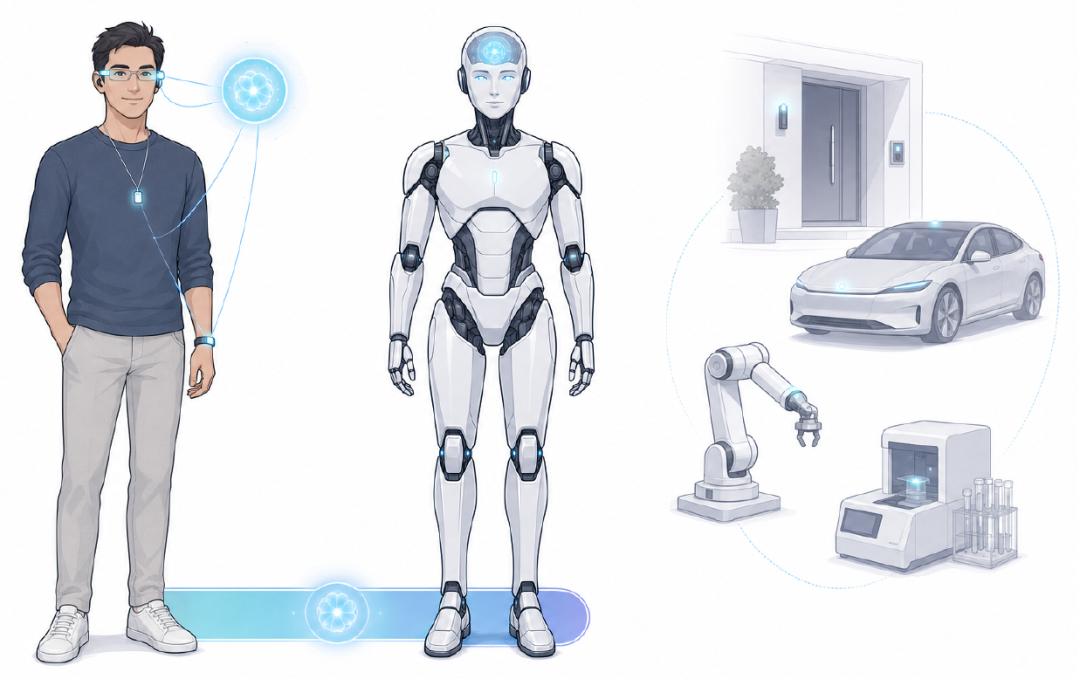
Figure | The AI-augmented individual (left) and the embodied robot (middle) share the same cognitive core; the environmental devices that both of the first two can call (right)
This division also brings changes to the evaluation criteria. The author divides the final state of AI into two halves: one half is AGI, which is evaluated by what the AI has completed; the other half is AHI, which is evaluated by what the person can achieve now. The two halves share the same set of foundation models, agents, memories and hardware. The same foundation model can not only act as an autonomous agent to complete tasks, but also act as a cognitive symbiont to augment a human. The article emphasizes that the two halves are in a parallel relationship, and every progress of the underlying base will benefit both sides at the same time.
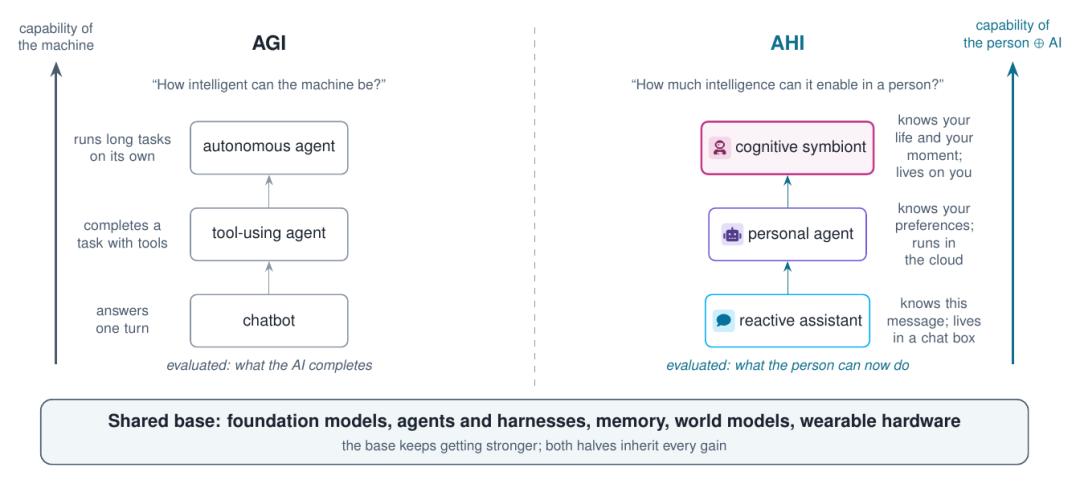
Figure | Two halves of the final state of AI. The AGI side evolves from chatbots to autonomous agents, and the AHI side evolves from passive assistants to cognitive symbionts, with both sides sharing the same underlying base
What stages has the relationship between humans and AI gone through?
According to the changes in the relationship between humans and AI agents, the author distinguishes four roles.
The earliest one to appear is the passive assistant, and conversational products such as ChatGPT, Claude, and Gemini fall into this category: humans ask a question, and it gives an answer. Then there are autonomous agents, such as Claude Code and Codex, where users assign goals and it completes tasks on the computer on its own. Next are personal agents, examples of which include Muse (Meta), Dots (OpenAI), and Grok Bot (xAI) launched in 2026, which run continuously in the cloud background and are familiar with users' preferences and long-term goals. The fourth type is the cognitive symbiont, which stays by the human side, understanding this person's life and current situation.
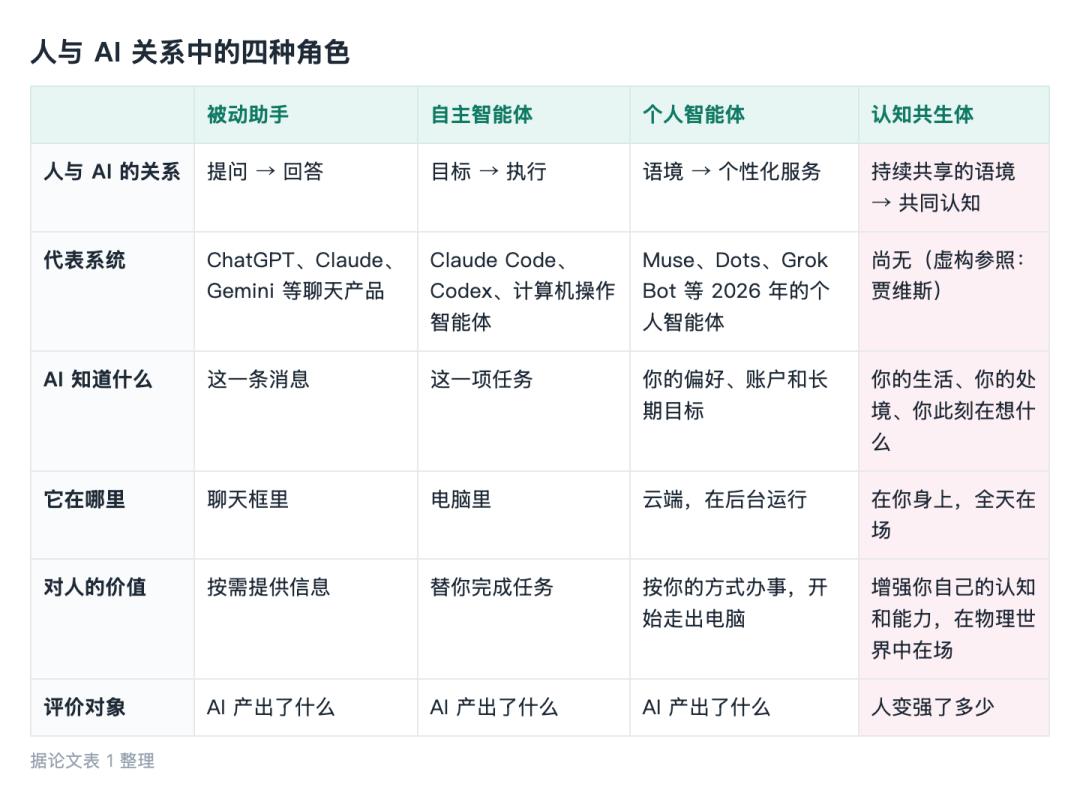
From the first type to the fourth type, AI understands humans more and more deeply, gets closer and closer to humans, and the way to evaluate it also changes accordingly: The first three roles all take the output of AI as the evaluation object, and only the symbiont takes the improvement of human capabilities as the evaluation object. The difference between a personal agent and a symbiont is that the former handles affairs for humans in the cloud, while the latter thinks together with humans beside them. The author also points out that the symbiont must first be competent for the work of the first three roles, and it must perform as well as the best agent in tasks such as booking tickets and writing code.
The author also proposes that the current bottleneck of personal AI has shifted from model capabilities to the "coupling" between humans and AI, including how much AI knows about this person, how fast it intervenes, how much disturbance it causes when intervening, and whether this person trusts it. The capabilities of models in single tasks continue to improve, but these indicators have not been significantly improved for many years. Users' feelings are also very direct: they have to re-explain the background every time they have a conversation, the help comes too late or is too noisy, and they dare not entrust important matters to it.
What is a cognitive symbiont?
According to the definition of the article, a cognitive symbiont is a kind of AI that exists in a new way. With the help of devices worn on the human body, it sees and hears the same things as the human, stores the life records of this person for many years, forms an understanding of his situation, psychology, interpersonal relationships and goals, joins his thinking at the right time, handles daily affairs for him with these understandings, and keeps learning as both sides change.
The author uses 6 attributes to define a qualified symbiont: lifelong, embedded, real-time, private, proactive and low-friction. The following table lists their meanings and the consequences of missing them item by item, and takes Jarvis in the movie and personal agents in 2026 as comparisons. Jarvis has all six attributes, while current personal agents are still absent in the three attributes of embedded, real-time and low-friction. The author also points out that these attributes restrict each other: proactivity may turn into disturbance, and long-term records conflict with privacy. How to balance them is exactly the main research problem in this direction.
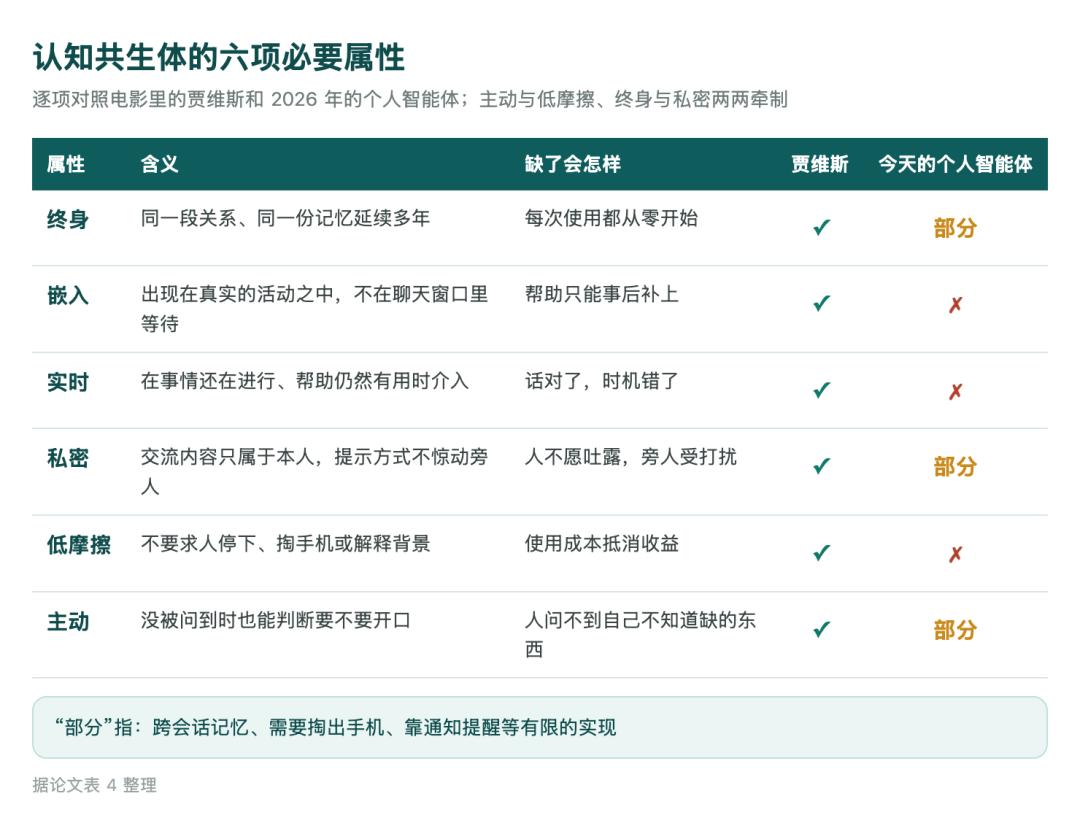
The article is not satisfied with replicating a Jarvis. Jarvis's perception relies on the laboratory and battle suit built by his master, his loyalty comes from the script, and his understanding of his master does not deepen after several movies; while the symbiont relies on glasses, earphones, pendants, rings and bracelets that ordinary people can afford to perceive, gets to know the master better and better in getting along, and writes loyalty into the system architecture. Its focus also shifts from schedules and tasks to human goals, emotions and blind spots.
In terms of participation methods, the article proposes "cognitive full-duplex": when a person is talking to others, the symbiont listens, retrieves and prepares synchronously in the background, and then sends a line or a sentence through a private channel that only the person can perceive, so that the person does not have to stop the ongoing conversation. To this end, the system is equipped with two loops: a slow loop responsible for retrieval, reasoning and updating the understanding of this person, and a fast loop responsible for sending instant prompts such as names and numbers within one second. The prompts will be automatically withdrawn after the timeliness expires, and the symbiont remains silent most of the time.
What practical problems can it solve for humans?
This is one of the largest sections in the full text. The author divides the help provided by the symbiont into three layers: the bottom layer is to get things done for humans, the middle layer is to participate in human thinking and give emotional support, the top layer is to assist humans in getting along with others, and there is also a care function that spans the three layers. To this end, the author has sorted out a list containing 27 functions, and wrote down the typical failures that can best distinguish the quality of the system for each item. The representative problems are introduced below according to different occasions in life.

Figure | 27 functions of the cognitive symbiont, grouped by three layers of help and the care function running through them
At work, affairs can be handled more in line with the individual's style. If you ask the current agent to reply to a tricky email, it first needs to figure out who the recipient is and what the user wants to express; the symbiont knows the past interactions between this person and the other party, the last disagreement and his usual tone, so the draft it writes usually does not need to be rewritten from scratch. The same is true for fixing a program error: it remembers which modules this person modified last week, how he is used to writing code, and knows that he only has half an hour today, so it gives the smallest fix first, and leaves the refactoring for when he is free. The author defines this difference as "personalized difference": under the condition that the task and the base model are the same, compare the result difference with or without personal context, and this quantity can be directly measured. In terms of acting on behalf of others, the author sets five levels of permissions, from only viewing, giving suggestions, drafting, to performing revocable operations, and then to irrevocable operations such as payment, sending, and making commitments. Each level up requires the gradual accumulation of user trust.
In conversations, key information can arrive within one second. At the regular meeting, a colleague mentions a number that this person reported last quarter. The slow loop finds the report in the background and checks it, and the fast loop immediately displays the number on his glasses. He answers in his own words, and the prompt disappears automatically after the topic shifts. The same is true at dinner parties: the symbiont can remind him where the person opposite talked last time, what they care about, or give him a better wording when he can't find a suitable expression for a moment.
In learning and research, it acts like a tutor who knows the student well. In 1984, educational psychologist Benjamin Bloom found that students who received one-on-one tutoring scored on average about two standard deviations higher than students in regular classrooms. The symbiont has seen every place where the student gets stuck, can give a hint when the student needs it most, and step aside when the student says he wants to figure it out by himself. The author of the article requires that the learning scenario only give hints by default, and leave the answers for the students to find by themselves. Language learners can get help in real conversations, and adults who change careers can use it to connect their existing knowledge with new fields. For researchers, it stores every branch of a multi-year project, and the thoughts that flash by on the road can be recorded by speaking softly. It has records of which hypothesis was abandoned a few weeks ago and which hypothesis is still to be verified. Teachers in the classroom can use it to find students who are falling behind in time, and the progress records after class are stored in accordance with the school's regulations on student data.
When making decisions and facing emotions, it helps people see themselves clearly. Many important things do not have clear goals at the beginning, such as whether to change a research direction or accept an opportunity. The symbiont can list several possible goals, retrieve conflicting reasons, and then ask which cost is the most unbearable. When encountering a familiar choice, it will call up this person's last reasoning process; if the current choice contradicts the long-term goals he once said, it will state the reasons for opposition, and then return the decision to him. At the emotional level, its help is based on understanding this person's real experience. For example, after an application is rejected again, it reminds this person: the last review comment pointed out the lack of pre-experimental data, and this time the data is already complete.
Mental health is the most prudently handled field in the article. Compared with general mental health applications, symbionts have three advantages: it understands this person's life and does not require the other party to retell the story; it is present when the trigger occurs, and does not have to wait for the next interview a few days later; it can see patterns from sleep, social withdrawal and language changes. Therefore, it is suitable for accompanying users to practice evidence-supported methods such as cognitive behavioral therapy, providing support and keeping records during the interval of professional treatment, and identifying signs of recurrence at an early stage. The article clearly states that symbionts should not undertake treatment alone, and when crisis signals appear, its primary responsibility is to bring in professionals. Existing evidence also supports this positioning: both the early randomized controlled trial of Woebot in 2017 and a randomized controlled trial of generative chat