Jensen Huang paid the price for going public prematurely.
Author | Huang Yeda
Editor | Zhang Fan
On November 12, Nvidia suddenly announced that Jensen Huang, co-founder of the company, has resigned from his positions as President, Chief Executive Officer and Director, effective immediately. The current Chief Financial Officer Colette Kress will serve as interim CEO, and the board of directors has concurrently appointed Harvey Jones as the first Chairman in the company's history, while launching the selection process for the new CEO.
Since founding Nvidia in 1993, Jensen Huang's 33-year tenure at the helm has officially come to an end. From GPUs to artificial intelligence, Jensen Huang led Nvidia through several major strategic transformations, developing a start-up chip enterprise into one of the most influential tech giants in the world.
However, less than five months ago, Jensen Huang still received about 99% of the affirmative votes in the director election at Nvidia's annual general meeting of shareholders. Such a sharp contrast has also prompted the market to re-examine a corporate governance issue that has long been overshadowed by Nvidia's dazzling performance:
As the founder and long-time leader of the company, why didn't Jensen Huang consolidate his control through the A/B share structure, like Page and Brin of Google and Zuckerberg of Meta?
01 1999 was not the era of A/B shares
The answer to this question may start with the equity arrangement when Nvidia went public in 1999. At that time, it was a common practice for Silicon Valley tech companies to adopt "one share, one vote" for listing. For founders, they could influence corporate decisions through shareholding, executive positions, personal reputation and other aspects, but they did not have natural voting rights superior to ordinary shareholders. Nvidia also followed this tradition and only issued common shares.
As for the dual-class share structure, it is actually not an invention of the Internet era. As early as the last century, many well-known US-listed companies used dual-class share structures to maintain control through shares with different voting rights, typical examples including Ford Motor and The New York Times. However, applying this system explicitly to protect the long-term strategies of tech enterprises and gradually making it a commonly adopted equity structure for large tech Internet enterprises during IPOs is a trend that did not take shape until the subsequent Internet era.
In 2004, Google adopted the A/B share structure when it went public. In terms of voting rights, Page and Brin set Class A shares held by the public to one vote per share, and Class B shares held by founders and others to ten votes per share. Google's prospectus clearly stated that the traditional listed company structure may weaken the independence of the enterprise, so it hopes to maintain the management's long-term control over the company through A/B shares to ensure the implementation of long-term strategies.
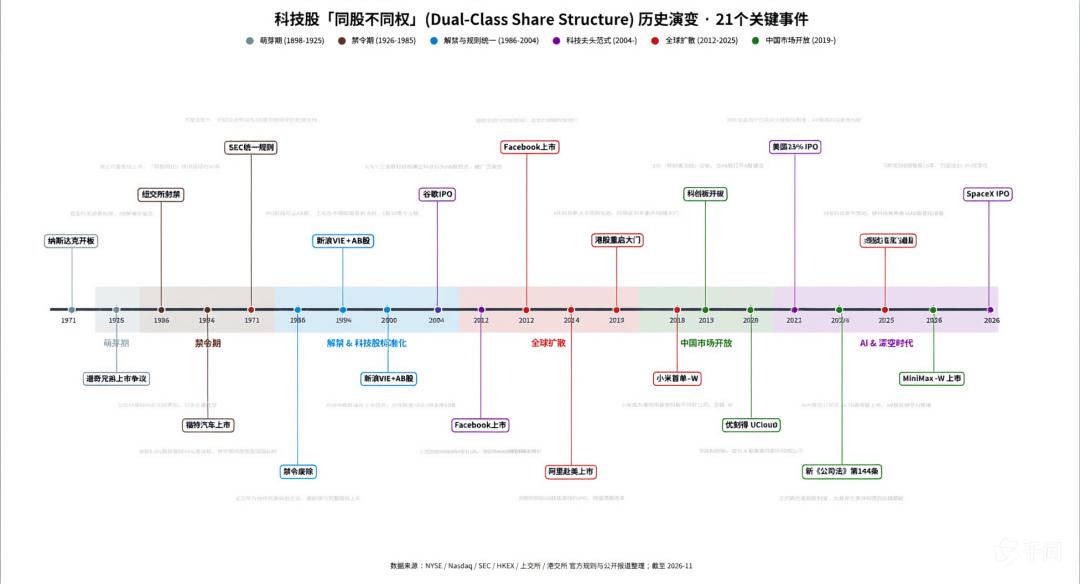
Figure: Historical evolution of unequal voting rights for tech stocks; Source: 36Kr illustration
In contrast, Nvidia went public only five years earlier, and its adoption of the one-share-one-vote equity arrangement largely reflected the equity governance practices of tech enterprises at that time. Moreover, Nasdaq's Rule 5640 restricts listed companies from unfairly weakening the voting rights of existing ordinary shareholders through measures such as issuing super-voting shares after listing. Therefore, for Nvidia, which had already gone public, the institutional difficulty of introducing super-voting rights to protect its founder was far higher than that before its IPO.
02 Jensen Huang's shareholding has been continuously diluted
Nvidia has a highly dispersed equity structure, which was evident as early as its listing. Its 1999 prospectus disclosed that Jensen Huang held about 13.1% of the shares before the IPO, which dropped to 10.8% after the IPO; the shareholding ratio further decreased to 3.58% in 2026. Financing, additional issuance, equity incentives and changes in personal shareholding have caused Jensen Huang's shareholding ratio to continue to decline, and his voting rights have correspondingly continued to weaken, laying the groundwork for this "ouster incident".

Figure: Timeline of Jensen Huang's equity dilution; Source: 36Kr illustration
In the early years, there were precedents where founders of Silicon Valley tech companies lost control due to equity dilution. In 1985, Jobs and Apple CEO Sculley had a fierce conflict over the company's operations. Although Jobs was still Apple's largest individual shareholder at that time, his shareholding ratio had dropped to about 11%, which was no longer enough to sway the board of directors' decisions. The board of directors chose to support Sculley, and through business structure adjustments, Jobs was relieved of his operational management authority and left Apple, the company he founded, in September of the same year.
Looking at Microsoft, after it went public in 1986, Gates still held about 45% of the shares. Although his personal shareholding ratio gradually decreased, he still retained about 14% of the shares before stepping down as CEO in 2000. Thanks to Gates' high shareholding ratio in the early stage of listing, the relatively gradual process of subsequent equity dilution, and his long-accumulated leadership authority, Gates always maintained strong control over the company during his tenure as CEO.
In contrast, Jensen Huang only held about 11% of the shares when Nvidia went public. Compared with Gates, the voting rights corresponding to his shareholding ratio were significantly weaker. Moreover, with the further decline of his shareholding ratio afterwards, Jensen Huang's already weak voting rights continued to weaken, which can be said to have lost the foundation of dominating corporate decisions by holding controlling shares very early.
03 Jensen Huang led the company for 33 years relying on performance authority
Therefore, Jensen Huang's influence on Nvidia can hardly be explained by the voting rights corresponding to the equity ratio. The management right in the operation of an enterprise never only comes from the ballot box, but also from performance authority, strategic judgment and the long-term trust of the board of directors in the executives.
From graphics chips to programmable GPUs, and then to continuous investment in the CUDA ecosystem, Nvidia has bet on long-term technology routes many times before the market reached a consensus. Especially CUDA, which was difficult to generate considerable returns immediately in the early stage, has gradually built a competitive barrier of software and hardware collaboration; afterwards, generative AI drove the explosion of computing power demand, and Nvidia further evolved from a chip supplier to a core participant in global AI infrastructure.
These key strategic decisions and the huge commercial success they brought have gradually established Jensen Huang's core leadership position in Nvidia. In the daily operation of the company, Jensen Huang has long dominated the direction of product R&D, the allocation of R&D resources, supply chain collaboration and customer relationship management, and the company's flat management method has strengthened his influence on grassroots business and experience-based decision-making. For the board of directors and institutional investors, supporting him is not only a recognition of his past achievements, but also includes trust in his future judgment ability.
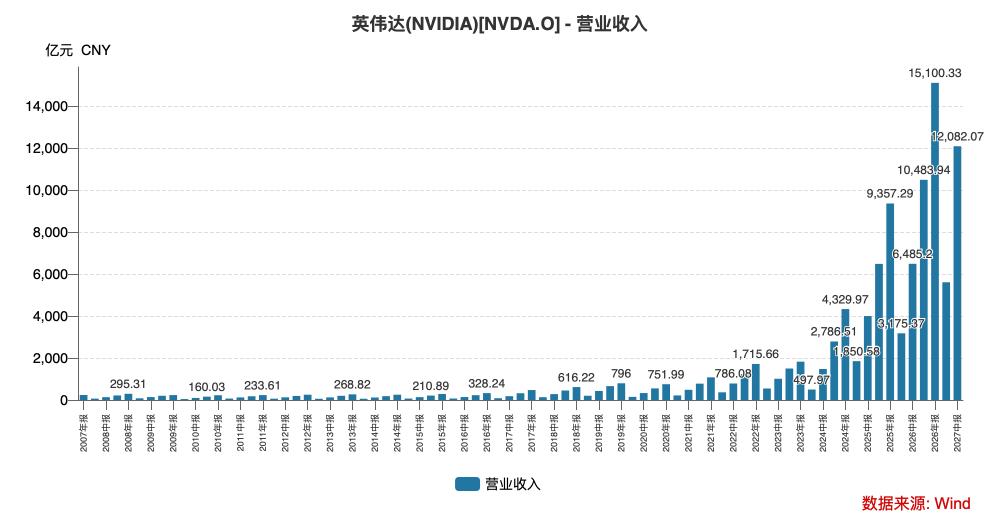
Figure: Nvidia's long-term operating revenue performance; Source: Wind, 36Kr
Therefore, even though Jensen Huang does not have absolute control in the legal sense, he has long had de facto strategic dominance, and maintained his leadership position for 33 years without equity protection by virtue of continuously delivered performance. The fact that he received about 99% of the affirmative votes in the director election in June 2026 is an intuitive reflection of this trust.
However, the above-mentioned "Jensen Huang model" has an inherent condition: performance authority must be continuously recognized. It can be enhanced with the success of the company. Once business performance or personal reputation is impacted, the long-accumulated leadership authority may be rapidly weakened. In particular, Jensen Huang, who lacks absolute control, may therefore lose the support of the board of directors, and even lose the operational dominance of the company. This "ouster incident" is clear evidence of the above point of view.
04 Who exactly does the A/B share structure protect?
Based on Nvidia's board-centered governance model, according to the company's bylaws, the board of directors only needs the support of more than half of the directors to have the right to appoint or remove senior management personnel such as CEO at any time, regardless of whether there is a just cause. Even as the founder, Jensen Huang cannot veto the board's personnel decisions solely with a shareholding ratio of less than 4%.
For Jensen Huang, who has a low shareholding ratio and lacks absolute control, even if he has served as CEO for a long time, he must rely on performance growth and shareholder trust to maintain his leadership position. Since he cannot control the board of directors by his own voting rights, the board of directors can form a substantial check and balance on his power, and promote the adjustment of management personnel when necessary. It can be seen that Jensen Huang's resignation this time is not unexpected, and it is exactly the result of the combined effect of Nvidia's long-standing equity structure and corporate governance mechanism.
Yale University professor Jeffrey Sonnenfeld pointed out in a recent interview that Jensen Huang, without the protection of a dual-class share structure, still successfully led Nvidia for more than 30 years, becoming a powerful example against the A/B share system; however, ironically, if Nvidia had granted him super-voting rights back then, the difficulty of removing him now would have increased significantly.
Google and Meta are typical examples of the A/B share structure. Super-voting rights give founders stronger control over the company, enabling them to reduce the interference of short-term market fluctuations and shareholder pressure, and promote long-term strategic layout. However, when there are problems with the founder's judgment or behavior, ordinary shareholders may find it difficult to change the corporate governance pattern through voting. Therefore, the A/B share structure amplifies the founder's strategic autonomy, and correspondingly reduces the convenience of external error correction.
Nvidia did not adopt the A/B share structure, which is not only due to historical factors when it went public in 1999, but also formed a governance logic different from that of tech giants such as Google and Meta, that is, choosing to speak with performance instead of locking control through the system, thus retaining the board of directors' supervision and error correction capabilities. Jensen Huang's resignation this time once again proves that no matter how great the performance authority used to be, founders without institutional control will always be bound by the rules of corporate governance.
*Disclaimer:
The content in this article only represents the author's opinion.
The market is risky, and investment requires caution. Under no circumstances shall the information or opinions expressed in this article constitute investment advice to anyone. Before deciding to invest, if necessary, investors must consult professionals and make decisions prudently. We have no intention of providing underwriting services or any services that can only be engaged in by holding specific qualifications or licenses to all parties to the transaction.