The new cloud "pretty boy" Nebius: Beneath its glamorous exterior, it is also teeming with "lice"
AI cloud startup Nebius (NBIS.US) released its Q3 earnings report before the U.S. Eastern time market open on November 12. At first glance, this quarter's performance looks quite solid, with both revenue growth and profitability significantly beating expectations, and GAAP operating profit turned positive for the first time.
But after CoreWeave released its strong earnings, NBIS had already risen by about 15% the next day, pricing in the better-than-expected quarterly performance in advance. A closer look reveals several notable hidden issues in this quarter's results:
The most critical point: Delays in compute power rollout led to Q4 revenue guidance significantly below expectations, RPO recorded almost no sequential growth, and the 2027 guidance was far from a positive surprise.
Specific breakdown:
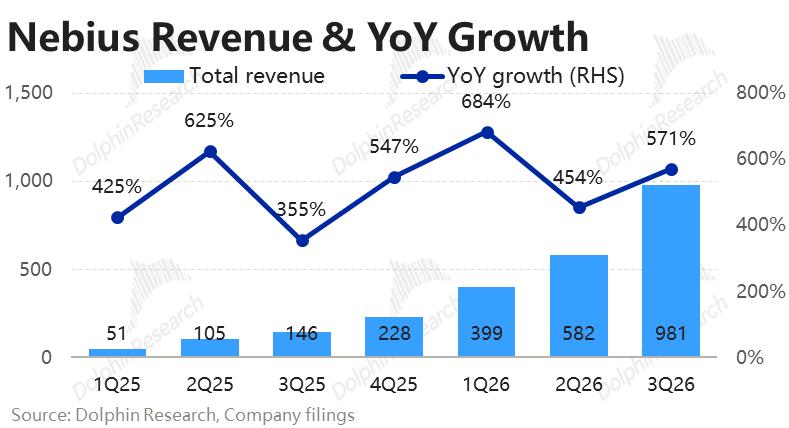
1. Revenue: Up 68% QoQ, but ~$330 million is one-off income
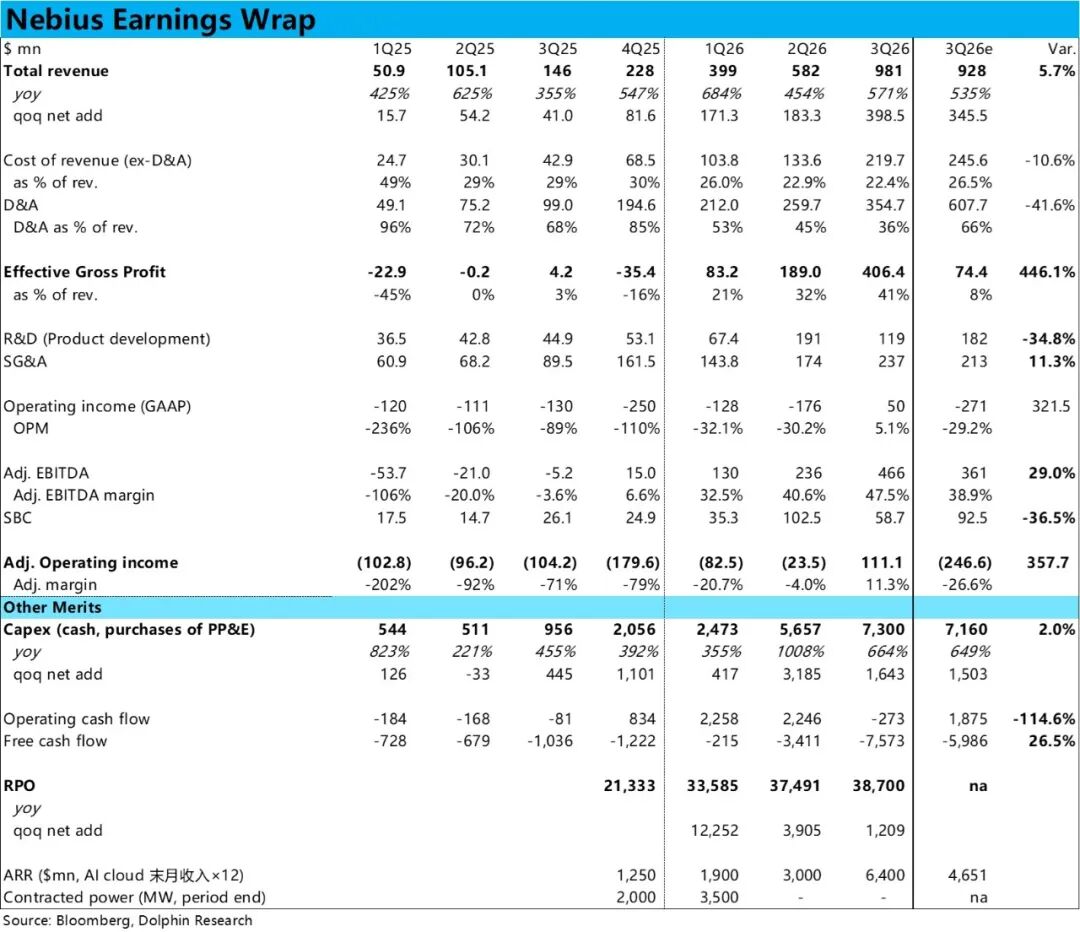
3Q26 revenue reached $980 million, with a net sequential increase of ~$400 million, slightly above the consensus expectation of $930 million. AI cloud revenue hit $970 million, accounting for ~99% of the group's total.
However, around $330 million of this total is one-off onboarding income from the first phase of partnerships under the asset-light model, and the company expects this type of income to become more normalized going forward.
In fact, the progress of compute power construction was delayed this quarter, the seemingly revenue beat is largely driven by this one-off income, with low real quality.
End-of-quarter ARR stood at ~$6.4 billion, doubling from $3 billion at the end of June and nearly 40% higher than the consensus expectation; but it is inferred that this figure also includes the "distortion" caused by this one-off income.
The company announced this quarter that it will no longer use ARR to measure business performance, the previously stated ARR target of $7-9 billion by year-end has been pushed back to exceeding $7 billion by next February.
2. Orders and Pricing: Unit price and prepayment ratio continue to rise, but RPO barely grows
The annualized revenue per MW of newly signed contracts in 3Q exceeded $25 million, compared to over $20 million in the previous quarter, and the price per GPU hour was over 20% higher on average than in 2Q. At the same time, the company re-emphasized that the price of short-term clusters for 3-6 months is more than twice the price of signed long-term contracts.
However, the market has almost fully priced in the rise in compute power rental prices in the stock price rebound over the past two days, which is no longer an incremental positive catalyst.
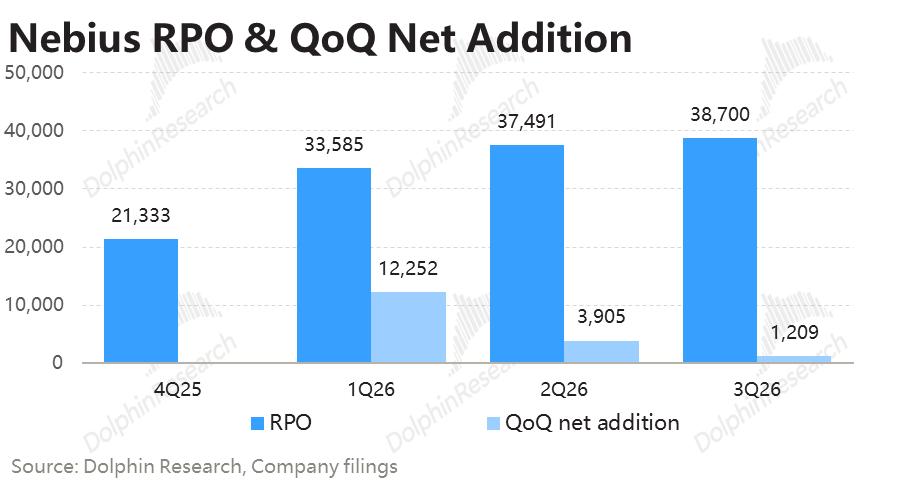
Meanwhile, the growth of order volume slowed down notably this quarter: End-of-quarter RPO stood at ~$38.7 billion, up only 3% QoQ (~$1.2 billion). This indicates that either the company reserved more compute power for flexible-pricing short-term contracts, or the company encountered challenges in signing new deals in 3Q.
Fortunately, the company stated the total value of new contracts signed since the start of 3Q exceeded $12 billion (including multi-billion-dollar 5-year contracts) , most of which were signed after the end of the quarter and will be reflected in 4Q RPO, signaling a recovery in deal signings.
3. Compute power rollout and Capex: Slow rollout pace, Capex continues to expand
This quarter, the delivery of multiple third-party hosting sites was postponed to the first half of 2027. For the New Jersey project built for Microsoft, over half of the contracted capacity will be delivered before the end of the year, and the remaining batches are scheduled for 2Q27. The company stated the progress of self-built sites is on track or ahead of schedule, and the U.S. election will not affect its self-built and hosted sites.
The company lowered its 4Q revenue guidance and pushed back the timeline for ARR to reach $7 billion, which is essentially driven by the delays in compute power construction. This is a major problem for new cloud companies that need to race against time to efficiently complete the whole process from financing to production and revenue generation.
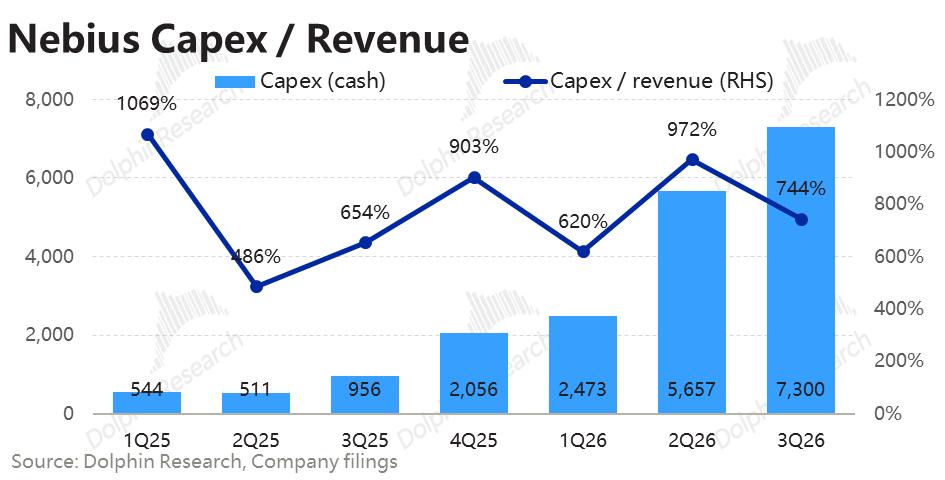
In terms of Capex, it reached ~$7.3 billion this quarter, up nearly 30% QoQ and basically in line with consensus expectations, equivalent to 7 times the quarterly revenue. Judging by the multiple to revenue, the Capex investment intensity seems to be decreasing, but if the one-off income from the asset-light model is excluded, the actual Capex is about 11 times the cloud leasing revenue.
That is, under the circumstance of delayed compute power rollout, the Capex expenditure intensity has not slowed down, but has instead continued to rise.
4. Cash flow and financing: Operating cash flow turns negative, the company moves to net debt position
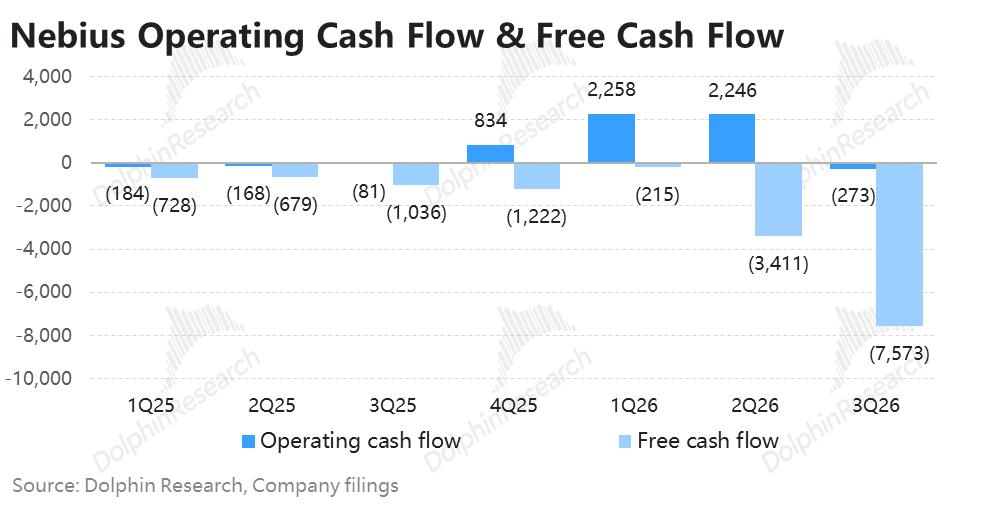
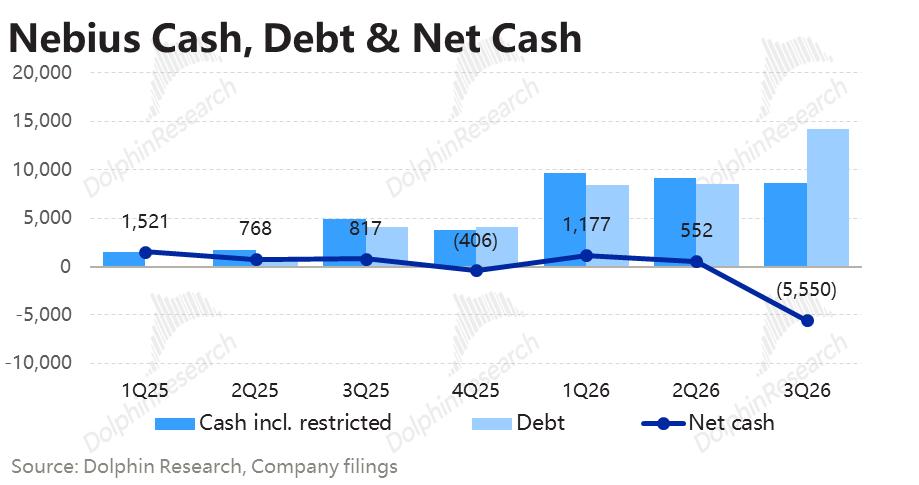
Due to high Capex, and operating cash flow of -$270 million this quarter (vs. net inflows of ~$2.25 billion in each of the previous two quarters), free cash outflow this quarter reached ~$7.6 billion, far below expectations.
As cash reserves declined and ~$5.7 billion of new debt was added this quarter, the company's balance sheet structure shifted from a net cash position to a net debt position of ~$5.5 billion. Although the company previously relied mainly on equity financing, under the pressure of huge expenditures, an inflection point deterioration has occurred in its balance sheet structure.
The low operating cash flow this quarter is mainly due to a notable ~$3.8 billion increase in accounts receivable, meaning customers' actual cash payments have been delayed.
Fortunately, similar to the situation of CoreWeave, the company said over 90% of the contracts with a term longer than one year signed in 3Q include prepayments, and the prepayments can already cover 100% of the Capex required for the corresponding contracts (50%~60% in the previous quarter). To a large extent, this will ease future cash flow pressure.
At the same time, the company announced that it has signed its first 5-year AI cloud contracts (all are existing customers expanding on new capacity), and added multi-year contracts with non-AI Lab customers including Databricks, Datadog and Snowflake. The customer structure continues to diversify.
5. Profit margin: Far exceeds expectations, but one-off income and low depreciation "inflated" profits
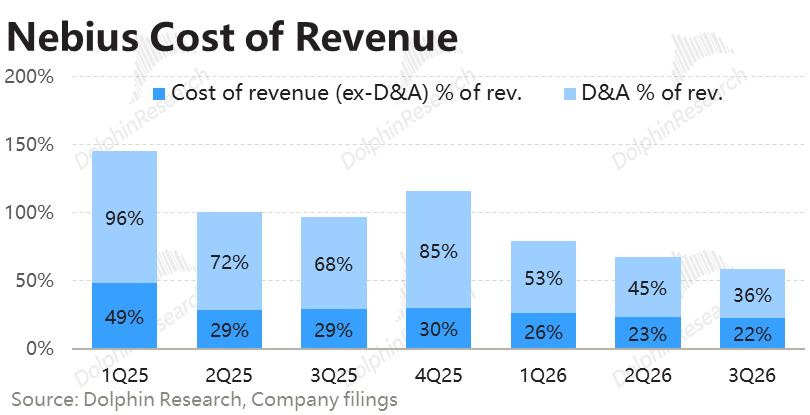
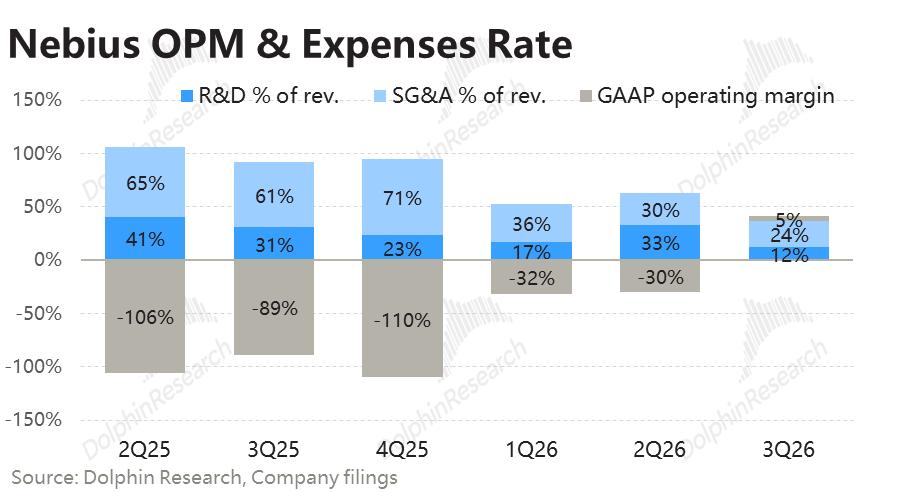
The group's adjusted EBITDA reached $470 million, with a profit margin of 47.5%, about 9 percentage points higher than the consensus expectation, rising for three consecutive quarters; among which the AI cloud division's adjusted EBITDA margin was 53.2% vs. 49.7% in the previous quarter. Meanwhile, GAAP operating profit reached $50 million, turning positive for the first time.
However, there are two "distortions" behind the better-than-expected result. First, the ~$330 million asset-light one-off income: when the company introduced this model in 2Q, it stated that this model has high profit margin and requires almost no capital investment. Second, depreciation: it stood at $350 million this quarter, about 40% lower than the consensus expectation, and its proportion in revenue dropped from 44.6% in the previous quarter to 36.2%.
It is speculated that this is mainly because the delay in compute power construction led to a large amount of assets not yet being put into use and not starting depreciation accrual, most of the GAAP operating profit beat came from this factor; therefore, after the delayed capacity goes online, depreciation will jump significantly.
The CFO stated that 4Q will first bear the rent, electricity and personnel costs before new sites go online, the full-year profit margin guidance of ~40% implies that the 4Q margin will fall back to around 35%.
6. 4Q and full-year guidance: Full-year revenue guidance lowered, next year's Capex far exceeds expectations
As part of the third-party capacity was postponed to the first half of 2027 (the company stated that the corresponding contracts are still valid), the 2026 full-year revenue guidance was lowered from $300~340 million to $300~320 million, implying 4Q revenue of ~$1.04~1.24 billion, about 17%~31% lower than the consensus expectation.
Based on the guided full-year EBITDA margin, the implied 4Q profit margin is ~35%~36%, also below expectations.
While the full-year Capex was raised to ~$27 billion, implying 4Q Capex of ~$11.6 billion, about 27% higher than the consensus expectation, revenue growth is slowing down while investment continues to accelerate; the target of 5GW of contracted power by year-end remains unchanged.
7. 2027 guidance:
Revenue of $12~13 billion (about 4 times of this year's figure), the midpoint is about 1% lower than the consensus expectation, the company said its assumptions for construction pace are relatively conservative;
Capex of $40~45 billion, the midpoint is about 34% higher than the consensus expectation, similarly, revenue growth brings no surprise but investment keeps rising;
Fortunately, it is expected that customer prepayments in 2027 will reach $17~20 billion, together with financing secured by long-term contracts, they can cover 75%~85% of Capex, and subsequent investments will be largely borne by customers.
The company expects to achieve pre-tax break-even in 4Q27 (including interest, it is not specified whether it is GAAP basis), the pace of margin turning positive is better than expected.
8. Core indicators at a glance:
Dolphin Research Viewpoints
1. This quarter: Core issue - delayed capacity rollout
At first glance, this quarter's financial report looks bright, but there are actually many hidden problems. The positive news that prepayments and contract mortgage loans can cover Capex has long been known and digested by the market from CoreWeave's earnings report, and the stock price has already risen in advance. This quarter's earnings report is a combination of realized known positive catalysts and unexpected negative surprises.
2. Core concerns
Core Issue 1: Price hike is already priced in, the key lies in the volume pace and deal-winning capability
a. Volume pace:
The whole process from financing, construction to production and revenue generation requires racing against time, delays mean capital is idling. We can already observe that:
A large amount of new PPE investment in the previous quarter did not translate into revenue this quarter. The direct cause is the power problem at third-party hosting sites such as the New Jersey site - the owner removed temporary power generation in advance, and the replacement fuel cell ramp-up speed cannot keep up.
Since the end of October, Microsoft stated that part of the third-party capacity delivery was delayed, and there were rumors that the New Jersey project was postponed and Microsoft narrowed its new cloud cooperation list; while the management stated that it is only a few months of delay, Microsoft participated in the schedule adjustment, the contracts are still valid.
But starting from 2027, new capacity will shift to self-construction, all construction risks will be borne by the company itself, the rollout pace will be the most important observation point every quarter going forward.
b. Order pace:
Not many new orders were recorded in 3Q, many large deals were signed after the end of the quarter; 4Q revenue and profit margin will also be dragged down by rollout delays.
There is no big difficulty in achieving next year's revenue guidance: the management's assumptions for the rollout timeline are very conservative, and asset-light revenue is not included in the guidance, the management said the selling price of capacity to be delivered in 2027 is rising, and customers are already looking for capacity for 2028.
But financing and revenue targets are all based on the premise that compute power remains in short supply and large customers are still willing to sign