It's a bombshell! The biggest landmine for NVIDIA is that it has no successor.
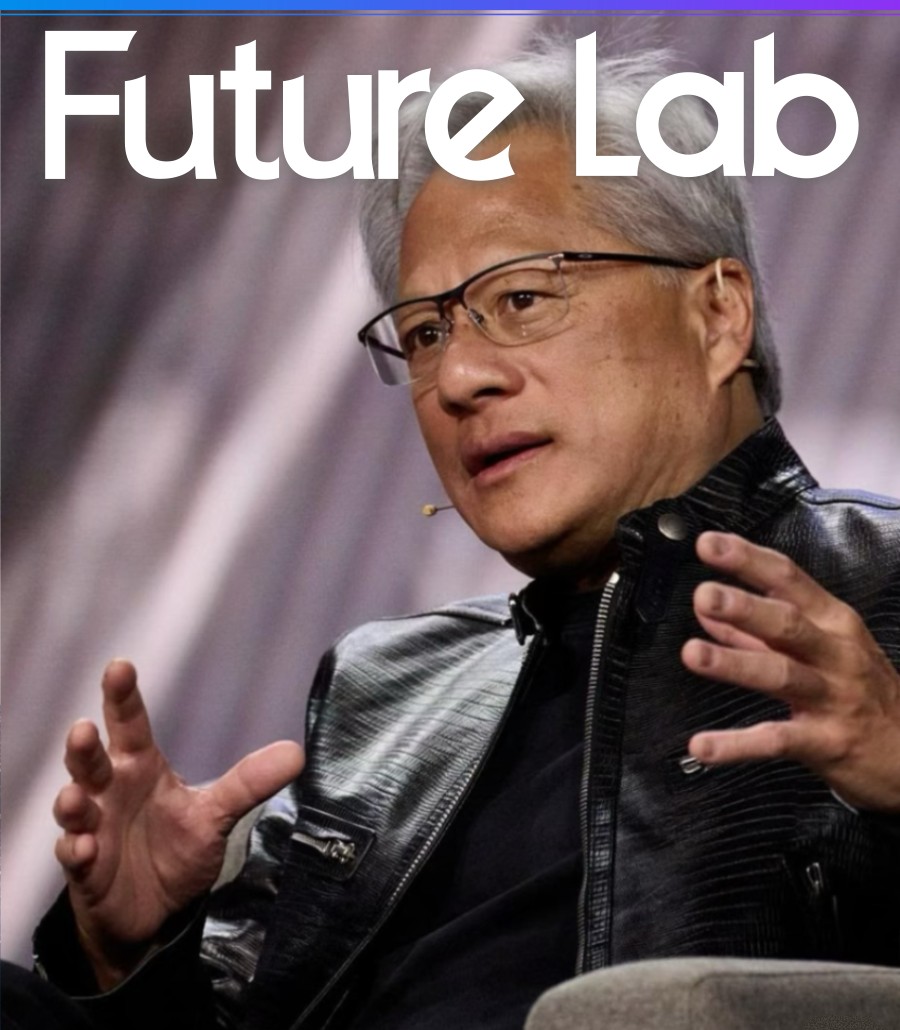
CFO takes over as interim CEO.
Text | Liu Sijie
Cover Source | Internet
On local time November 12, 2026, NVIDIA officially announced that Jensen Huang, co-founder, has stepped down from his positions as President, Chief Executive Officer and member of the board of directors, with immediate effect.
NVIDIA also announced that Colette Kress, current Executive Vice President and Chief Financial Officer, will serve as interim CEO and continue to hold the CFO position until a formal successor is confirmed. The board of directors will launch the selection process for the new CEO, considering both internal and external candidates. In addition, NVIDIA's board of directors has appointed Harvey C. Jones as the company's first Chairman of the Board.
The announcement did not specify the reason for the resignation. However, over the past week, reports surrounding Jensen Huang's personal relationships have continued to escalate, and on November 8, NVIDIA's board of directors had already announced the launch of an independent investigation.
The founder who has led the company for 33 years has thus left one of the world's most valuable technology companies by market capitalization.
NVIDIA's stock price has also been impacted. At the opening of US stocks on the 12th, NVIDIA was quoted at $150.99, down 13% from the previous day, and once hit $148.8 during the session. Back on October 6, NVIDIA's stock price hit an all-time high of $243.37, and has now fallen by nearly 40% cumulatively.
Why could several extramarital affair rumors lead to the resignation of a company's founder and CEO? And who will be the next CEO of NVIDIA?

Why is the relationship between CEO and subordinate not a private matter?
Jensen Huang previously publicly admitted to an extramarital affair. Later, *The New York Times*, citing statements from five former NVIDIA employees, reported that he also had an extramarital affair with Kimberly Powell, Vice President of the company's healthcare business, who reports directly to him.
Isn't the boss's extramarital affair a private life matter?
If the other party is an outsider, it is indeed a private matter. But when the other party is an employee of the company, especially a senior executive who reports directly to the CEO, the situation changes. This is already a power relationship, not just a personal relationship.
Large listed companies in the United States generally restrict undisclosed intimate relationships between executives and their subordinates. The logic is simple: companies must ensure that the distribution of power and resources is based on competence and performance, rather than personal relationships. Once such relationships are undisclosed, they may be regarded as conflicts of interest and governance defects.
The pressure at the capital market level is more direct. Large institutional investors in Europe and the United States, such as pension funds, sovereign wealth funds and large public offering funds, are generally bound by ESG (Environment, Social and Governance) investment guidelines. Workplace sexual harassment, abuse of power and major governance defects may all lower a company's ESG rating. If the board of directors fails to handle the situation properly, some passive funds and institutions with compliance requirements may be forced to reduce their holdings.
Therefore, in large American enterprises, an undisclosed intimate relationship between the CEO and a subordinate may trigger human resources investigations, board investigations, and even directly lead to the CEO stepping down.
Steve Easterbrook, former CEO of McDonald's, is a typical case. In 2019, the McDonald's board of directors removed him from his position on the grounds of violating company policies and misjudgment, which was caused by his consensual intimate relationship with an employee.

Who will succeed Jensen Huang?
What does NVIDIA need most right now to get through the founder's departure and the series of storms brought about by it? The answer may be stability.
Another notable new position in this personnel change is the Chairman of the Board. This is the first time NVIDIA has established this position in its 33 years of establishment, and the person taking the position is Harvey C. Jones.
Jones once served as CEO of Synopsys, a chip design software company. He has been a director of NVIDIA since the year the company was founded in 1993, and has also served on the Audit Committee, the Nomination and Corporate Governance Committee. At the moment when the CEO suddenly leaves and the independent investigation is still ongoing, the purpose of having the most senior old director who is familiar with corporate governance serve as the chairman is obviously to stabilize the board of directors and the market.
And Colette Kress seems to be exactly the most suitable person to serve as interim CEO.
Colette Kress has served as NVIDIA's CFO since 2013. She previously worked at Microsoft, Cisco and Texas Instruments, and has nearly 25 years of financial experience in the technology industry. She is familiar with NVIDIA's financial status, capital market and internal operations, and has long appeared at earnings calls and investor events together with Jensen Huang.
At present, what NVIDIA needs to deal with first is a series of very practical issues: stabilizing employees, stabilizing investors, maintaining relationships with customers and suppliers, and ensuring that NVIDIA's financial reports, product launches and business decisions will not be interrupted due to the CEO's departure. This makes Colette Kress the most natural transition candidate.
But her shortcomings are also obvious. Her core resume is financial management, not chip architecture or the CUDA ecosystem. Obviously, she cannot define the next-generation technology route like Jensen Huang, and she is more like a stable transitional CEO.
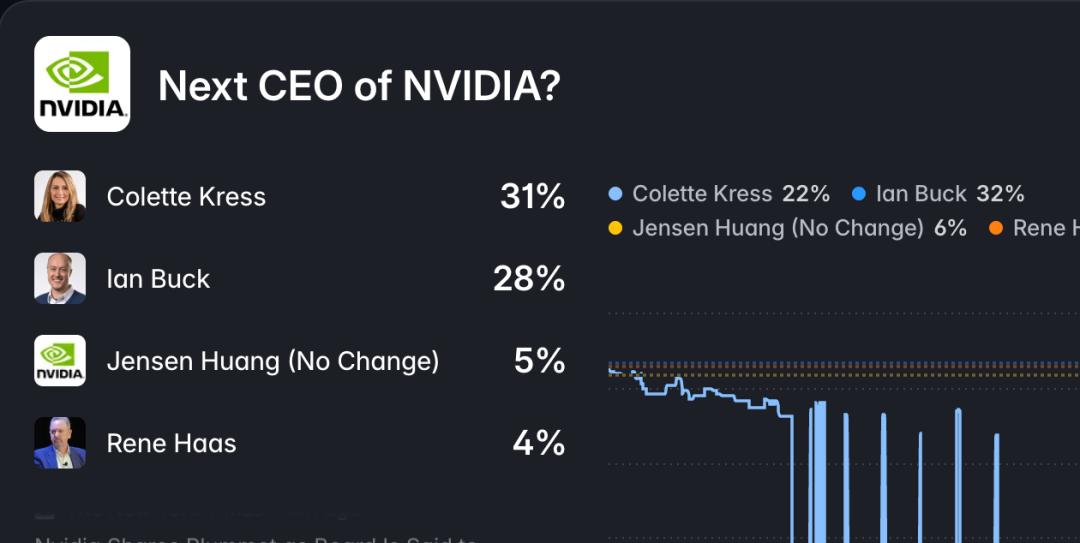
Prediction on who will succeed Jensen Huang on Polymarket
At present, another top candidate for CEO on the prediction platform Polymarket is Ian Buck.
Buck is currently NVIDIA's Vice President responsible for hyperscale computing and high-performance computing business, in charge of hardware, software and product cooperation for large cloud service providers and AI customers. He is also one of the important creators of CUDA.
In 2004, Buck joined NVIDIA. Before that, he pursued a doctorate in computer science at Stanford University, studying how to make GPUs undertake general-purpose computing tasks beyond graphics rendering.
NVIDIA was able to grow from a gaming graphics card company into an infrastructure company for the artificial intelligence industry, and CUDA is one of the most critical technical and commercial foundations. Buck participated in the early construction of this software ecosystem, and has long been responsible for NVIDIA's accelerated computing business.
From a technical genetic perspective, he is closer to NVIDIA's "technical successor" than Kress.
But problems still exist. A technical leader and a CEO are two completely different types of jobs. Publicly available information currently proves that Ian Buck is NVIDIA's core technical and product leader, but cannot prove that he already has the same leadership ability as Jensen Huang.
The board of directors may also look for candidates externally. Names discussed by the public also include Jeff Fisher, Michael Kagan, and even Lisa Su, CEO of AMD, but these are all just public speculations for now.
The past 33 years belonged to the era of Jensen Huang, and NVIDIA's biggest risk is perhaps its over-reliance on Jensen Huang alone. But a company with a market capitalization of trillions of dollars should never tie its fate to a single person.


What do you think is the exact reason why Jensen Huang stepped down?
Welcome to share your opinions in the comment section~