Is the Fed likely to raise interest rates three times in a row? Wall Street fears that the stock market is underestimating a tsunami.
If the prospect of more aggressive interest rate hikes by the Federal Reserve turns into a tangible risk, stock investors may currently underestimate the upcoming shock that the bond market is about to bear.
The U.S. Treasury market was closed on Wednesday for the Veterans Day holiday, allowing the bond market a temporary respite from the market warnings that emerged on Tuesday. However, after trading resumed on Thursday, U.S. Treasury yields across all maturities rose further — the 2-year yield climbed to 4.88%, and the 10-year yield even stood at 5.13%.
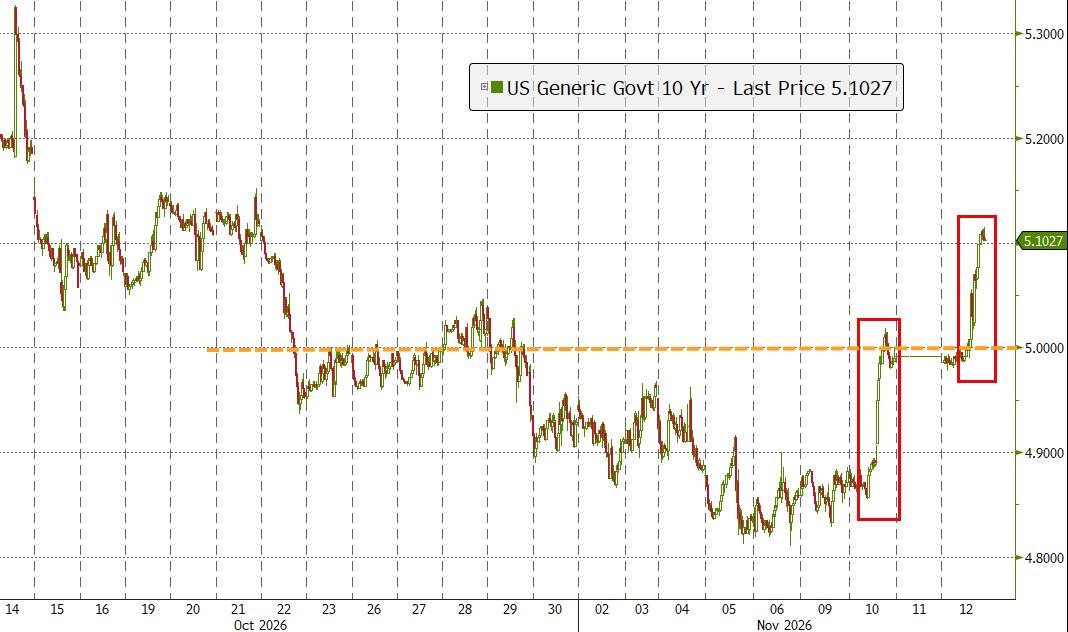
The current round of rise in U.S. Treasury yields is mainly driven by the newly released October consumer inflation data that exceeded expectations, which not only substantiates the basis for the Fed to raise interest rates by 25 basis points at its December policy meeting, but also triggers market concerns about further rate hikes in 2027. What worries many Wall Street practitioners is that stock investors have so far not fully priced in this risk scenario.
Warren Pies, co-founder and strategist at 3Fourteen Research, pointed out: "In the medium term, the Federal Reserve is the real core risk. The market is currently not at all prepared to price in the possibility of more than two additional interest rate hikes that may come."
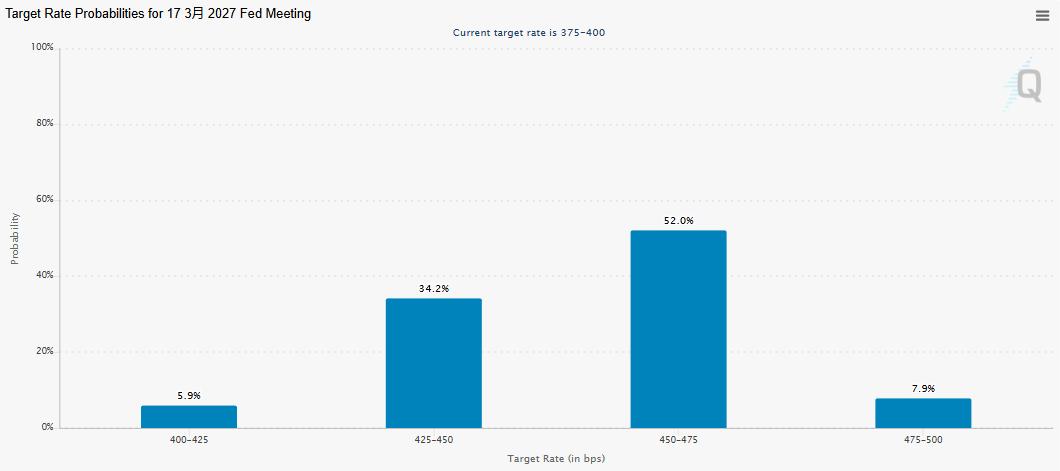
The "Fed Watch" tool of the Chicago Mercantile Exchange shows that the interest rate hike expectations reflected in federal funds rate futures are heating up at an accelerated pace, and the latest pricing has reflected that the Fed is expected to raise interest rates three times in a row (25 basis points each time) by March next year. At that time, the benchmark interest rate range will be pushed up to 4.50% to 4.75%, significantly higher than the current 3.75% to 4.00%.
Although NVIDIA has continued to plummet recently, boosted by capital rotation to sectors such as AMD and Broadcom, the major U.S. stock indexes remained resilient overall on Thursday. However, what Pies is currently worried about is that by the beginning of 2027, as enterprises concentrate on adjusting prices at the start of the new year and trigger the so-called "residual seasonality" phenomenon, inflation readings may deteriorate significantly, forcing the stock market to face up to inflation pressures again, and the interest rate outlook will once again become the focus.
"At that point, you may see the stock market start to have real indigestion," Pies said.
Some Wall Street institutions have begun to quantitatively simulate its potential impact.
Chris Senyek, strategist at Wolfe Research, pointed out, historical experience shows that in the first three months after the start of the interest rate hike cycle, the U.S. stock market usually pulls back by an average of 0.6%. Looking at historical data since 1972, the median duration of the Fed's interest rate hike cycle is 19 months, and the median cumulative increase in the federal funds rate reaches 3.94 percentage points (this statistic covers the high inflation and ultra-high interest rate periods in the 1970s and early 1980s).
Senyek wrote in Wednesday's research report: "Our judgment is that even if international oil prices are slowly trending down with fluctuations, under the current Fed policy tone, investors still underestimate the risk that the interest rate hike cycle may last longer than expected."
David Mericle, chief U.S. economist at Goldman Sachs, also adjusted his forecast: on the basis of the original expected 25-basis-point rate hike in December, he believes the Fed will raise interest rates by another 25 basis points in March next year. He also expects inflation data in November and December to be relatively moderate, but inflation may pick up again in January next year.
Focus on the tone-setting of the December interest rate meeting
Of course, it is not completely impossible for high U.S. Treasury yields and a strong stock market to coexist. Just last month, when the 10-year U.S. Treasury yield broke through 5.3%, the S&P 500 index still hit a new historical record in tandem, standing above 7800 points. Many investors still expect the boom in corporate productivity and profitability driven by the AI wave to offset higher borrowing costs.
However, from a macro logic perspective, the suppression of rising bond yields on equity assets is an undeniable fact — when the 10-year U.S. Treasury yield stands above 5%, it usually poses a substantial blow to stock market valuations: on the one hand, fixed income assets can provide more attractive, lower-risk and certain returns, diverting capital from the equity market; on the other hand, the rise in the discount rate will directly erode the discounted value of enterprises' future long-term cash flows.
In the view of many market participants, boosted by the huge credit demand brought by AI infrastructure construction, the federal fiscal deficit as high as more than 6% of U.S. GDP, and the hidden concern of re-inflation, the risks facing U.S. Treasury yields are clearly skewed to the upside.
Steve Englander, head of G10 FX Research at Standard Chartered, is closely watching the Fed's December interest rate meeting. He believes that any hawkish remarks released by Fed Chairman Kevin Warsh on inflation issues may alert the stock market, forcing it to readjust its expectations just like the bond market and the U.S. dollar.
Englander said bluntly: "If the Fed raises interest rates directly by 50 basis points and makes a hawkish statement that 'it will not only raise rates by 50 basis points, but subsequent tightening will not stop', this will inevitably trigger market panic." Although Englander's basic assumption remains that there will only be a moderate 25-basis-point rate hike in December, he also expects that by the middle of next year, the 10-year U.S. Treasury yield is likely to further approach 5.50%.
This article is from the WeChat Official Account "CLS.cn", author: Xiaoxiang, authorized for release by 36Kr.