NVIDIA is experiencing an "epic" retail buying spree.
On Thursday, U.S. retail investors made massive dip purchases of Nvidia shares, showing that the boom in AI concept stocks remains unabated even after the company's CEO Jensen Huang stepped down.
Although Thursday's slump wiped out a massive $550 billion from Nvidia's market value this week, investors have favored buying the dip since the end of the 2009 financial crisis — and Thursday was no exception. "Every time this strategy works, it gets further reinforced," said Mark Hackett, chief market strategist at Nationwide Financial. "This is idiosyncratic behavior common in a healthy market."
This "epic" retail buying spree came after Nvidia's share price plunged as much as 14% at the open on Thursday, but by the close of trading that day, the stock's decline had narrowed to 4.34%. According to Vanda Research, net retail capital inflow into Nvidia at the opening bell on Thursday hit the highest level ever recorded in the first half hour of trading, estimated at as high as $111 million.
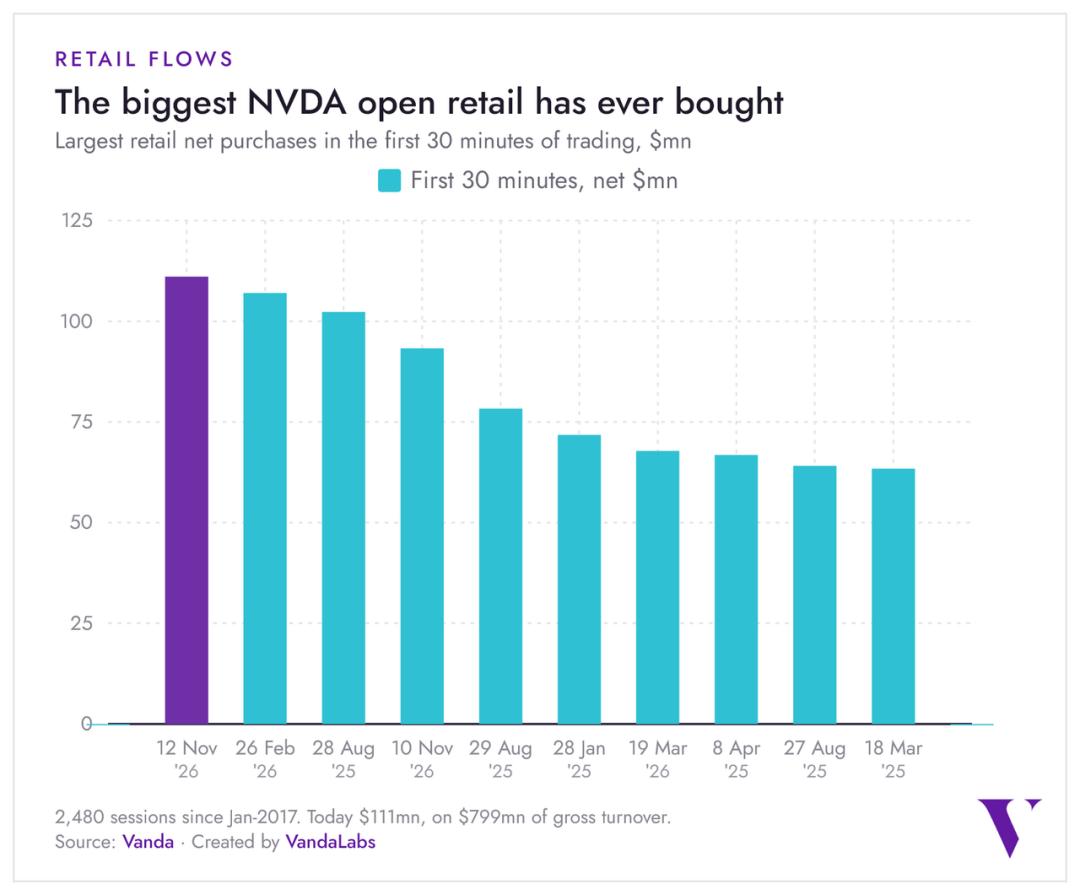
"For retail investors, this is entirely a one-way capital inflow carnival," Vanda Research wrote.
CFA Mike Zaccardi posted on social platform X that "this is one of the most spectacular 'buy the news' events in history".
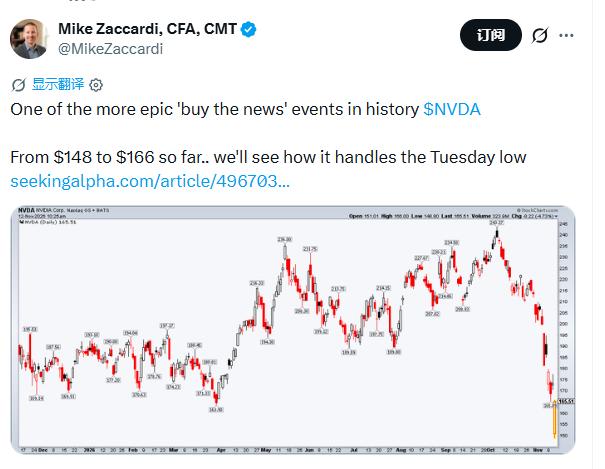
Data shows that on Thursday, a large amount of retail capital poured into major mainstream brokerage platforms. As of noon Eastern Time, there were 394,818 buy orders for Nvidia on the Fidelity Investments platform, compared with only 80,088 sell orders.
This volume of buy orders not only ranks firmly at the top, but is more than twice the total number of buy orders for the remaining 9 most actively traded stocks on the platform. AMD, which ranks second, recorded 24,790 buy orders, while Nebius in third place saw 24,519 buy orders.
In addition, in the options market, traders closed out some of their bearish bets on Nvidia on Thursday and positioned for a long-term recovery in the share price. Options give the holder the right, but not the obligation, to buy or sell the underlying stock at a set price before a specified date. Call options typically appreciate when a stock rises, while put options appreciate when a stock falls.
Data disclosed by Chris Murphy, co-head of derivatives strategy at Susquehanna, shows that multiple large block option movements indicate that long funds have not completely cut their exposure to Nvidia, but have massively extended their call positions to 2027, actively lowered their upside target price, and cashed out their downside hedging protection positions at low levels.
Murphy noted that one investor spent approximately $18.8 million to buy a call spread contract, which will deliver full returns if Nvidia rises about 16% from its current level by March. Other trades in the market pushed back call positions by three months and lowered target prices, giving more time for the share price to stage a recovery rally.
"Nvidia's competitive advantages and customer base will not disappear overnight," said Seth Hickle, chief investment officer at Mindset Wealth Management. "The market is trying to determine whether this is a temporary leadership crisis or a fundamental event that completely rewrites the logic of AI investment."
Judging from one of the most commonly used valuation indicators on Wall Street, Nvidia's current share price does look quite attractive — the sharp drop since it hit an all-time high on October 6 has pushed its forward price-to-earnings ratio as low as around 12 times at one point, marking the lowest valuation multiple since 2012.
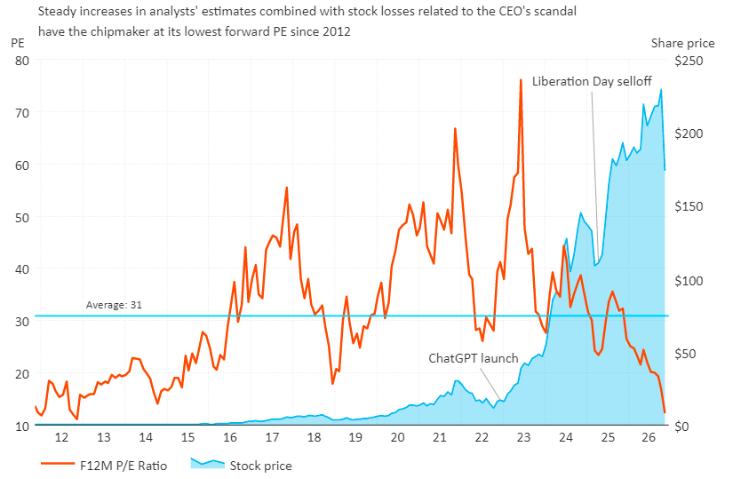
Of course, the market sentiment surrounding Nvidia is far from unanimous at the moment. On WallStreetBets, the popular retail forum on Reddit, negative discussions about Nvidia's future direction account for as high as 60%. The wave of downgrade reports released intensively by Wall Street this week has added to the pressure: Baird Equity Research downgraded the stock to "neutral" on Wednesday and cut its target price by 60% to $200 — though this target price is still much higher than the $164 trading price at 4 p.m. Thursday.
Tristan Gerra, senior research analyst at Baird, wrote in a research note: "Given the sudden drop in visibility of the near-term market outlook, forecasts for the 2027 data center are being delayed and adjusted. The main trigger for the slowdown in growth lies in supply chain bottlenecks, but potential weakening in demand cannot be ignored either. By 2027, the capital expenditure growth rate of AI hyperscalers may slow to 40% or lower."
Looking ahead, investors generally believe that the key variable that will affect the market trend next may be: what will Nvidia executives say at the quarterly earnings call next Tuesday?
Susquehanna's data shows that Nvidia's 90-day implied volatility has climbed from around 33% a month ago to about 52%, reflecting the growing uncertainty ahead of the company's earnings release next week.
"Implied volatility will remain high ahead of the earnings release and the subsequent call, as these events may provide some clear direction on how Nvidia plans to navigate this chaotic crisis," Hickle said.
This article is from the WeChat Official Account "CLS.cn", written by Xiaoxiang, and published with authorization from 36Kr.