The title of the second-largest city in central China is about to change hands.
If no black swan event occurs, by the end of this year, there is little suspense that Zhengzhou will replace Changsha as the second-largest city in central China.
The judgment is based on the already small gap between the two cities and their vastly different current growth speeds: In 2025, Changsha's GDP reached 1,573.782 billion yuan, 49.3 billion yuan higher than that of Zhengzhou. In the first three quarters of 2026, Zhengzhou's GDP increment was 67.232 billion yuan, while Changsha's increment was only 27.923 billion yuan. Zhengzhou's increment is nearly 40 billion yuan higher than Changsha's.
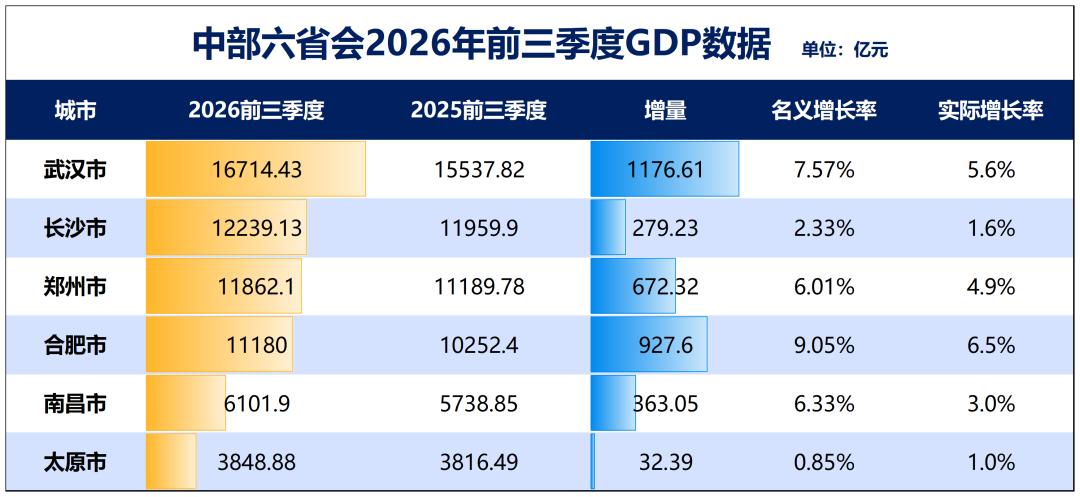
Graphics: Urban Finance; Data: Municipal Bureau of Statistics of each city
Judging from the current development speed and situation of the two cities, Zhengzhou's full-year GDP increment this year may be about 55 billion yuan higher than that of Changsha, which will fill the gap with Changsha.
Overall, Zhengzhou is not growing particularly fast among key cities. Although its growth rate outperforms the overall market, neither its increment nor growth rate is particularly prominent, mainly because Changsha is growing far too slowly. In the past five years, it outperformed the overall market in only one year. Last year, its growth rate was already one percentage point slower than the overall market.
Entering 2026, the growth rate has slowed down significantly. The growth rate in the first quarter was only 3%, 2.5% in the first half of the year, and 1.6% in the first three quarters.
Urban competition is inherently like sailing against the current: if you do not move forward, you will fall back.
01
From a longer-term perspective, Zhengzhou is only returning to its original position.
According to historical data, more than 40 years ago, Zhengzhou was already the second-largest city in central China. During the reform and opening-up period in 1978, Zhengzhou's GDP was 2.03 billion yuan, ranking second only to Wuhan among the six provincial capitals in central China. At that time, Changsha only ranked fourth, behind Taiyuan, and it was not until two years later that Changsha overtook Taiyuan to rank third.
The pattern where Zhengzhou led Changsha lasted for 20 years, during which it was only overtaken by Changsha once in 1988. In 2007, Changsha overtook Zhengzhou for the first time, and then kept expanding the gap to 115.72 billion yuan in 2015, which became the largest gap between the two cities in history. After 2016, Zhengzhou continued to make efforts to narrow the gap with Changsha, and finally overtook it in 2018. This advantage only lasted for two years, and it was overtaken back by Changsha in 2020.
Overall, in the era of the all-round rise of central cities in the past two decades, especially driven by the strong impetus of urbanization and land finance, the national rankings of both Zhengzhou and Changsha have risen significantly.
In 2005, Zhengzhou ranked 23rd nationwide, and Changsha ranked 24th. In 2025, Changsha ranked 15th, rising 9 places in 20 years, while Zhengzhou ranked 16th, rising 7 places. However, looking back at the past five years, neither Changsha nor Zhengzhou has performed prominently among the 27 provincial capitals.
The performance of the 27 provincial capitals in the past five years, in terms of growth rate: Lhasa ranks first with a growth rate of 60.9%, and is the only city with a growth rate exceeding 60%; Hohhot and Fuzhou rank in the top three, with growth rates all above 50%.
In terms of increment: Wuhan ranks first in increment, and Wuhan, Chengdu, Guangzhou, Hangzhou and Fuzhou rank in the top five in increment, among which the increments of Wuhan, Chengdu, Guangzhou and Hangzhou are all above 600 billion yuan.
In terms of ranking change: The rankings of Fuzhou and Shijiazhuang both rose by two places, while the rankings of Xi'an, Kunming and Changchun all dropped by two places. Changsha and Zhengzhou have mediocre increments, mediocre growth rates, and no change in their rankings.
The reason for this logically is that from the industrial perspective, in the past five years, with the transformation of the real estate economy, the economic engine of local cities has shifted from the real estate sector to the industrial track.
From the industrial perspective, neither Changsha nor Zhengzhou is strong enough. For example, in terms of industrial strength, Changsha's industrial revenue in 2024 (the 2025 data has not yet been released) was 977.567 billion yuan. Compared with Hefei, which has been developing prosperously in recent years and ranks behind them, the gap is very large. Hefei's industrial revenue in 2025 reached 1,606.661 billion yuan, not to mention the gap with top strong industrial cities.
Another example is high-tech enterprises. In terms of technology-based small and medium-sized enterprises, specialized and sophisticated "little giant" enterprises, etc., there is still a long distance between Changsha, Zhengzhou and Wuhan. The total number of enterprises in strategic emerging industries such as new generation information technology, high-end equipment manufacturing, and new materials in Zhengzhou and Changsha combined cannot match that of Wuhan.
Since neither Zhengzhou nor Changsha has strong industries, why did their growth rates diverge this time, with Changsha losing momentum while Zhengzhou can still outperform the national overall market?
The logic is as follows: First, Zhengzhou has built an electronic information industry relying on Foxconn. Although the electronic information industry built relying on a single OEM enterprise is not very strong, it does not prevent Zhengzhou from sharing the dividends brought by this round of AI. Second, Zhengzhou took the lead over Changsha in transforming and upgrading its own industries long ago.
The comparison of the industrial data growth rates of the two cities in the first three quarters of this year is the best illustration.
On Zhengzhou's side: In the first three quarters, the city's added value of industries above designated size increased by 13.2% year on year, 7.9 percentage points and 5.7 percentage points higher than that of the whole country and the whole province respectively. By industry, the added value of the seven leading industries of industries above designated size increased by 17% year on year. Among them, the added value of the electronic information industry, automobile manufacturing industry, and biological and pharmaceutical industry increased by 30.5%, 13.3% and 13.3% year on year respectively.
On Changsha's side: In the first three quarters, the city's added value of industries above designated size increased by 0.6% year on year. More importantly, Changsha's core pillar industry, the automobile industry, is declining. Although both Changsha Municipal Bureau of Statistics and Hunan Provincial Bureau of Statistics have kept silent on this, the automobile output data released by the National Bureau of Statistics has revealed the truth. In the first three quarters, Hunan's automobile output was 1.0074 million units, down 14.5% compared with 1.1786 million units in the same period of last year. Hunan's automobile manufacturing industry is basically concentrated in Changsha, so Hunan's data is roughly the data of Changsha.
02
The changes in central China will continue in the future, and the changes will mainly be concentrated in the second to fourth places.
The position of Wuhan as the largest city in central China is as stable as a mountain. In the past 40 years, no one has been able to shake Wuhan's position as the top city in central China, and no one will be able to shake it in the future, not even Hefei. The reason is that from the perspective of GDP data, Wuhan not only takes a far lead, but also ranks first steadily in terms of increment.
In the past five years, Wuhan's increment has led by a large margin. In the first three quarters of this year, Wuhan's increment still takes the lead. Apart from Wuhan, Hefei will most likely overtake Changsha and Zhengzhou to rank second within five years.
The reason is that the industries Hefei has grasped will continue to drive Hefei's rapid growth.
Look at Hefei's industrial performance in the first three quarters of this year: the added value of the secondary industry (broad sense industry) reached 420.22 billion yuan, up 10.4%. This growth rate ties for first place among trillion-GDP cities with Wuhan. The added value of industries above designated size increased by 28.7% year on year, maintaining double-digit growth for 35 consecutive months, and this growth rate ranks first among trillion-GDP cities, with no other city catching up.
Among them, the added value of the computer, communication and other electronic equipment manufacturing industry, and the automobile manufacturing industry increased by 106.2% and 14.7% respectively. The new quality driving force provides strong support, with high-tech manufacturing and equipment manufacturing continuing to lead, and their added values increased by 90.3% and 40.3% respectively.
162 products of industries above designated size saw increased output compared with the same period of the previous year, among which the output of lithium-ion batteries, semiconductor discrete devices, and liquid crystal displays increased by 86.5%, 18.8% and 16.4% respectively.
With this industrial growth rate, Hefei has greatly narrowed the gap with Changsha. At the end of last year, Hefei's GDP was more than 150 billion yuan less than Changsha's, while Hefei's GDP increment in the first three quarters of this year was 92.76 billion yuan, 64.837 billion yuan higher than Changsha's. The full-year increment may exceed Changsha's by 100 billion yuan. This means that by the end of this year, the gap between Hefei and Changsha will shrink to about 50 billion yuan.
The most critical point is that Hefei, which has the industrial matrix of "display panels + new energy vehicles + artificial intelligence + memory chips", will continue to grow rapidly in the future.
Neither Changsha nor Zhengzhou can easily resist such a rapidly developing Hefei. Only Wuhan, which also has Optics Valley, Auto Valley, Star Valley, Medicine Valley and Network Valley, can keep it under control.
This article is from the WeChat Official Account "Urban Finance", author: Yu Fei, published with authorization from 36Kr.