Will a 350-square-meter fast food restaurant that adopts both the weight-based self-selection model and the full open chef counter operation have good business?
A single store packs numerous popular operational strategies, attempting to capture all kinds of dining demands.
Recently, a fast-food restaurant with a novel business model has opened in Guangzhou. Self-service portion weighing, small-sized dishes, counter-side light meals... these trending catering elements nowadays are unexpectedly concentrated in the same store.
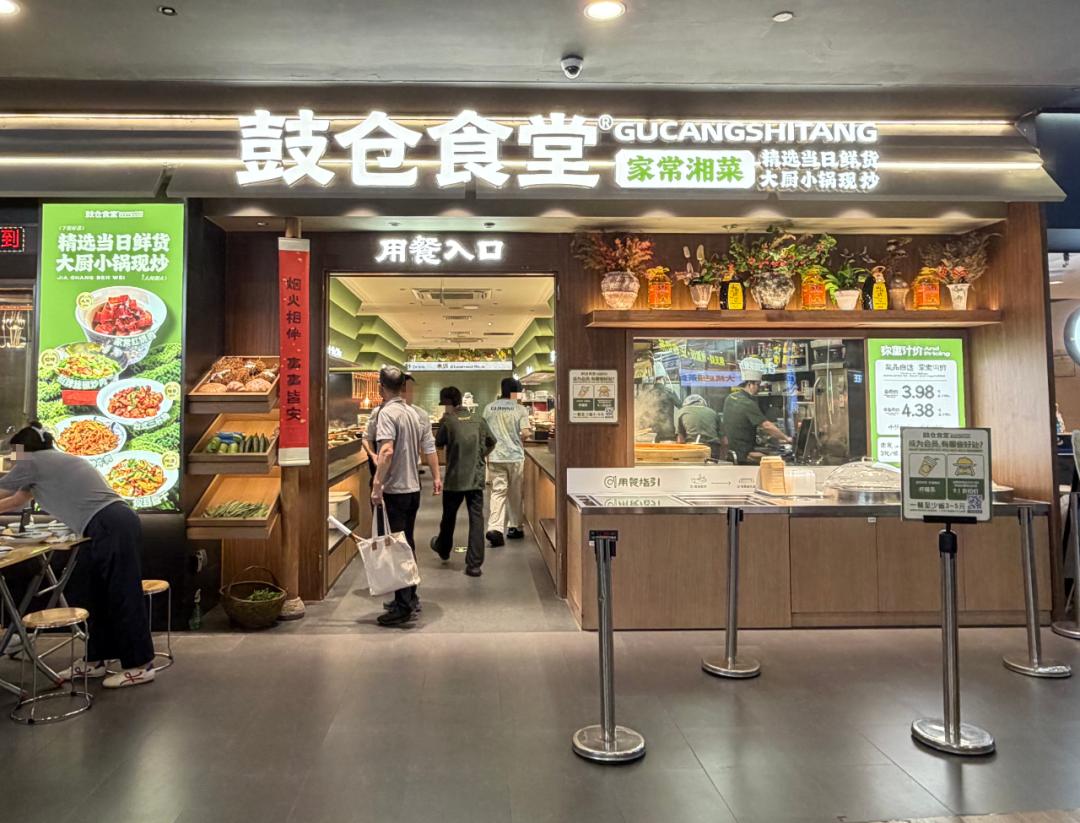
It is understood that this restaurant, named "Gucang Canteen", is located in the North Zone of Huacheng Hui, Guangzhou, where chain fast-food brands cluster and the catering competition is extremely fierce.
Even so, Gucang Canteen enjoys considerable popularity. During a weekday noon, Red Meal Net conducted an on-site visit and found that the in-store seating occupancy rate reached around 80%.
So, will the approach of packing a large number of popular models into one store make the business better?
01. With per capita consumption over 30 yuan, can one store earn double profits?
Gucang Canteen covers two categories: self-service fast food and light meals, and the latter adopts a shop-in-shop model.
It is reported that the store covers an area of about 350 square meters. Stepping into the store, you can see three major areas: the self-service zone, the counter-side light meal zone and the dine-in zone, with a relatively clear overall layout.
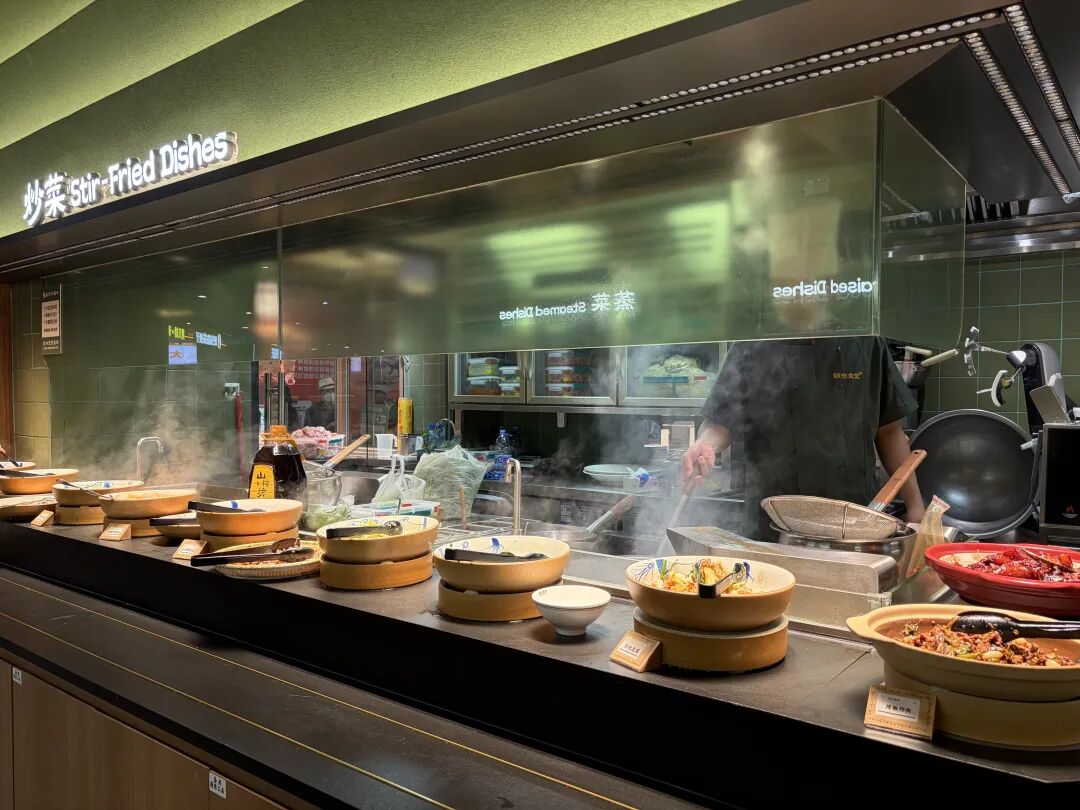
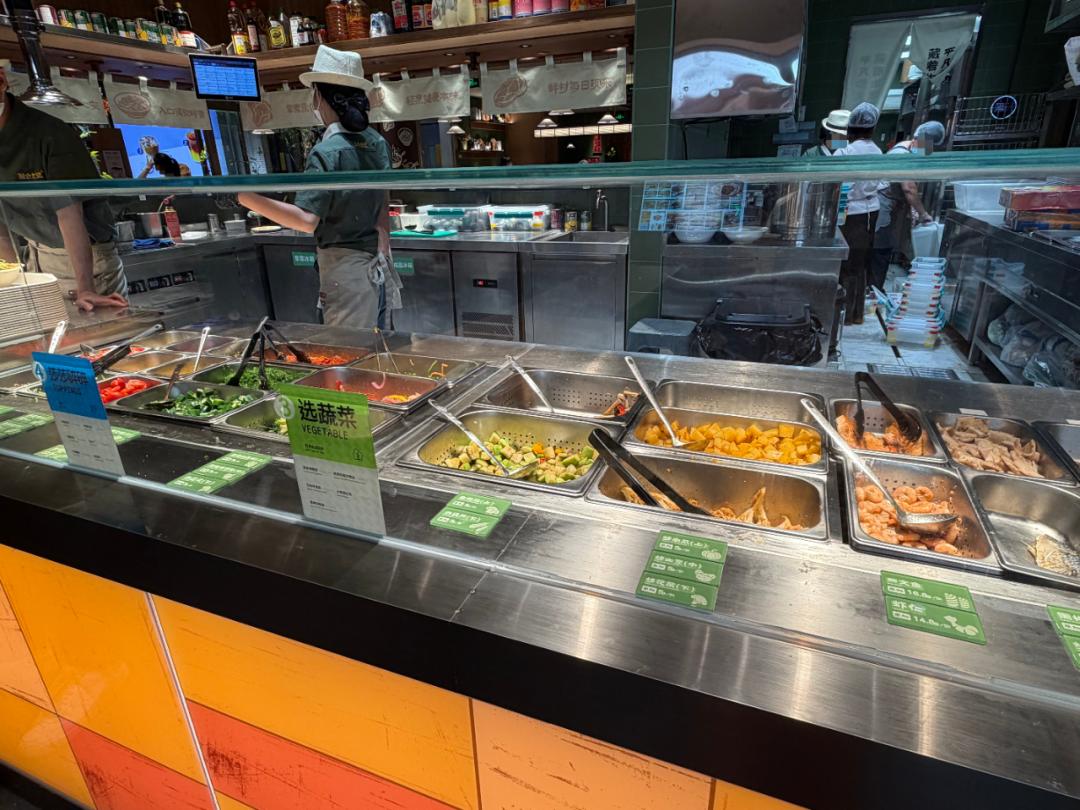
First look at the self-service zone. Its moving line design is similar to that of self-service fast food brands such as Xiaonv Dangjia and Damixiansheng, adopting a multi-island counter mode, which is divided according to different cooking methods such as stewed dishes, steamed dishes, iron-plate cooking and deep-fried food, with more than 50 kinds of dishes in total. There are chefs cooking on site behind each food pickup counter. Consumers can select dishes while intuitively seeing the cooking process, which is full of lively street food atmosphere.
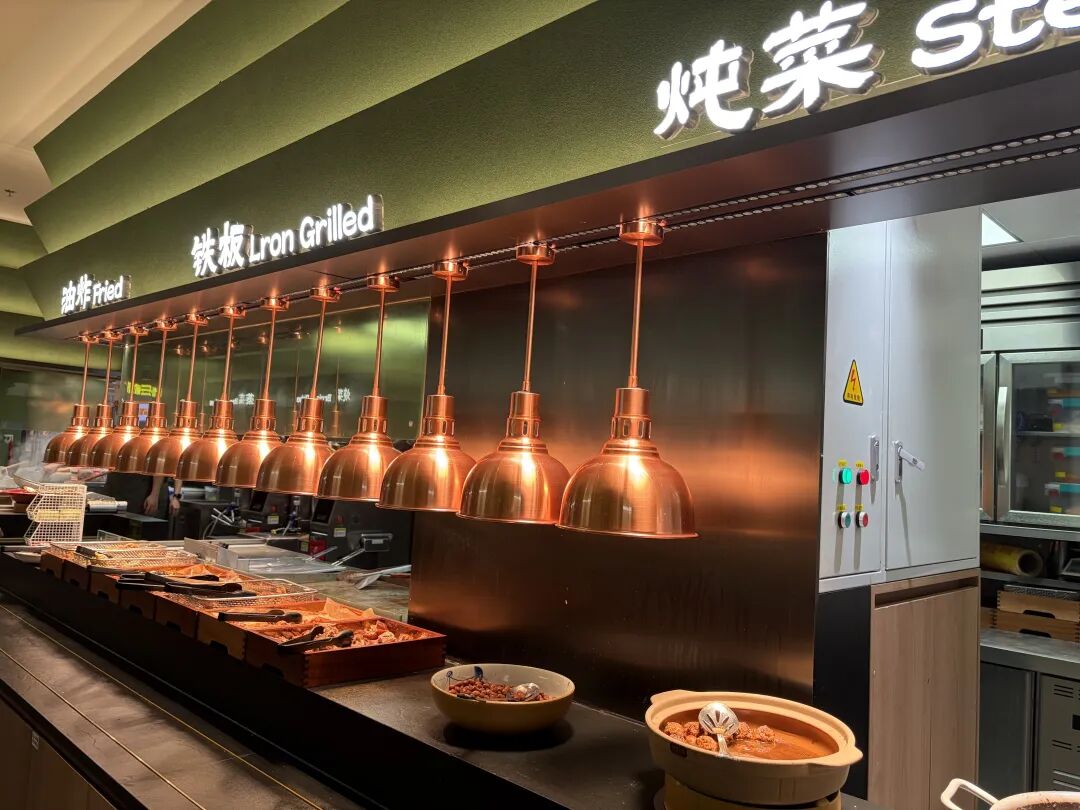
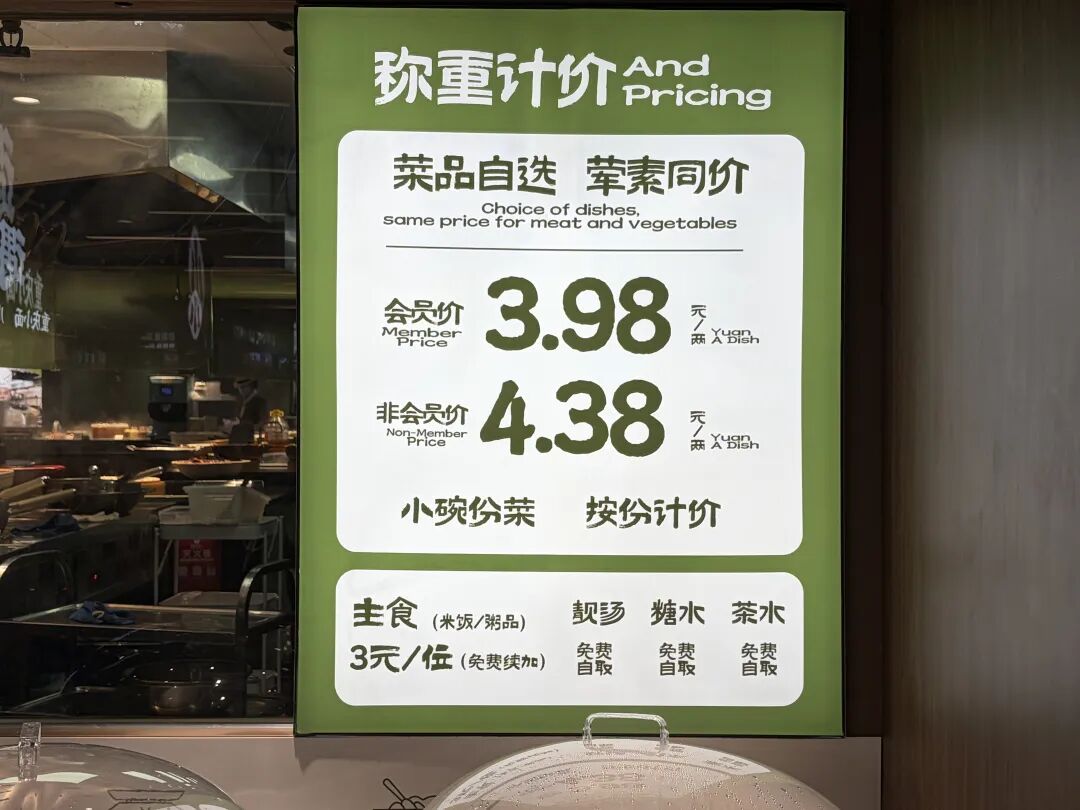
In terms of charging methods, most dishes are priced by weight, while some soups and stewed dishes are sold separately in the form of small-portion dishes. The weighing mode allows consumers to freely match dishes according to their appetite, while small-portion dishes provide more intuitive price options. The two methods operate in parallel, offering more flexible choices.
All meat and vegetable dishes are priced at the same rate, at 4.38 yuan per 50 grams for non-members and 3.98 yuan per 50 grams for members. Compared with similar fast food brands, this pricing is at a medium level in the business district where white-collar workers gather. In similar locations, the non-member price of Xiaonv Dangjia in Shenzhen is about 5 yuan per 50 grams, and the non-member price of Daozhuangyuan in Hangzhou is around 3.68 yuan per 50 grams. According to Dianping, the current per capita consumption of Gucang Canteen is 33 yuan.
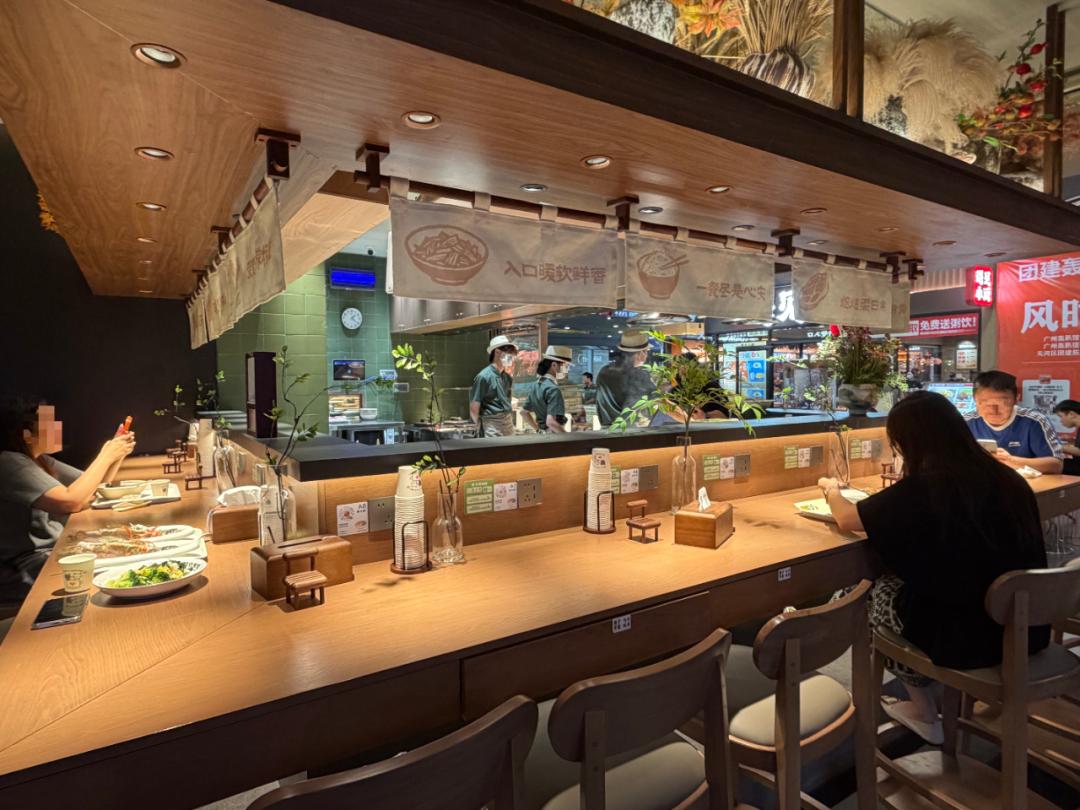
Adjacent to the self-service zone is the light meal area, which adopts a shop-in-shop mode, with an independent storefront, the brand name "Full Score Bowl", and the words "handmade at counter" marked on it.
Compared with the relatively open layout of the self-service zone, Full Score Bowl covers a small area and looks relatively compact, with an overall square bar counter, and the middle area is the operating table for food material processing and production.
A self-service counter is set on the side of the bar facing the mall aisle, and the ingredients are placed by categories such as staple food, protein, vegetables, salsa crumbs and sauces. 12 counter-side seats are set on the other two sides, so that consumers can either pick ingredients in front of the counter or order online.
In terms of products, Full Score Bowl is not limited to conventional light meals, but also provides snacks and simple meals such as korokke, hand-held sushi, and dry curry rice, further enriching the product matrix. Among them, the price of most light meals and simple meals ranges from 20 yuan to 30 yuan, and the price of snacks is around 10 yuan.
It is worth mentioning that although the in-store self-service fast food and light meals are operated under different brands respectively, the two are not completely separated, but share the same dine-in area, which is somewhat similar to the symbiosis idea of KPRO and K-Yue Coffee under KFC. No matter which brand or type of product consumers choose, they can dine in the same area.
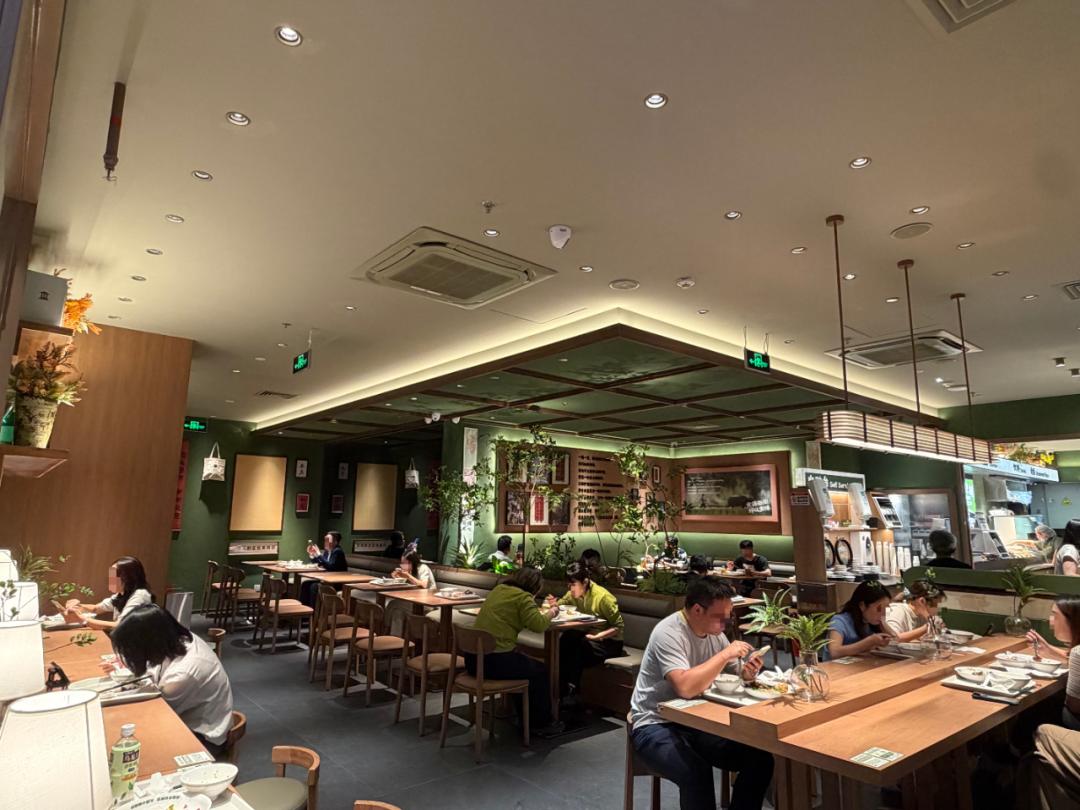
In terms of decoration, the store adopts fresh green as the main tone, and green plants are placed on the table tops and aisles, so the overall atmosphere is closer to a casual full-service restaurant. The store has various table and chair configurations, including 2-seat and 4-seat booths, as well as long tables convenient for single diners.
This design is more in line with the target customer group of Gucang Canteen. The surrounding area of the store is full of office buildings, including office workers who come alone for a meal, and consumers who dine with three or five colleagues. Seats of different specifications can meet different dining demands. At the same time, the relatively comfortable environment also reflects a higher sense of value.
02. New scenarios are created, but good business is not necessarily guaranteed
Nowadays, the competition in the catering industry is becoming increasingly fierce, and merchants are constantly looking for new ways to attract consumers. Open-kitchen on-site cooking, counter-side mode, and self-service format are all popular operational strategies at present, which can all be seen in Gucang Canteen.
However, apart from the specific presentation forms, the business logic of Gucang Canteen is not complicated. Essentially, it puts the two consumption forms of self-service fast food and light meals in the same store, and expands the consumption demands that the store can undertake through the complementarity of products and scenarios.
Specifically, self-service fast food focuses on efficiency and satiety, which can meet the daily dining needs of office workers; light meals emphasize health and low burden, adapting to another group of consumers with different dietary preferences. The two have their own relatively clear consumption scenarios. After combination, the store will no longer rely solely on a single product or a single type of customer group.
This model may have more room to play in scenarios with concentrated catering demands such as near office buildings and shopping malls. In the same business district, consumers have different preferences, and single-category stores can often only meet part of the crowd. The multi-format combination can gather the demands scattered in different categories into the same space, attracting more different types of customers to enter the store.
However, the addition on the customer acquisition end may turn into a multiplication of costs on the operation end.
Zhai Bin, a columnist of Red Meal Net and brand consulting expert, said that the store model of Gucang Canteen is relatively heavy: it not only has a large area, but also involves two product forms at the same time, which means the store needs to bear higher labor, rent and food material expenses, thus putting forward higher requirements for site selection and marketing capabilities.
In other words, for this model to work, there must be sufficiently high passenger flow density and table turnover rate to dilute the fixed costs. At the same time, both formats need to have a sufficient order volume. Otherwise, if one side has good business while the other drags behind, it will become a burden instead.
In Zhai Bin's view, Gucang Canteen combines the currently relatively popular formats in the market, which can enrich consumption choices, but it will also weaken the store's own personality, lacking a distinct memorable point. "However, if the location advantage is obvious enough, this model has the opportunity to achieve profitability in the future."
It is worth noting that checking the store reviews on Dianping, the location of Gucang Canteen used to run a self-service fast food restaurant, and before that it was a simple meal restaurant. To a certain extent, this adjustment can be regarded as a re-combination of the store model.
The same location has been operating catering businesses all the time, indicating that there is a certain consumption base here, but none of the previous several models could continue to operate, which also shows that having passenger flow does not equal to running a good business. How to convert the surrounding flow into stable consumption is still a problem that the new model needs to solve.
At present, Gucang Canteen has been open for only about a month, and the overall business is doing well. Although many fast food brands gather near the store, there are not many peers operating light meals or self-service fast food, which brings a certain sense of novelty and easily attracts consumers to try.
However, the passenger flow performance in the initial stage of opening is not enough to prove that this model has been fully verified. How long the popularity can last, whether consumers will form stable repurchase, and whether the two formats can form real synergy still need to be tested by time.
This article is from the WeChat Official Account "Red Meal Net", written by the Editorial Department of Red Meal, and published with authorization from 36Kr.