Who will extend the lifeline of embodied intelligence amid a 30-fold data gap?
The data gap of embodied intelligence, and the multi-layered businesses that fill it.
In 2026, capital's enthusiasm for embodied intelligence has reached a new level.
According to data updated by Dealroom in October, global embodied intelligence startups have secured $110 billion in venture capital this year, more than double the total amount for the whole of 2025.
In Yizhuang, Beijing in August, the World Robot Conference was equally bustling. 373 enterprises participated in the exhibition, attracting 557,000 visitors over five days, doubling the audience size from last year.
But for all the fanfare, how far are robots from actually starting to work on the job?
According to IDC statistics, global shipments of humanoid robots exceeded 18,000 units in 2025, of which over 85% were used for cultural and entertainment performances, education and scientific research, data collection, and guided tours and shopping guidance. Only a small number of robots have actually entered scenarios such as factories and logistics to undertake production tasks.
Both funding and public attention are growing, but the actual production value created by robots is far from keeping pace.
Over the past two years, the story of embodied intelligence has mostly centered on robot bodies: whose robot is more flexible, whose dexterous hand has more degrees of freedom, and who can complete more complex motion demonstrations. This year, however, a new variable has begun to influence the direction of industry competition: data.
With continuous iteration of models from companies such as Generalist and Physical Intelligence, the industry has begun to see a development path similar to that of large language models: expanding the scale of training data and computing power is expected to bring stronger generalization capabilities and reduce the cost of learning new tasks.
If this Scaling curve continues to hold, the competition in embodied intelligence will no longer be limited to hardware comparison, but will further shift to data: how much real-world experience is needed? Where will this data come from? What kind of data is the most valuable? And who can make money from it?
But the problems faced by robots may be more complex than those of large language models. The internet has left massive amounts of text and video, but rarely records the force, contact, failure and error correction processes when humans perform actions. Larger volumes of data do not necessarily mean that robots can complete tasks better.
What is truly worth paying attention to is not just how many hours of data robots are still missing, but whether this data can be converted into working capabilities in the real world. This is exactly the most noteworthy technical problem and business opportunity to unpack in this round of embodied data boom.
From 270,000 to 500,000 hours: The Scaling curve of embodied models
In November 2025, Generalist AI released GEN-0, which was pre-trained with more than 270,000 hours of real physical interaction data. In comparison, the most representative open-source dataset Open X-Embodiment only had 6,000 hours at that time, and the data volume of GEN-0 was nearly 50 times higher.
Generalist observed in experiments that as the scale of pre-training data and computing power expands, the performance of the model on multiple downstream tasks continues to improve. This sends an important signal: the Scaling Law similar to that of large language models may also exist in the physical interaction learning of robots.
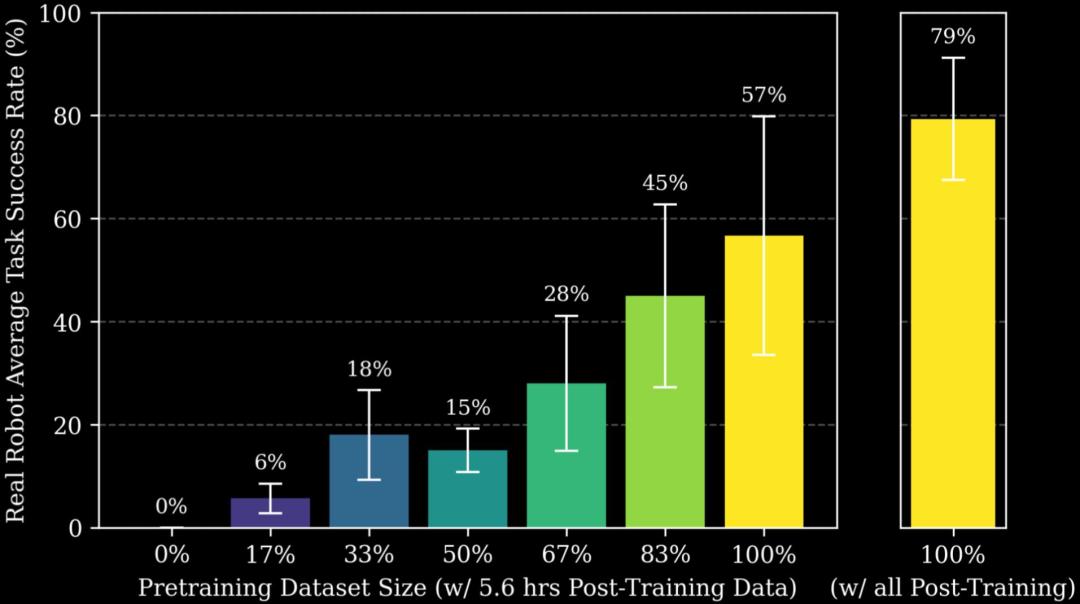
Generalist GEN-0 experiments show that increasing pre-training data can improve the success rate of real-machine tasks. Source: Generalist AI
Five months later, GEN-1 pushed the data scale to 500,000 hours, with the task success rate rising from 64% to 99%, and the speed 3 times faster. More importantly, GEN-1 began to show certain cross-scenario generalization and autonomous error correction capabilities.
In August 2026, Generalist launched GEN-1.5, which further advanced this generalization capability. After more than 8 months of continuous pre-training, the model began to demonstrate capabilities similar to the In-Context Learning of large language models: it only needs a 3-12 second action demonstration to try to perform new tasks without updating model parameters. Generalist calls this Physical Prompting.
The three generations of Generalist models have initially verified a noteworthy path: larger-scale pre-training data is expected to bring stronger model capabilities and lower learning costs for new tasks. As a result, embodied data has evolved from a technical issue to a new direction competed for by capital.
The next question is: what scale of data does embodied intelligence actually need, and where should this data come from?
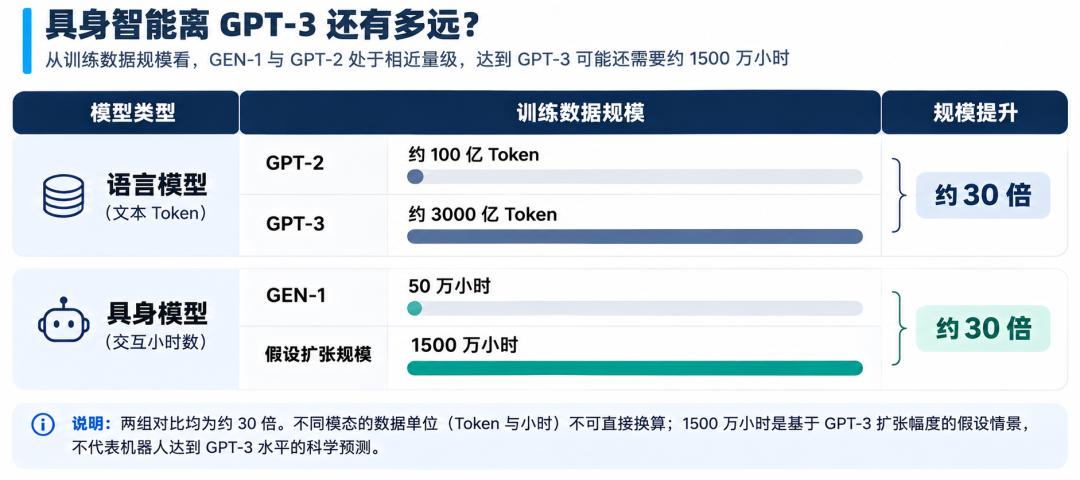
500,000 hours: Is embodied intelligence still at the GPT-2 stage?
What level is 500,000 hours exactly? We can use the amount of information a human is exposed to in their lifetime as a reference.
Assuming a person reads 200-300 English words per minute, reads 12 hours a day, and accumulates about 6.7 billion to 10.1 billion tokens over 80 years. The training data of GPT-2 is about 10 billion tokens, which is in the same order of magnitude as the amount of reading a human completes in their lifetime.
The same applies to embodied intelligence. Assuming a person observes and learns the real world for 12 hours a day, that adds up to about 350,000 hours over 80 years. The 500,000 hours of training data for GEN-1 is equivalent to 1.43 times the observation time of a human lifetime.
If we take the amount of information in a human lifetime as the benchmark, the training data of GEN-1 and GPT-2 are at similar orders of magnitude. This is only an analogy of data scale, and does not mean that the capabilities of the two types of models are equivalent.
Produced by SiliconRabbit
But the development of large language models went far beyond GPT-2. The training data of GPT-3 reached 300 billion tokens, about 30 times that of GPT-2. If embodied models also require a similar magnitude of data expansion, starting from GEN-1's 500,000 hours, the next stage may require 15 million hours.
Moreover, data volume is not the only bottleneck. Robots need to learn not only what they see, but also how to operate, how much force to use, and what results the actions produce.
Take unscrewing a bottle cap as an example. Most of the time in an operation video is spent moving, aligning, and adjusting posture. What really determines success or failure may be the force applied at the moment of contact, the adjustment when slipping, and the re-attempt after failure. These key interactions account for a very small proportion of the entire trajectory, but contain important learning signals.
Therefore, embodied data faces two bottlenecks: first, how to expand the data scale at low cost, and second, how to improve the effective information density of the data.
Where does data come from: Three paths, one conversion challenge
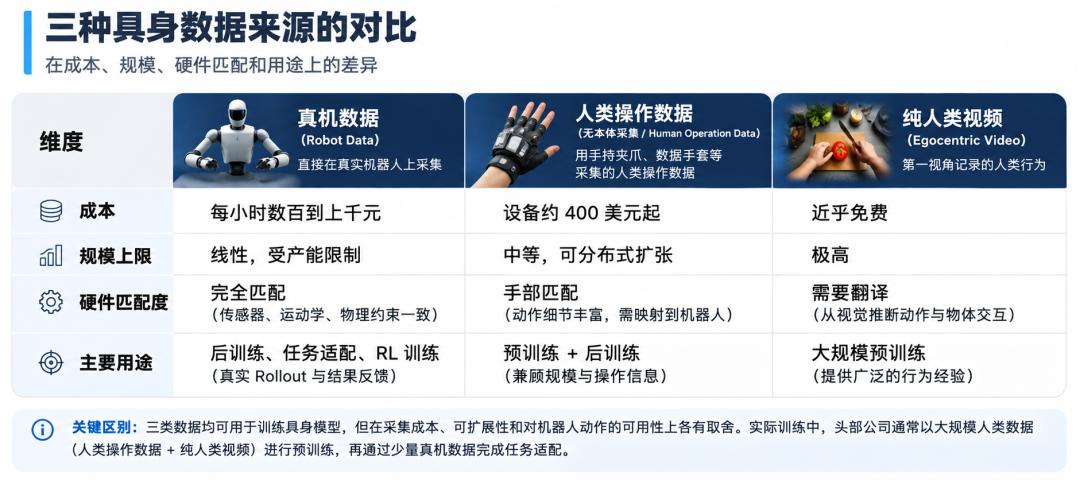
Facing the dual bottlenecks of data scale and quality, the industry has mainly explored three real data collection paths. The core difference is that the more directly the data comes from the robot body, the more the data matches the target hardware, but the higher the collection cost; the closer it is to human daily behavior, the easier it is to scale the data, but the more difficult it is to convert it into robot actions.
Produced by SiliconRabbit
The first type: Robot Data
Robots complete tasks through teleoperation, while recording vision, joint status, and motion trajectories. The data directly matches the target hardware, and is suitable for task training and fine operations.
Body manufacturers such as Tesla, Figure AI, and Agibot have all adopted the real-machine collection method. However, real-machine collection relies on robots, operators, and venues, with high costs and slow expansion, making it difficult to support the data demand at the tens of millions of hours level.
The second type: Human operation data (no body collection)
Instead of using robots, humans complete operations by holding grippers, wearing data gloves and other devices, while recording first-person perspective images and hand or tool movements. In 2024, Stanford University and other institutions proposed the UMI solution, which collects human operation data through a camera-equipped handheld gripper, without the participation of real robots in collection, reducing the cost of data acquisition.
Sunday Robotics has scaled up this route. The company recruits a large number of "Memory Developers" to wear self-developed collection gloves to complete housework in real homes. According to the founder's disclosure, it has accumulated nearly 10 million task trajectories, and trained ACT-1, the basic model of the home robot Memo. Generalist's 500,000 hours of pre-training data is also mainly collected by wearable devices to record human operations.
The third type: Pure human video (Ego Video)
Directly use first-person perspective videos to learn human behaviors, no need to synchronously collect precise operation trajectories, which has the greatest potential for scaling. NVIDIA's EgoScale uses more than 20,000 hours of human first-person perspective videos; in August 2026, Dyna Robotics released Dyna-2, further expanding the pre-training scale to more than 1 million hours.
The difficulty of videos is the lack of action signals that robots can directly execute. The model needs to infer human actions from the images, understand the changes in object states, and then convert them into control instructions that robots can execute. Research on Dyna-2 shows that large-scale video pre-training is expected to improve the cross-body migration capability, but this process still requires data processing and a small amount of real-machine adaptation.
The three paths have their own trade-offs: real-machine data solves action matching, human operation data balances scale and action supervision, and pure human video provides larger-scale behavioral experience.
The training methods of leading companies have also begun to show a common trend: using large-scale human data for pre-training, and then completing task adaptation with a small amount of real-machine data. However, different companies have very different data formulas, and there is no unified optimal ratio yet.
This means that the competition for embodied data lies not only in who can collect more hours, but also in who can convert data from different sources into actions and experiences that robots can truly learn at a lower cost.
New data gap: From motion to contact
The first three data collection methods solve the problems of scale and motion learning, but there is still a type of information that is difficult to obtain through vision: force and tactile feedback during contact. In fine operations, many failures precisely occur in contact and force control.
The internet has taught large models language, but it has not recorded how much force a person uses when unscrewing a bottle cap, how the fabric slides when folding a towel, and at what angle a cup will spill when tilted. The common point is that success or failure does not depend on the picture, but on the contact. This is also the hardest ceiling of the video route.
This has already been verified by experiments. In 2026, Panasonic, in collaboration with Berkeley, NVIDIA and other institutions, launched T-Rex, which introduced fingertip haptics into robot motion models. In 12 fine operation tasks such as screwing in light bulbs and turning over paper, the average success rate of the model reached 65%; after removing the haptic information, the success rate dropped to 42%.
However, force and haptic data are more difficult to collect at scale than video. Video only requires a camera, while contact information often requires additional sensors, and it is also necessary to solve the problems of data synchronization, calibration, and cross-device adaptation.
New collection solutions are emerging. In the latest YC F26 of 2026, there are three startups that cut into embodied data from different angles:
Axonnic: Using electromyography to restore fine hand movements. It develops a wearable forearm EMG sleeve that synchronously collects electromyography, video, and hand posture, estimates finger movements and fingertip force when both hands are unobstructed, and can track movements even when the hands are occluded. It is mainly oriented to complex industrial operations such as sewing and precision assembly, converting the motion data of skilled workers into robot training data.
Hemlock: Using EMG bracelets to supplement force information. It self-develops The Bracelet, which infers force and contact status by reading forearm muscle electrical signals combined with first-person perspective video. Compared with haptic gloves, the bracelet does not block the hands, making it more suitable for distributed collection.
Preload: Multimodal collection of vision, haptics and electromyography. It combines a first-person perspective camera, haptic gloves, and EMG sensors to synchronously record operation images, contact pressure, and muscle activity. Compared with a single EMG solution, it can provide more complete physical interaction information.
The three companies have different focuses, but the direction is the same: embodied data is moving from recording what humans did, to recording the force, contact, and physical feedback behind the actions.
This means that the next round of opportunities for embodied data lies not only in increasing the collection scale, but also in supplementing the physical information beyond vision, and making this information truly converted into model capabilities.
Data players: Who can make money from embodied data?
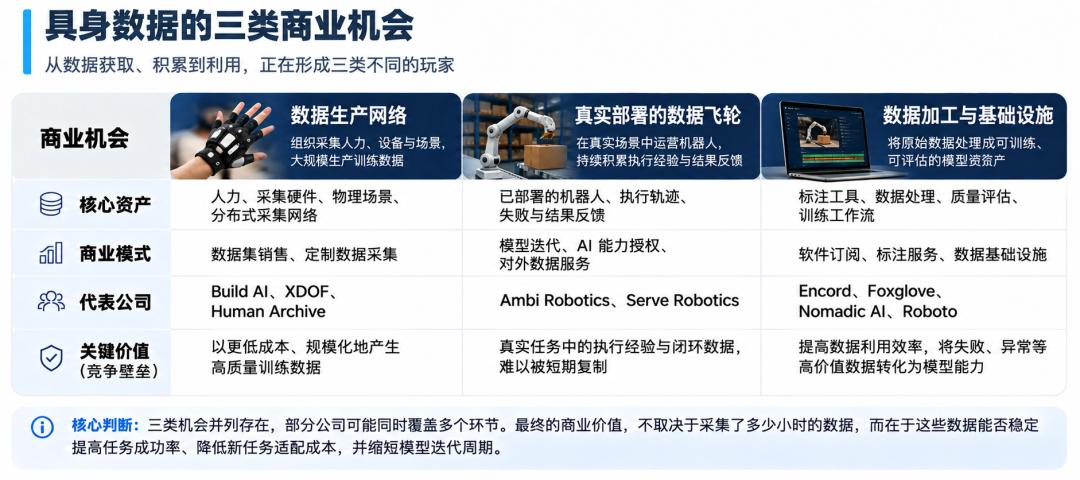
As embodied models enter the Scaling stage, business opportunities around data are beginning to emerge. From the perspective of data asset sources and monetization methods, three different types of opportunities are taking shape in the market.
Produced by SiliconRabbit
The first category: Data production networks, the core of which is to master scenarios, manpower, and large-scale collection capabilities.
These players continuously supply training data to model companies by organizing personnel, equipment, and physical scenarios. They can be divided into two routes: data collection based on human work, and real-machine teleoperation collection.
Build AI chooses the former. The company collects first-person perspective data in real factories and professional labor scenarios, covering tasks such as textiles, precision manufacturing, and maintenance, providing model developers with off-the-shelf datasets and customized collection services. Its advantage is to use existing human labor to obtain large-scale and diverse real operation experience.
XDOF cuts in from real-machine data. The company builds low-cost dual-arm robot teleoperation collection facilities, directly recording robot vision, joint status, and motion trajectories. The ABC-130K dataset released in June 2026 contains more than 130,000 trajectories, about 3,500 hours of real interaction, covering nearly 200 types of dual-arm operation tasks. Compared with human videos, this type of data matches the robot's motion space more directly, but the collection cost is also higher.
Other representative players are also expanding data supply. Human Archive (YC W26) cuts in from the external labor network, cooperating with service networks such as housekeeping, hotels, and catering, allowing