Gemini 4 Hydrogen is here, and it is accessible to everyone.
Just now, Google launched Gemini 4 Hydrogen, which focuses on speed and execution efficiency.
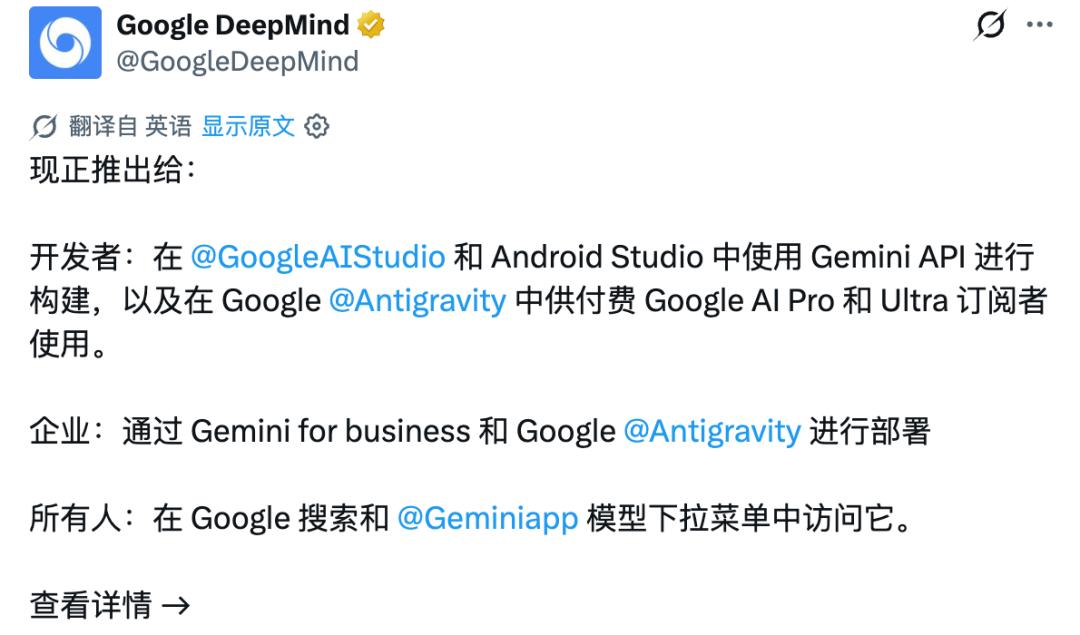
Different from the previous two updates of "high-end models", Hydrogen is directly open to everyone. Free users can use it through the automatic model selection in the Gemini App, while paid users can select it manually. Developers can also access it via Google AI Studio and the Gemini API.
Google Search has also integrated Hydrogen, which can better understand complex, scattered, and even misspelled queries, providing more intuitive answers and more relevant web page links.
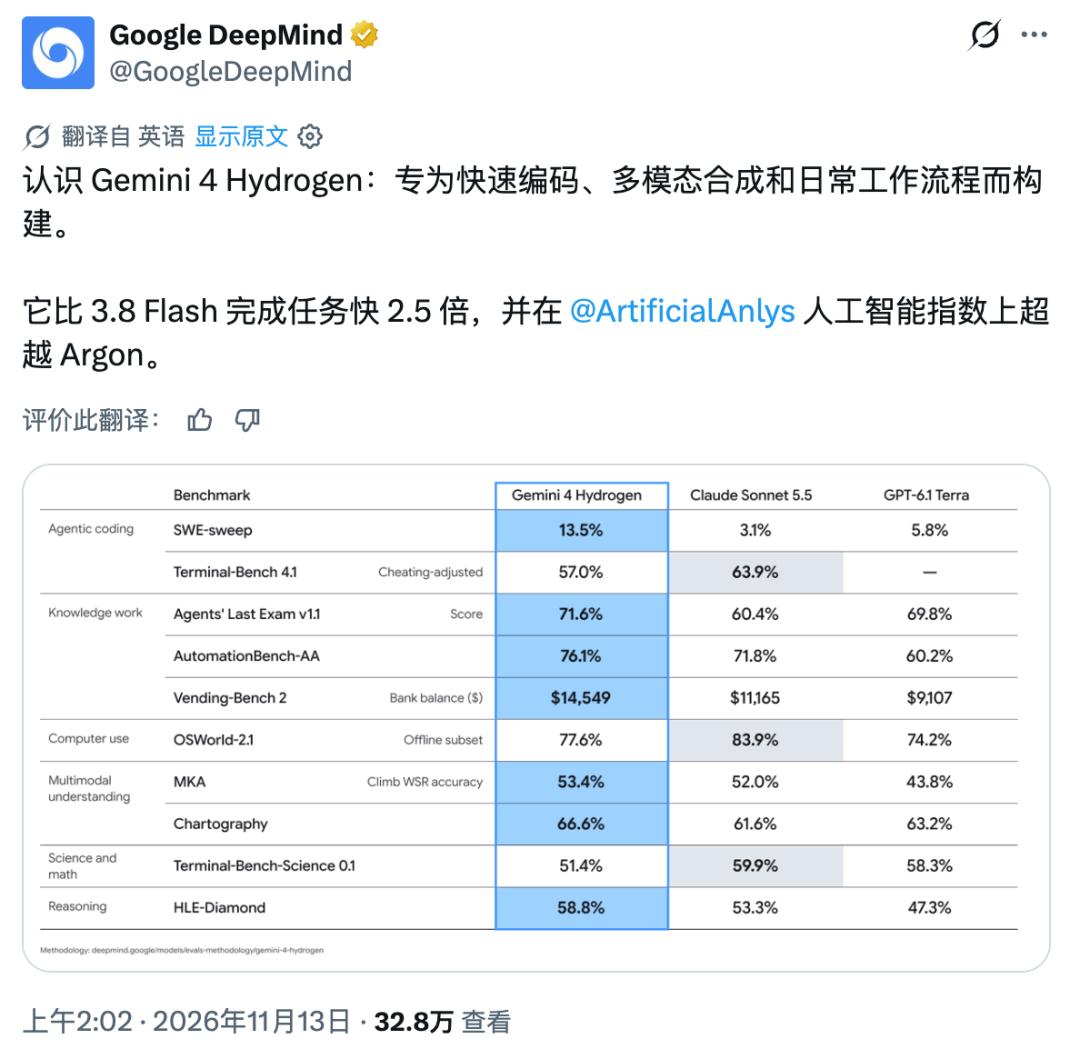
According to Google, under the default High inference gear, Hydrogen completes tasks 2.5 times faster than the previous generation Gemini 3.8 Flash, with further improved instruction following capability, and the occurrence of fact fabrication is reduced by more than 80%.
On the Artificial Analysis Intelligence Index list, it even surpasses the higher-positioned Gemini 4 Argon.
Google Search is the first to adopt the new model
Robby Stein, Vice President of Google Search Products, called this integration the largest model upgrade in Google Search so far. Gemini 4 Hydrogen has begun rolling out to global users, covering all languages supported by the AI mode.
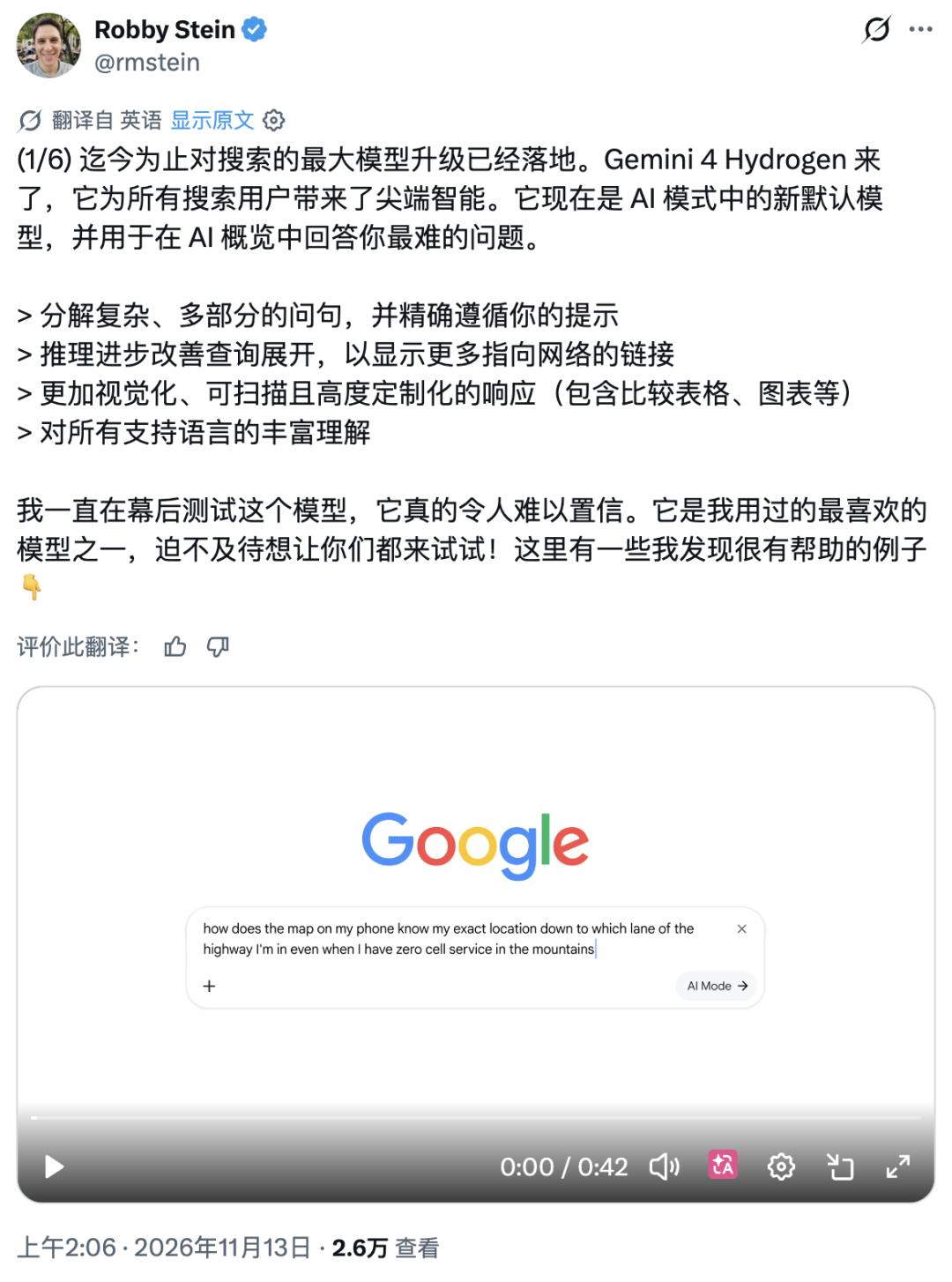
The most immediate change is that users no longer need to spend extra effort figuring out the right search keywords.
Now, you can directly input all the thoughts in your mind into the search box. Even if the query is very long, has many conditions, or even contains spelling errors, Hydrogen can more accurately understand exactly what you are looking for, and organize answers based on these requirements.
Search results have also become more flexible.
Google stated that the upgraded search can select a more appropriate presentation method according to the query. When information comparison is needed, it can generate tables; when encountering complex knowledge questions, it can help users understand the answers through images, visual content, and even interactive tools.
Tasks that previously required opening multiple websites and repeatedly cross-referencing information can now be completed directly on the search page.
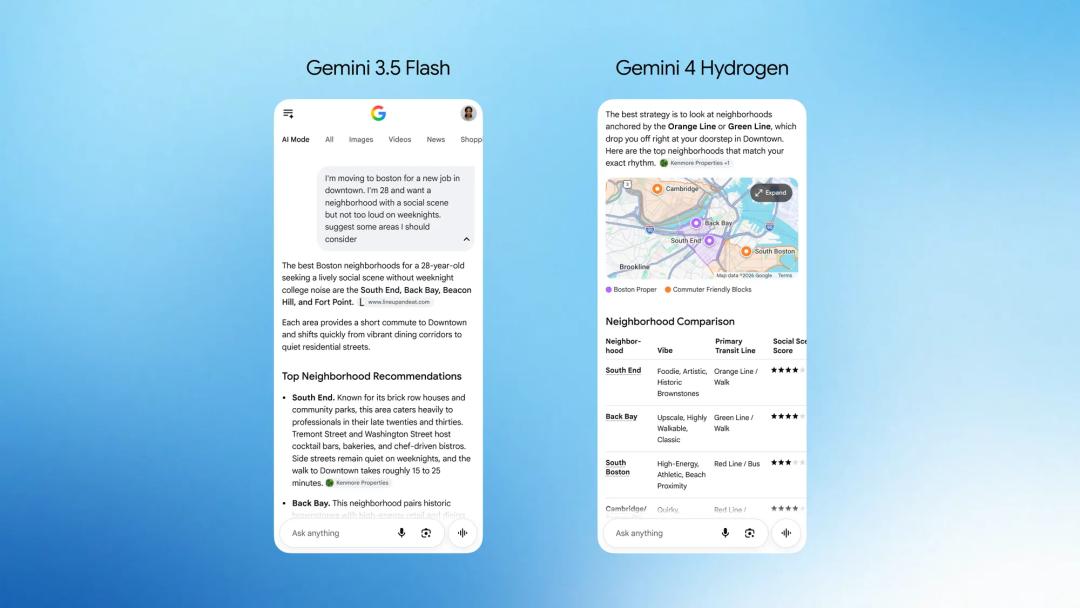
At the same time, Google Search has also upgraded the Query fan-out technology. Facing complex problems, the system can simultaneously retrieve multiple relevant directions, cover a wider range of information sources, and provide more relevant web page links.
This is quite interesting. AI search has long been criticized for keeping answers directly on the search page, making users less and less willing to click on external websites. Now Google is emphasizing that the upgraded AI search can help users discover more websites.
Google itself is also facing the monetization pressure of AI search. At the earnings call on October 28, Philipp Schindler, Google's Chief Business Officer, admitted that the monetization efficiency of AI Mode is lower than that of traditional search, and its rapid growth in query volume has also dragged down the growth rate of search advertising revenue.
As for whether websites can actually get more clicks after the number of links increases, it still takes time to prove.
Gemini is more compliant and more capable
Google may think the codename Hydrogen is intuitive enough. Even though it does not have "Flash" in its name, Hydrogen plays the role of the high-efficiency model in the Gemini 4 series.
Google positions Carbon and Argon for complex deep reasoning tasks, while Hydrogen puts more emphasis on execution efficiency, especially for programming, tool calling, and multi-step tasks.
However, this model focused on speed and execution efficiency even outperforms its own high-end models.
On the Intelligence Index list from third-party evaluation agency Artificial Analysis, Hydrogen scored 51 points at the High inference gear, and further increased to 54 points at the Xhigh gear, exceeding the 50 points of Gemini 4 Argon.
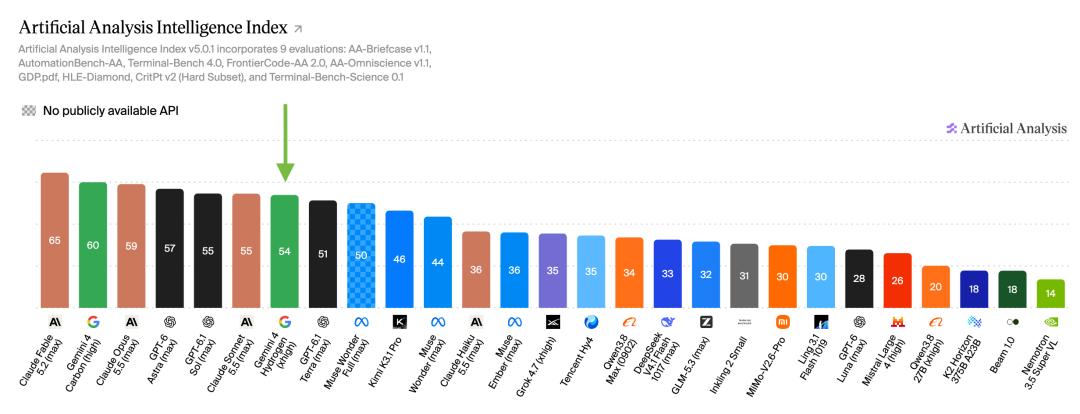
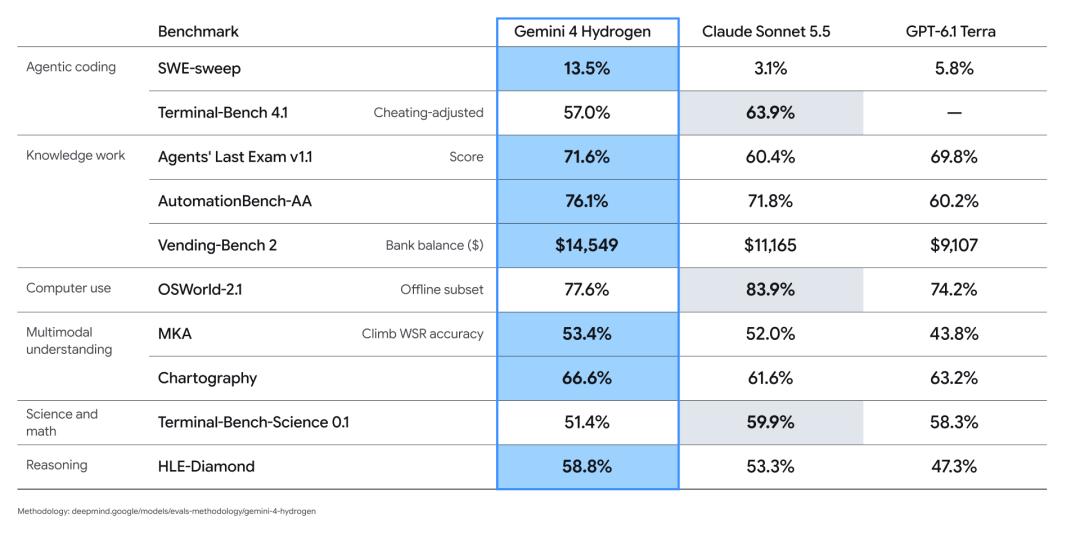
According to the official benchmarks released by Google, Hydrogen performs particularly well in knowledge work, automation, and reasoning.
In the Agents' Last Exam v1.1, which tests the AI's ability to handle complex knowledge tasks, it achieved a score of 71.6%, surpassing Claude Sonnet 5.5's 60.4% and GPT-6.1 Terra's 69.8%.
In the Vending-Bench 2 test that simulates long-term business tasks, Hydrogen finally accumulated a capital balance of 14,549 US dollars, also leading the other two models.
In terms of programming, it leads with a score of 13.5% in SWE-sweep, but lags behind Claude Sonnet 5.5's 63.9% with 57% in Terminal-Bench 4.1.
Beyond benchmark scores, the more direct change is that Gemini is more compliant and more capable in daily use.
Google says Hydrogen can better comply with tone, format, and specific rules, maintain task objectives in multi-round conversations, and reduce the number of repeated revisions.
When processing complex materials, it can extract information from uploaded files, organize tables and visual content, and complete tasks in combination with connected applications such as Gmail, Google Drive, Airtable, and Dropbox.
Hydrogen's tool calling capability has also been improved. Google says the model can select the required tools more accurately, and can adjust subsequent operations even if tool calling fails or the search returns no results.
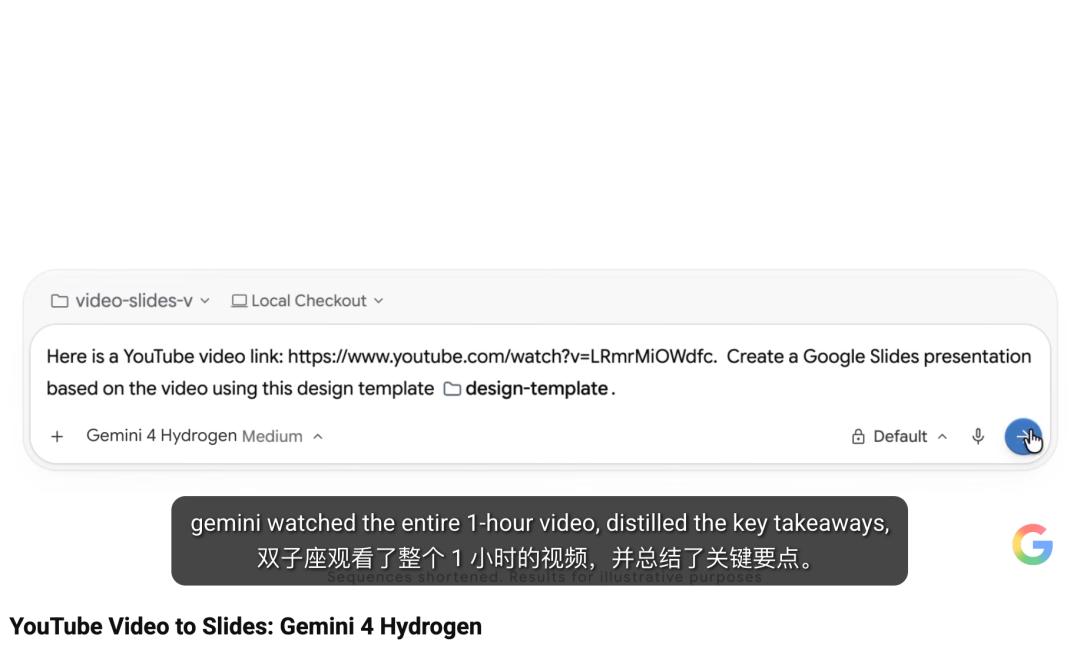
In an official demonstration, Hydrogen directly generated multiple pages of slides in Google Slides through Google Antigravity based on a YouTube speech video and a design template. After that, it independently checked the presentation and fixed typesetting issues such as overlapping text.
Another notable change is that this time Google has launched a new Orchestrator feature for Google Antigravity.
Antigravity previously supported multiple Agents working collaboratively with different models. The newly launched Orchestrator can automatically switch between Carbon and Hydrogen in the same task according to execution progress.
According to Google's workflow, Carbon can first analyze the task and make a plan, then hand it over to Hydrogen to modify the code, update dependencies, and run tests. If new difficulties are encountered during execution, the task can be handed back to Carbon for analysis and adjustment.
The whole process does not require users to manually switch models.
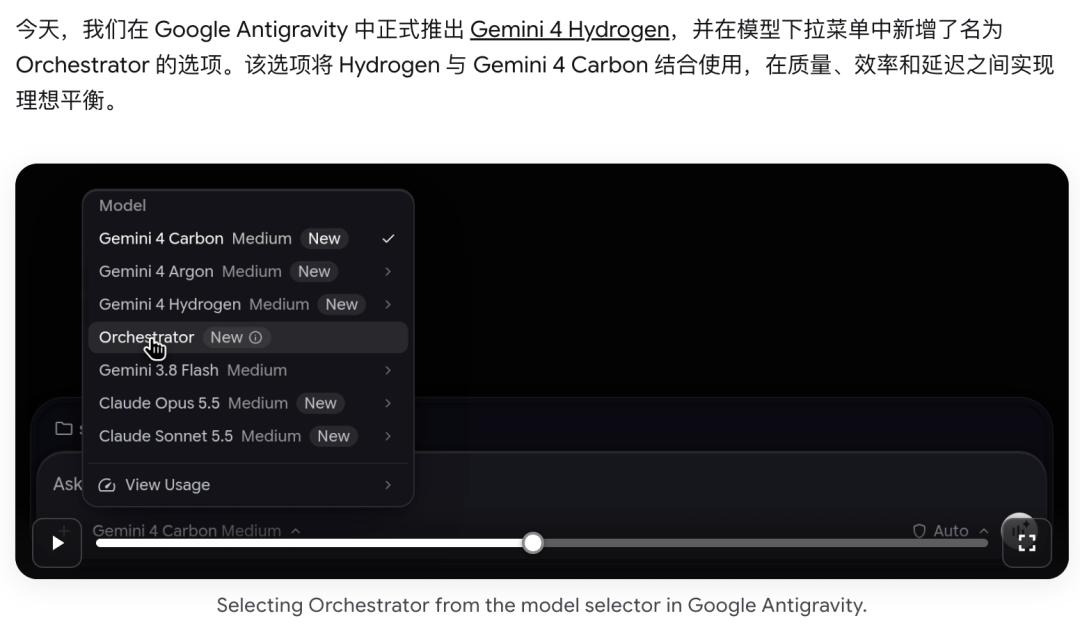
Google says in internal tests, Orchestrator achieved a task success rate close to using Carbon alone, while reducing quota consumption by an average of 24% and increasing task completion speed by 19%.
This feature is now first available to Google AI Ultra users, and will support more models and subscriptions in the future.
In terms of pricing, Hydrogen's API charges $1.5 per million input tokens and $7.5 per million output tokens, which is lower than the current promotional price of Gemini 4 Argon at $2 per million input tokens and $10 per million output tokens.
Compared with the previous generation Flash, the price of the new model has increased. The current input and output prices of Gemini 3.8 Flash are $0.75 and $3.75 respectively, only half of Hydrogen's prices.
However, the promotional price of the old version of Flash will end on December 31, and will be adjusted to the same level as Hydrogen starting January 1 next year.
Netizens: What about Argon then?
Shortly after Hydrogen was released, many people started testing it.
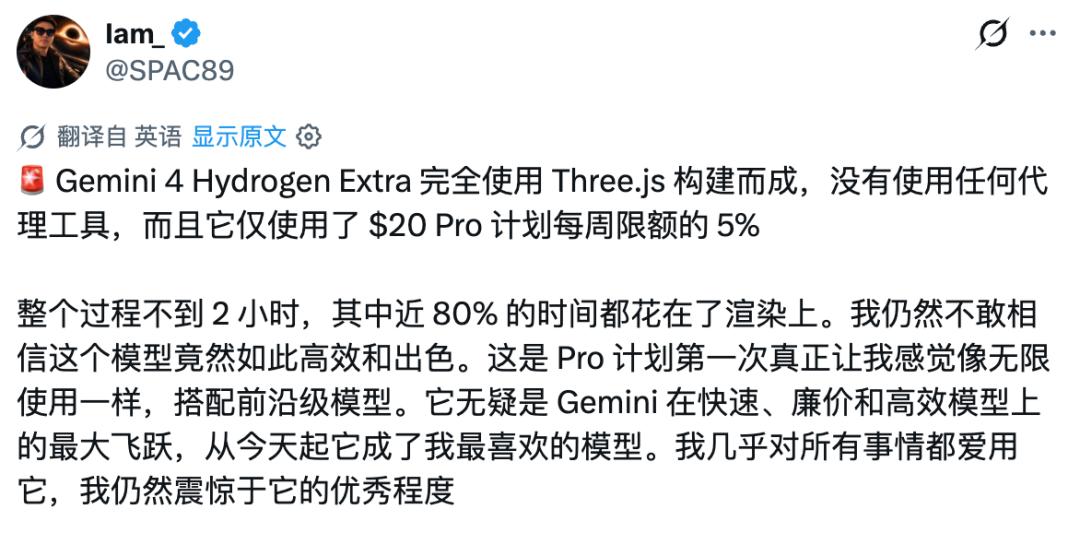
Netizen @SPAC89 showed off a Three.js project he made with Hydrogen Extra. He said the whole project took less than two hours, nearly 80% of which was spent on rendering, and only consumed 5% of the weekly quota of his Google AI Pro subscription.
He is quite satisfied with the new model, even saying that this is the first time he feels that the $20 Pro subscription has almost no quota limits in use.

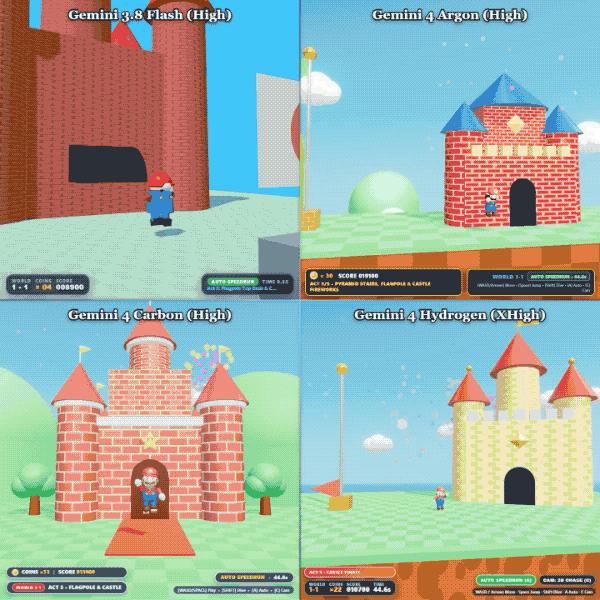
User @StatsWire ran a same-question test on four Gemini models: he asked them to use Three.js to make a playable 3D Mario game without calling any external 3D models or textures.
Some netizens in the comment section suggested that the author also publish the time and cost required for each model to generate the game. The author said he will add these data in the next test.
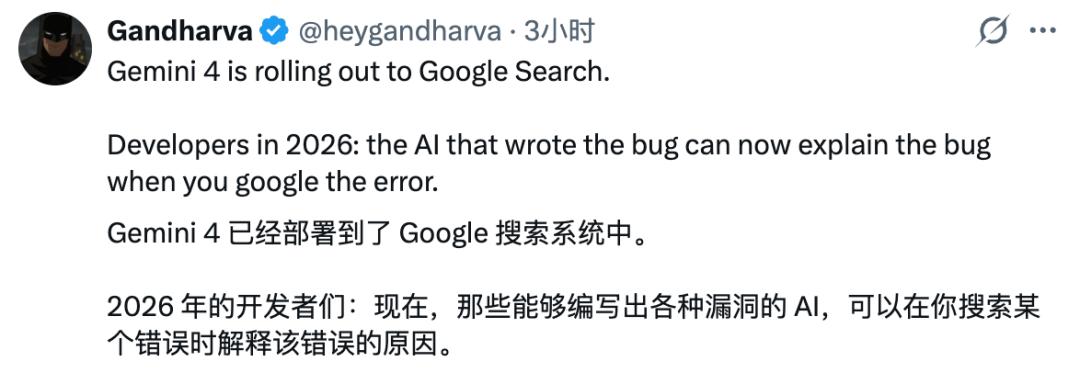
The news that Google Search integrated Hydrogen has also sparked a lot of discussions.
Some netizens thought of a very interesting scenario: "Developers in 2026: AI writes a Bug, now you throw the error message into Google Search, and the same AI is the one explaining the Bug."
But some netizens are not optimistic about Google's search business.
These complaints are not aimed at Hydrogen, but more about dissatisfaction with Google's existing products.

Under Google DeepMind's official post, Hydrogen's performance raised another question: So what is Argon useful for now?
After all, Hydrogen is cheaper, faster, and even outperforms the higher-positioned Argon in some evaluations.

Some people also question the speed improvement — what's the use of just speeding up?
One netizen pointed out that a 2.5x speed increase is indeed good, but if the answer is wrong, the cost of re-executing the task may be higher than a slow but correct response.

Another netizen joked that AI can now write code so fast that it finishes before you finish your coffee, but checking the code may require you to drink the entire remaining pot.
