After 8 years of dedication to chip development that culminated in the public listing of its semiconductor arm, has Alibaba secured a massive outcome valued at tens of billions of US dollars?
Against the backdrop of the ongoing booming wave of IPOs for domestic Chinese chips, internet giant Alibaba has officially announced that it will spin off its chip subsidiary for a separate public listing.
On November 10, Alibaba released an announcement stating that the company plans to propose spinning off its chip subsidiary T-Head for an independent listing on the Hong Kong Stock Exchange (HKEX), and the proposal has been confirmed by HKEX.
Meanwhile, Alibaba revealed that on September 11 this year, T-Head has submitted its listing application form to HKEX in confidential form.
According to 21st Century Business Herald, a professional investment institution insider said that T-Head's valuation may range from 20 billion to 30 billion US dollars.
As the core entity of Alibaba's chip business layout, T-Head's development can be traced back to 2018. At that time, Alibaba fully acquired C-Sky, and integrated it with the self-developed chip business of Damo Academy to form T-Head Semiconductor Co., Ltd.
After 8 years of development, T-Head has grown into a top player in the domestic Chinese chip track, with a mature chip R&D system and end-to-end full-link R&D capabilities for chips.
Leida Finance learned that at present, T-Head's product matrix includes the Zhenwu series AI chips, Yitian series Arm server CPUs, Panmai series smart network cards, Zhenyue series storage main control chips, etc.
According to IDC data, calculated by AI accelerator shipment volume, T-Head's share in the Chinese market in the first half of this year is about 7%, ranking after NVIDIA and Huawei.
It is worth noting that the spin-off and listing of T-Head comes at a stage when Alibaba is heavily increasing its investment in AI. In May this year, Alibaba CEO Wu Yongming stated that for the five-year goals in the future, the company's investment in AI infrastructure will far exceed 3800 billion yuan.
However, the huge investment also makes Alibaba face certain challenges in terms of performance. For the three months ended June 30, 2026, the group recorded revenue of 268.953 billion yuan, a year-on-year increase of 8.6%; the net profit attributable to owners of the parent company was 10.537 billion yuan, a sharp year-on-year drop of 75.56%.
Spin off T-Head for independent listing, valuation may reach tens of billions of US dollars
After market close on November 10, Alibaba released a major announcement — it has proposed to spin off its wholly-owned subsidiary T-Head (Shanghai) Technology Co., Ltd. (referred to as "T-Head") for independent listing to HKEX in accordance with the Guidance 15 under the Listing Rules.
Alibaba stated that HKEX has confirmed that the company can proceed with the proposed spin-off. On September 11 this year, T-Head has submitted the listing application form (Form A1) to HKEX in confidential form. After the completion of the proposed spin-off, T-Head is expected to remain a subsidiary of the company.
In fact, the independent listing of T-Head has been paved for a long time. In January this year, market news spread that Alibaba planned to restructure T-Head into an independent company partially owned by its employees, and explore the possibility of its IPO.
At that time, JPMorgan analysts estimated the potential valuation of T-Head to be between 25 billion and 62 billion US dollars through a rough benchmarking method.
On March 19, Wu Yongming mentioned on the earnings call that T-Head has achieved successful commercialization, with annualized revenue exceeding the 10 billion yuan level. At the same time, Wu Yongming also revealed that "we do not rule out the possibility of an IPO in the future, but there is no clear timeline yet."
In the announcement released this time, Alibaba stated that the proposed spin-off will be carried out through a global offering of T-Head's H shares, including a public offering to the public in Hong Kong, and placement to institutional and professional investors.
The details of the proposed spin-off, such as the scale and structure of the global offering, and the reduction range of Alibaba's shareholding in T-Head, have not been finalized yet.
Just on November 9, *International Financing Review* (IFR) under Reuters cited people familiar with the matter as saying that T-Head aims to list on the Hong Kong stock market in 2027, with an expected fundraising of 2 billion to 3 billion US dollars, but this news has not been officially confirmed by Alibaba.
In Alibaba's view, the proposed spin-off is commercially beneficial to both the company and T-Head. It is expected that the value of T-Head will be enhanced through the proposed spin-off, which will in turn benefit the company and its shareholders as a whole.
Specifically, on the one hand, the proposed spin-off allows investors to better evaluate and assess the value of Alibaba's retained group business, and better reflect T-Head's own value.
Investors can independently and clearly distinguish T-Head's performance and potential from that of the retained group, and evaluate and assess them separately.
At the same time, T-Head's business can attract investors who seek to invest specifically in its business, while the retained group continues to operate a relatively more diversified business model.
On the other hand, the spin-off and listing of T-Head can enhance its independent image among customers, suppliers and potential strategic partners, thus helping it gain a more favorable position in negotiating and attracting more business.
In addition, this move will also enable T-Head to directly and independently access the equity and debt capital markets as an independent entity when needed in the future, and further enhance its ability to obtain bank credit financing, so as to allocate Alibaba Group's financial resources more efficiently.
According to 21st Century Business Herald, a professional investment institution insider said that T-Head's valuation is about 20 billion to 30 billion US dollars.
It is worth noting that with the ongoing boom of domestic AI chip IPOs, the so-called "Four Little Dragons of Domestic GPUs", namely Moore Threads, Muxi Co., Ltd., Biren Tech and Enflame, have successively landed on the capital market.
In addition to Alibaba, other large internet enterprises have also chosen to spin off their subsidiaries for public listing. In January this year, Baidu's subsidiary Kunlunxin submitted a listing application to HKEX in confidential form.
It is reported that Kunlunxin's predecessor was Baidu's internal self-developed AI chip team. With the expansion of computing power demand for large models, Baidu independently spun off its Kunlun chip business segment.
Years of strategic chip layout, Alibaba reaps "fruitful results"
Information from Tianyancha shows that T-Head Semiconductor Co., Ltd. was announced to be established in September 2018; T-Head (Shanghai) Technology Co., Ltd. was registered and established in 2023, with Wu Zeming, Alibaba's current Chief Technology Officer, serving as the company's chairman.
Since its establishment in 2018, T-Head has spent several years successfully completing full-link technical integration of self-developed chips, cloud infrastructure and algorithm models.
Looking back at T-Head's development history, Hangzhou C-Sky Microsystems Co., Ltd. (referred to as "C-Sky") and Damo Academy have played a very important role.
According to public information, C-Sky was founded in 2001, an integrated circuit design company dedicated to the R&D of 32-bit high-performance low-power embedded CPUs, with chip architecture authorization as its core business.
At the same time, it was also the only independent embedded CPU IP Core (full name Intellectual Property Core) company in Chinese mainland at that time.
In 2014, Alibaba began to lay out its chip strategy and made its first investment in C-Sky; in 2017, Alibaba made a follow-up investment in C-Sky again.
In October of the same year, Zhang Jianfeng, then Chief Technology Officer of Alibaba, announced the establishment of a global research institute named "Damo Academy", where chips are one of the key R&D directions in its planning.
In 2018, Alibaba announced the full acquisition of C-Sky. Meanwhile, to quickly advance the progress of its chip business, it integrated C-Sky with the self-developed chip business of Damo Academy to form the predecessor of T-Head — T-Head Semiconductor Co., Ltd.
After the integration was completed, "fruitful results" kept emerging. In July 2019, T-Head released its first XuanTie 910 chip; in September, it released its first artificial intelligence chip Hanguang 800, which can be used in public transportation, e-commerce and other fields.
In 2021, Alibaba's first self-developed cloud-native processor chip Yitian 710 was launched. According to Zhang Jianfeng, Yitian 710 is an important step for Alibaba Cloud to promote the "One Cloud, Multiple Chips" strategy, and it is also Alibaba's first CPU chip born for the cloud, which will be deployed and applied in Alibaba Cloud data centers.
However, what really supports T-Head's high valuation is the Zhenwu series AI chips oriented to artificial intelligence.
At the 2026 Alibaba Cloud Summit on May 20, Gao Hui, Vice President of T-Head Semiconductor, revealed that as of April this year, the company's AI chips have accumulated shipments of 560,000 units, serving more than 400 customers across 20 industries.
"(Zhenwu AI chips) can be said to be the most widely applied and fastest commercialized AI chips in China at present, and are highly competitive products," said Gao Hui. They have not only realized full-scenario application from training to inference, but also significantly improved cost performance.
On September 22, T-Head released the new-generation training and inference integrated AI chip Zhenwu V900 at the Hangzhou Yunqi Conference.
According to 21st Century Business Herald, in terms of paper parameters, the computing power of Zhenwu V900 is 3 times that of the previous generation M890, equipped with 216GB of video memory, the inter-chip interconnection bandwidth is as high as 1200GB/s, a single cluster can be expanded to 500,000 cards, and it is planned to be mass-produced in the first quarter of 2027.
T-Head stated that Zhenwu V900 is currently the Chinese self-developed AI chip with the strongest computing power performance. As of June this year, the Zhenwu series chips have served more than 650 enterprise customers, covering intelligent driving, finance, foundation models, embodied intelligence, energy, manufacturing and thousands of other industries, making it one of the Chinese self-developed AI chips with the widest scenario applications.
From the perspective of the shipment volume of AI accelerators (special chips dedicated to training and running AI models), T-Head has also successfully entered the first tier of domestic players.
IDC data shows that in the first half of this year, Huawei's AI accelerator shipments reached 572,000 units, higher than the more than 300,000 units in the same period last year, accounting for 28% of the Chinese market; T-Head, the chip design department under Alibaba, accounts for 7% of the share; Cambricon follows closely, accounting for 5%.
Continuous increase in AI investment, Alibaba's quarterly profit under pressure
At the earnings analyst call for the fourth quarter of the 2026 fiscal year in May this year, Alibaba CEO Wu Yongming stated that for the five-year goals in the future, the company's investment in AI infrastructure will far exceed 3800 billion yuan.
It is worth noting that according to Alibaba's financial report disclosed in August, in the quarter ended June 30, 2026, Alibaba carried out strategic integration of some of the group's businesses to achieve synergies among various e-commerce platforms, and strengthen the full-stack AI capability.
Among them, T-Head, which is proposed to be spun off for listing, is integrated with the Cloud Intelligence Group to jointly form "AI Cloud and Computing Power Services".
Alibaba China E-Commerce Group, Alibaba International Digital Commerce Group and Freshippo are integrated to form Alibaba E-Commerce Group; the AI Model Lab, Qianwen 2C Division and Qianwen Office, which were previously classified into the "All Others" segment, are integrated into "AI Labs and Applications".
The financial report shows that in this quarter, the single-quarter revenue of the group's AI Cloud and Computing Power Services reached 48.437 billion yuan, a year-on-year increase of 45%, leading the growth rate of all other businesses.
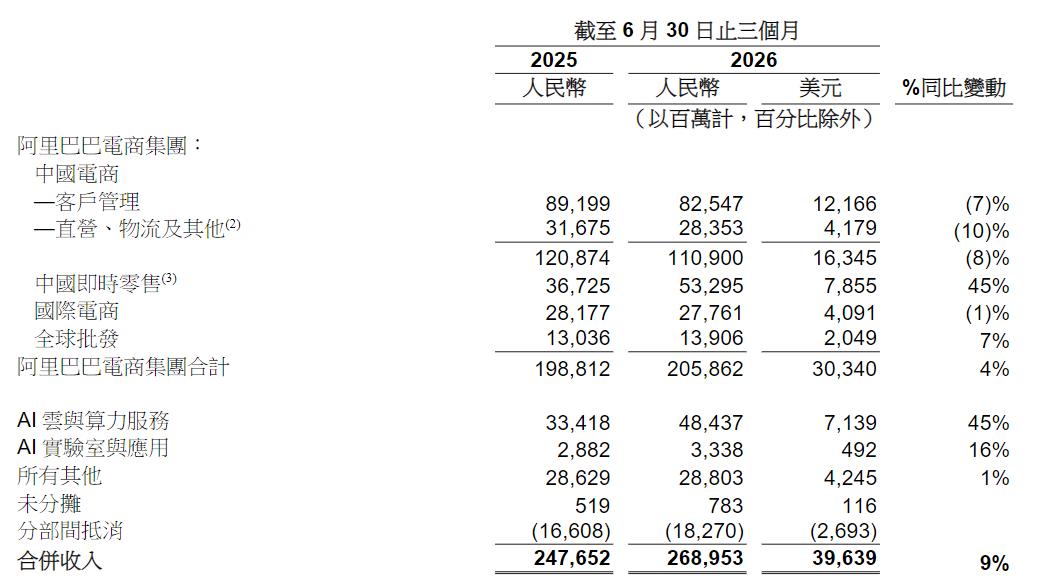
Alibaba stated that this revenue growth is mainly driven by the increase in public cloud business revenue, including the rising adoption of AI-related products.
Specifically, revenue from AI-related products reached 12.376 billion yuan, achieving triple-digit year-on-year growth for the 12th consecutive quarter.
In the same period, the adjusted EBITA of the AI Cloud and Computing Power Services segment was 5.628 billion yuan, an increase of 133% compared with 2.419 billion yuan in the same period of 2025, which was mainly due to revenue growth and improvement in operational efficiency, partially offset by increased investment in customer growth and technological innovation.
With the joint support of the AI Cloud and Computing Power Services segment and other business sectors, Alibaba achieved overall revenue of 268.953 billion yuan in this quarter, a year-on-year increase of 9%.
Alibaba CEO Wu Yongming said, "Benefiting from our full-stack AI strategy, Alibaba is in a very favorable position to seize the huge growth opportunities in the artificial intelligence and AI computing power market."
However, while the company's revenue has achieved growth, Alibaba's profit indicators are clearly under pressure. The financial report shows that Alibaba's adjusted EBITA for this quarter decreased by 30% year-on-year to 27.329 billion yuan, which is mainly attributable to investment in technology, partially offset by the improvement of cloud business operating performance and the operational efficiency improvement of multiple businesses.
For the three months ended June 30, 2026, Alibaba recorded a net profit attributable to owners of the parent company of 10.537 billion yuan, a sharp year-on-year drop of 75.56% compared with the same period of last year.
In the same period, the group's product development expenses reached as high as 22.529 billion yuan, accounting for about 8.4% of revenue; while in the same period of 2025, this expense was 15.001 billion yuan, accounting for about 6.1% of revenue.
Alibaba stated that without considering the impact of share-based payment expenses, the proportion of its product development expenses in revenue will increase from 5.5% in the same period of last year to 7.8%, which is mainly due to its investment in technology infrastructure costs and R&D personnel.
In addition, Alibaba also faces certain pressure at the cash flow level. In this quarter, the net cash flow generated from operating activities of Alibaba was 22.945 billion yuan, a year-on-year increase of 11%; but the free cash flow had a net outflow of 44.67 billion yuan, an increase of more than 137% compared with 18.815 billion yuan in the same period of 2025, which is mainly due to the increase in cloud infrastructure expenditure.
Leida Finance will continue to pay attention to the follow-up progress of Alibaba's spin-off of T-Head for independent listing.