The 500,000-yuan annual salary that fresh graduates look down on is not even within reach for many employees at leading embodied intelligence companies.
The ultimate end of AI still traces back to talents themselves.
Recently, Blue Whale Tech reported that during this year's autumn recruitment, a fresh master's graduate majoring in embodied intelligence received an offer with an annual salary of 500,000 yuan, but this compensation is even jokingly called "the entry-level low price" by many peers in the industry.
This statement is three parts banter and seven parts truth.
The 2026 Spring Recruitment Report from Maimai shows that from January to April 2026, the number of embodied intelligence positions skyrocketed 15 times year on year, and the average monthly salary of such positions rose from 59,000 yuan to 62,000 yuan. In the compensation guide of Career International, the upper limit of the annual salary for embodied intelligence algorithm engineers even reaches 2 million yuan.
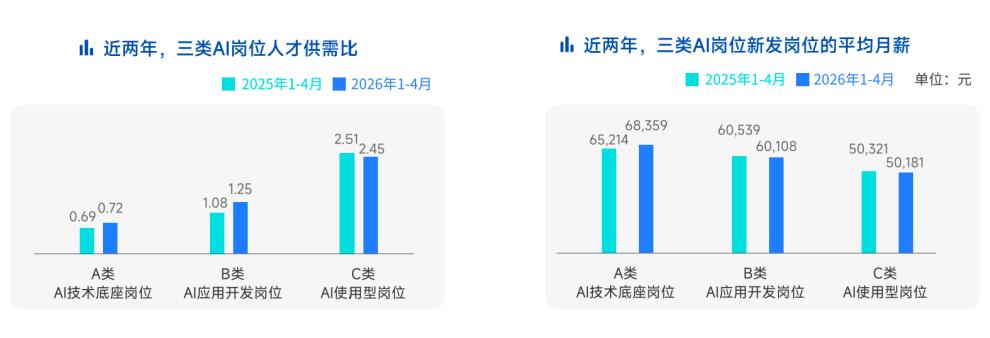
Image source: Maimai
How crazy is the competition in this track? Some start-ups even offer an annual salary of nearly one million yuan to recruit interns, to lock in potential talents who have not yet graduated in advance.
The industry salary has been rising all the way, but these attractive compensations do not come out of nowhere.
01. Investors have poured in extremely sufficient capital
Regarding the aforementioned incident that an annual salary of 500,000 yuan is jokingly called "entry-level low price", an industry insider told us: "This figure is indeed not high." But she also added that the salary a fresh graduate can get still depends on the papers they have published before and the quality of their research achievements.
However, some product managers said that this should be an isolated case, which may be achievable for algorithm positions, but not necessarily for other positions.
Compared with previous batches of college graduates across the country, this salary level is already very considerable.
Wind data shows that the compensation of graduates from the three batches from 2024 to 2026 presents the characteristics of "slow growth of actual salary, stable starting salary for campus recruitment, and intensifying internal differentiation".
Measured by MyCOS's statistical standard, the actual monthly income of undergraduate graduates half a year after graduation rose from 6,199 yuan for the 2024 batch to 6,435 yuan for the 2025 batch, with a nominal growth of 3.8%.
Even in top universities, an annual salary of 500,000 yuan is significantly higher than the average level. Data from China Salary Network shows that the average monthly salary of 2025 graduates from Tsinghua University, Shanghai Jiao Tong University and Peking University counted in 2026 is 13,245 yuan, 13,200 yuan and 12,947 yuan respectively, equivalent to a total annual salary of about 155,000 to 160,000 yuan.
The salary gap between different educational backgrounds, majors and industries is still widening, and the salary of top positions such as AI algorithm and integrated circuits can be several times higher than that of ordinary positions. This also indicates that the aforementioned high salaries are more concentrated in specific positions and for specific talents.
Given that the figure is so staggering, why is the embodied intelligence market still willing to offer such high pay?
The answer first lies in the primary market — capital is eager for companies to absorb talents, so as to accelerate business development and realize returns.
Statistics show that the total financing amount in China's domestic embodied intelligence and robotics sector reached about 735 billion yuan in the whole year of 2025; in the first half of 2026, the figure further soared to nearly 1.092 trillion yuan; the disclosed financing in the first four months exceeded 350 billion yuan, which means capital is pouring into this track almost every day on average.
In addition, single financing deals worth 1 billion yuan have increased significantly: there were about 6 such deals in the whole year of 2025, and the number has exceeded 20 in less than half a year this year.
For example, ItsRobot obtained 455 million US dollars in its Pre-A round financing, refreshing the record of single-round financing for domestic embodied intelligence enterprises; Lingchu Intelligent completed 2 billion yuan in Pre-A round financing. After suddenly receiving hundreds of millions of yuan in new funds, the founders of the companies did not choose to purchase equipment or expand production capacity first, but to compete for talents.
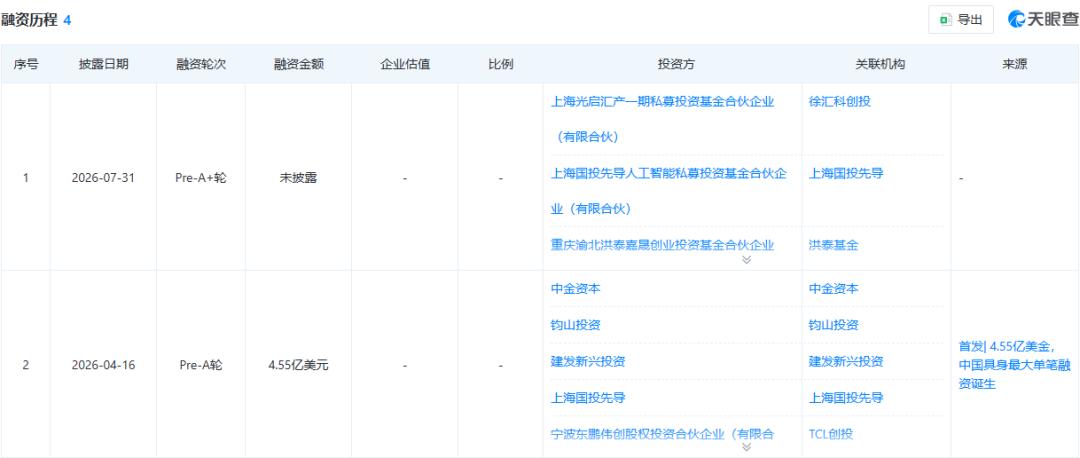
Image source: Tianyancha
This sense of urgency did not just emerge recently.
02. Talent gap cannot be filled even with sufficient capital
Wang Xingxing, founder of Unitree Robotics, known as the "whistleblower of talent shortage", has publicly stated on many occasions before the company's listing that almost all positions in the company are short of staff, with gaps widely existing in R&D, algorithm, marketing and operation teams. He said frankly that long-term understaffing is a key reason for the team's long-term high-intensity operation.
The focus of industry competition is also changing.
In the past few years, the difficulties of embodied intelligence were concentrated on the ontology hardware and the motion "cerebellum": whether the robot can stand up stably, walk around and complete complex movements. With the maturity of the industrial chain, this part of capability is no longer an absolute barrier.
What truly determines the outcome of the next round of competition is the "brain" of the robot — whether it can perceive the environment, make autonomous decisions and dynamically plan actions according to tasks.
Wang Xingxing from Unitree once again stood up to "blow the whistle". He publicly expressed his "anxiety" on many occasions, saying that he and his team have long been engaged in robot hardware and motion control, but once missed the early dividend of general AI.
This is actually the common anxiety of the entire embodied intelligence industry: hardware can be iterated, models can be retrained, and data can be accumulated slowly, but top talents who can truly apply AI capabilities to robot scenarios are extremely rare.
The underlying logic is very cruel: for the layout of the "brain", there may only be two outcomes in the future, either taking the lead or being eliminated.
However, more and more players are entering the market now, and the technology iteration cycle is also constantly shortening. Previously, the iteration cycle of an embodied intelligent robot product was calculated by the year, but now it is advanced by the month, or even by the week.
When the "brain" becomes the core battlefield of the industry, directions such as VLA models, real machine data and intelligent decision-making are directly related to the next round of technical narrative of the company. Once you fall behind temporarily, the difficulty of catching up will multiply.
As a result, the competition for key talents has gradually broken away from the conventional salary logic.
In early April this year, UBTECH first released the news of "124 million yuan to recruit a chief officer": it is recruiting a chief scientist of embodied intelligence globally, with a total annual salary package starting from 15 million yuan and up to 124 million yuan, benchmarking against top Silicon Valley tech companies.
A week later, Magic Atom under Dreame Technology also spread the news that its founder Yu Hao said he would offer an annual salary of 200 million yuan to recruit a chief scientist. Earlier, there was also news that a leading embodied intelligence enterprise intended to offer an annual salary of ten million yuan to poach talents from universities.
On the surface, many enterprises are very generous in spending money, but in fact most of them are not yet profitable. They are willing to poach talents with high salary even at a loss, and the logic behind this calculation is not complicated: key talents joining the team will not only bring technical capabilities, but also influence the market's judgment on the company.
The industry even once believed that poaching a top scholar from a prestigious university or scientific research institution, or a senior executive with industrial experience, could increase the company's valuation by hundreds of millions of yuan in the next round of financing.
03. After the sky-high price talent grabbing
But this high salary treatment is only limited to top talents, and the salary level of ordinary employees is a completely different picture.
Financial data and Tianyancha show that in 2025, UBTECH had about 2,550 full-time employees, with a total compensation cost of about 915 million yuan, equivalent to an average annual salary of about 358,700 yuan per person; the prospectus of Unitree Robotics shows that it had 516 employees in 2025, with employee compensation payable of 65.2244 million yuan, equivalent to an average annual salary of about 126,000 yuan per person.
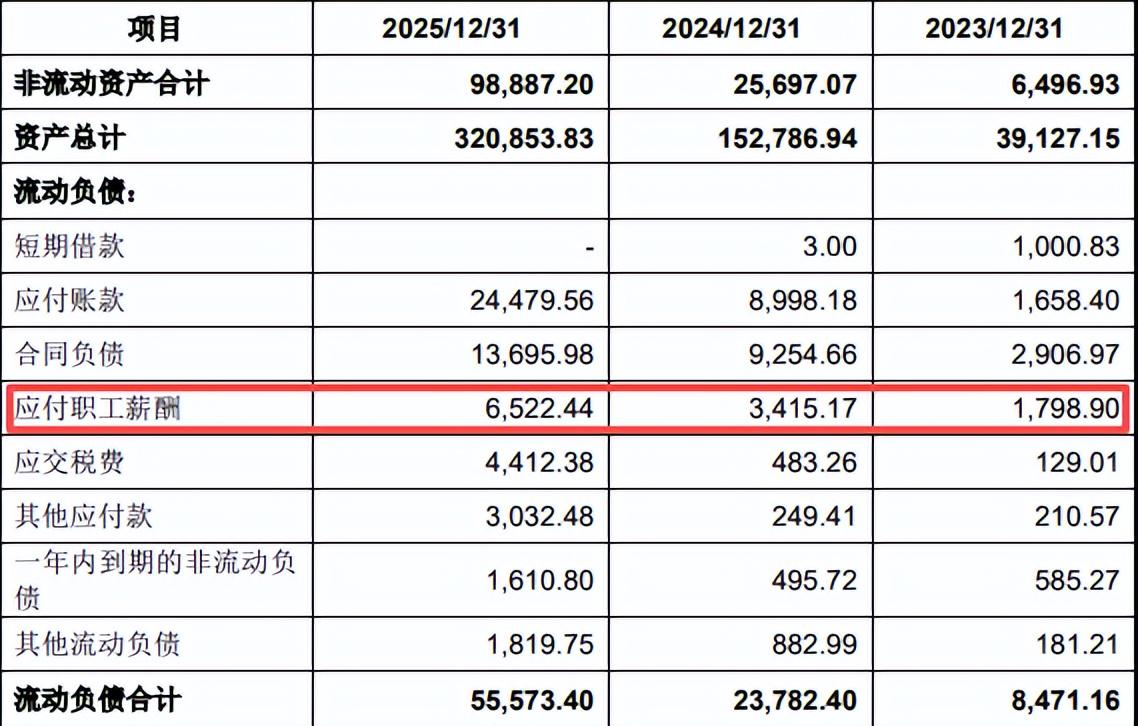
Image source: Unitree Prospectus
Comparing the two sets of data, even for leading companies, the average annual salary is not as exaggerated as the outside world imagines. According to the report from Dahe Daily, a former employee of Unitree mentioned that the salary increase for ordinary employees at Unitree is lower than the general industry level, and the work intensity is not low.
This is not an isolated case. Many start-ups will raise the compensation of the core team and key positions first after getting financing. Although the salary of ordinary R&D personnel will also rise accordingly, the increase range is far less exaggerated than the outside world imagines.
The reason why an annual salary of 500,000 yuan is called "entry-level low price" does not lie in the number itself, but in the fact that the entire industry's judgment on "normal price" has been distorted by the capital rhythm and technological anxiety.
On the one hand, the price of top fresh graduates and key talents is rising rapidly; on the other hand, the salary of a large number of ordinary R&D personnel is still in a more realistic range. The gap between the two sides is often not determined by product revenue, but propped up by financing rhythm, technical positioning and valuation expectations.
However, the capital environment that supports this set of high-salary narratives is not static.
In the second half of this year, the first batch of embodied intelligence enterprises that went out of business emerged, and the IPO environment has also tightened, marking that the market has gradually entered a period of capital calm. Relevant data shows that the industry financing amount in September 2026 decreased by about 40% compared with August 2026. Once the financing rhythm slows down, the high salary space supported by valuation expectations and financing chips will also narrow accordingly.
Therefore, the really important point is that when the industry regards high salary as a sense of security, this sense of security itself may not be very stable.